Roman Core Texts and Inscriptions
 Call Kai
 Learn
Learn Practice Test
 Spaced Repetition
 Match
Match Flashcards
 Knowt Play
1/40

There's no tags or description
Looks like no tags are added yet.
Name | Mastery | Learn | Test | Matching | Spaced | Call with Kai |
|---|
No analytics yet
Send a link to your students to track their progress
41 Terms
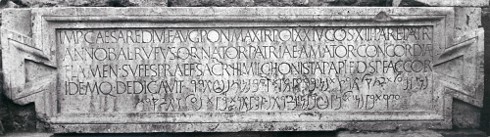
Inscriptions from Theatre at Lepcis
Latin and Punic inscriptions
one leading into the theatre was only in Punic
AD 1/2
Frame of text = tabula ansana
Latin Text:
When Imperator Caesar, son of the deified one, Augustus was pontifex maximus, invested with tribunitian power for the 24th time, consul for the 13th time, father of his country, Annobal Rufus, decorator of his home city, lover of concord, flamen, sufes, prefect of sacred rites, son of Himilcho Tapapius, had and dedicated it.
Neo-Punic Text:
Annobal, who adorns the country, who loves friendship, sacrifice, sufet, lord of the ‘ZRM offering, the son of Himilcho Tapapi, Rufus, made it according to plan at his own expense and consecrated it.
“Once after a series of droughts had caused a scarcity of grain, a mob stopped Claudius in the Forum and pelted him so hard with curses and stale crusts… as a result he too all possible steps to import corn, even during the winter months – insuring merchants against the loss of their ships in stormy weather (which guaranteed them a good return on their ventures), and offering a bounty for every new grain-transport built, proportionate to its tonnage.”
Suet. Claudius. 18
“He also thought it very important that the people should be kept pure and uncorrupted by any taint of foreign or slave blood; so he was very sparing in granting Roman citizenship, and set limits to the number of slaves that might be manumitted…”
Suet. Aug. 40.
c. AD 120
“Why do I have to punish my slave with a whipping or imprisonment if he gives me a cheeky answer or disrespectful look or mutters something which I can’t quite hear? Is my status so special that offending my ears should be a crime? There are many people who have forgiven defeated enemies—am I not to forgive someone for being lazy or careless or talkative? If he’s a child, his age should excuse him, if female, her sex, if he doesn’t belong to me, his independence, and if he does belong to my household, the ties of family (familiaritas).”
Seneca the Younger, Dialogue 5
50s AD
openly moralistic
gives insight into the frequency with which slaves were punished for insignificant offences
“You must approach him with all kinds of flattery, unless you happen to have sufficient status to be able to crush his anger, as the Divine Augustus once did when he was having dinner with Vedius Pollio. One of the host’s slaves had broken a crystal cup; Vedius ordered the man to be seized and executed in a particularly bizarre way, by being thrown as food to lampreys – he kept some huge ones in his fish pond… It was an act of savagery.”
“Caesar was horrified at this unprecedented cruelty, and ordered the slave to be set free, all the crystal cups to be smashed in his presence, and the fish pond to be filled in.”
Seneca the Younger, Dialogue 5
emphasises Aug.’s mercy
owner used his fish pond as another exercise of control, interesting for villas
“In later years we saw many freed slaves who were richer than Crassus—not long ago during Claudius’ reign there were three at once, Callistus, Pallas and Narcissus.”
“On 27 January 8 BC, Caius Caecilius Isidorus, freedman of Caius, stated in his Will that although he had lost a great deal in the civil wars, he left 4,116 slaves, 3,600 pairs of oxen, 257,000 other animals, sixty million Sesterces in coined money; and he ordered eleven hundred thousand to be spent on his funeral.”
Pliny, Natural History
AD 77
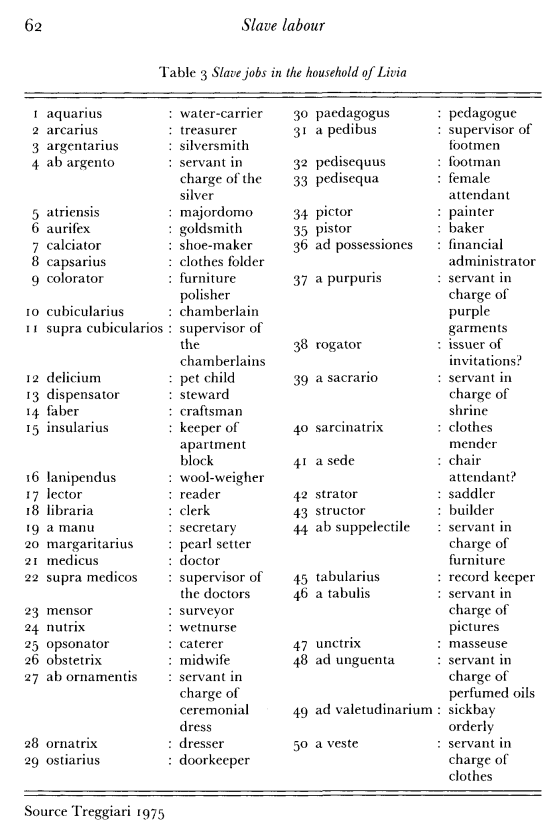
Inscription from columbaria of Livia’s household and their jobs
1st century AD
Livia = independent household
“I like him for his exceptional conscientiousness and fidelity towards his former master; moreover, he has rendered mc personally important services, making himself available to me in the most difficult period of my life, with as much loyalty and good-will as if I had given him his freedom.”
Cicero. Familiares
62-43 BC
belittling language
Cicero doesn’t realise it
idea of patronage and freedpeople having a close social connection to their masters
“These, my son, will be the names of places which are at this moment places without names.“
Virgil Aeneid
Book 6
parade of heroes
colonial aspirations
“When I am in Rome, up and down the Forum, decrees are drawn up at the residence of your admirer… what is more when it happens to occur to him, I am put down as present at drafting, and I hear of some decree, allegedly passed on my motion, reaching Armenia and Syria before I know that there has been so much as a mention of the matter concerned.“
Cicero
letter to Papirius Paetus
46 BC
about Caesar
shift from Forum beurocracy to his private residence
“…you care not only about the common life of all men, and the constitution of the state, but also about the provision of suitable public buildings; so that the state was not only made greater… by its new provinces, but the majesty of the empire also was expressed through the eminent dignity of its public buildings…“
Vitruvious De Architectura
30-20BC
dedication to Augustus
“By means of new laws brought in under my sponsorship, I revived many exemplary ancestral practices which were by then dying out in our generation, and I myself handed down to later generations exemplary practices for them to immitate.“
RGDA 5
“When Agrippa gave up the ghost, untimely fate, or the treachery of their stepmother Livia, cut off both Lucius and Caius Caesar…“
Tacitus Annals
1.3
AD 116-20
“…he [Tiberius] was paraded through all the armies, not as before by the secret diplomacy of his mother, but openly at her injunction…“
Tacitus
1.3
“For so firmly has she riveted her chains on the aged Augustus that he banished to the isle of Planasia his one remaining grandson, Agrippa Postumous, who though guiltless of a virtue… had been convicted of no open scandal.“
Tacitus 1.3
“…they must be slaves it appears to the distaff…“
Tacitus 1.4
“… Livia, as a mother a curse to the realm; as a stepmother, a curse to the house of the Caesars.“
1.10
“Augusta herself enjoyeda full share of senetorial adultation. One party proposed to give her the title “Parent of her Country“… a majority through the qualification “Son of Julia“ ought to be appended to the name of the Caesar.“
Tac. 1.14
“Nothing, however sank deeper into Tiberius’ breast than the kindling of men’s enthusiasm for Agrippina - “the glory of her country, the last scion of Augustus, the peerless pattern of ancient virtue.“ So they styled her: and turning to heaven and the gods, prayed for the continuance of her issue - ‘and might they survive their persecutors!‘“
Tac 3.4
Agrippina as a paragon of virtue
tool of stability and reassurance
optics more important than the truth
“Rumour the swiftest of all evils. Speed lends her strength, and she wins vigour as she goes; small at first through fear, soon she mounts up to heaven, and walks the ground with head hidden in the clouds.“
Virgil
Aeneid 4
“From this moment it was a changed state, and all things moved at the fiat of a woman… It was a tight-drawn, almost masculine tyranny: in public there was austerity and not infrequently arrogance; at home, no trace of unchastity, unless it might contribute to power.“
Tac. 12.7
About the marriage between Claudius and Agrippina
“chose his stepson Tiberius, obliging him to divorce his wife, who was with child and by whom he was already a father…“
Suetonius, Divine Augustus 63
C. AD 120s
“In bringing up his daughter and his granddaughter he even had them taught spinning and weaving, and he forbade them to say or do anything except openly and such as might be recorded in the household diary.“
Suet. Divi Aug. 64
“Worst of all, when she persisted in her resolution and so perished, he assailed her memory with the basest slanders, persuading the senate to add her birthday to the days of ill omen, and actually taking credit to himself for not having had her strangled with a cord and her body cast out on the stairs of Mourning. “
Suet, Life of Tiberius 53
about Agrippina
“Since ancient usage made it impious to stranglle virgins, young girls were first violated by the executioner and then strangled. Those who wished to die were forced to live; for he though death so light a punishment.“
Suet, Life of Tiberius 61
“On the road to Tibur, less than a mile from home… there was a monument to Pallas with the following inscription: ‘To him the senate decreed in return for his loyal services to his patrons, the insignia of a praetor, and sun of fifteen million sesterces‘“ … he refused
“…that rascal could presume to accept and refuse them, all with a show of setting posterity in example of moderation.“
“The praetorian insigna granted to Pallas were engraved and cut on a public monument for all time as if they were an ancient covenant or a sacred law.“
Pliny the Younger, Letter to Montanus 8
Pallas = freedman of Claudius
“The truth is, a man’s dignity may be enhanced by the house he lives in, but wholly secured by it; the owner should bring honour to his house, not the house to its owner.“
Cicero, On Duties
1.139
“So in the home of a distinguished man, in which numerous guests must be entertained the crowds of every sort of people received, care must be taken to have it spacious.“
Cicero, On Duties
1.139
“If he ever planned to do anything in private or without interruption, he had a retired place at the top of the house, which he called ‘Syracuse‘ and ‘techyphion‘.“
Suetonius, Augustus.
72
about the house of Augstus
“His own villa, which were modest enough, he decorated not so much with handsome statues and pictures as with terraces, graves, and objects noteworthy for their antiquity and rarity…“
bones of sea monsters and wild beasts in his villa in Capri
Suet. Aug. 72
Stayed in the country-house of Scipio Africanus
“For he was accustomed to keep himself busy and to cultivate the soil with his own hands, as the good old Romans were wont to do. Beneath this dingy roof he stood; and this floor, mean as it is, bore his weight.“
Seneca the Younger, Letters 86
“We think ourselves poor and mean if our walls are not resplendent with large and costly mirrors; if our marbles from Alexandria are not set off by mosaics of Numidian stone, if their borders are not faced over on all sides with difficult patterns… if our swimming pools are not lined with Thasian marbled, once a rare and wonderful sight in any temple - pools into which we let down our bodies…“
Seneca the Younger, Letters 86
“Also while this villa is the common property of the whole population, that one belongs to you alone; this one is for citizens and other people to come to from the Campus, and that one is for mares and asses…“
Varro. On Agriculture 3.2
“I own, near the town of Casinum, a stream which runs through my villa, clear and deep, with a stone facing, 57 feet wide, and requiring bridges for passage from one side of the villa to the other…“
Varro. On Agriculture 3.4
about control of natural resources
“Overseas conquest taught us to consume the wealth of others, and the civil wars taught us to spend our own… But nobody makes any proposal about the fact that Italy depends on supplies from overseas, and the life of the Roman people is daily tossed at the mercy of the sea and wind.“
Tacitus Annals 3.54
“… not one of you cares how much the price of wheat grinds us down. I swear I couldn’t afford a mouthful of bread today. And look how the drought still continues. For a year now there’s been starvation… So the little people suffer hardships, because those with the big jaws grind them down and never stop celebrating Saturnalia.“
Petronius Satyricon. 44.
Ganymede speaking
“I want to have all kinds of fruit trees growing round my ashes… It is quite wrong for a man to have handsome house while he is alive, and not be concerned about the house where we have to live a longer time. Place a sundial in the middle so that whoever looks at the time will read my name, whether he want to or not.“
Petronius Satyricon 53
Trimalchio speaking
“To keep a long story short, I built five ships, loaded them with a cargo of wine… and sent them to Rome. All the boats were wrecked, a fact not a fairytale. In one day Neptune ate up thirty million sesterces.“
Petronius Satyricon 53
Trimalchio speaking
“Tribes whom it was safe to pardon, I kept alive rather than eradicated.“
RGDA 3
Volubilis Tablets
grants the citizens of Volubilis Roman citizenship because of ‘Bostar’’s military sacrifice
by Claudius
found as a stone tablet on the steps of a temple
“But the relationship of the ‘colonies‘ is a different one; for they do not come into citizenship from without, nor grow from roots of their own by they are as it were transplanted from the state and have all the laws and institutions of the Roman people, not those of their own choice.“
Gellius, Attic Nights 16
AD 177
perhaps true for ‘‘new colonies', but definitely not for older settlements