plg41o week 5 & 6
 Call Kai
 Learn
Learn Practice Test
 Spaced Repetition
 Match
Match Flashcards
 Knowt Play
1/23

There's no tags or description
Looks like no tags are added yet.
Name | Mastery | Learn | Test | Matching | Spaced | Call with Kai |
|---|
No analytics yet
Send a link to your students to track their progress
24 Terms
Population Growth
The increase or decrease in the population of an area.
Population Distribution
The spatial patterns of a population across an area.
Population Composition
The internal makeup of a population, including characteristics such as sex, race, and age.
Absolute Change (Calculation)
Measures numerical change over time. Formula: {Population}_{2021} - {Population}_{2016}.
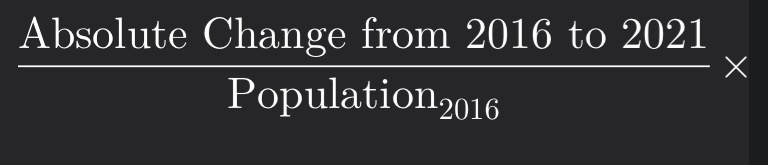
Percent Change (Calculation)
Measures relative change as a percentage of the initial population. Formula:
Population Estimate
An indirect measure used to determine population size/characteristics when direct measurement (like a census) is unavailable; it provides updated counts between census periods.
Population Projections
Estimates of future population changes based on assumptions about expected demographic trends in fertility (birth rates), mortality (death rates), and migration.
Population Pyramid (Age-Sex Pyramid)
A graphical representation of population distribution by age groups and sex, usually showing males on the left and females on the right.
Expansive Pyramid
A fast-growing population pattern that is very wide at younger ages, indicating high birth rates and low life expectancy.
Stationary Pyramid
A constant population pattern where age and sex percentages remain approximately the same over time because births and deaths roughly balance.
Constrictive Pyramid
A declining population pattern that is narrow at the bottom, typical of developed countries with long life expectancy and low birth/death rates.
Lorenz Curve
A graph representing inequality by plotting the cumulative percentage of the population against the cumulative share of income or wealth they hold.
Gini Coefficient
A single numerical measure of inequality (0 to 1) derived from the Lorenz curve; 0 represents perfect equality and 1 represents perfect inequality.
Trend Extrapolation Method
A method that predicts future values (population, employment) by extending historical trends forward, assuming past patterns will continue.
Linear Trend
A model assuming a constant absolute rate of change over time (the same numerical amount of change each year).
Parabolic Trend
A model where the rate of change itself varies over time, resulting in a constantly changing slope with one bend.
Exponential/Geometric Trend
A model assuming growth changes by a constant percentage (compound growth).
Gompertz Trend
A sigmoid (S-shaped) growth model where growth starts slowly, accelerates, and then slows down as it approaches a maximum limit.
Linear Regression Equation
A mathematical process used to calculate the best-fit line for trend extrapolation. Formula: Y_t = a + bt, where Y_t is the predicted value, a is the intercept, b is the slope, and t is time.
Share Projection Method
Estimates future population of a study area based on its constant percentage share of a larger context area (e.g., a city within a province).
Share Calculation (Process)
The ratio of the study area population to the larger area population

Growth Share Method
A variation that allocates future growth according to the study area's historical share of total growth, allowing the population share to vary over time.
Shift-Share Method
An advanced analysis that breaks down growth into components: national/regional growth, structural (sector) effects, and local/competitive effects.
Projected Population (Share Method)
