Psychology AOS2 Key Terms
 Call Kai
 Learn
Learn Practice Test
 Spaced Repetition
 Match
Match Flashcards
 Knowt Play
1/24

Earn XP
Name | Mastery | Learn | Test | Matching | Spaced | Call with Kai |
|---|
No analytics yet
Send a link to your students to track their progress
25 Terms
Brain vs Heart Debate
A historical debate as to whether the heart or the brain is responsible for mental processes, such as thought, emotion, and behaviour
Mind-Body Problem
The complex philosophical question as to whether our mind is separate and distinguishable from our body or whether they are one integrated entity
Monism
The belief that the human mind and body are together a singular complete entity
Dualism
The belief that the human mind and body are separate and distinguishable from one another
Phrenology
The study of the shape and size of the human skull to determine personality and mental functioning
Pseudoscience
A theory or method that appears to be based in science, but is actually not.
Consists of practices that claim to be both scientific and factual, but do not follow the scientific method; they are ‘fake’ sciences
Brain Ablation
The surgical removal, destruction, or cutting of a region of brain tissue
Brain Lesioning
The practice of inducing and/or studying the effects of damage to an area of the brain
Cerebral hemispheres
The symmetrical halves of the cerebrum in the brain
Hemispheric Specialisation
The difference in functioning between the left and right hemispheres of the brain when performing a specific behaviour or task
Corpus Collosum
A bundle of nerve fibres that connects the left and right brain hemispheres
Split-Brain Research
Experiments conducted on patients with a severed Corpus Collosum, and therefore their left and right cerebral hemispheres had been separated
Contralateral
Relating to the opposite side of the body
Neuroimaging
A range of techniques used to capture images of the brain’s structure, function, and activities
Structural Neuroimaging Techniques
Produce images of the brain’s structure and composition
Functional Neuroimaging Techniques
Uses images to show the brain’s activity and functions
Computerised Tomography (CT)
A neuroimaging technique that involves taking continuous two-dimensional x-ray images of the brain which are then stacked to create a comprehensive three-dimensional image of the brain (structural technique)
Magnetic Resonance Imaging (MRI)
A neuroimaging technique that uses magnetic and radio fields to take detailed two-dimensional and three-dimensional images of the brain (structural technique)
Positron Emission Tomography (PET)
A neuroimaging technique that uses a scanning device to take coloured images of the brain, showing its functional activity by tracing the levels of a radioactive substance in the brain (functional technique)
Functional Magnetic Resonance Imaging (fMRI)
A neuroimaging technique that uses magnetic and radio fields to take two and three-dimensional images of the brain and record its activity levels (functional technique)
Brain
A complex organ contained within the skull that coordinates mental processes and behaviour, and regulates bodily activity
Brainstem
An extension of the spinal cord that is made up of the medulla, pons, and midbrain
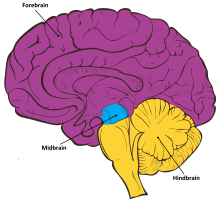
Hindbrain
A region at the base of the brain, located around and including some of the brainstem. (Key Structures - Pons, Medulla, Cerebellum)
Responsible for regulation of sleep-wake cycle, regulation of autonomic functions (breathing, heartrate, digestion, etc), coordination of muscle movement.
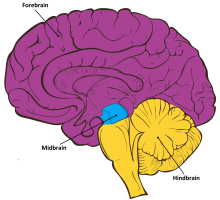
Midbrain
A region at the centre of the brain, between the hindbrain and forebrain, and is part of the brainstem. (Key Structures - Reticular Formation)
Responsible for relaying messages between hindbrain and forebrain, filtering and directing sensory information, regulating arousal and awareness.
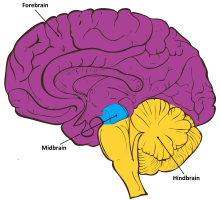
Forebrain
A large and prominent brain region that is located at the top and front of the brain. (Key Structures - Cerebrum, Thalamus, Hypothalamus, Cerebral Cortex)
Responsible for complex mental processes (decision making, problem solving, processing sensory information, initiating voluntary movement, etc), attention, filtering sensory information, maintaining homeostasis.