Physics - CH.3 Forces and movement
 Call Kai
 Learn
Learn Practice Test
 Spaced Repetition
 Match
Match Flashcards
 Knowt Play
1/17

There's no tags or description
Looks like no tags are added yet.
Name | Mastery | Learn | Test | Matching | Spaced | Call with Kai |
|---|
No analytics yet
Send a link to your students to track their progress
18 Terms
equation of force, mass and acceleration
force = mass x acceleration
why is a linear air track used
to remove the effects of friction
what measures the acceleration of a glider
electronic timer and light gates
what is the variable being investigated - force
the effect of force is done by measuring the acceleration of the glider with different falling mass ( different forces pulling on the glider) . The mass of the glider must remain constant
what is the variable being investigated - mass
the effect of the mass is done by measuring the acceleration glider when adding different masses to the glider
what does this investigation show
this shows us that acceleration is directly proportional to force but that acceleration is inversely proportional to mass, if you double the mass you half the acceleration
what is the thinking distance
the distance a car travels whilst the person is reacting
what is the breaking distance
the distance a car travels whilst breaking/ under the breaking force
factors affecting thinking distance
distractions
alcohol
drugs
tiredness
age
factors affecting breaking distance
road conditions/ weather - snow, wet roads
condition of tyres
condition of brakes
mass of car
speed of car
what is the relationship between speed and thinking distance
They are directly proportional if you increase speed you increase thinking distance, the straight lien shows the reaction time is constant
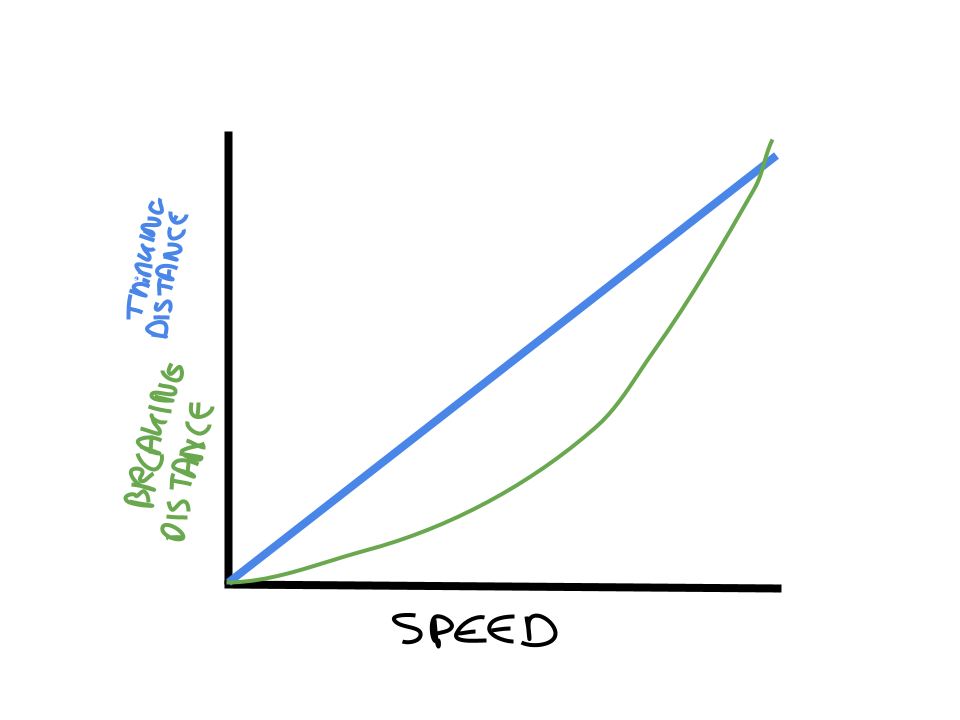
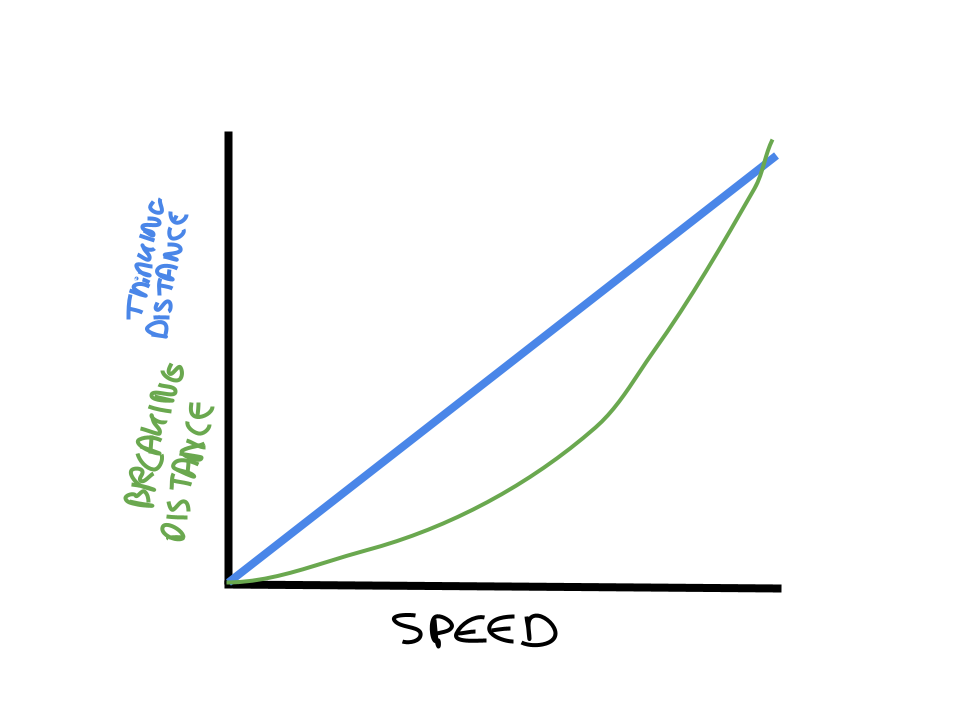
what is the relationship between speed and braking distance
the force of the breaks is constant however when you double the speed you quadruple the kinetic energy ( Ek = ½ mv2 ), therefore the breaking distance more than doubles this means BD increases at a faster rate than thinking distance as evident by the graph
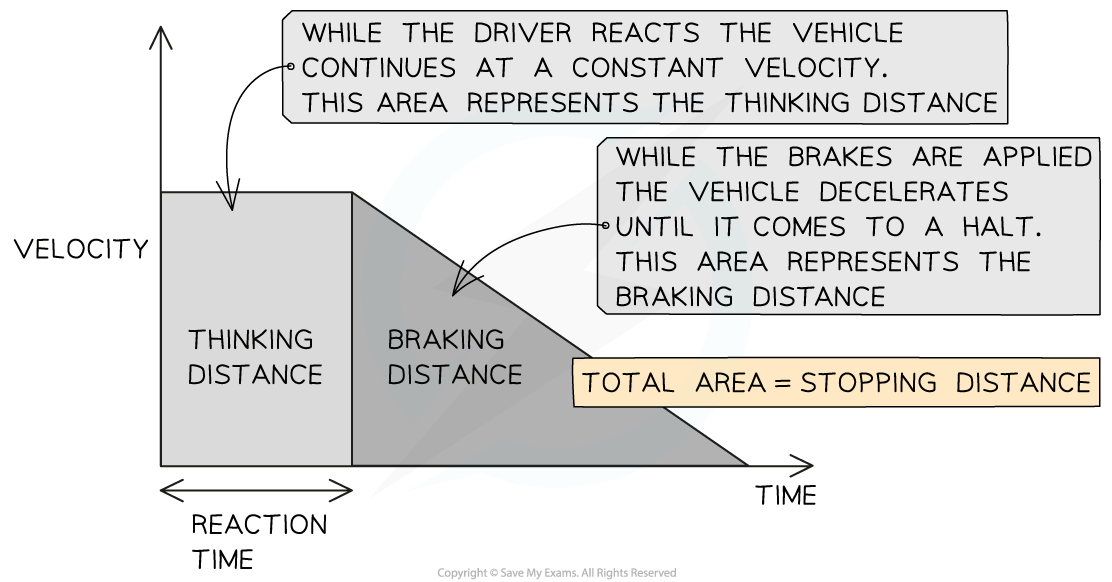
velocity - time graphs
initial line is the thinking distance
slopping line is the braking distance
total graph is the stopping distance
how do you find deceleration
( v - u )/t
V is the end of the line for BD
U is the initial speed or velocity of the car
t is only the time of braking distance not thinking distance
how do you find thinking distance
initial velocity x reaction time
how do you find the braking distance
( initial velocity x time of braking distance )/ 2 - if a triangle
what is overall stopping distance
TD + BD
relationship between speed and drag
speed increase = drag decreases