Chemistry - CH.3 Key Concepts
 Call Kai
 Learn
Learn Practice Test
 Spaced Repetition
 Match
Match Flashcards
 Knowt Play
1/33

There's no tags or description
Looks like no tags are added yet.
Name | Mastery | Learn | Test | Matching | Spaced | Call with Kai |
|---|
No analytics yet
Send a link to your students to track their progress
34 Terms
Pure Substance
Substance composed of any one type of atom or molecule
Has a constant composition
Can be an element or compound
PS: Element
A substance that CANNOT be broken down into simpler substances
All known elements on the periodic table
Chemically REACTIVE and COMBINE with other elements to form compounds
PS: Compound
A pure substance composed of TWO OR MORE elements in FIXED, DEFINED proportions
More common than pure elements
Can be decomposed into SIMPLER substances
Mixture
Composed of 2+ different types of atoms or molecules that can be labeled as heterogenous and homogeneous.
Can contain 2+ substances that are PHYSICALLY MIXED but NOT CHEMICALLY COMBINED
Can be combined UNIFORMALY or UNEVENLY
M: Heterogeneous
Uneven distribution of 2+ substances
Can be told apart
M: Homogeneous
Uniform properties throughout → 2+ substances are uniform
Cannot be told apart
Matter
Anything that has mass and volume (Occupies space) → Dimensional
EX: Solid, liquid, gas
Solid
Tightly packed particles of matter
May vibrate at a fixed point, but do not move relative to each other
PROPERTIES:
Definite shape and volume
Proximate and rigid particles
Vibrate slowly at fixed positions
Liquid
Loosely packed molecules
Free to move past one another and in random directions
PROPERTIES:
Definite volume
Proximate and mobile particles
No set movement pattern → Random
Takes shape of container
Gas
Flexible and uniform particles that are far apart
Take the shape of a container
PROPERTIES:
No definite shape or volume
Far apart particles
Fast moving particles with little attraction to each other
Physical Property
A substance that displays WITHOUT changing its chemical composition
EX: Color, melting point, conductivity, and boiling point (tested without changing the chemical composition)
- Change in state, appearance, shape, and size
Chemical Property
A reaction must occur upon interaction → A change in chemical composition
EX: Reactivity with oxygen, combustibility, flammability…
- Molecules are broken for molecules to interact, causing a change
Change of State: Solid and Liquid
Solid-to-Liquid: Melting → heat is added
Liquid-to-Solid: Freezing → heat is removed
Change of State: Liquid to Gas
Liquid-to-Gas: Vaporization → +Heat
Gas-to-Liquid: Condensation → -Heat
Change of State: Solid to Gas
Solid-to-Gas: Sublimation → +Heat
Gas-to-Solid: Deposition → -heat
Thermal Energy
The amount of motion in a substance
- The unit of measurement for temperature → More heat increases motion in atoms and molecules
Heat
The transfer of thermal energy between two bodies at different temperatures
- Contains its own units of energy
EQUATION: Heat =( mass (m) x Delta-T ) x Specific Heat Capacity (C)
Celsius to Fahrenheit
9/5(C +32)
Fahrenheit to Celsius
5/9(F - 32)
Celsius to Kelvin
K = C +273
- Kelvin avoids the negative temperature by assigning onto the coldest possible temperature
The Law of Conservation
States that energy is neither CREATED nor DESTROYED
PROPERTIES:
- Total amount of energy is constant
- Energy can be charged from one form to another
- Transformed from one object to another
- CANNOT be created out of nothing nor vanish into nothing
Potential Energy
Energy stored for use at a later time
- Determined by the position of an object or chemical composition of a substance
EX: Chemical bonds in foods
Kinetic Energy
Matter in motion
- Any moving object has kinetic energy
EX: Water flowing over a dam or working out
Joule (J)
The S.I. unit of energy
- calories is a second measurement unit of energy
1. 1 cal = 4.184 J
2. 1kJ = 1×10³J
3. 1ucal = 1×10³cal
The Nutritional Calorie
The necessary amount of energy needed each day depends on factors like age, gender, and level of activity.
- Written with a capital “C” → labeled as the kilojoules (kJ)
1. 1 Cal = 1×10³ cal
2. 1 Cal = 1kCal
3. 1 Cal = 4184 J
4. 1 Cal = 4.184 kJ
Specific Heat Capacity
Specific Hear Capacity (C) = Heat (q) / mass(m) x Delta-T
→ In the S.I. system, the units are J/g x degrees Celsius
→ In the metric system, the units are cal/ g x degrees Celsius
How is the movement of heat calculated?
The amount of heat lost or gained by a substance is concluded from:
1. The mass of the substance
2. The temperature change (T)
3. The specific heat of the substance (cal or J)
3 Conditions for a Chemical Reaction
1. Collision: Reactions MUST collide
2. Orientation: Reactions must align properly to break and form bonds
3. Energy: The collision must provide the energy of activation
Activation Energy
The amount of energy acquired to break the bonds between atoms of reactants
1. If activation energy → Collision energy, the molecules bounce apart without reacting
Exothermic Reaction (Released Energy, -H)

- Heat is being produced and released into the environment/system!
Endothermic Reaction (Absorbed, +H)
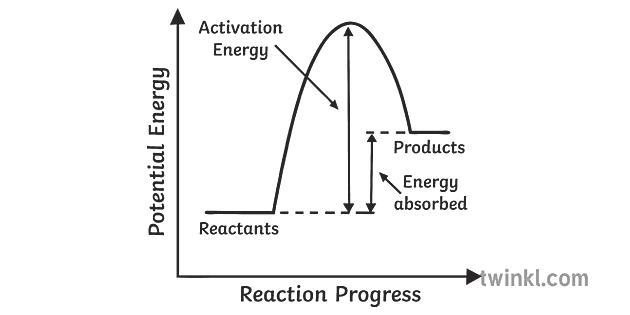
- Heat is being put into the system/environment
System
The substance(s) undergoing the chemical or physical change
- EX: Beaker and solution
→ Positive heat is when heat is flowing INTO the system
→ Negative heat is when heat flows OUT of the system
Surroundings
All other matter—including components of the measurement apparatus—but serve to provide or absorb heat from the system.
Work
The process of causing matter to more against on opposing forces
- At a constant pressure: -work (w) = Pressure (P) x Delta-V (change in volume)
→ -w occurs if done by the system
→ +w occurs if done on the system