11.1 Policies to correct disequilibrium in the balance of payments
 Call Kai
 Learn
Learn Practice Test
 Spaced Repetition
 Match
Match Flashcards
 Knowt Play
1/40

There's no tags or description
Looks like no tags are added yet.
Name | Mastery | Learn | Test | Matching | Spaced | Call with Kai |
|---|
No analytics yet
Send a link to your students to track their progress
41 Terms
What does the balance of payments (BoP) record
All economic transactions between residents and non‑residents during a given period, arranged into the current account, capital account and financial account, plus a balancing item called net errors and omissions.
Which two BoP accounts should you focus on in essays
The current account and the financial account.
Key concept link - equilibrium and disequuilibrium
What is the current account
The component of the BoP that records trade in goods and services, primary income (investment income and wages), and secondary income (current transfers). - Surplus means net inflows; deficit means net outflows.
Where is income from foreign investments recorded
In primary income of the current account (profits, interest and dividends from direct/portfolio/other investment).
Where are financial investments themselves recorded
In the financial account (the asset flows), not in primary income.
What is the financial account (4 things it contains)
Records movements of funds into and out of the country via direct investment, portfolio investment, other investment and reserve assets.
- Essentially the buying and selling of assets between countries
What is direct investment in the financial account
Cross‑border investment giving lasting interest/control (e.g., building a factory abroad, takeover of a firm, or setting up a new plant).
- Outflows are debits; inflows are credits.
What is portfolio investment in the financial account
Purchases and sales of government and corporate bonds and shares that do not involve legal control of a firm.
What is other investment in the financial account
Shorter‑term flows such as bank deposits, bank loans and inter‑government loans moving between countries.
What are reserve assets in the financial account (4)
Central bank holdings of gold, foreign exchange reserves, Special Drawing Rights (SDRs) and the country’s reserve position in the IMF; changes reflect intervention and affect the exchange rate.
Tip - confusion about items that go in the primary income part of the current account and those that go in the financial account
Key concept link - progress and development
What is a financial account deficit
When more funds leave than enter via investment and loans.
- Not always a problem: it can precede future inflows of profits, interest and dividends.
Why can a financial account deficit be a concern
If due to loss of confidence and capital flight (when the country's residents move their money abroad or countries firms move production abroad), it can reduce tax revenue, lower growth and employment prospects, and contribute to exchange‑rate depreciation.
What is a financial account surplus
When more direct and portfolio investment and loans enter than leave, often because foreigners are attracted by the country’s prospects.
What are the pros of a financial account surplus (3)
Can finance a current account deficit, create employment and raise economic growth.
What is a long‑run risk of a financial account surplus
Future outflows of profits, interest and dividends (recorded in primary income) can worsen the current account unless offset by other items.
What is the capital account + EXAMPLES
A relatively small account recording transactions in non‑produced, non‑financial assets and certain one‑off capital transfers
- e.g., debt forgiveness, migrants’ transfers, sales/purchases of copyrights, patents, trademarks and mineral rights
What are net errors and omissions
A balancing item added so the BoP as a whole sums to zero, compensating for timing, valuation, coverage and recording mistakes.
Why are net errors and omissions needed
Because every credit should be matched by a corresponding debit, but with many transactions some items are mis‑measured or omitted. The balancing item reconciles the accounts.
How do net errors and omissions work in practice e.g. If current + capital + financial sum to −$2,000m…
If current + capital + financial sum to −$2,000m, an errors/omissions of +$2,000m is added, bringing the BoP total to zero.
What happens to net errors and omissions over time
They usually decline as information improves, though global mismatches mean some countries’ current account deficits are not perfectly offset by others’ surpluses.
How can fiscal policy improve a current account deficit
Contractionary fiscal policy (↑ taxes, ↓ government spending) reduces aggregate demand, leading to lower imports → improves the current account.
What is a limitation of using fiscal policy on the BoP
• Contractionary: may reduce output and employment
• Expansionary: extra income can increase imports (leakage) → weakens the impact on the current account
How can monetary policy affect the BoP
Tighter monetary policy (↑ interest rates, ↓ money supply):
- reduces spending and imports
- attracts capital inflows (as higher interest rates offer higher returns) → creates capital inflows for the financial account and affects exchange rate
What are the exchange‑rate effects of monetary tightening
Higher interest rates → currency appreciation →
- exports become more expensive
- imports become cheaper
→ may worsen the current account, so overall effect is ambiguous
How can exchange‑rate policy improve the current account
Depreciation (market-driven or engineered):
- exports become cheaper
- imports become more expensive
→ exports rise, imports fall → improves the trade balance/current account
What is the special case for exchange‑rate policy when the currency is overvalued
If a central bank has kept the exchange rate above its equilibrium (overvalued), allowing it to float back to market level will depreciate the currency.
This makes exports cheaper and imports more expensive, helping to reduce a current account deficit.
How do supply‑side policies affect the BoP
Supply-side policies improve international competitiveness (e.g. ↑ productivity, better infrastructure, skills, innovation), which:
• increases exports
• reduces reliance on imports
→ improves the current account over time
Note: They are mainly used to reduce a current account deficit, but stronger competitiveness could also increase a surplus (not just reduce a deficit).
What are key limitations of supply‑side policies for the BoP (3)
They take time, outcomes are uncertain, and some measures (privatisation, labour‑market reforms) can increase inequality or unemployment in the short run.
How do protectionist policies affect the BoP
Tariffs/quotas raise import prices or restrict volumes, reducing imports and likely improving a current account deficit in the short run.
What are drawbacks of protectionism for the BoP (4)
Risk of retaliation, efficiency losses, higher costs for domestic producers using imported inputs, and possible conflict with trade rules.
How can attracting MNCs affect the BoP
Inward FDI raises the financial account surplus and can expand capacity, supporting exports.
Later, profit repatriation increases primary income outflows, potentially weakening the current account.
Tip - in answering essays on policy meausres
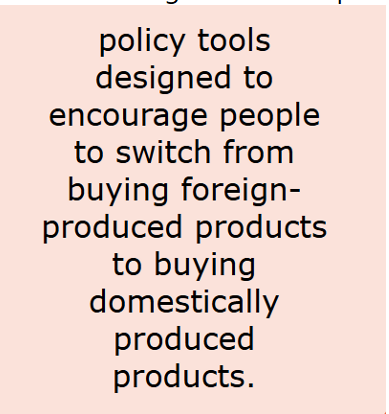
What is an expenditure‑switching policy
A policy that redirects spending from imports to domestically produced goods and towards exports, without aiming to cut total spending.
Which tools are typically expenditure‑switching
Most commonly supply-side, protectionist and exchange rate
- Exchange‑rate depreciation, protectionist measures (tariffs/quotas), and supply‑side actions that lower domestic costs/prices and raise competitiveness.
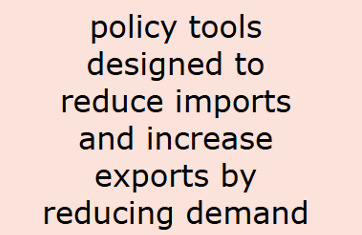
What is an expenditure‑reducing policy
Any policy designed to reduce total spending in the economy, thereby cutting import demand.
- Domestic producers may offset weaker home demand by selling more abroad.
Which tools are typically expenditure‑reducing
Contractionary fiscal policy (higher taxes/lower government spending) and contractionary monetary policy (reducing money growth/raising interest rates).
How do you decide whether a policy is switching or reducing
Ask whether it primarily changes the composition of spending (domestic vs imported) or the level of total spending in the economy.
What equity issue can arise with switching policies
Some expenditure‑switching tools can increase inequality if they raise unemployment.