physics final exam study guide

0.0(0)
Studied by 0 people
call kaiCall Kai
learnLearn
examPractice Test
spaced repetitionSpaced Repetition
heart puzzleMatch
flashcardsFlashcards
GameKnowt Play
Card Sorting

1/93

encourage image

There's no tags or description

Looks like no tags are added yet.

Last updated 1:21 AM on 4/25/26
Name
Mastery
Learn
Test
Matching
Spaced
Call with Kai

No analytics yet

Send a link to your students to track their progress

94 Terms

1
New cards
<p>Where in space was the rock three minutes before it passed through the origin?</p>

Where in space was the rock three minutes before it passed through the origin?

position update formula
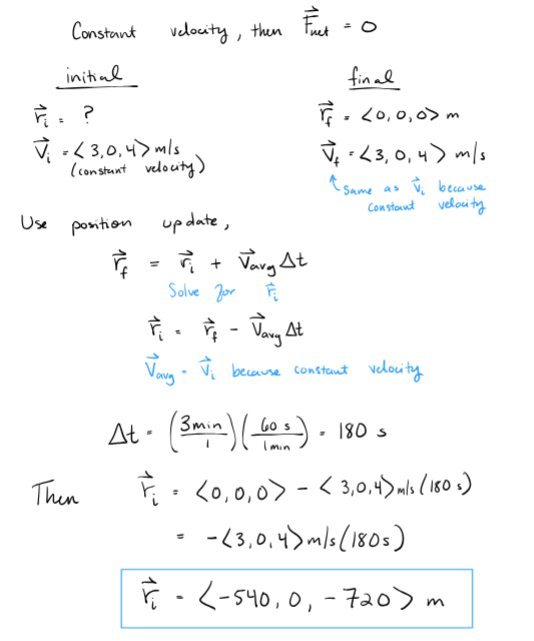
<p>position update formula</p>
2
New cards
<p>determine what is the force F that caused this change in motion</p>

determine what is the force F that caused this change in motion

momentum principle
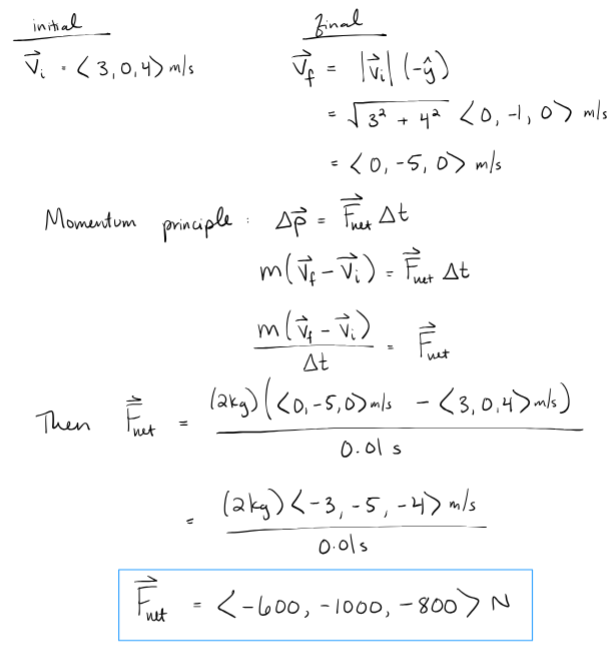
<p>momentum principle</p>
3
New cards
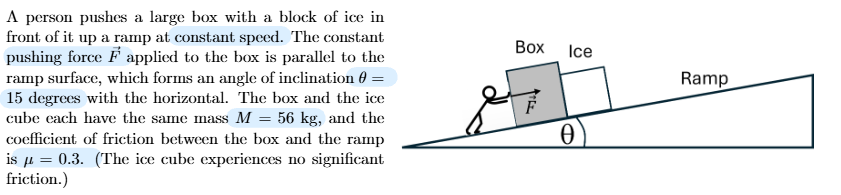
<p>Use the tilted coordinated system below to draw two free body diagrams: (a) one diagram that</p><p>includes all the forces acting on the box, and (b) another diagram that includes all the forces acting on the</p><p>block of ice. Your diagram should include angles where needed.</p>

Use the tilted coordinated system below to draw two free body diagrams: (a) one diagram that

includes all the forces acting on the box, and (b) another diagram that includes all the forces acting on the

block of ice. Your diagram should include angles where needed.

For the box: normal force points up, Force points right, gravity force points down at theta degrees left of vertical, frictional force points left, and force from ice points left.

For the ice: normal force points up, force from block points right, and gravitational force points down at theta degrees.
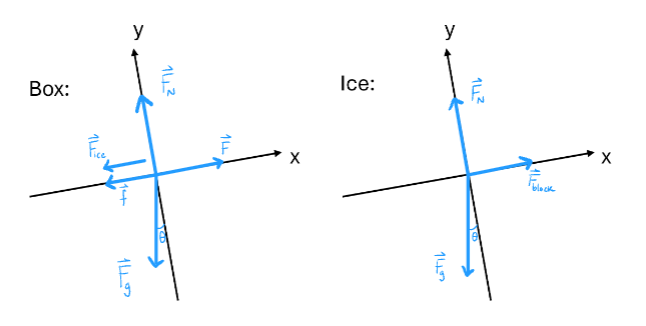
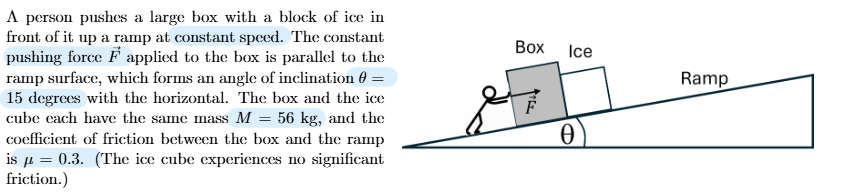
<p>For the box: normal force points up, Force points right, gravity force points down at theta degrees left of vertical, frictional force points left, and force from ice points left.</p><p>For the ice: normal force points up, force from block points right, and gravitational force points down at theta  degrees.</p>
4
New cards
<p>Find the magnitude F of the pushing force.</p>

Find the magnitude F of the pushing force.

break Fnet into x and y components and only focus on the x component. set Fnet_x to zero since velocity is constant. also set the system as both the block and ice.
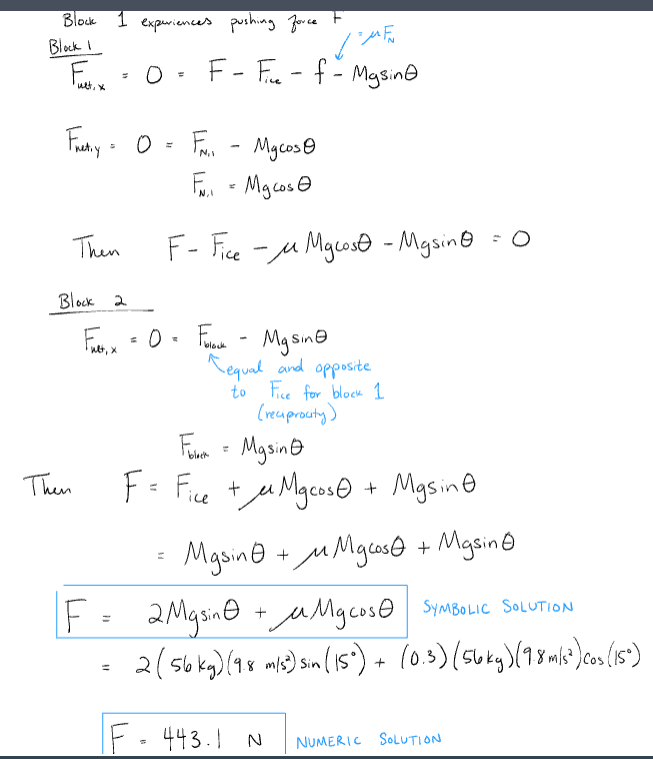
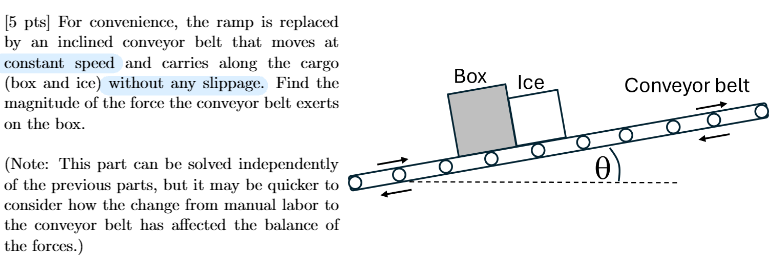
<p>break Fnet into x and y components and only focus on the x component. set Fnet_x to zero since velocity is constant. also set the system as both the block and ice.</p>
5
New cards
<p>Find the magnitude of the force the conveyor belt exerts on the box.</p>

Find the magnitude of the force the conveyor belt exerts on the box.

the frictional force from the belt is the force the conveyor belt exerts on the box. just set up Fnet_x and set it to zero due to no slipping. also set up system and both ice and block.
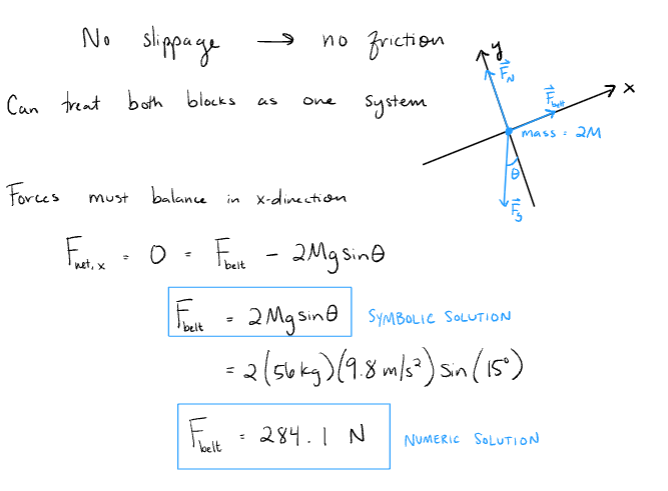
<p>the frictional force from the belt is the force the conveyor belt exerts on the box. just set up Fnet_x and set it to zero due to no slipping. also set up system and both ice and block.</p>
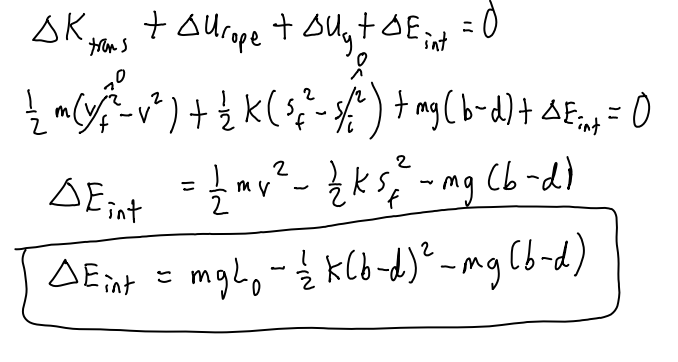
6
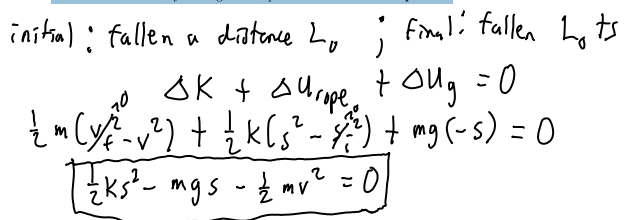
New cards
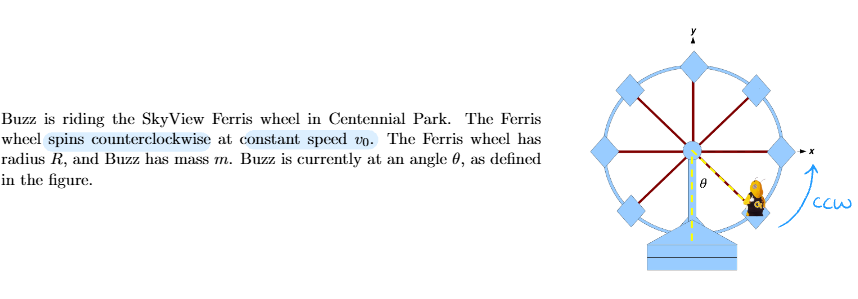
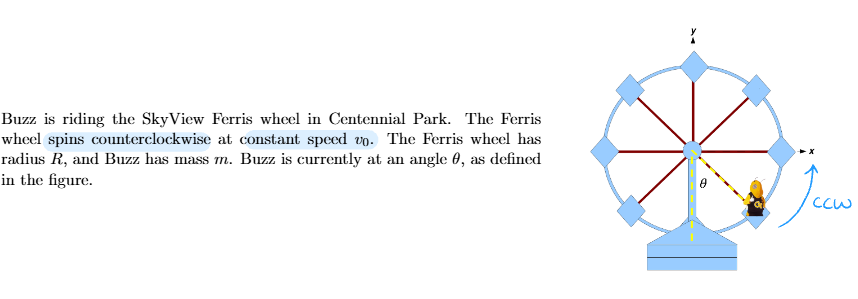
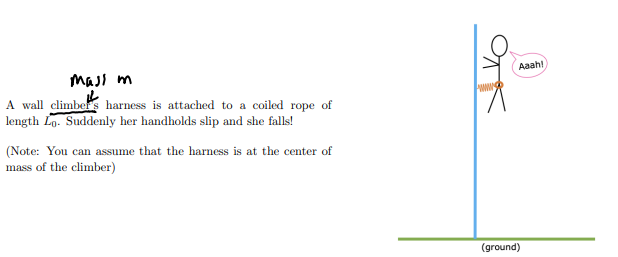
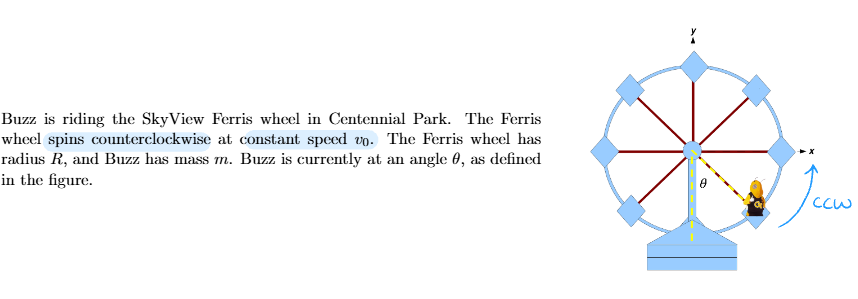
<p>What is the net force on Buzz in the direction parallel to the motion?</p>

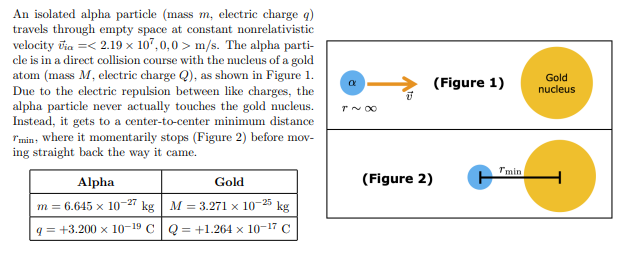
What is the net force on Buzz in the direction parallel to the motion?

zero since velocity is constant.
7
New cards
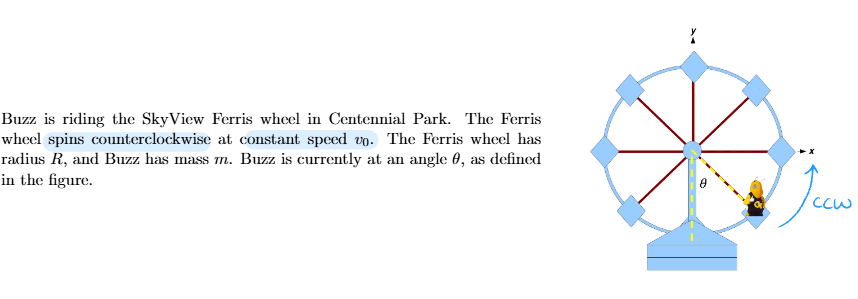
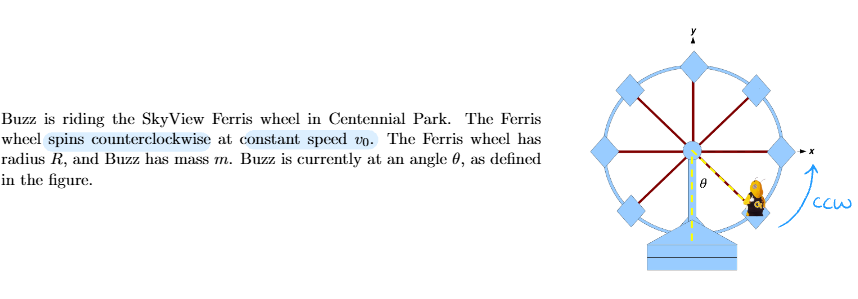
<p>What is the net force on Buzz in the direction perpendicular to the motion?</p>

What is the net force on Buzz in the direction perpendicular to the motion?

just set it to the definition of Fnet_perpendicular, (mv²)/R in the n hat direction.
8
New cards
<p>What is the magnitude of the perpendicular component of the force of gravity?</p>

What is the magnitude of the perpendicular component of the force of gravity?

find the component of gravitational force aligned with n hat via soh cah toa.
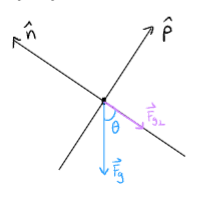
<p>find the component of gravitational force aligned with n hat via soh cah toa.</p>
9
New cards
<p>What is the magnitude of the parallel component of the force of gravity?</p>

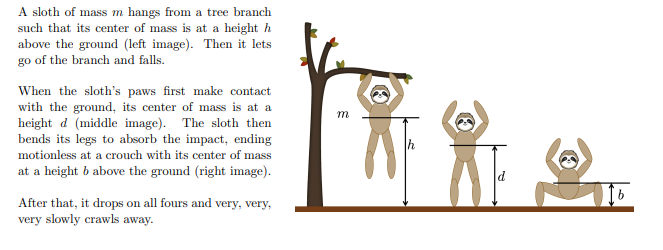
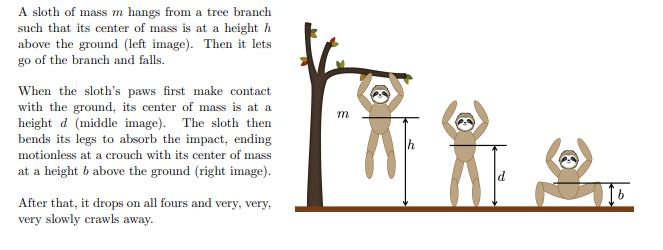
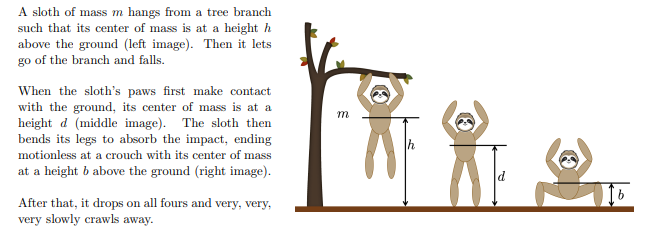
What is the magnitude of the parallel component of the force of gravity?

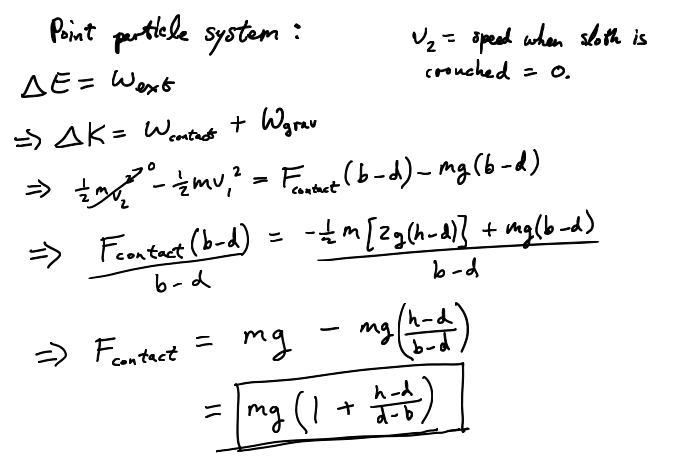
find the component of gravitational force aligned with p hat via soh cah toa.
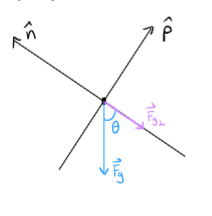
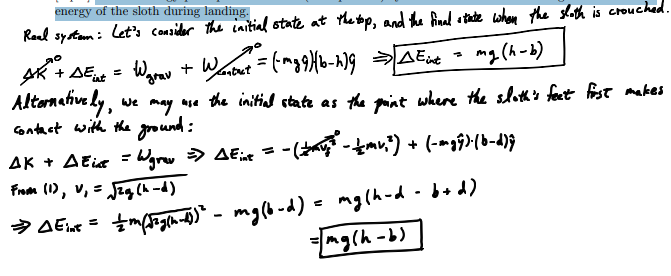
<p>find the component of gravitational force aligned with p hat via soh cah toa.</p>
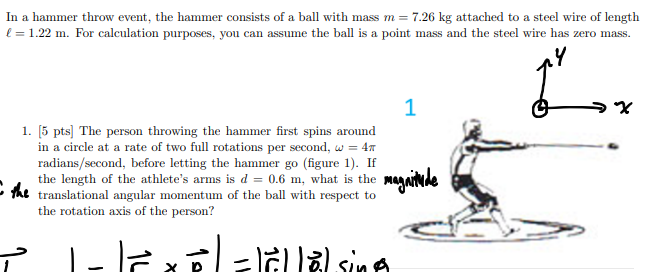
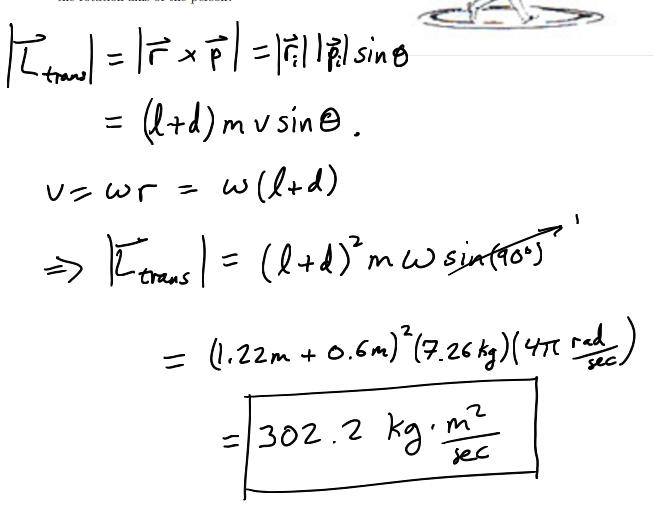
10
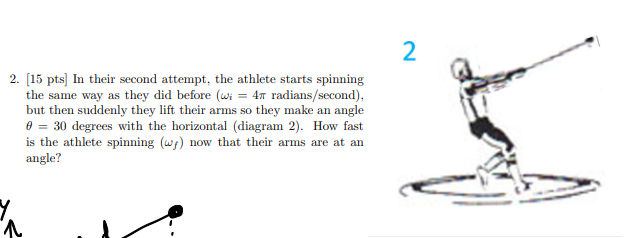
New cards
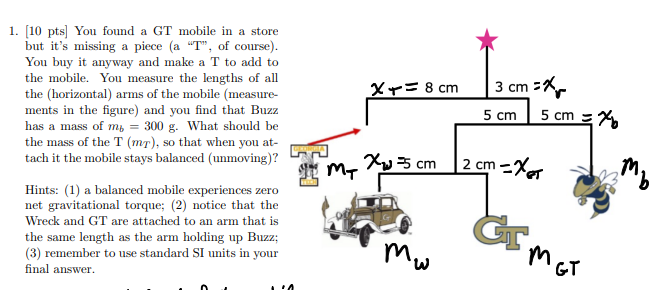
<p>What is the magnitude of the force of the Ferris wheel on Buzz?</p>

What is the magnitude of the force of the Ferris wheel on Buzz?

break up the Fnet into parallel and perpendicular components. set Fnet_parallel to zero due to constant velocity. set Fnet_perpendicular to its definition. Finally, add up the parallel and perpendicular components from the ferris wheel, and find the magnitude of that sum.
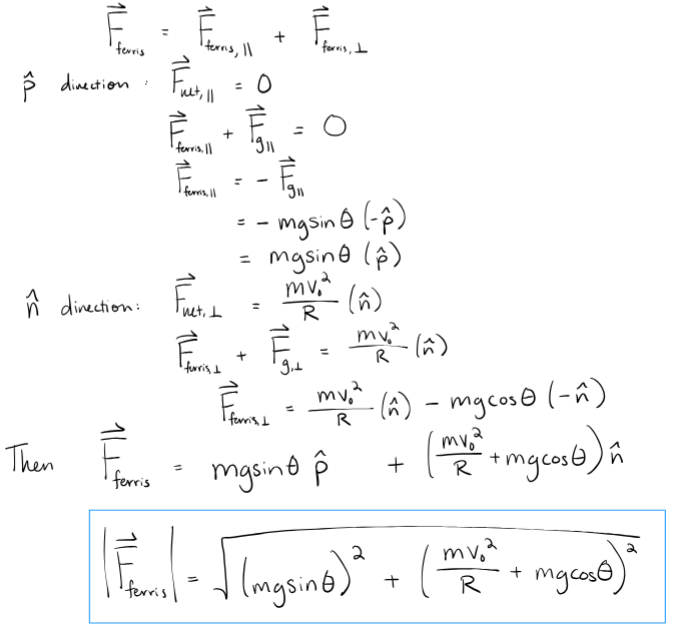
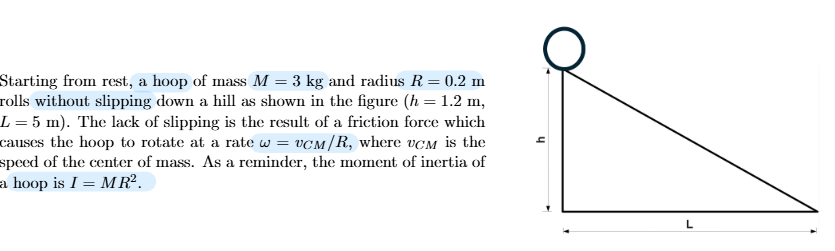
<p>break up the Fnet into parallel and perpendicular components. set Fnet_parallel to zero due to constant velocity. set Fnet_perpendicular to its definition. Finally, add up the parallel and perpendicular components from the ferris wheel, and find the magnitude of that sum.</p>
11
New cards
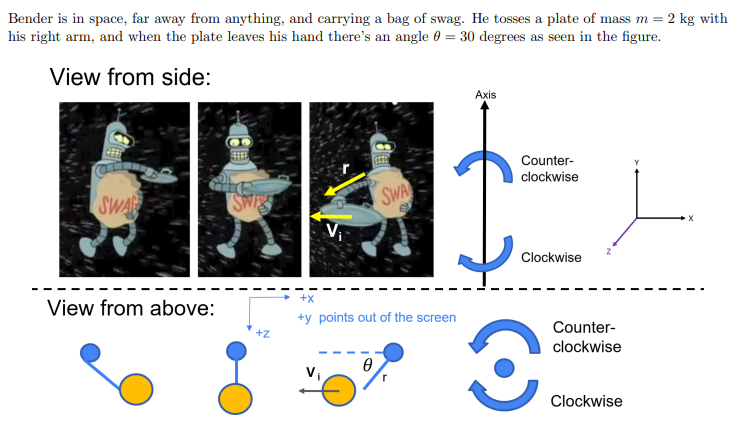
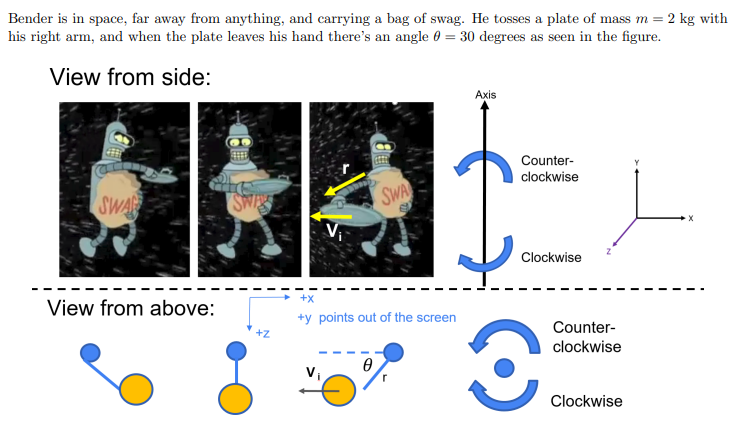
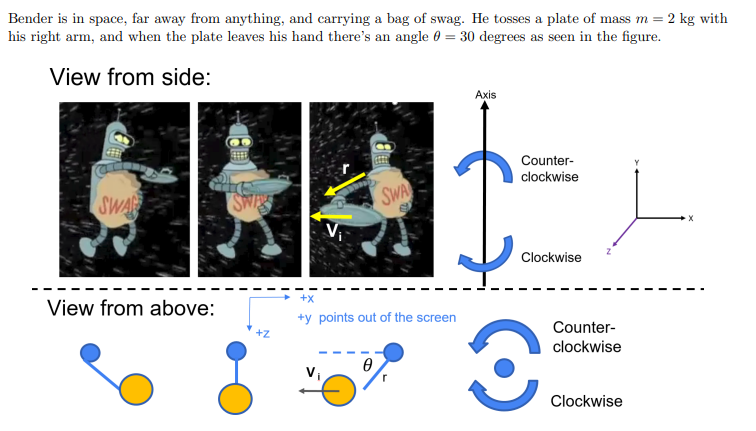
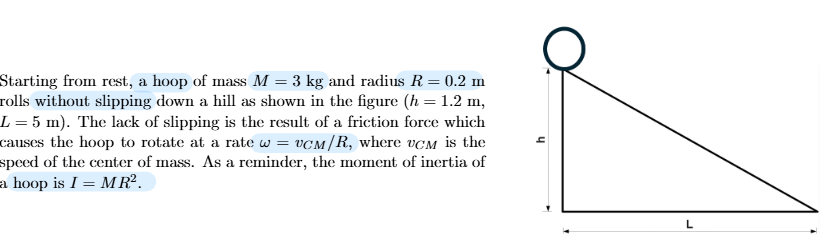
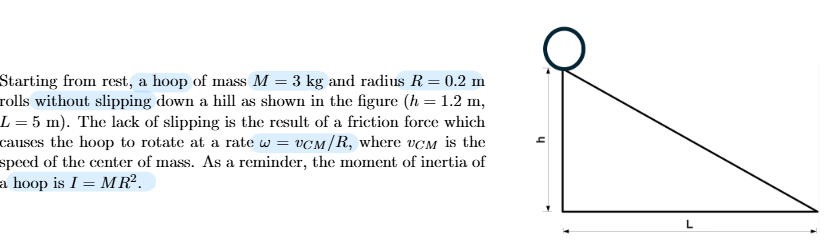
<p>Applying the energy principle on the real system consisting only of the hoop, determine the work done by the friction force on the hoop as it rolls from the top to the bottom of the hill.</p>

Applying the energy principle on the real system consisting only of the hoop, determine the work done by the friction force on the hoop as it rolls from the top to the bottom of the hill.

zero since hoop doesn’t slip → r = 0.
12
New cards
<p>Applying the energy principle on the real system consisting only of the hoop, determine the NET work done on the hoop as it rolls from the top to the bottom of the hill.</p>

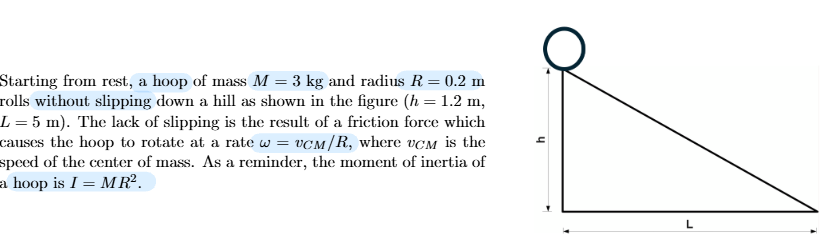
Applying the energy principle on the real system consisting only of the hoop, determine the NET work done on the hoop as it rolls from the top to the bottom of the hill.

only force is coming from gravity, set up component form multiplication to find work done by gravity.

<p>only force is coming from gravity, set up component form multiplication to find work done by gravity.</p>
13
New cards
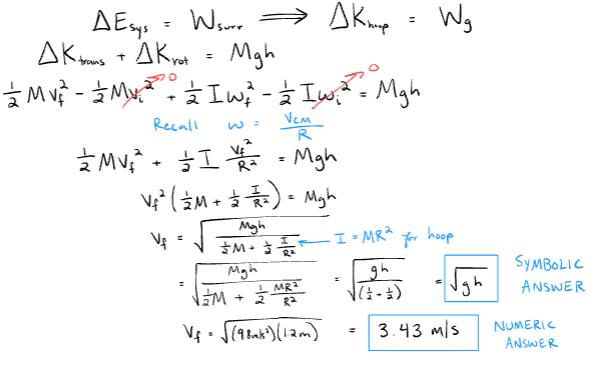
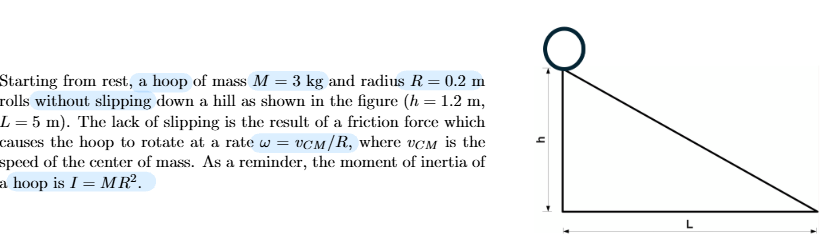
<p>Applying the energy principle on the real system consisting only of the hoop, determine the speed of the hoop when it reaches the bottom of the hill.</p>

Applying the energy principle on the real system consisting only of the hoop, determine the speed of the hoop when it reaches the bottom of the hill.

set delta energy of the system, which is delta k_trans + delta k_rot, to work done by surroundings, which is work done by gravity. remember to convert omega(w) to v_cm/R. also, inertia from a hoop is MR².
<p>set delta energy of the system, which is delta k_trans + delta k_rot, to work done by surroundings, which is work done by gravity. remember to convert omega(w) to v_cm/R. also, inertia from a hoop is MR².</p>
14
New cards
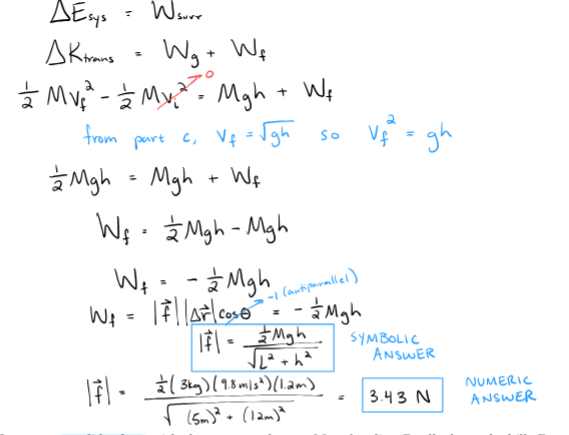
<p>Applying the energy principle on the point particle system consisting only of the hoop, determine the magnitude of the friction force (assumed constant) acting on the hoop as it rolls to the bottom of the hill. v_f = sqrt(gh) from a previous problem.</p>

Applying the energy principle on the point particle system consisting only of the hoop, determine the magnitude of the friction force (assumed constant) acting on the hoop as it rolls to the bottom of the hill. v_f = sqrt(gh) from a previous problem.

since its point particle, work done by friction exists, so work done by surroundings is work done by gravity + work done by friction. remember delta energy of the system only equals to delta k_trans due to point particle system. remember to definition for all work is the product of the magnitudes of force and r.
<p>since its point particle, work done by friction exists, so work done by surroundings is work done by gravity + work done by friction. remember delta energy of the system only equals to delta k_trans due to point particle system. remember to definition for all work is the product of the magnitudes of force and r.</p>
15
New cards
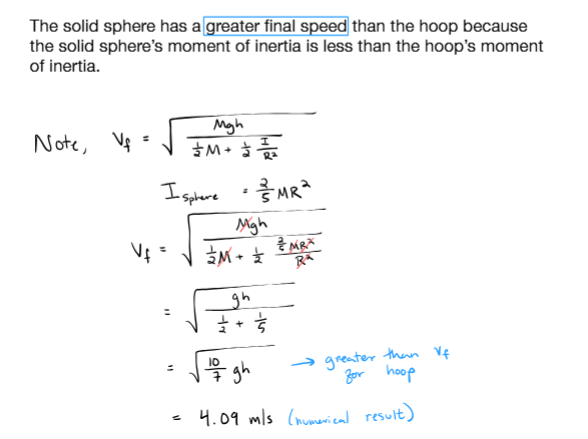
<p>Starting from rest, a solid sphere with the same total mass M and radius R rolls down the hill. Does the sphere have a final speed (at the bottom) that is greater than, equal to, or less than the hoop’s final speed? Briefly explain how you know this; you don’t need to do a full calculation of the sphere’s final speed.</p>

Starting from rest, a solid sphere with the same total mass M and radius R rolls down the hill. Does the sphere have a final speed (at the bottom) that is greater than, equal to, or less than the hoop’s final speed? Briefly explain how you know this; you don’t need to do a full calculation of the sphere’s final speed.

solid sphere is faster since its inertia is less compared to the hoop.
<p>solid sphere is faster since its inertia is less compared to the hoop. </p>
16
New cards
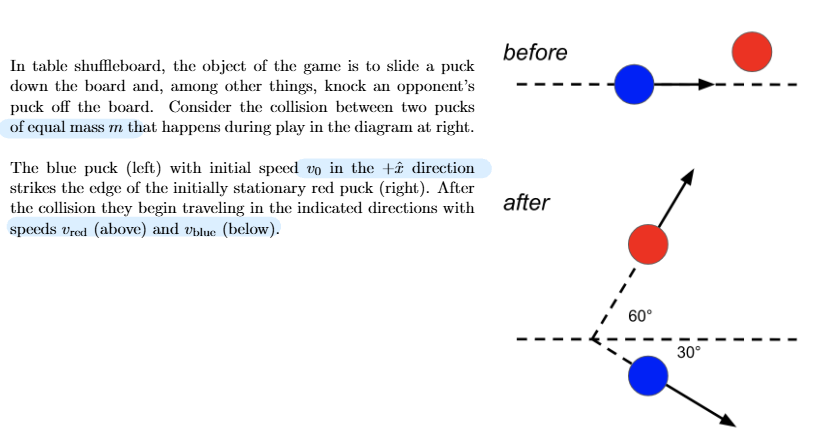
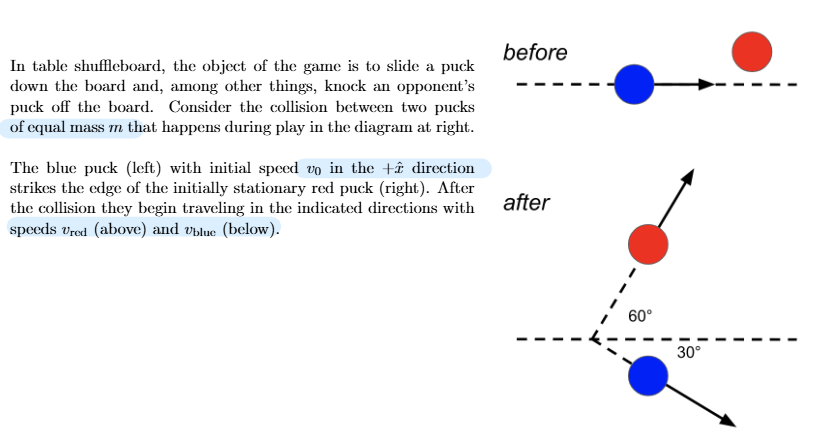
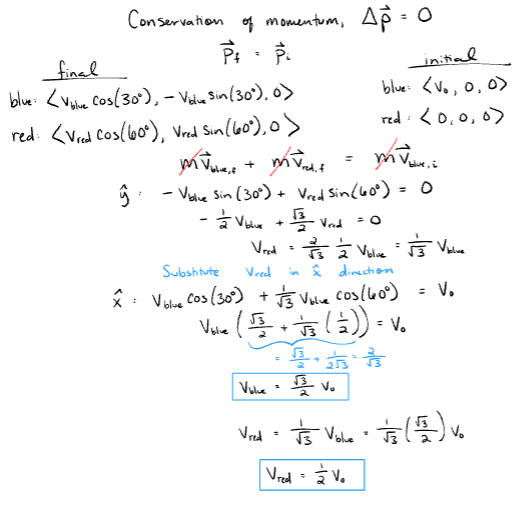
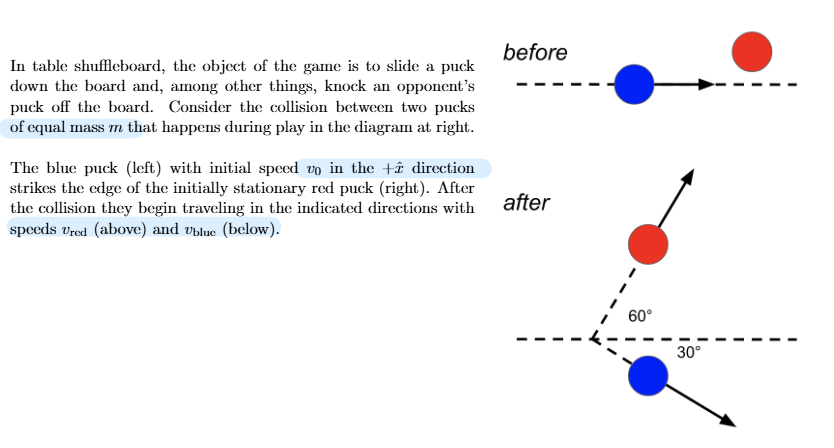
<p>What are the speeds v_red and v_blue? look up trig identities online.</p>

What are the speeds v_red and v_blue? look up trig identities online.

conservation of momentum and know your trig identities, though i dont think they take points off if you dont simplify them to their trig identities. name of the game is substitution.
<p>conservation of momentum and know your trig identities, though i dont think they take points off if you dont simplify them to their trig identities. name of the game is substitution.</p>
17
New cards
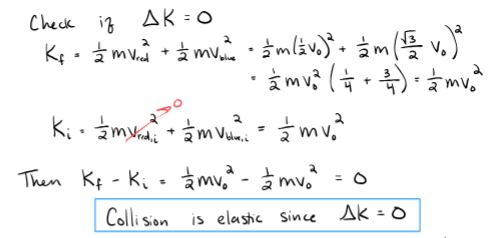
<p>Is the collision elastic or inelastic? Indicate how you know by writing and simplifying an appropriate equation.</p>

Is the collision elastic or inelastic? Indicate how you know by writing and simplifying an appropriate equation.

elastic since delta k = 0. you can find this by setting k_f = k_i and checking if its true.
<p>elastic since delta k = 0. you can find this by setting k_f = k_i and checking if its true.</p>
18
New cards
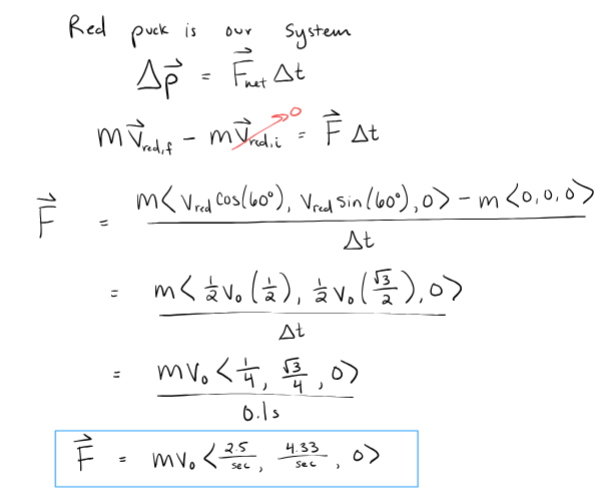
<p>During the collision, the pucks are in contact for 0.1 s. What is the contact force F of the blue puck on the red one? Assume that F is constant during the collision.</p>

During the collision, the pucks are in contact for 0.1 s. What is the contact force F of the blue puck on the red one? Assume that F is constant during the collision.

momentum principle.
<p>momentum principle.</p>
19
New cards
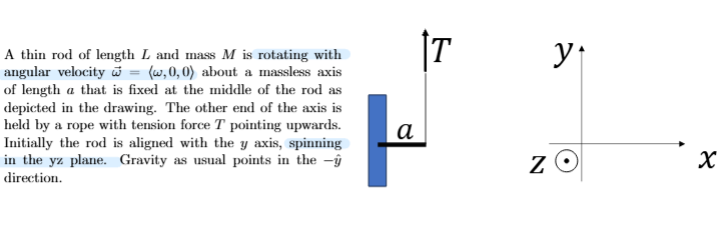
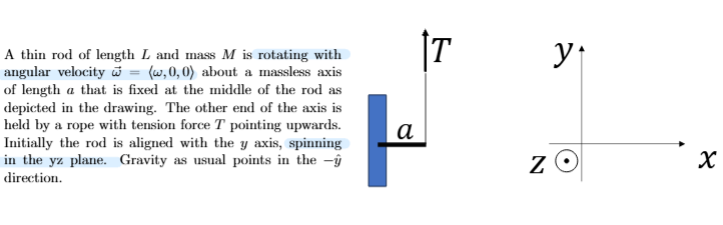
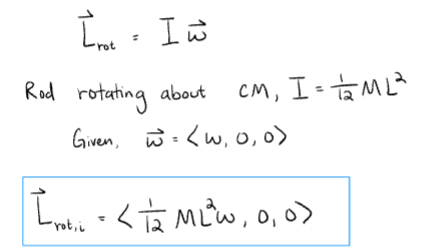
<p>Calculate the initial rotational angular momentum L_rot_i of the rod about its center of mass.</p>

Calculate the initial rotational angular momentum L_rot_i of the rod about its center of mass.

just the definition of L, which is the product of inertia and angular velocity.
<p>just the definition of L, which is the product of inertia and angular velocity.</p>
20
New cards
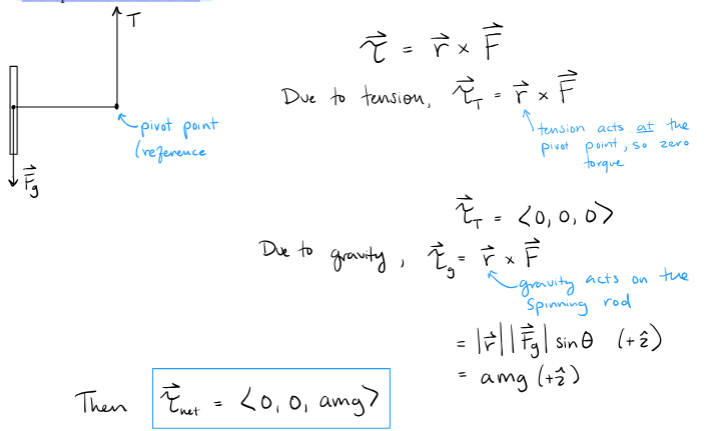
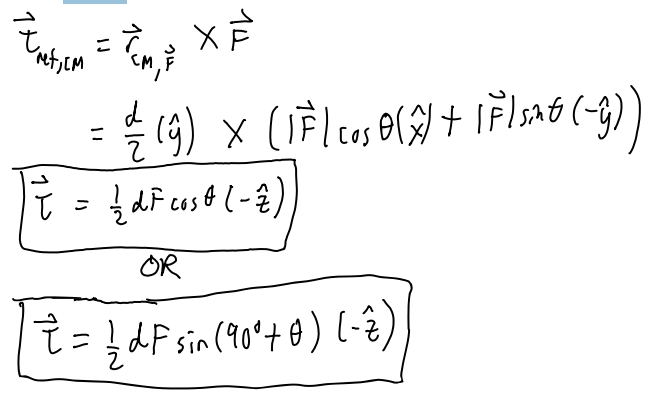
<p>The tension T balances the weight of the rod, such that its center of mass remains in the xz plane at all times. Calculate the initial net torque (magnitude and direction) on the system about the point where the rope attaches to the rod.</p>

The tension T balances the weight of the rod, such that its center of mass remains in the xz plane at all times. Calculate the initial net torque (magnitude and direction) on the system about the point where the rope attaches to the rod.

just the definition of torque, which is r from the point to the rod times force.
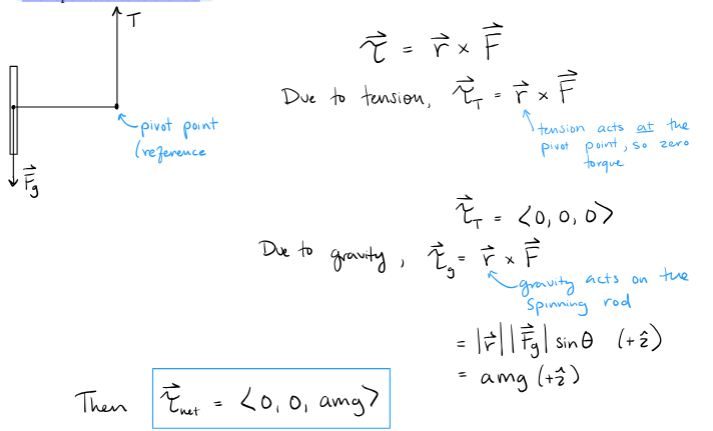
<p>just the definition of torque, which is r from the point to the rod times force.</p>
21
New cards
<p>Using the Angular Momentum Principle, calculate the rotational angular momentum of the rod L_rot_f after a short time interval deltat.</p>

Using the Angular Momentum Principle, calculate the rotational angular momentum of the rod L_rot_f after a short time interval deltat.

same as momentum principle, but its deltaL instead of deltaP and net torque instead of net force.
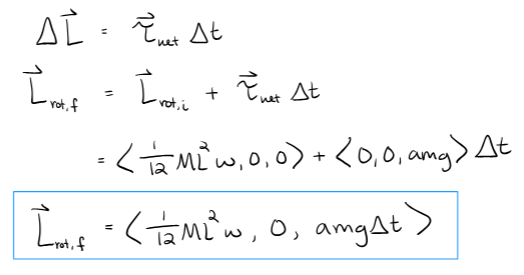

<p>same as momentum principle, but its deltaL instead of deltaP and net torque instead of net force. </p>
22
New cards
<p>what was the initial velocity v_i of the ball?</p>

what was the initial velocity v_i of the ball?

two position update formulas for the x and y directions, remember Fnet_x is zero and Fnet_y is -mg
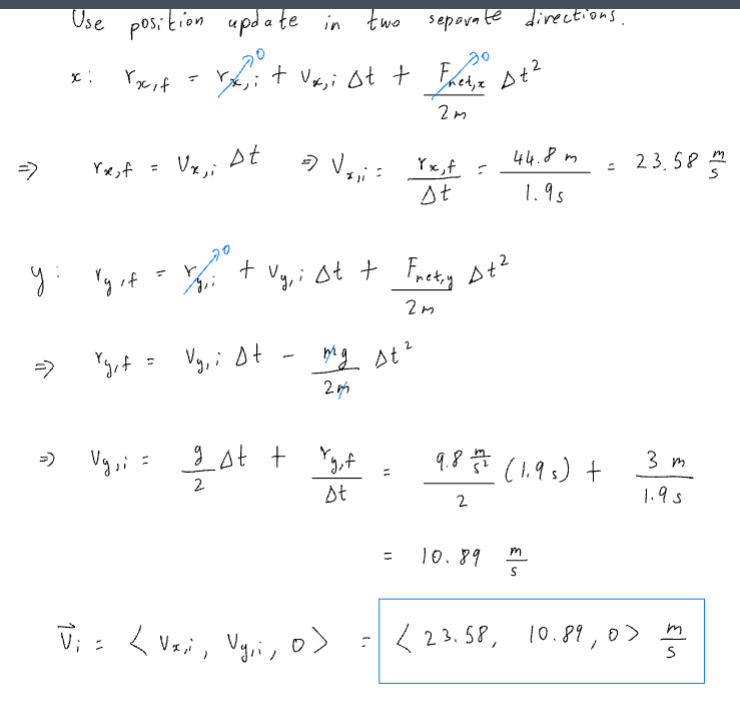

<p>two position update formulas for the x and y directions, remember Fnet_x is zero and Fnet_y is -mg</p>
23
New cards
<p>Determine the gravitational force Fg that the star exerts on the planet at t = 0.</p>

Determine the gravitational force Fg that the star exerts on the planet at t = 0.

just use the gravitational force formula. remember r = r_system - r_source.
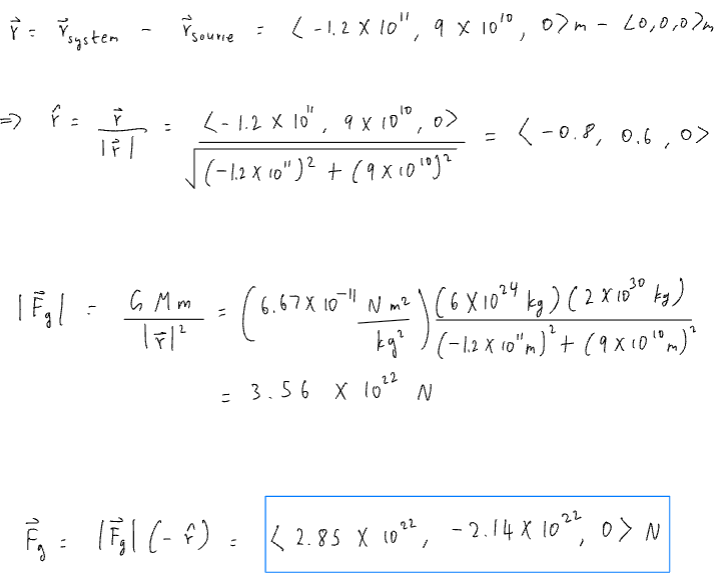
<p>just use the gravitational force formula. remember r = r_system - r_source.</p>
24
New cards
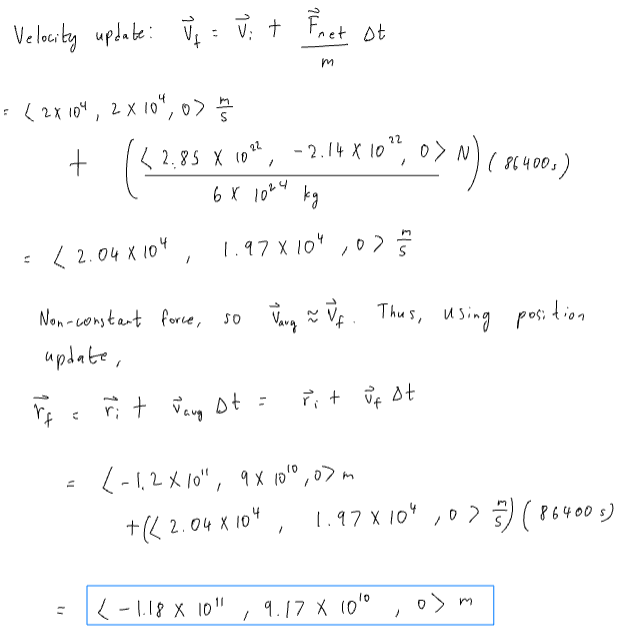
<p>Determine the position r_f of the planet 24 hours later. Fg is &lt;2.85 × 10 ^ 22, -2.14 × 10 ^ 22, 0&gt; from a previous problem.</p>

Determine the position r_f of the planet 24 hours later. Fg is <2.85 × 10 ^ 22, -2.14 × 10 ^ 22, 0> from a previous problem.

velocity and position update formulas. since its a non constant force, v_avg = v_f when using the position update formula.
<p>velocity and position update formulas. since its a non constant force, v_avg = v_f when using the position update formula.</p>
25
New cards
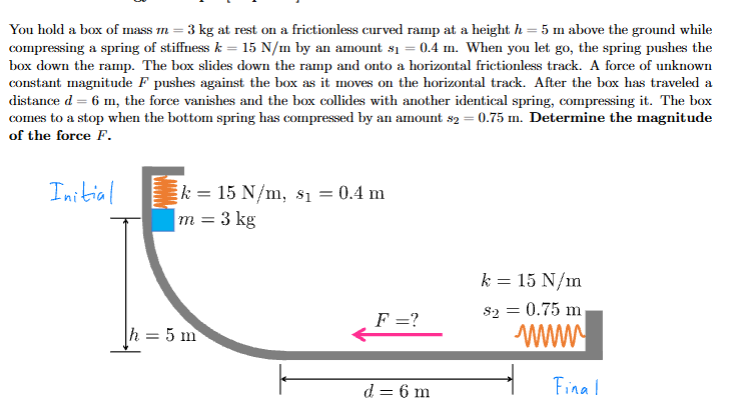
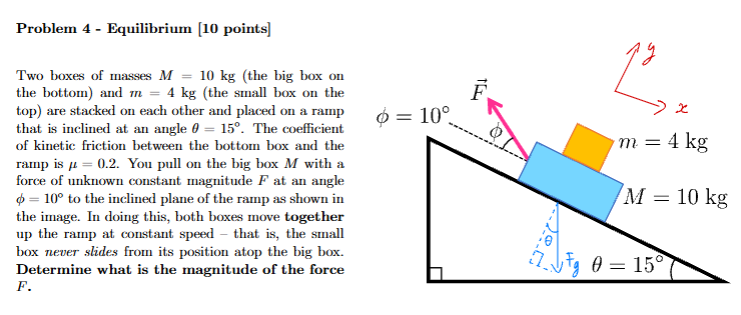
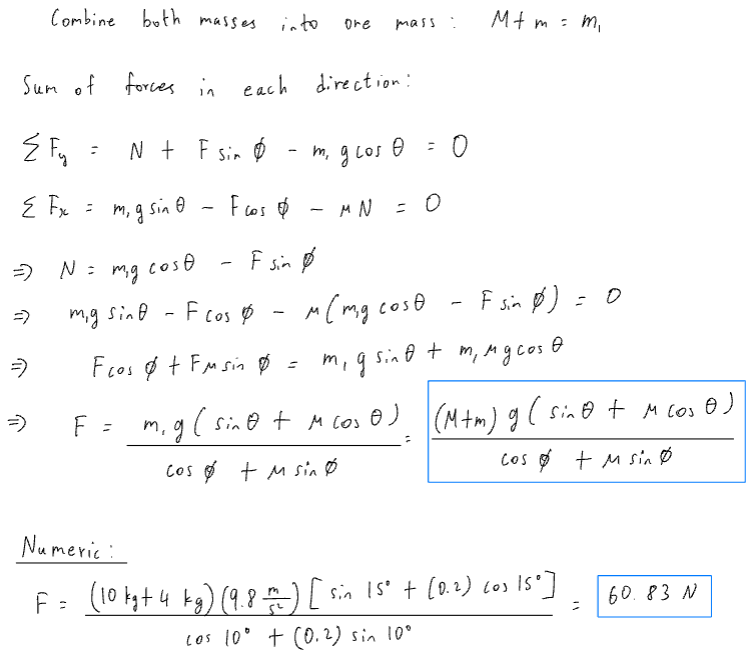
<p>Determine what is the magnitude of the force F.</p>

Determine what is the magnitude of the force F.

set the system to both blocks. break up Fnet into x and y components and set both the zero since constant velocity. find normal force using Fnet_y, and plug in that value into Fnet_x’s normal force. finally, put force F on one side of that equation.
<p>set the system to both blocks. break up Fnet into x and y components and set both the zero since constant velocity. find normal force using Fnet_y, and plug in that value into Fnet_x’s normal force. finally, put force F on one side of that equation.</p>
26
New cards
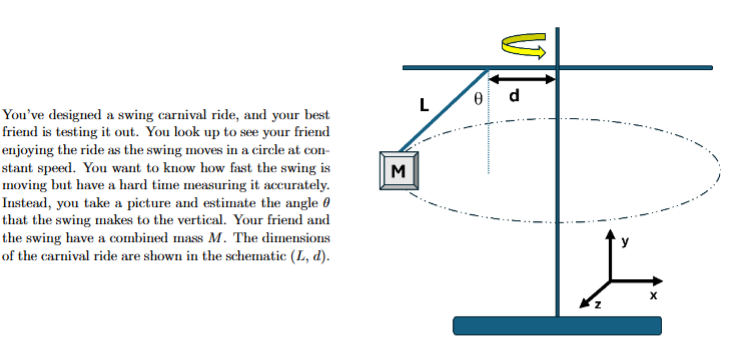
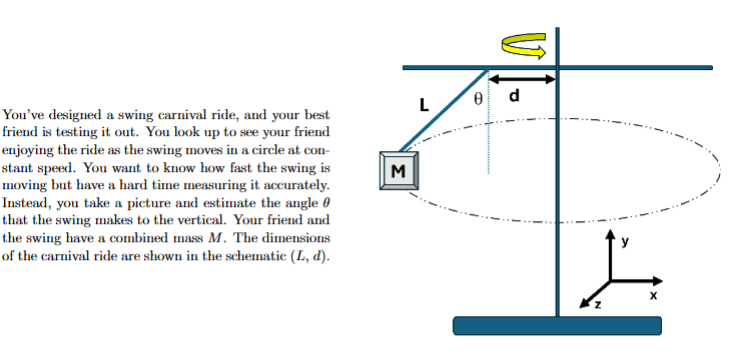
<p>What is the magnitude of the tension in the rope, T ? Your answer may use any or all of these variables: M , g, theta, L, d.</p>

What is the magnitude of the tension in the rope, T ? Your answer may use any or all of these variables: M , g, theta, L, d.

set up Fnet_y and set it to zero due to constant velocity.
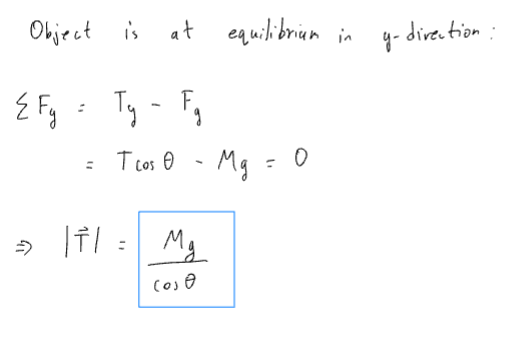
<p>set up Fnet_y and set it to zero due to constant velocity.</p>
27
New cards
<p>What is the speed v of the system, in terms of the variables M , g, theta, L, d?</p>

What is the speed v of the system, in terms of the variables M , g, theta, L, d?

set Fnet_perpendicular to its definition where R = Lsin(theta) + d.
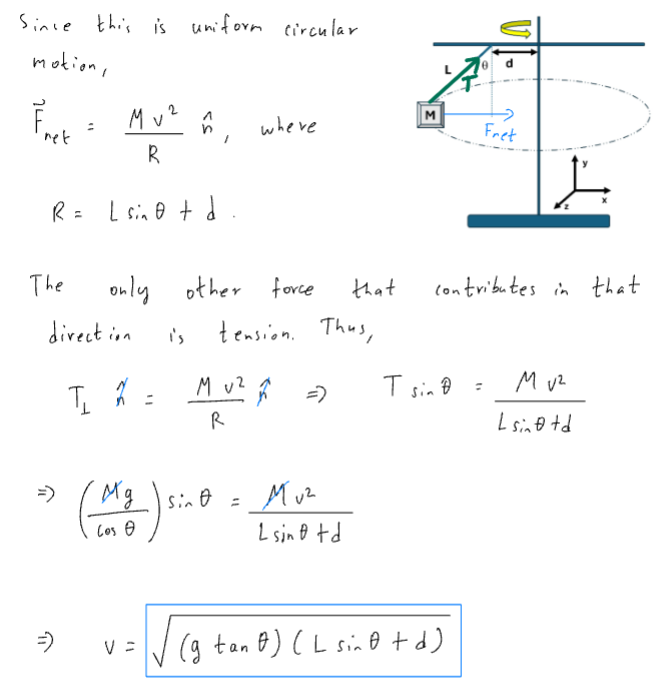
<p>set Fnet_perpendicular to its definition where R = Lsin(theta) + d.</p>
28
New cards
<p>Determine the magnitude of the force F .</p>

Determine the magnitude of the force F .

use the energy equation W done by non-conserved forces = deltaE of all forces acting in the system.
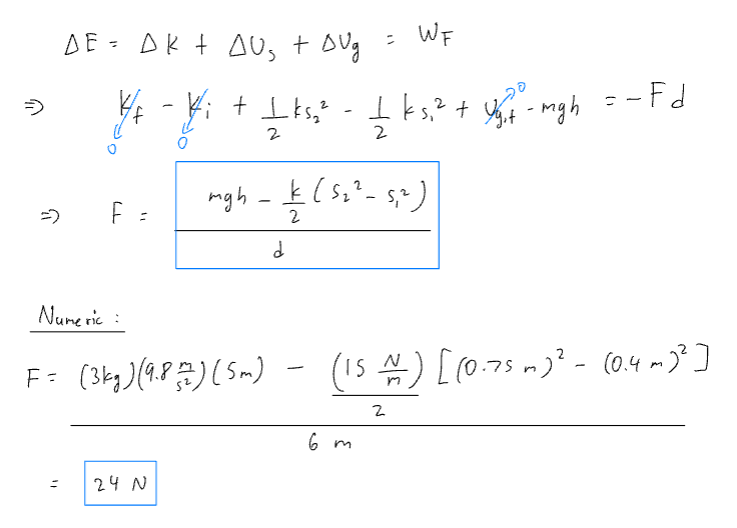
<p>use the energy equation W done by non-conserved forces = deltaE of all forces acting in the system.</p>
29
New cards
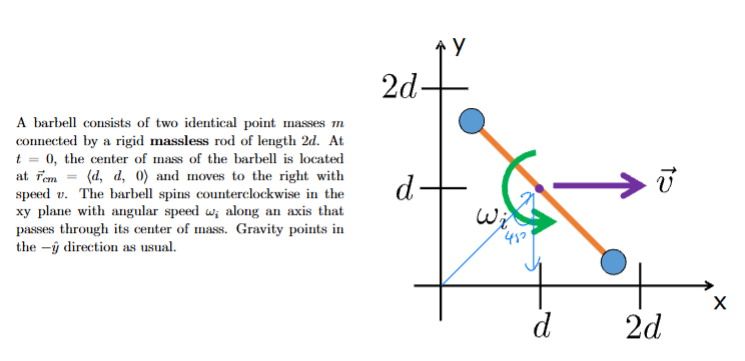
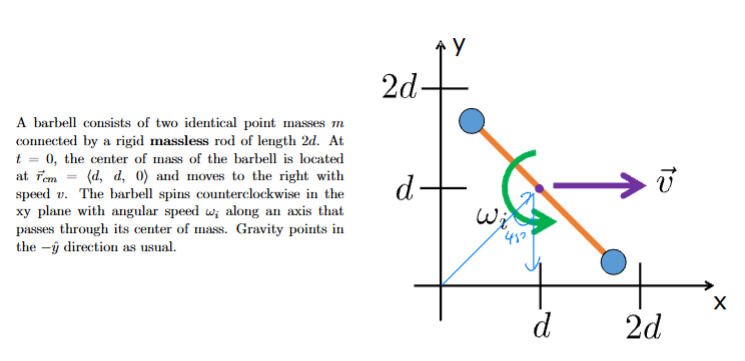
<p>Determine the translational angular momentum Ltrans of the barbell, with respect to the origin.</p>

Determine the translational angular momentum Ltrans of the barbell, with respect to the origin.

simple angular momentum formula where L = r times p
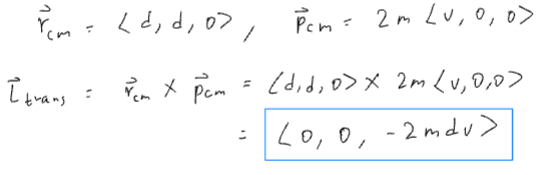
<p>simple angular momentum formula where L = r times p</p>
30
New cards
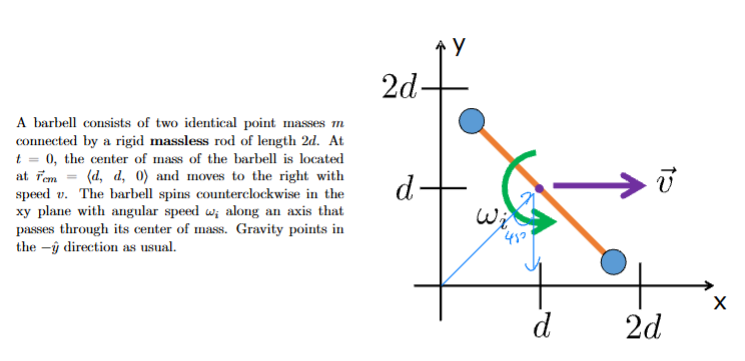
<p>Determine the rotational angular momentum Lrot of the barbell.</p>

Determine the rotational angular momentum Lrot of the barbell.

simple angular momentum formula wher L = I times w.
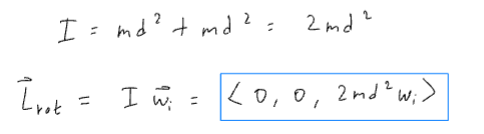
<p>simple angular momentum formula wher L = I times w.</p>
31
New cards
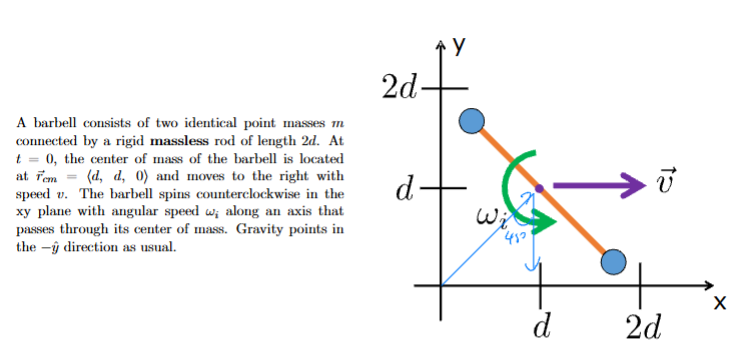
<p>Determine the torque exerted by gravity t_g on the barbell, with respect to the origin</p>

Determine the torque exerted by gravity t_g on the barbell, with respect to the origin

torque formula t = r times Fg
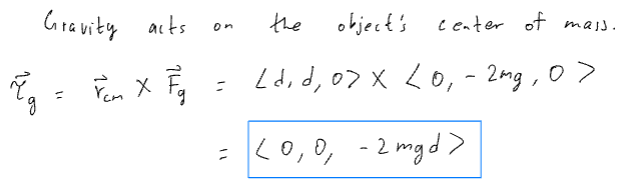
<p>torque formula t = r times Fg</p>
32
New cards
<p>What is the total angular momentum of the barbell Ltotal,f with respect to the origin a short time !t later?</p>

What is the total angular momentum of the barbell Ltotal,f with respect to the origin a short time !t later?

torque update formula, where L_f = L_i + t_net * deltaT
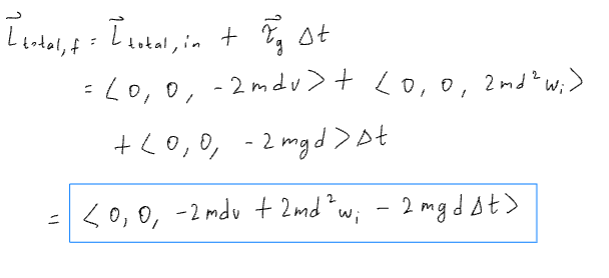
<p>torque update formula, where L_f = L_i + t_net * deltaT</p>
33
New cards
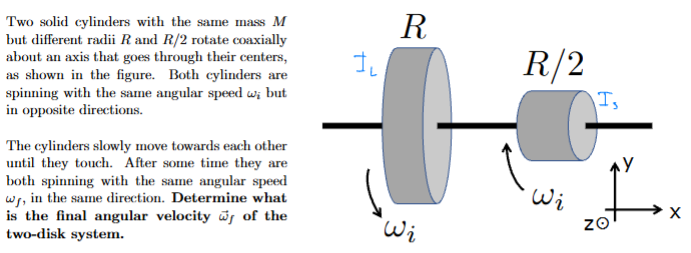
<p>Determine what is the final angular velocity w_f of the two-disk system.</p>

Determine what is the final angular velocity w_f of the two-disk system.

conservation of angular momentum and L = Iw
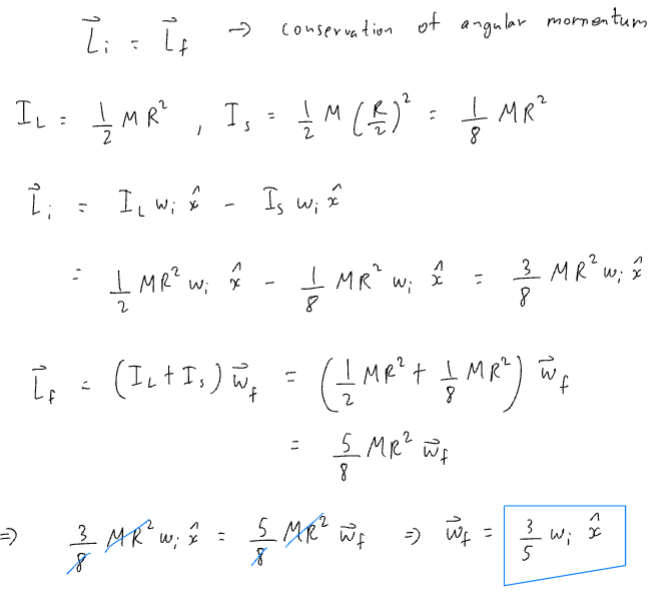
<p>conservation of angular momentum and L = Iw</p>
34
New cards
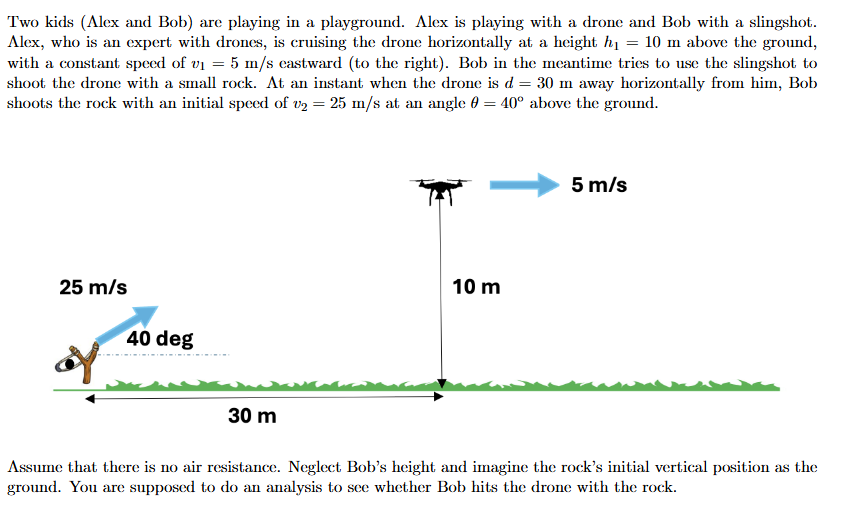
<p>At what time does the rock reach its maximum height in its trajectory?</p>

At what time does the rock reach its maximum height in its trajectory?

velocity update formula.
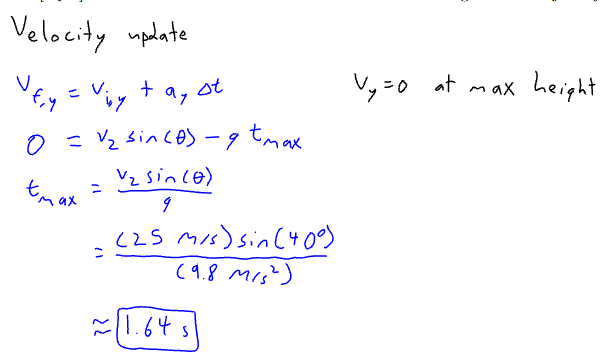
<p>velocity update formula.</p>
35
New cards
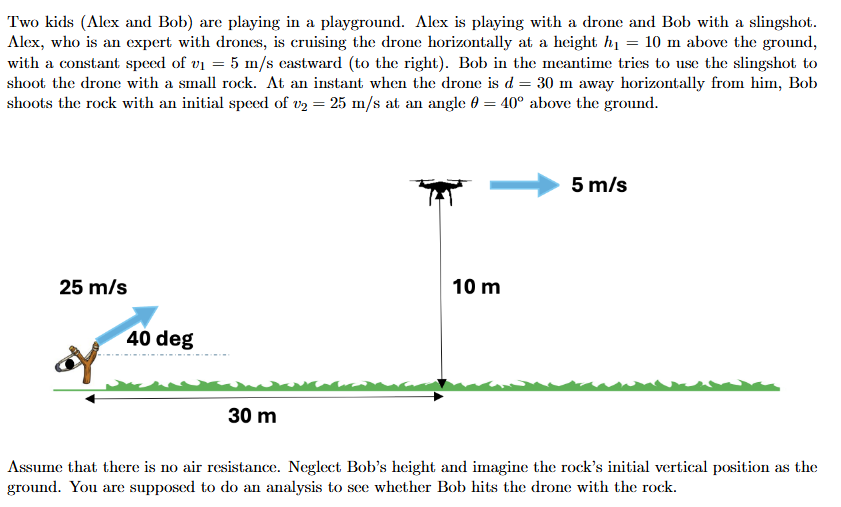
<p>Calculate the maximum height reached by the rock. deltaT is 1.64s from a previous problem.</p>

Calculate the maximum height reached by the rock. deltaT is 1.64s from a previous problem.

projectile position update formula.
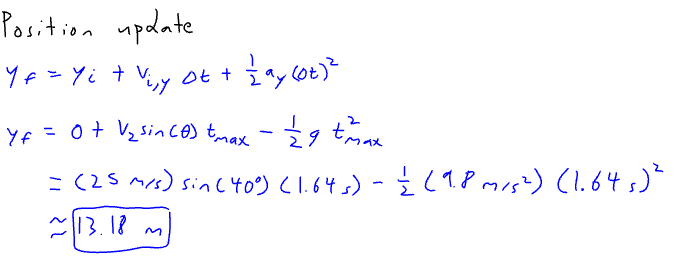
<p>projectile position update formula.</p>
36
New cards
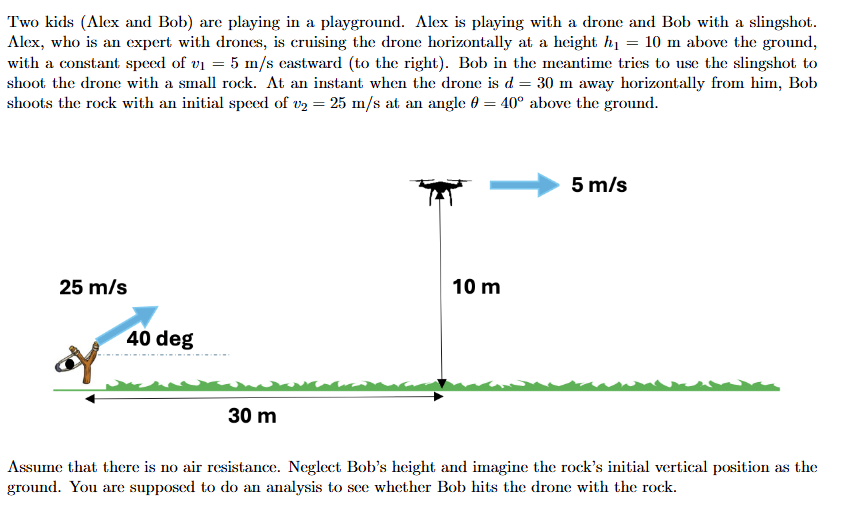
<p>Will Bob hit the drone with the rock? Justify your answer with calculations. Hint: think about how far (horizontally) the rock and the drone travel.</p>

Will Bob hit the drone with the rock? Justify your answer with calculations. Hint: think about how far (horizontally) the rock and the drone travel.

first find when the rock’s x position meets the drone’s x position, then use that deltaT to calculate the rock’s y position, then compare heights to see if they hit.
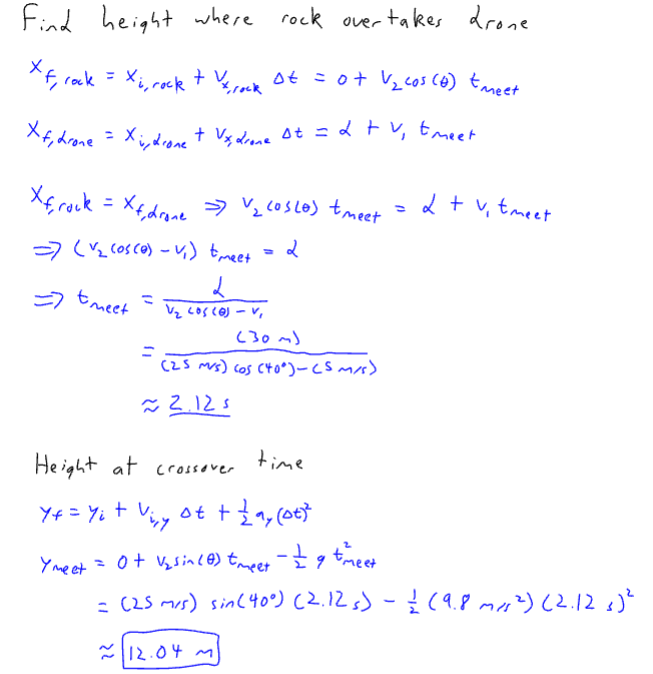
<p>first find when the rock’s x position meets the drone’s x position, then use that deltaT to calculate the rock’s y position, then compare heights to see if they hit.</p>
37
New cards
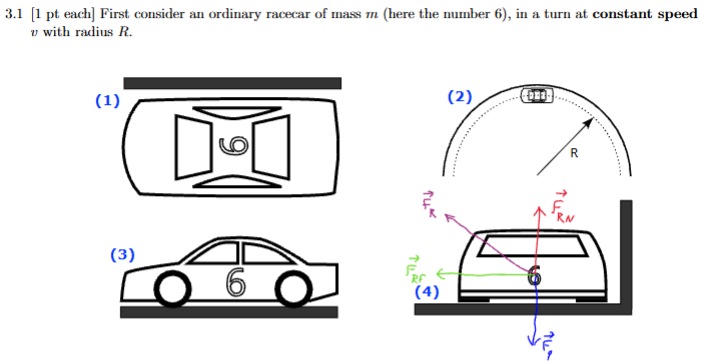
<p>In terms of mass m, turn radius R, the constant g and the coefficient of static friction between the tires and the road, μR, what is the maximum speed that the racecar can drive?</p>

In terms of mass m, turn radius R, the constant g and the coefficient of static friction between the tires and the road, μR, what is the maximum speed that the racecar can drive?

calculate normal force using Fnet_vertical = 0 since constant speed, then find v using Fnet_perpendicular = Force from frictional component = definition of perpendicular force.
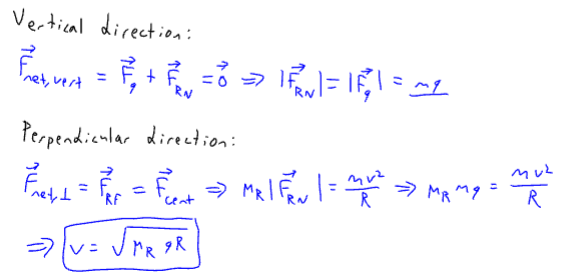
<p>calculate normal force using Fnet_vertical = 0 since constant speed, then find v using Fnet_perpendicular = Force from frictional component = definition of perpendicular force.</p>
38
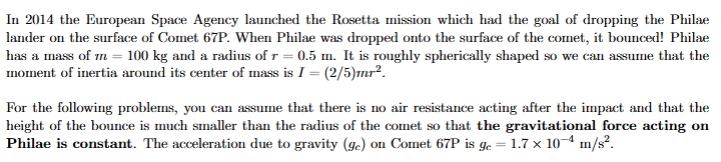
New cards
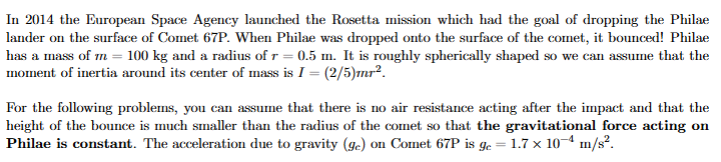
<p>Immediately after the first collision Philae bounces off the surface of the comet at an angle of θ = 45◦. At the peak of its bounce, it is h = 70 m above the surface of the comet (that’s a big bounce!). What was the speed of Philae immediately after impact? Hint: use the Energy Principle.</p>

Immediately after the first collision Philae bounces off the surface of the comet at an angle of θ = 45◦. At the peak of its bounce, it is h = 70 m above the surface of the comet (that’s a big bounce!). What was the speed of Philae immediately after impact? Hint: use the Energy Principle.

deltaE = W → delta k_trans = W_gc
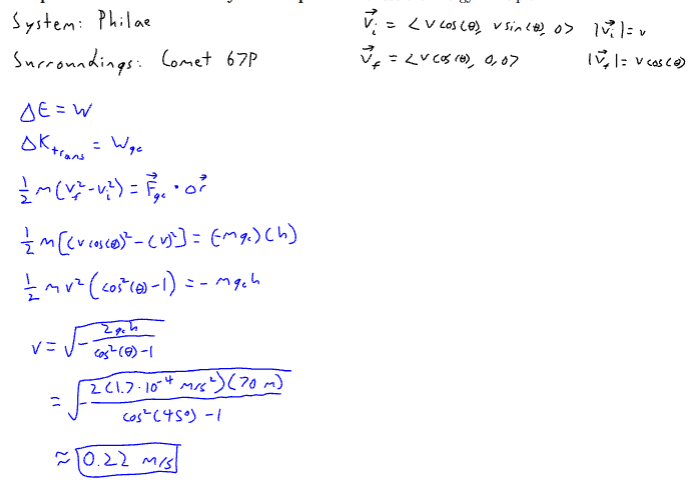
<p>deltaE = W → delta k_trans = W_gc</p>
39
New cards
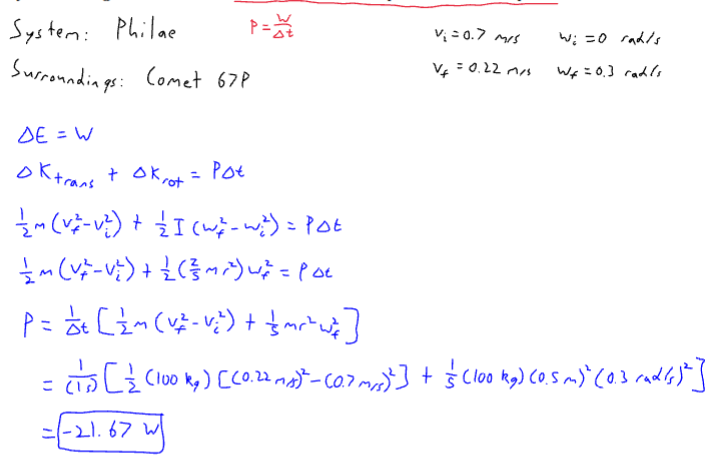
<p>After the first impact Philae is also spinning at ω = 0.3 radians/second. Immediately before the first impact, Philae had a speed of v = 0.7 m/s and was not spinning. Philae’s damping system was in contact with the ground for ∆t = 1 second during the collision. What is the average power of its damping system during this time? Hint: remember the relationship between work and power.</p>

After the first impact Philae is also spinning at ω = 0.3 radians/second. Immediately before the first impact, Philae had a speed of v = 0.7 m/s and was not spinning. Philae’s damping system was in contact with the ground for ∆t = 1 second during the collision. What is the average power of its damping system during this time? Hint: remember the relationship between work and power.

damping system equal is delta k_trans + delta k_rot = p * deltaT. you are trying to find p. derived from p = w/deltaT.
<p>damping system equal is delta k_trans + delta k_rot = p * deltaT. you are trying to find p. derived from p = w/deltaT.</p>
40
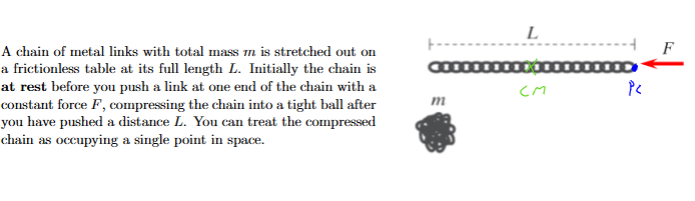
New cards
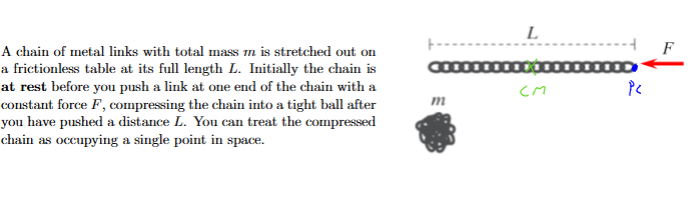
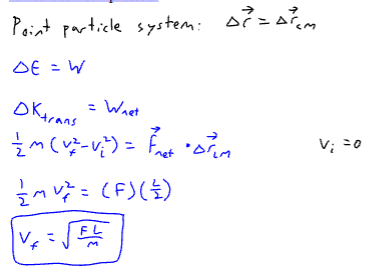
<p>Consider the point particle (i.e. center of mass) system. What is the speed of the chain after it has been compressed?</p>

Consider the point particle (i.e. center of mass) system. What is the speed of the chain after it has been compressed?

set up point particle work system, where delta k_trans = net work.
<p>set up point particle work system, where delta k_trans = net work.</p>
41
New cards
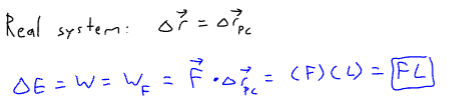
<p>Consider the real (i.e. extended) system. What is the change in the total energy of the chain?</p>

Consider the real (i.e. extended) system. What is the change in the total energy of the chain?

set up real work system, remember delta r starts from where force was applied from.
<p>set up real work system, remember delta r starts from where force was applied from.</p>
42
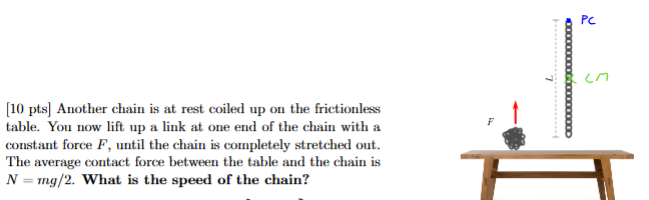
New cards
<p>Another chain is at rest coiled up on the frictionless table. You now lift up a link at one end of the chain with a constant force F , until the chain is completely stretched out. The average contact force between the table and the chain is N = mg/2. What is the speed of the chain?</p>

Another chain is at rest coiled up on the frictionless table. You now lift up a link at one end of the chain with a constant force F , until the chain is completely stretched out. The average contact force between the table and the chain is N = mg/2. What is the speed of the chain?

set up point particle system, remember to include contact force in net force
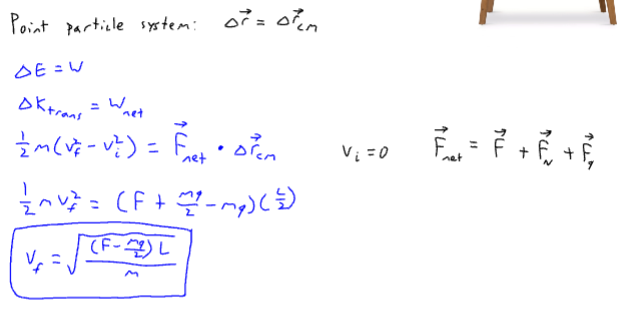
<p>set up point particle system, remember to include contact force in net force</p>
43
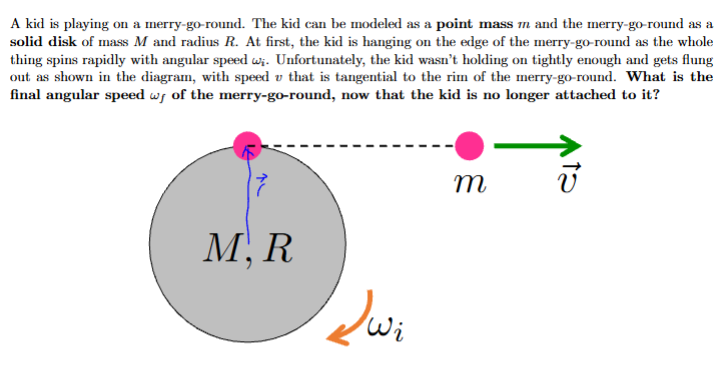
New cards
<p>What is the final angular speed ωf of the merry-go-round, now that the kid is no longer attached to it?</p>

What is the final angular speed ωf of the merry-go-round, now that the kid is no longer attached to it?

set up conservation of angular momentum, initial L only has L_rots while final L has one L_rot and one L_trans
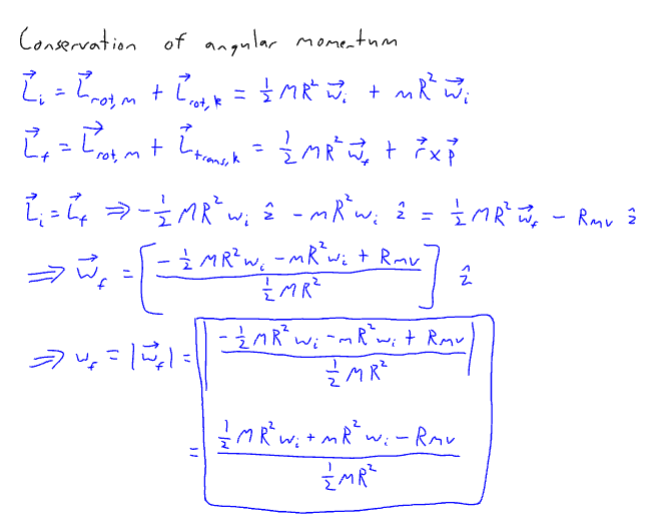
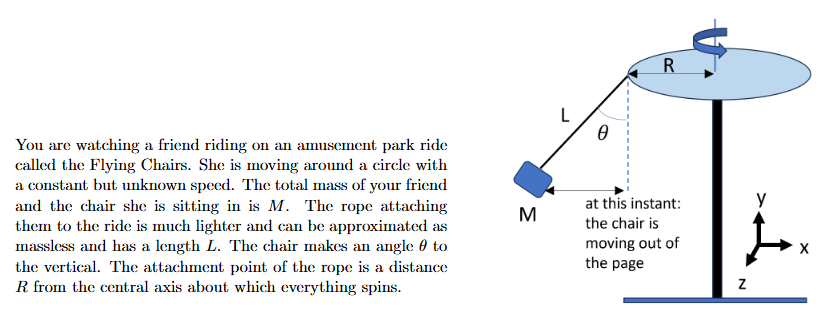
<p>set up conservation of angular momentum, initial L only has L_rots while final L has one L_rot and one L_trans</p>
44
New cards
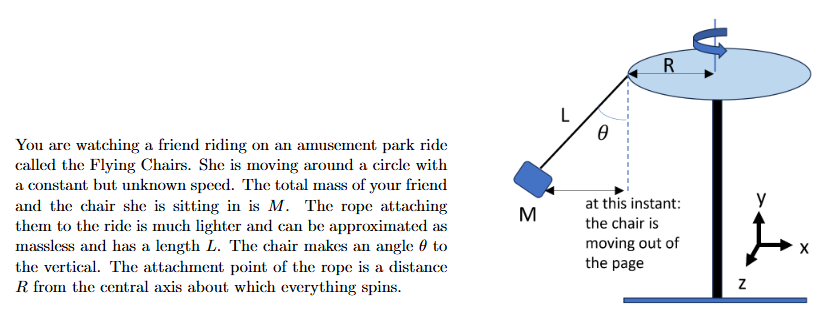
<p>What is the direction of F⃗ net⊥?</p>

What is the direction of F⃗ net⊥?

+x hat
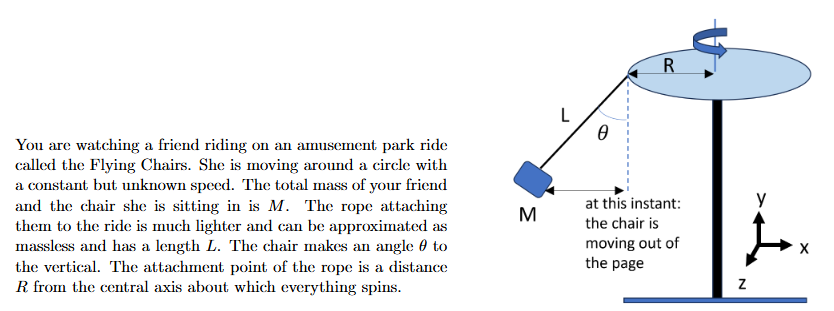
45
New cards
<p>What is the direction of F⃗ net∥?</p>

What is the direction of F⃗ net∥?

zero
46
New cards
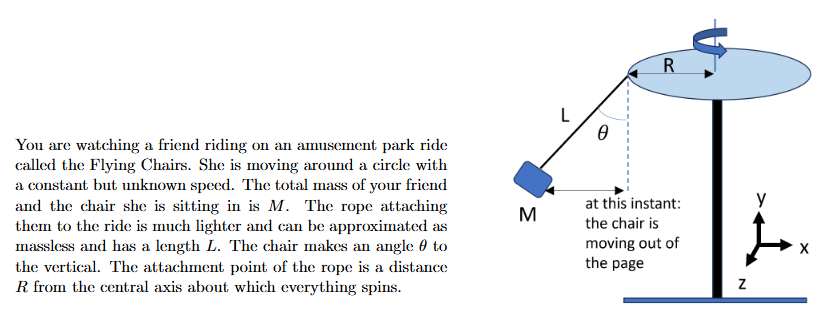
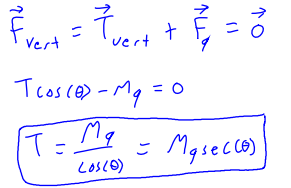
<p>What is the magnitude of the tension in the rope, |T⃗|?</p>

What is the magnitude of the tension in the rope, |T⃗|?

set up Fnet_y
<p>set up Fnet_y</p>
47
New cards
<p>Using your knowledge of curving motion and the variables given in the schematic (R, L, θ, M) and any relevant physical constants, at what speed v is your friend (and the chair) moving?</p>

Using your knowledge of curving motion and the variables given in the schematic (R, L, θ, M) and any relevant physical constants, at what speed v is your friend (and the chair) moving?

set up Fnet_perpendicular and set it equal to its definition
48
New cards
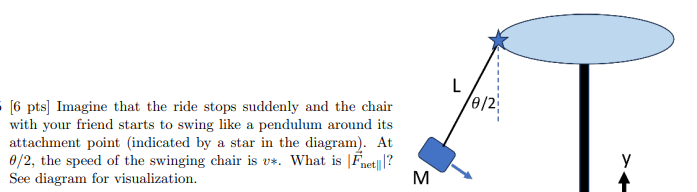
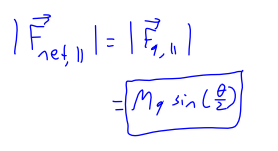
<p>What is |F⃗ net∥ |?</p>

What is |F⃗ net∥ |?

only force acting on the mass now is gravitational force
<p>only force acting on the mass now is gravitational force</p>
49
New cards
<p>What minimum force do you need to apply in order to stop the truck before it hits the kittens, which are a distance d = 13 m away?</p>

What minimum force do you need to apply in order to stop the truck before it hits the kittens, which are a distance d = 13 m away?

set up energy equation delteE = work done by non conserved forces, which in this case is work done by you + work done by friction.
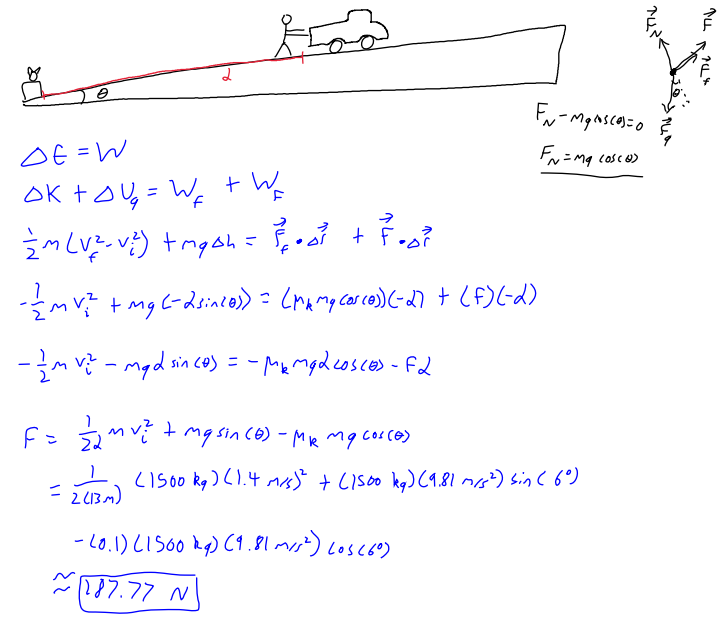
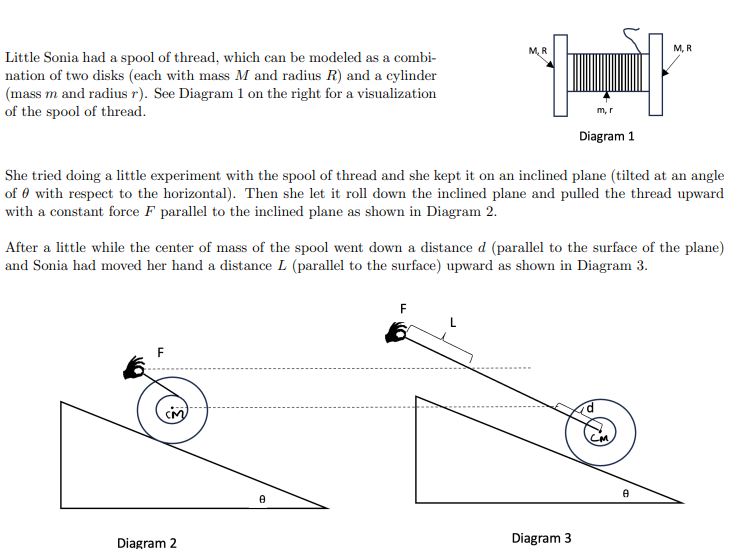
<p>set up energy equation delteE = work done by non conserved forces, which in this case is work done by you + work done by friction.</p>
50
New cards
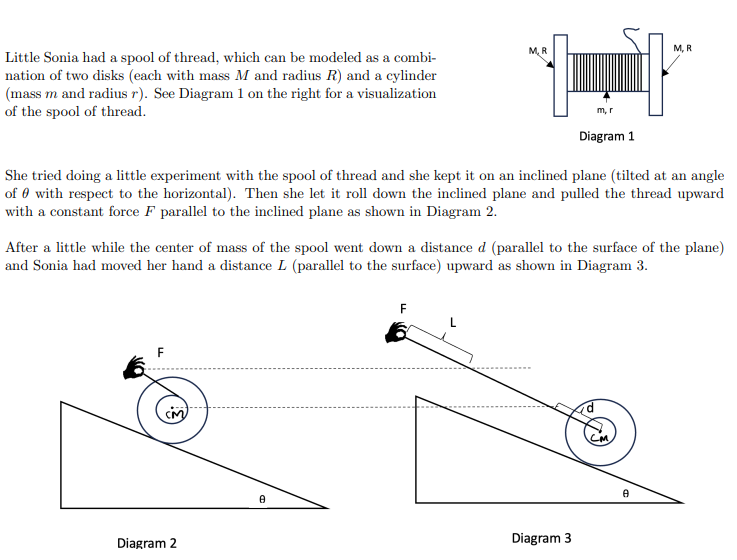
<p>Using the point particle system, calculate the final translational kinetic energy of the system.</p>

Using the point particle system, calculate the final translational kinetic energy of the system.

set up w_cm = delta k_trans
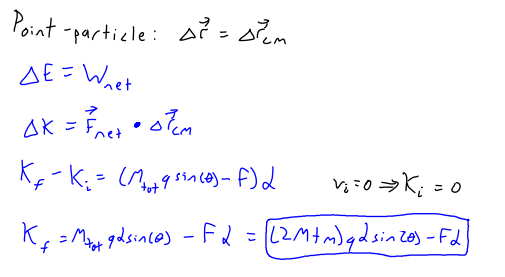
<p>set up w_cm = delta k_trans</p>
51
New cards
<p>Using the real system, calculate the final rotational speed of the spool</p>

Using the real system, calculate the final rotational speed of the spool

set up energy equation delta E = work done by nbon-conserved forces, which in this case is gravity and sonia. since we can about rotational speed, set delta E to delta k_trans + delta k_rot
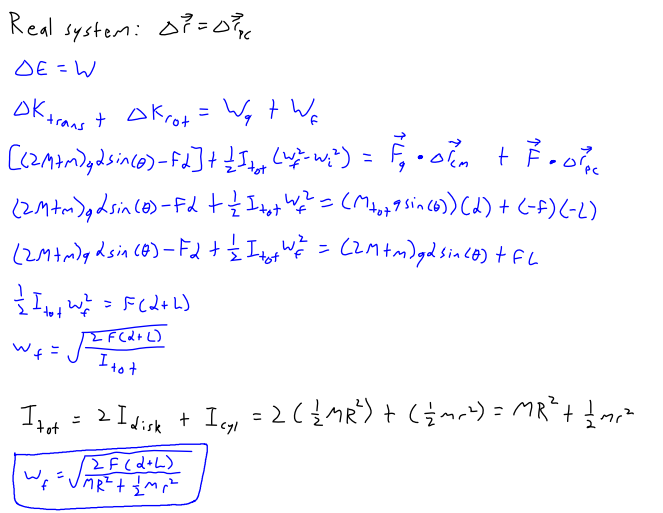
<p>set up energy equation delta E = work done by nbon-conserved forces, which in this case is gravity and sonia. since we can about rotational speed, set delta E to delta k_trans + delta k_rot</p>
52
New cards
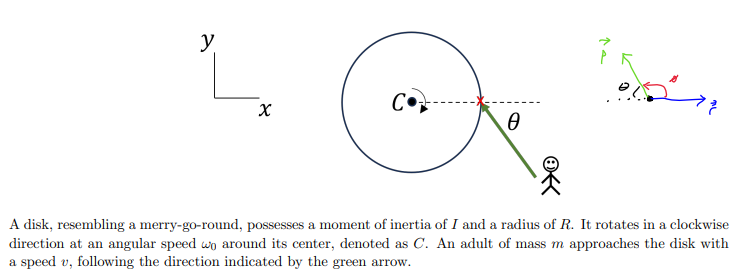
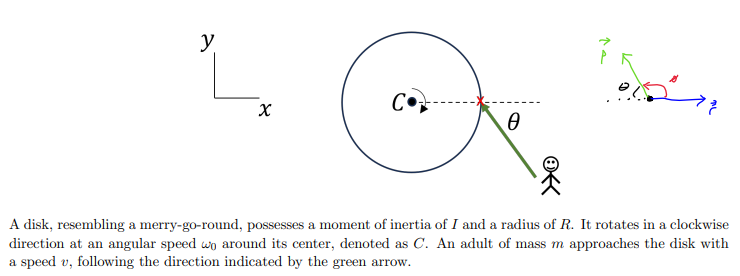
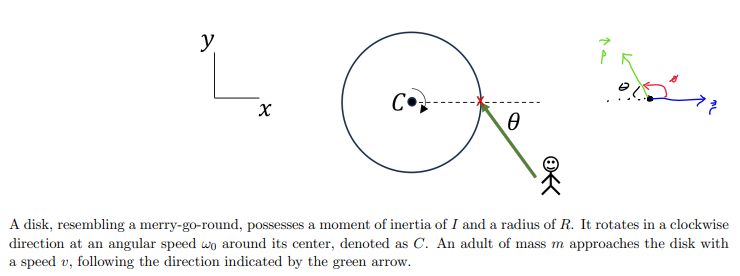
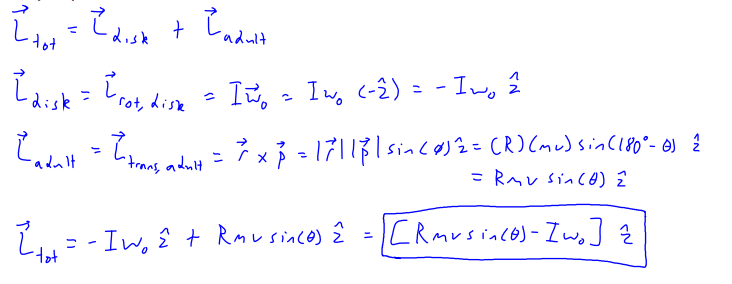
<p>Find the total angular momentum of the disk and the adult together around the point C.</p>

Find the total angular momentum of the disk and the adult together around the point C.

add up the angular momentums from the disk and adult. use Iw for the disk and rp for the adult.
<p>add up the angular momentums from the disk and adult. use Iw for the disk and rp for the adult.</p>
53
New cards
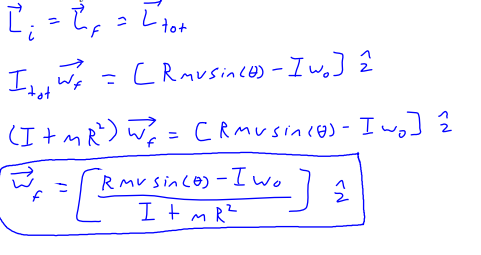
<p>After the adult hops and lands on the marked point ‘x’ at the disk’s rim, what is the angular velocity ⃗ωf of the combined system? Express your answer as a vector using the conventional right-handed xyz coordinate system. L_total = Rmvsin(theta)-Iw_0 from a previous question.</p>

After the adult hops and lands on the marked point ‘x’ at the disk’s rim, what is the angular velocity ⃗ωf of the combined system? Express your answer as a vector using the conventional right-handed xyz coordinate system. L_total = Rmvsin(theta)-Iw_0 from a previous question.

conservation of angular momentum also includes L_i = L_f = L_total
<p>conservation of angular momentum also includes L_i = L_f = L_total</p>
54
New cards
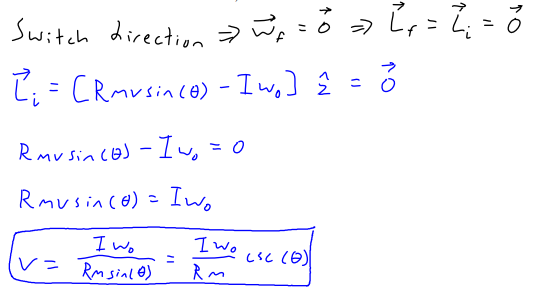
<p>Determine the minimum speed v required to reverse the rotation direction of the disk (meaning, from clockwise to counterclockwise).</p>

Determine the minimum speed v required to reverse the rotation direction of the disk (meaning, from clockwise to counterclockwise).

set L_i = L_total = 0 since direction is changed and needs to pass through zero in order to start reversing directions.

<p>set L_i = L_total = 0 since direction is changed and needs to pass through zero in order to start reversing directions.</p>
55
New cards
<p>Calculate the velocity ⃗vf and position ⃗rf of the space junk a short time ∆t = 10 seconds later using one iteration step.</p>

Calculate the velocity ⃗vf and position ⃗rf of the space junk a short time ∆t = 10 seconds later using one iteration step.

find the gravitational force, then velocity and position update formulas.
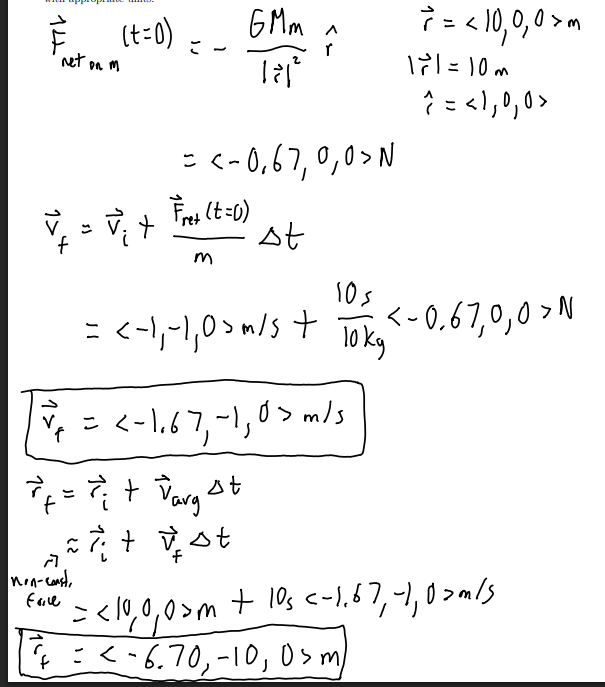
<p>find the gravitational force, then velocity and position update formulas.</p>
56
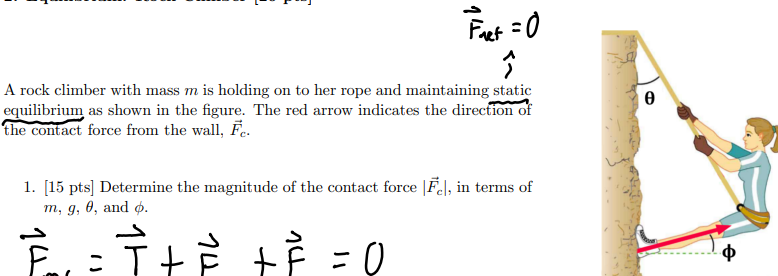
New cards
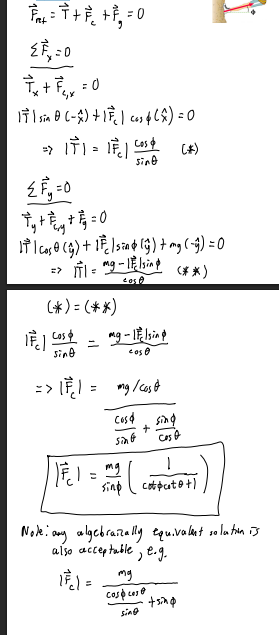
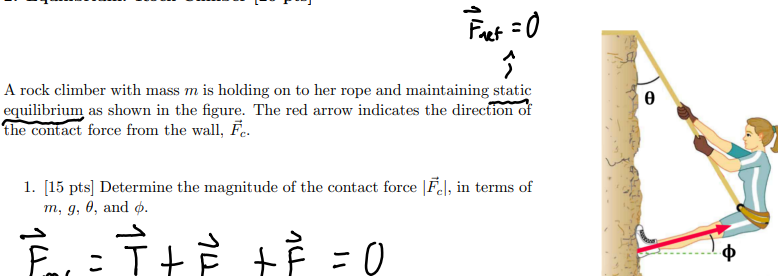
<p>Determine the magnitude of the contact force |F⃗ c|, in terms of m, g, θ, and ϕ.</p>

Determine the magnitude of the contact force |F⃗ c|, in terms of m, g, θ, and ϕ.

break up Fnet into x and y directions, plug in the value of T from x direction into y direction, then single out T on one side. Finally, plug in that value of T back into x direction and single out contact force.

<p>break up Fnet into x and y directions, plug in the value of T from x direction into y direction, then single out T on one side. Finally, plug in that value of T back into x direction and single out contact force.</p>
57
New cards
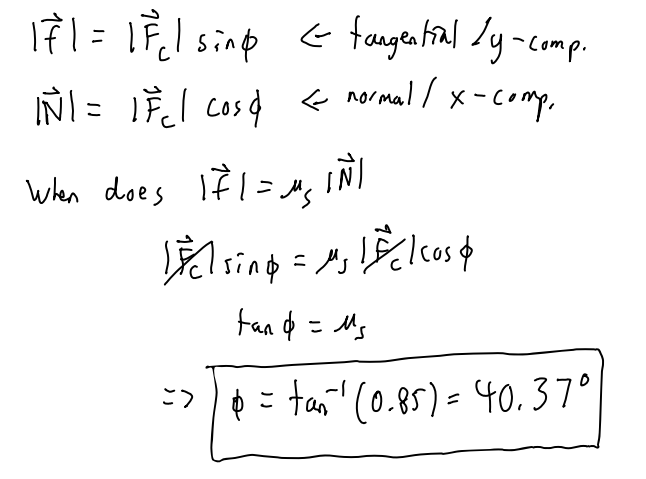
<p>The vector contact force F⃗ c is the vector sum of the friction force ⃗f and the normal force N⃗ . The climber will start sliding when | ⃗f| &gt; µs|N⃗ |, where µs = 0.85. What is the maximum value the angle ϕ can have before she starts sliding?</p>

The vector contact force F⃗ c is the vector sum of the friction force ⃗f and the normal force N⃗ . The climber will start sliding when | ⃗f| > µs|N⃗ |, where µs = 0.85. What is the maximum value the angle ϕ can have before she starts sliding?

set up frictional force definition and find contact force version for frictional force and normal force, then single out theta.

<p>set up frictional force definition and find contact force version for frictional force and normal force, then single out theta.</p>
58
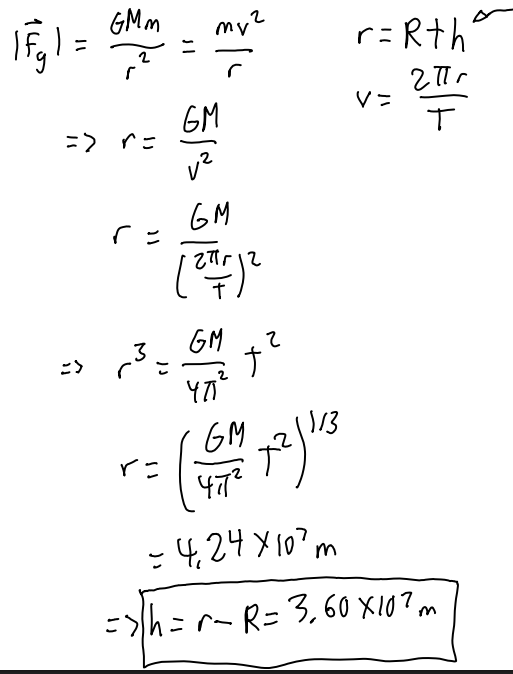
New cards
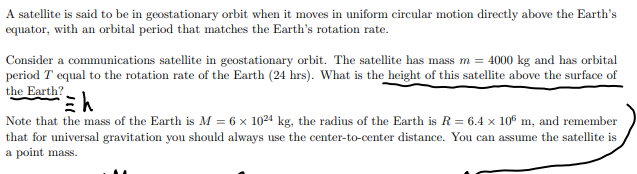
<p>What is the height of this satellite above the surface of the Earth?</p>

What is the height of this satellite above the surface of the Earth?

set gravitational force equal to mv²/r, also remember its from the surface so subtract radius of earth from final answer.

<p>set gravitational force equal to mv²/r, also remember its from the surface so subtract radius of earth from final answer.</p>
59
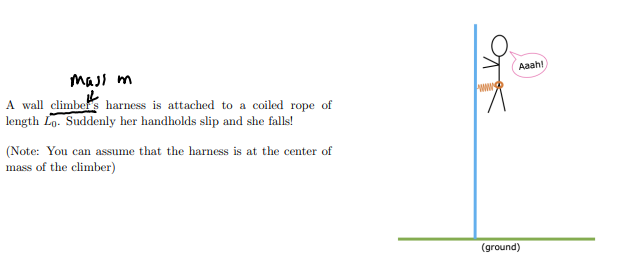
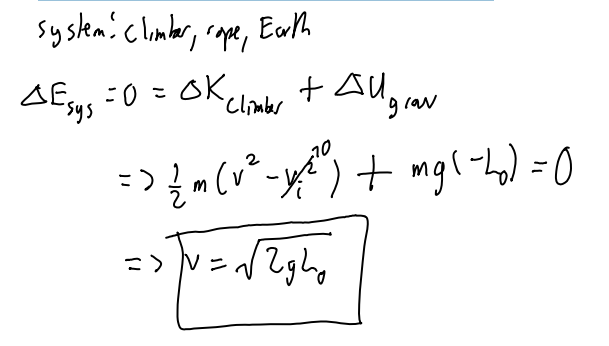
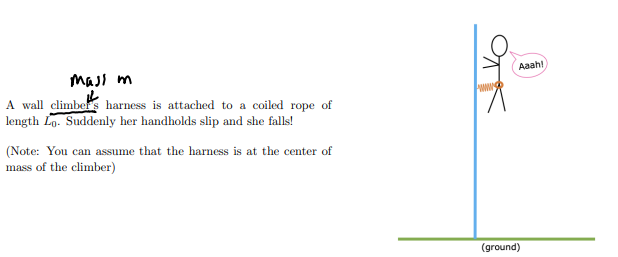
New cards
<p>What is her speed v when she has fallen a distance just equal to the length of the rope, L0? You can assume the climber fell from rest, and that she can be modeled as a point mass.</p>

What is her speed v when she has fallen a distance just equal to the length of the rope, L0? You can assume the climber fell from rest, and that she can be modeled as a point mass.

set total delta E to energy changes of the system, K and U deltas, then find v_f.

<p>set total delta E to energy changes of the system, K and U deltas, then find v_f.</p>
60
New cards
<p>The rope actually has some elasticity, so it could be thought of as a spring with stiffness k. Use the energy principle to set up an equation that could be used to determine the additional distance s that she can fall before naturally coming to a stop. Do not solve this equation!</p>

The rope actually has some elasticity, so it could be thought of as a spring with stiffness k. Use the energy principle to set up an equation that could be used to determine the additional distance s that she can fall before naturally coming to a stop. Do not solve this equation!

set delta E of the system to zero and set it to delta K,U, and spring.

<p>set delta E of the system to zero and set it to delta K,U, and spring.</p>
61
New cards
<p>Unfortunately, the climber was originally at a height h = L0 + d above the ground, where d is the distance between her feet and the location of the harness (at her center of mass), so she hits the ground at the speed v you found in part 1 (ouch!). After her feet touch the ground, she bends her knees and crouches to minimize the impact. When she comes to a rest after crouching, her center of mass is at height b above the ground (note: b &lt; d). What is the change in internal energy of the climber, from the moment her feet touch the ground until the moment when she comes to rest crouching? Hint: real system.</p>

Unfortunately, the climber was originally at a height h = L0 + d above the ground, where d is the distance between her feet and the location of the harness (at her center of mass), so she hits the ground at the speed v you found in part 1 (ouch!). After her feet touch the ground, she bends her knees and crouches to minimize the impact. When she comes to a rest after crouching, her center of mass is at height b above the ground (note: b < d). What is the change in internal energy of the climber, from the moment her feet touch the ground until the moment when she comes to rest crouching? Hint: real system.

set total delta E of the system to delta K,U,spring,and internal energy, then single out delta int on one side. no external energy so all of these energy changes equal to zero.

<p>set total delta E of the system to delta K,U,spring,and internal energy, then single out delta int on one side. no external energy so all of these energy changes equal to zero.</p>
62
New cards
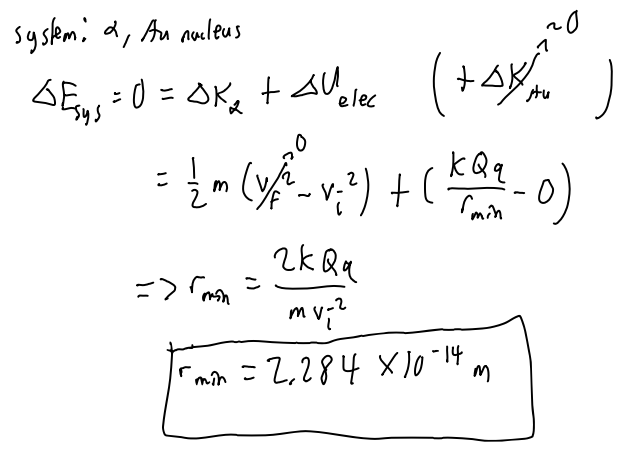
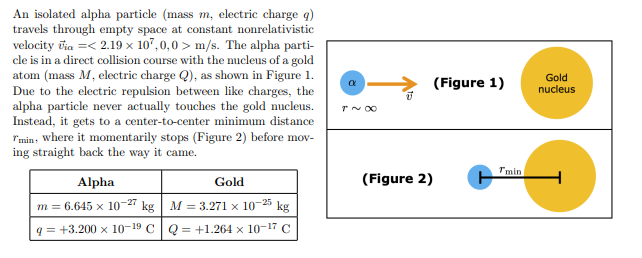
<p>Use the energy principle to determine what is the distance rmin. You can assume the gravitational interaction between the alpha and the gold is negligible. Use the numerical values in the table above for m, q, M, and Q. All your calculations must keep 3 decimal places.</p>

Use the energy principle to determine what is the distance rmin. You can assume the gravitational interaction between the alpha and the gold is negligible. Use the numerical values in the table above for m, q, M, and Q. All your calculations must keep 3 decimal places.

set total energy of the system to delta K and potential electrical and set it to zero. single out r from final potential electrical.

<p>set total energy of the system to delta K and potential electrical and set it to zero. single out r from final potential electrical.</p>
63
New cards
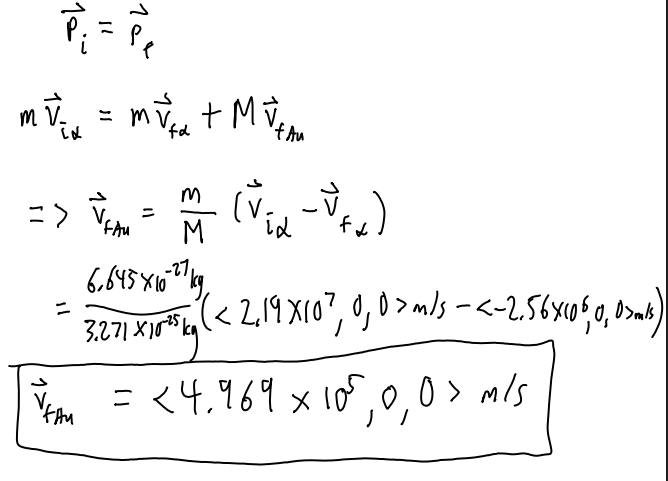
<p>If the gold nucleus started out motionless, and the final velocity of the alpha particle after the collision is ⃗vfα =&lt; −2.56 × 10⁶ , 0, 0 &gt; m/s, what is the final velocity of the gold nucleus after the collision? Keep 3 decimal places in all your calculations. Your answer should be a vector with correct units.</p>

If the gold nucleus started out motionless, and the final velocity of the alpha particle after the collision is ⃗vfα =< −2.56 × 10⁶ , 0, 0 > m/s, what is the final velocity of the gold nucleus after the collision? Keep 3 decimal places in all your calculations. Your answer should be a vector with correct units.

conservation of momentum.

<p>conservation of momentum.</p>
64
New cards
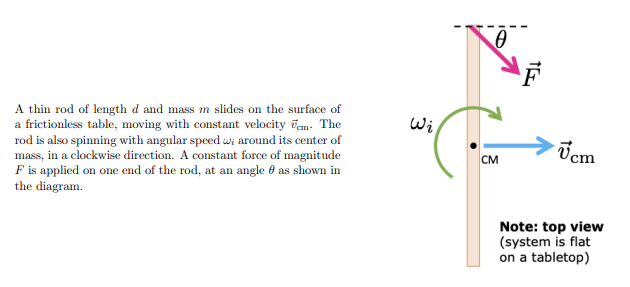
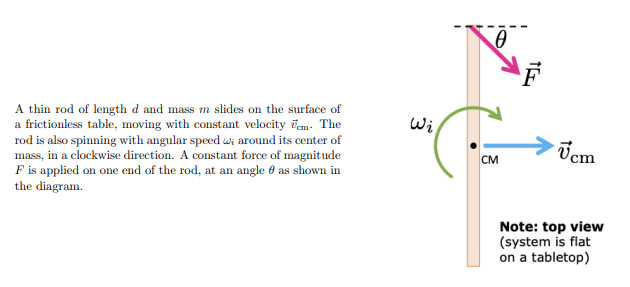
<p>What is the net torque ⃗τ acting on the rod, with respect to its center of mass? Your answer must be a vector.</p>

What is the net torque ⃗τ acting on the rod, with respect to its center of mass? Your answer must be a vector.

torque definition.

<p>torque definition.</p>
65
New cards
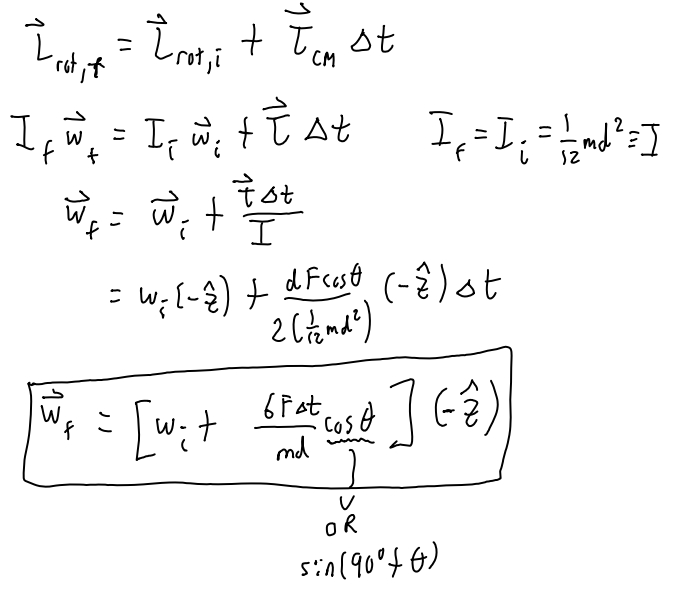
<p>Determine what is the angular velocity ⃗ωf of the rod a short amount of time ∆t later. Your answer must be a vector.</p>

Determine what is the angular velocity ⃗ωf of the rod a short amount of time ∆t later. Your answer must be a vector.

angular momentum update formula and set L = Iw to find w_f.

<p>angular momentum update formula and set L = Iw to find w_f.</p>
66
New cards
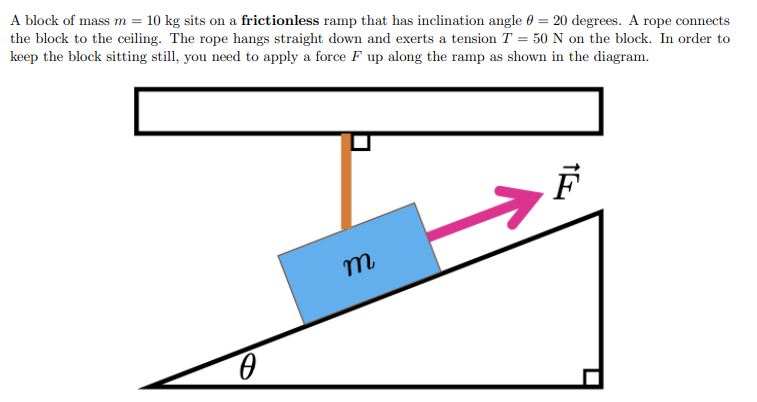
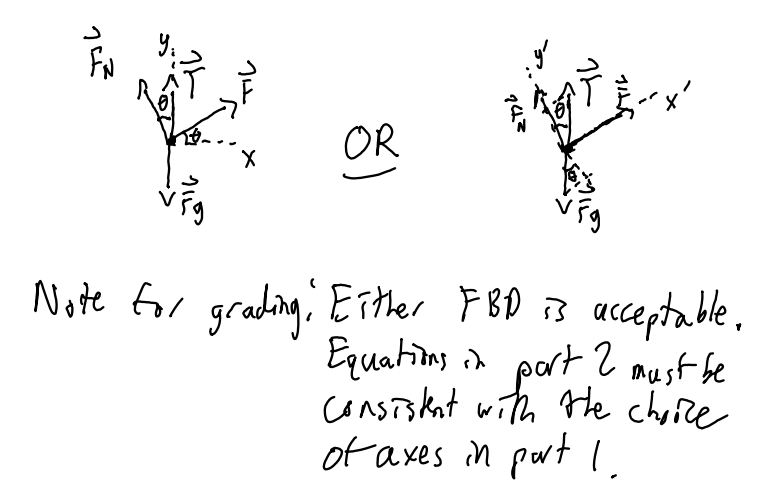
<p>Draw a free-body-diagram showing all the forces acting on the block. To receive full credit, your diagram must have correctly labeled x and y axes, forces, and angles.</p>

Draw a free-body-diagram showing all the forces acting on the block. To receive full credit, your diagram must have correctly labeled x and y axes, forces, and angles.

normal pointing up at an angle, force pointing right at an angle, gravity pointing directly down, tension pointing direction up.

<p>normal pointing up at an angle, force pointing right at an angle, gravity pointing directly down, tension pointing direction up.</p>
67
New cards
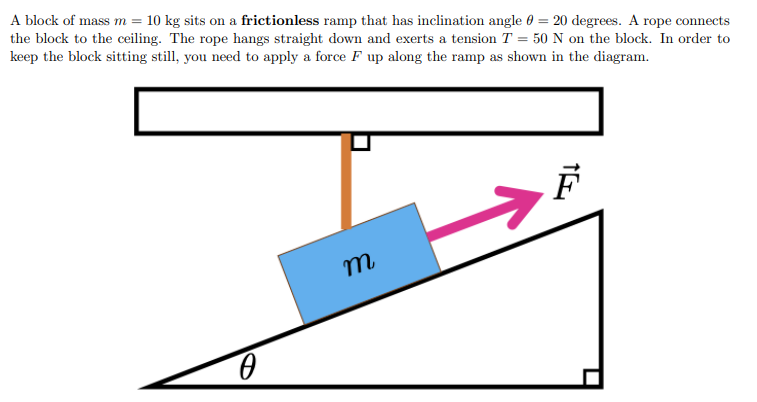
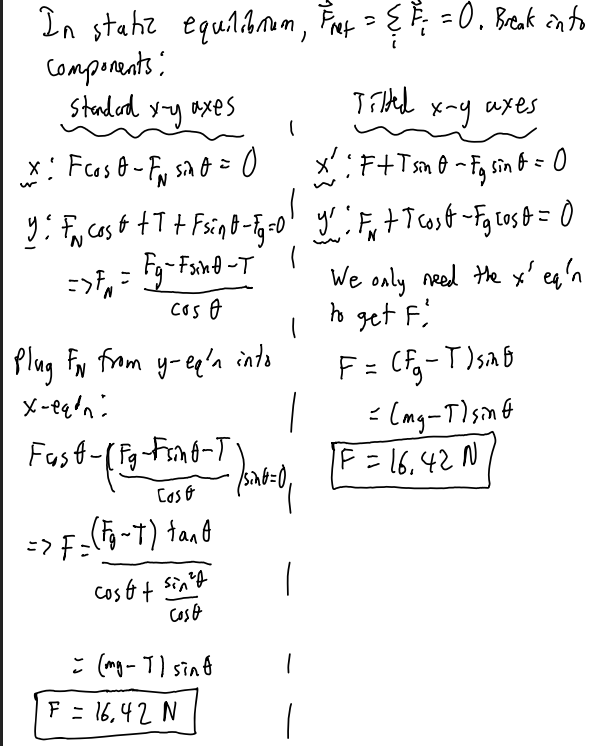
<p>Determine the magnitude of the force F that you need to apply to keep the block at rest</p>

Determine the magnitude of the force F that you need to apply to keep the block at rest

break up Fnet into x and y directions, set both to zero.

<p>break up Fnet into x and y directions, set both to zero.</p>
68
New cards
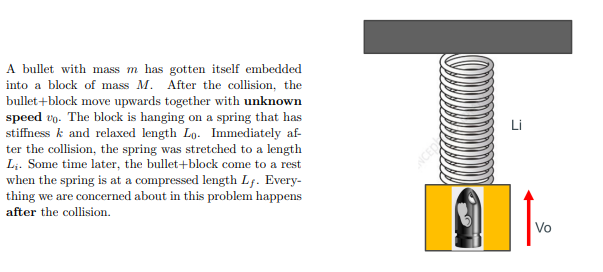
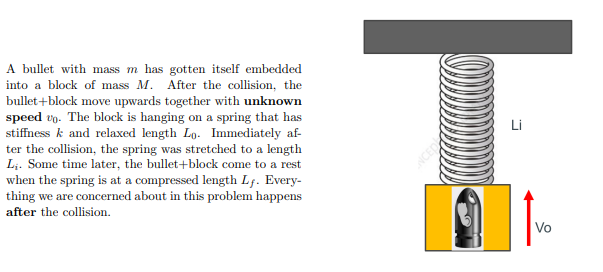
<p>Consider the bullet, the block, and the spring to be the system, and the Earth to be the surroundings. What is the total work being done on the system, from the moment just after the collision to the moment when the system comes to a rest?</p>

Consider the bullet, the block, and the spring to be the system, and the Earth to be the surroundings. What is the total work being done on the system, from the moment just after the collision to the moment when the system comes to a rest?

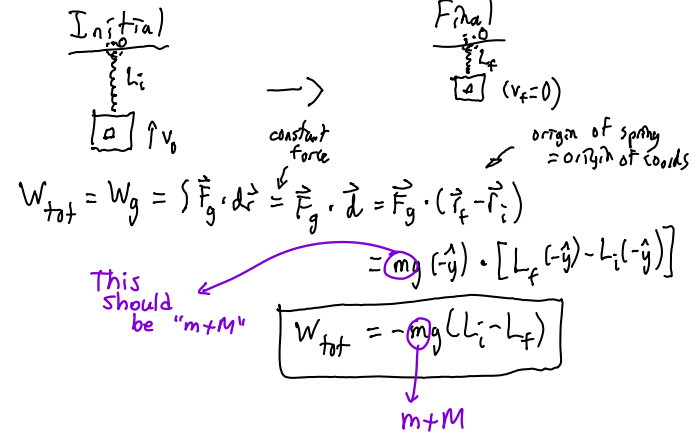
set W_total to Fd, where F is Fg only.

<p>set W_total to Fd, where F is Fg only.</p>
69
New cards
<p>What is the unknown speed v0? Use the same system and surroundings from Part 1. W_total = -mg(L_f-L_i) from a previous problem.</p>

What is the unknown speed v0? Use the same system and surroundings from Part 1. W_total = -mg(L_f-L_i) from a previous problem.

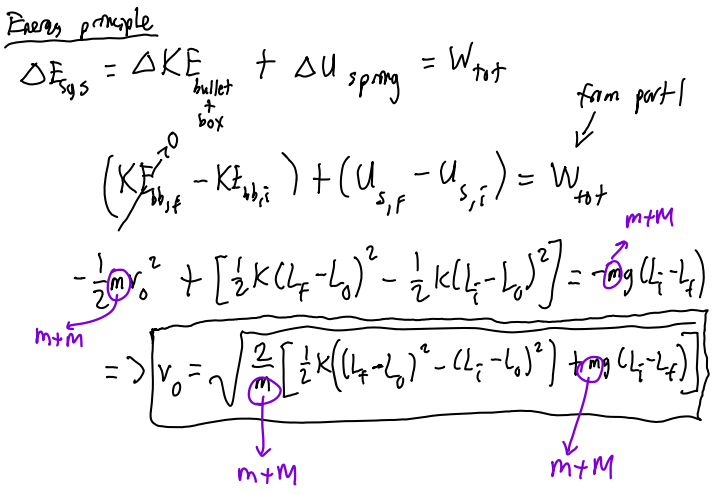
energy principle where delta E (delta K from box and bullet system and delta U from spring) equals to W_total.

<p>energy principle where delta E (delta K from box and bullet system and delta U from spring) equals to W_total.</p>
70
New cards
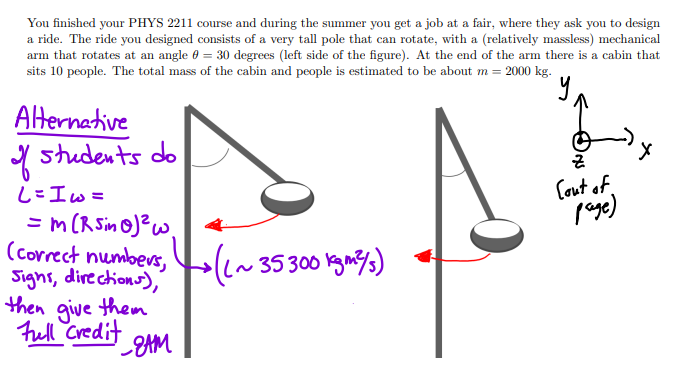
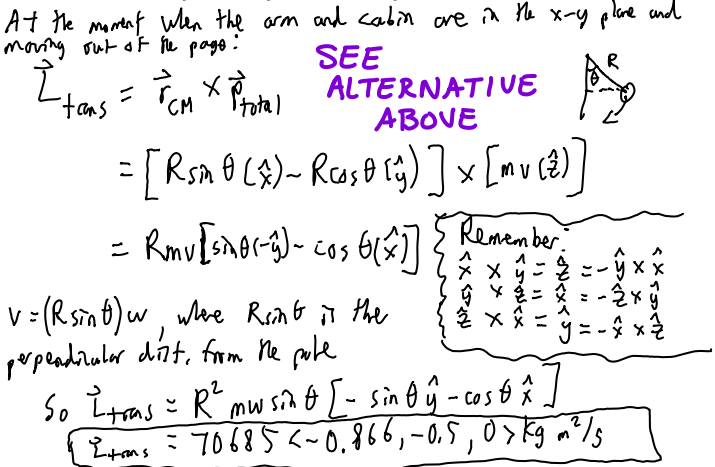
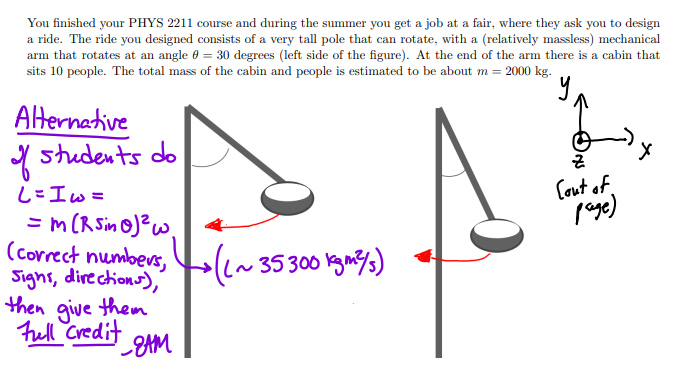
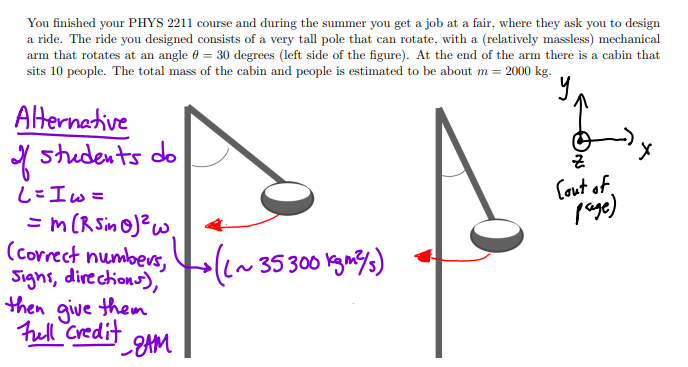
<p>If the length of the arm is R = 15 m, and the pole rotates at an angular speed of ! = 2⇡/20 rads/sec, what is the translational angular momentum of the cabin with respect to the point where the mechanical arm attaches to the pole? You can pretend the cabin is a point mass.</p>

If the length of the arm is R = 15 m, and the pole rotates at an angular speed of ! = 2⇡/20 rads/sec, what is the translational angular momentum of the cabin with respect to the point where the mechanical arm attaches to the pole? You can pretend the cabin is a point mass.

set up L_trans = r_cm times p_total

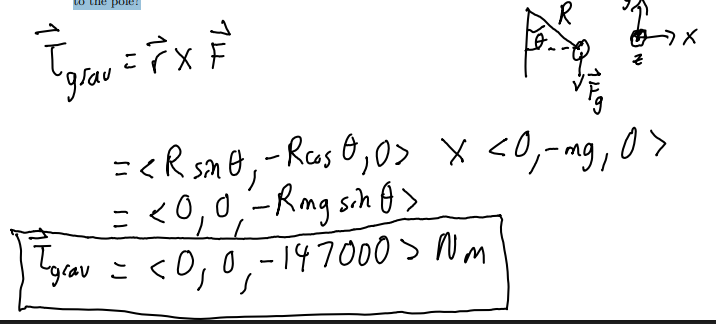
<p>set up L_trans = r_cm times p_total</p>
71
New cards
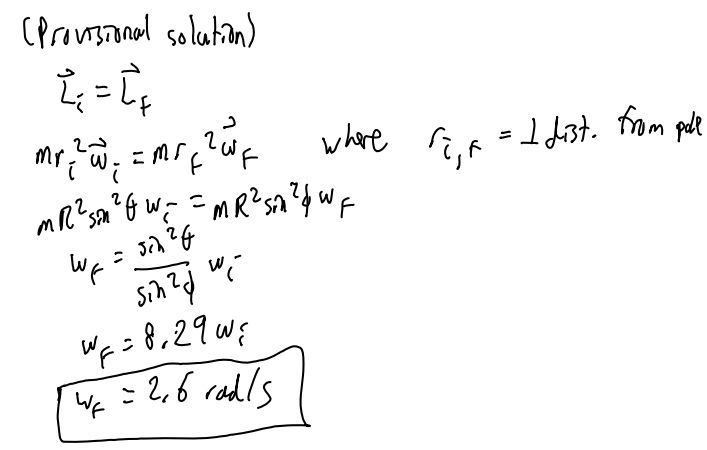
<p>Assume the ride conserves angular momentum. If the angle between the arm and the pole were = 10 degrees instead (right side of the figure), what would be the angular speed of the pole?</p>

Assume the ride conserves angular momentum. If the angle between the arm and the pole were = 10 degrees instead (right side of the figure), what would be the angular speed of the pole?

conservation of angular momentum. where L = Iw.

<p>conservation of angular momentum. where L = Iw.</p>
72
New cards
<p>In the original version (left side of the figure), what is the magnitude and direction of the torque exerted by the gravitational force on the cabin, with respect to the point where the mechanical arm attaches to the pole?</p>

In the original version (left side of the figure), what is the magnitude and direction of the torque exerted by the gravitational force on the cabin, with respect to the point where the mechanical arm attaches to the pole?

definition of torque.

<p>definition of torque.</p>
73
New cards
<p>Right before the collision, the center of mass (CM) of the motorcycle (pink dot in the middle of m2) is aligned with the front end of the car (in other words, the CM of the motorcycle is along the same vertical line as the front end of the car). Determine the total angular momentum of the car+motorcycle system with respect to the CM of the car (purple dot in the middle m1).</p>

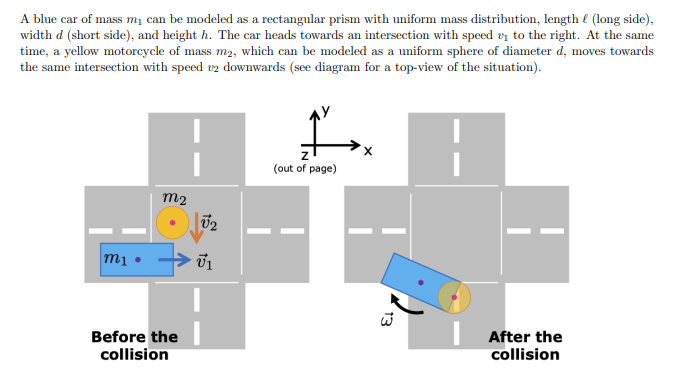
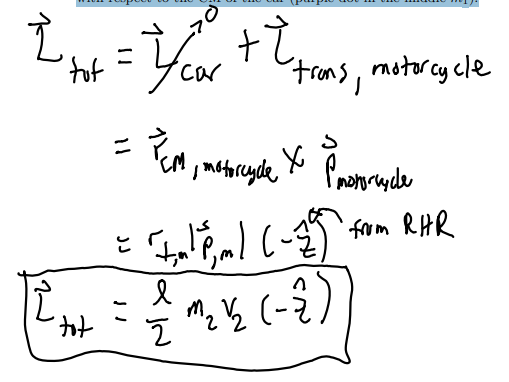
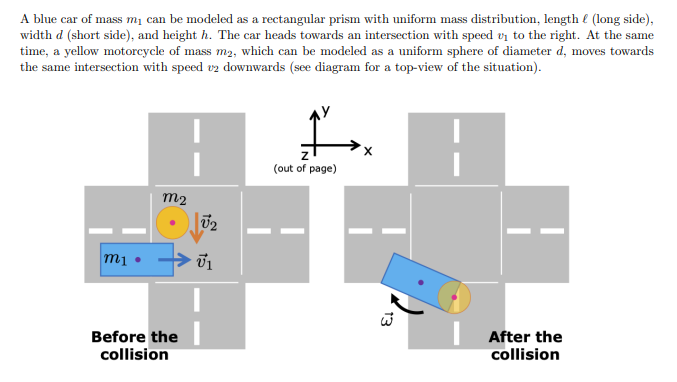
Right before the collision, the center of mass (CM) of the motorcycle (pink dot in the middle of m2) is aligned with the front end of the car (in other words, the CM of the motorcycle is along the same vertical line as the front end of the car). Determine the total angular momentum of the car+motorcycle system with respect to the CM of the car (purple dot in the middle m1).

definition of L_total = all Ls in the system

<p>definition of L_total = all Ls in the system</p>
74
New cards
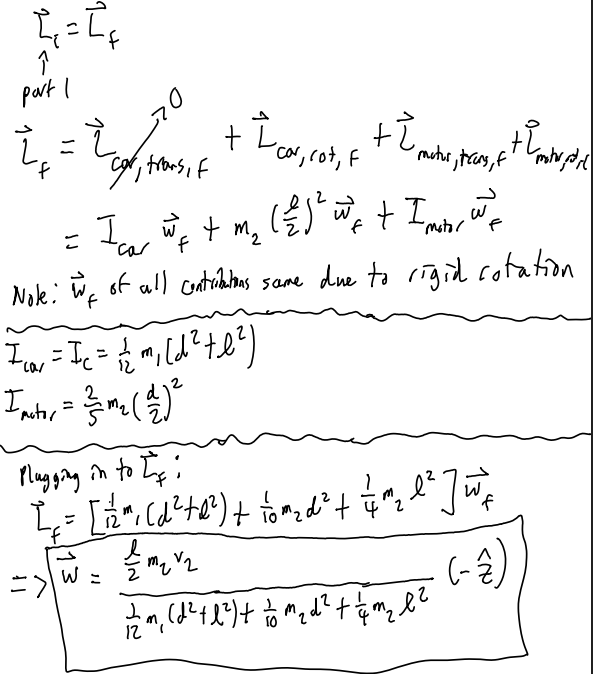
<p>In this maximally inelastic collision, the motorcycle embeds itself into the front end of the car (see diagram). Determine the angular velocity ~! (magnitude and direction) of the combined car+motorcycle system immediately after the collision, with respect to the CM of the car. The moment of inertia of the car is Ic = (1/12)m1(d2 + `2). L_total = (l/2)m_2*v_2*-z_hat from a previous question.</p>

In this maximally inelastic collision, the motorcycle embeds itself into the front end of the car (see diagram). Determine the angular velocity ~! (magnitude and direction) of the combined car+motorcycle system immediately after the collision, with respect to the CM of the car. The moment of inertia of the car is Ic = (1/12)m1(d2 + `2). L_total = (l/2)m_2*v_2*-z_hat from a previous question.

conservation of angular momentum, single out w_f on one side.

<p>conservation of angular momentum, single out w_f on one side. </p>
75
New cards
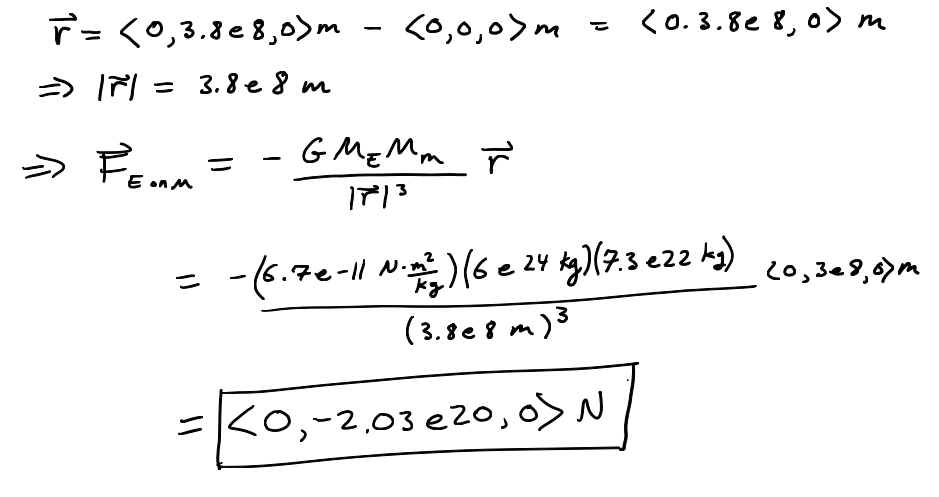
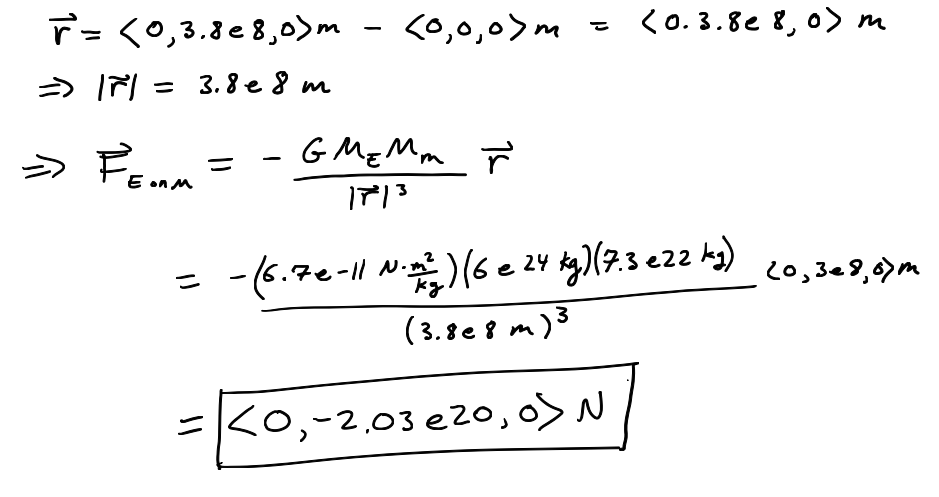
<p>At t = 0, you can find the Earth at the origin and the Moon at location ~rm =&lt; 0, 3.8 × 10⁸ , 0 &gt; m. What is the net vector force on the Moon due to the Earth?</p>

At t = 0, you can find the Earth at the origin and the Moon at location ~rm =< 0, 3.8 × 10⁸ , 0 > m. What is the net vector force on the Moon due to the Earth?

gravitational force formula.

<p>gravitational force formula.</p>
76
New cards
<p>At t = 0 the Moon moves with velocity &lt; −1 × 10³ , 0, 0 &gt; m/s. Determine the position of the Moon after a time ∆t = 1 hour.</p>

At t = 0 the Moon moves with velocity < −1 × 10³ , 0, 0 > m/s. Determine the position of the Moon after a time ∆t = 1 hour.

velocity and position update formulas.
<p>velocity and position update formulas.</p>
77
New cards
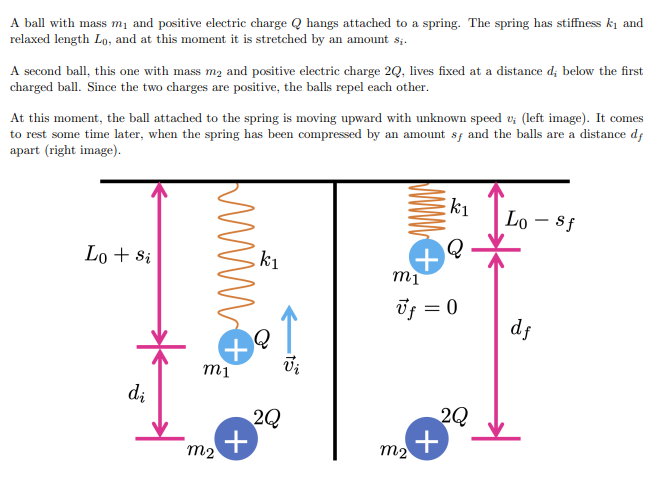
<p>Use the energy principle to determine the unknown speed vi . Hints: (1) this is happening near the surface of the Earth; (2) the ONLY interaction you can ignore here is the gravitational attraction between the two balls; (3) putting all the things in the system means you do not have to calculate work due to the surroundings.</p>

Use the energy principle to determine the unknown speed vi . Hints: (1) this is happening near the surface of the Earth; (2) the ONLY interaction you can ignore here is the gravitational attraction between the two balls; (3) putting all the things in the system means you do not have to calculate work due to the surroundings.

delta E of the system = 0. single out delta K on one side which also singles out v_i.
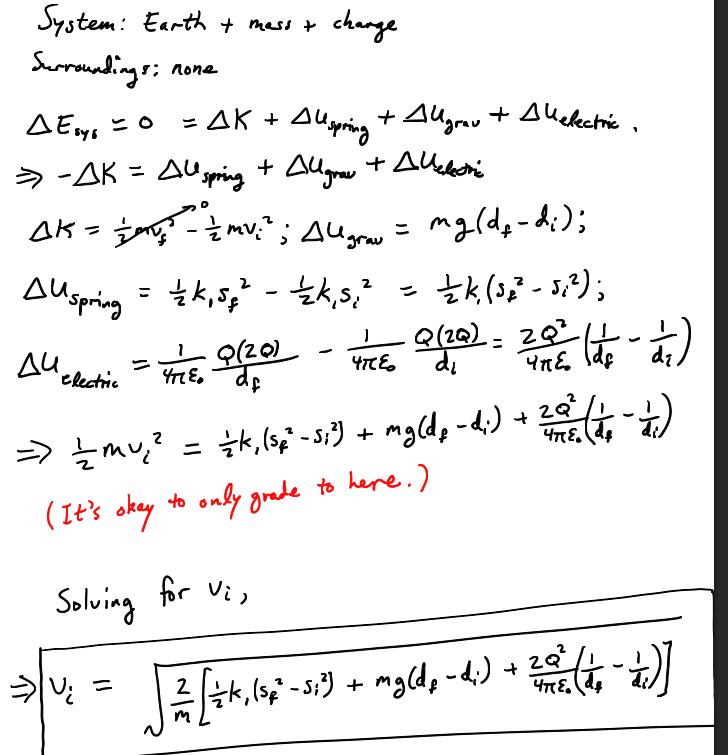
<p>delta E of the system = 0. single out delta K on one side which also singles out v_i.</p>
78
New cards
<p>Use the energy principle on the center-of-mass (point-particle) system to determine the speed of the sloth at the moment just before its paws touch the ground.</p>

Use the energy principle on the center-of-mass (point-particle) system to determine the speed of the sloth at the moment just before its paws touch the ground.

delta E = w_external = F_gravity x r.
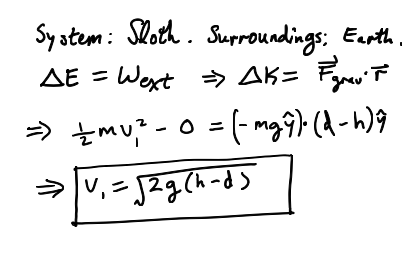
<p>delta E = w_external = F_gravity x r.</p>
79
New cards
<p>Assuming that the contact force from the ground on the sloth’s paws is constant, use the energy principle on the center-of-mass (point-particle) system to determine the magnitude of this contact force. v_i = sqrt(2g(h-d)) from a previous problem.</p>

Assuming that the contact force from the ground on the sloth’s paws is constant, use the energy principle on the center-of-mass (point-particle) system to determine the magnitude of this contact force. v_i = sqrt(2g(h-d)) from a previous problem.

point particle system where delta E = delta K = work from external forces = w_contact + w_gravity. single out contact force on one side.
<p>point particle system where delta E = delta K  = work from external forces = w_contact + w_gravity. single out contact force on one side.</p>
80
New cards
<p>Use the energy principle on the real (multiparticle) system to determine the change in the internal energy of the sloth during landing.</p>

Use the energy principle on the real (multiparticle) system to determine the change in the internal energy of the sloth during landing.

just understand that delta E_internal = work done by gravity by setting up real work system.
<p>just understand that delta E_internal = work done by gravity by setting up real work system.</p>
81
New cards
<p>The person throwing the hammer first spins around in a circle at a rate of two full rotations per second, ω = 4π radians/second, before letting the hammer go (figure 1). If the length of the athlete’s arms is d = 0.6 m, what is the translational angular momentum of the ball with respect to the rotation axis of the person?</p>

The person throwing the hammer first spins around in a circle at a rate of two full rotations per second, ω = 4π radians/second, before letting the hammer go (figure 1). If the length of the athlete’s arms is d = 0.6 m, what is the translational angular momentum of the ball with respect to the rotation axis of the person?

definition of L = rp. also know that v = wr.
<p>definition of L = rp. also know that v = wr.</p>
82
New cards
<p>In their second attempt, the athlete starts spinning the same way as they did before (ωi = 4π radians/second), but then suddenly they lift their arms so they make an angle θ = 30 degrees with the horizontal (diagram 2). How fast is the athlete spinning (ωf ) now that their arms are at an angle?</p>

In their second attempt, the athlete starts spinning the same way as they did before (ωi = 4π radians/second), but then suddenly they lift their arms so they make an angle θ = 30 degrees with the horizontal (diagram 2). How fast is the athlete spinning (ωf ) now that their arms are at an angle?

conservation of angular momentum.
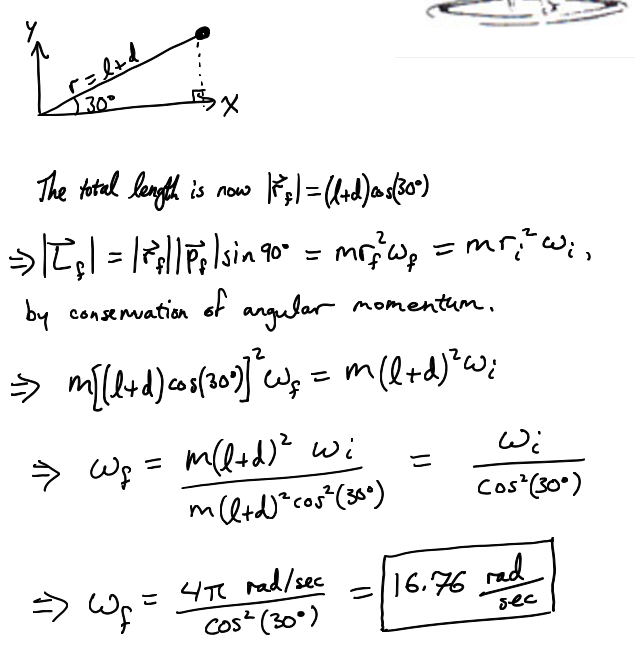
<p>conservation of angular momentum. </p>
83
New cards
<p>You found a GT mobile in a store but it’s missing a piece (a “T”, of course). You buy it anyway and make a T to add to the mobile. You measure the lengths of all the (horizontal) arms of the mobile (measurements in the figure) and you find that Buzz has a mass of mb = 300 g. What should be the mass of the T (mT ), so that when you attach it the mobile stays balanced (unmoving)? Hints: (1) a balanced mobile experiences zero net gravitational torque; (2) notice that the Wreck and GT are attached to an arm that is the same length as the arm holding up Buzz; (3) remember to use standard SI units in your final answer.</p>

You found a GT mobile in a store but it’s missing a piece (a “T”, of course). You buy it anyway and make a T to add to the mobile. You measure the lengths of all the (horizontal) arms of the mobile (measurements in the figure) and you find that Buzz has a mass of mb = 300 g. What should be the mass of the T (mT ), so that when you attach it the mobile stays balanced (unmoving)? Hints: (1) a balanced mobile experiences zero net gravitational torque; (2) notice that the Wreck and GT are attached to an arm that is the same length as the arm holding up Buzz; (3) remember to use standard SI units in your final answer.

conservation of torque where torque from the T is equal to the torque from the right side of the scale.
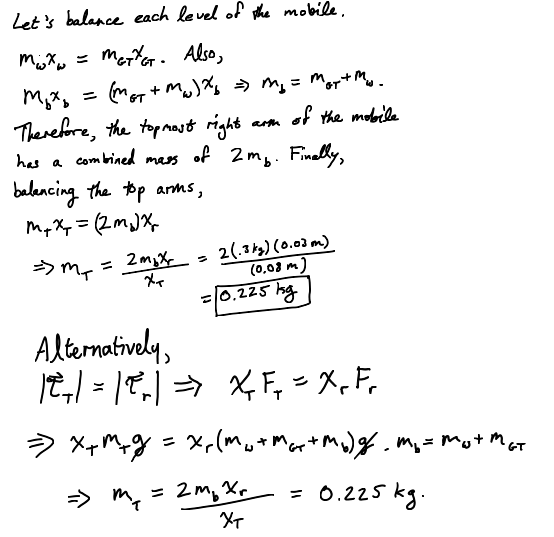
<p>conservation of torque where torque from the T is equal to the torque from the right side of the scale.</p>
84
New cards
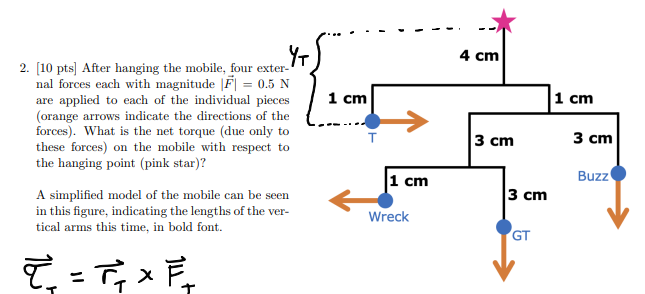
<p>After hanging the mobile, four external forces each with magnitude |F~ | = 0.5 N are applied to each of the individual pieces (orange arrows indicate the directions of the forces). What is the net torque (due only to these forces) on the mobile with respect to the hanging point (pink star)? A simplified model of the mobile can be seen in this figure, indicating the lengths of the vertical arms this time, in bold font</p>

After hanging the mobile, four external forces each with magnitude |F~ | = 0.5 N are applied to each of the individual pieces (orange arrows indicate the directions of the forces). What is the net torque (due only to these forces) on the mobile with respect to the hanging point (pink star)? A simplified model of the mobile can be seen in this figure, indicating the lengths of the vertical arms this time, in bold font

definition of torque to find all torques, then add them all up to find net torque.
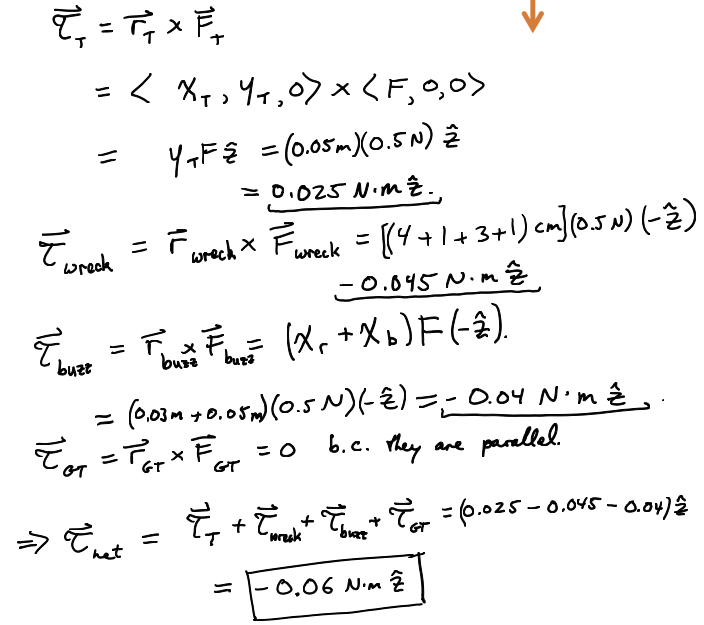
<p>definition of torque to find all torques, then add them all up to find net torque.</p>
85
New cards
<p>Determine the magnitude of the net force acting on S2 at any point in its circular orbit around Sagittarius A*. You can assume that S2 moves at a constant rate throughout its orbit.</p>

Determine the magnitude of the net force acting on S2 at any point in its circular orbit around Sagittarius A*. You can assume that S2 moves at a constant rate throughout its orbit.

since its circular motion, we set gravitational force = circular motion (mv²/R) where v = 2piR/T
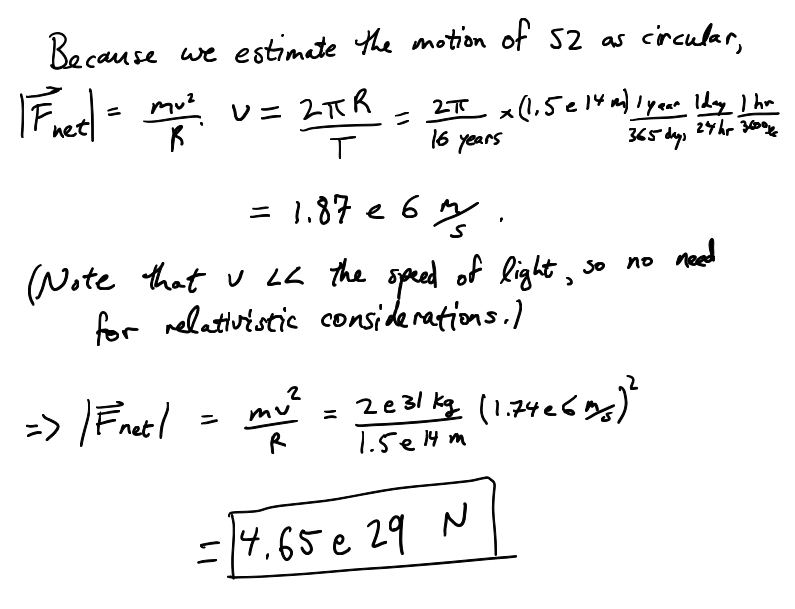
<p>since its circular motion, we set gravitational force = circular motion (mv²/R) where v = 2piR/T</p>
86
New cards
<p>Under the assumption that S2’s orbit is a circle, what is the mass of Sagittarius A*? Fnet = 4.65e29 N from a previous problem.</p>

Under the assumption that S2’s orbit is a circle, what is the mass of Sagittarius A*? Fnet = 4.65e29 N from a previous problem.

gravitational force formula = Fnet.
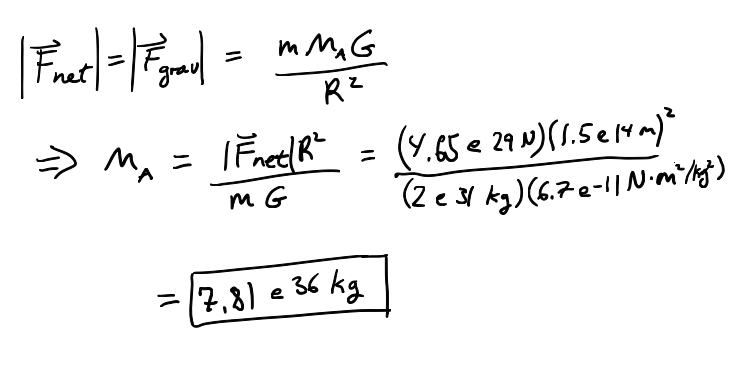
<p>gravitational force formula = Fnet.</p>
87
New cards
<p>Tycho engineers need to launch a 200 kg package of raw materials from Ceres to Anderson Station. How fast does the package need to be launched, if it needs to have a speed of 3 m/s when it arrives at Anderson?</p>

Tycho engineers need to launch a 200 kg package of raw materials from Ceres to Anderson Station. How fast does the package need to be launched, if it needs to have a speed of 3 m/s when it arrives at Anderson?

delta E = 0, single out v_i on one side.
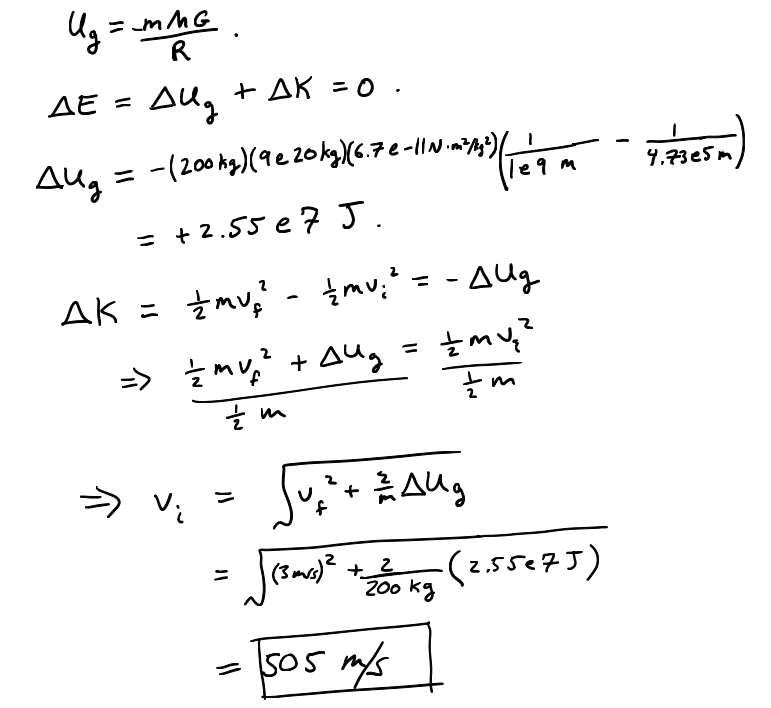
<p>delta E = 0, single out v_i on one side.</p>
88
New cards
<p>To send the package, Tycho engineers built a horizontal spring-loaded launching mechanism on Ceres. When the apparatus is ready to engage, the package is at rest and the spring is compressed a distance of 1.5 m. What is the sti↵ness of the spring? v = 505 m/s from a previous problem.</p>

To send the package, Tycho engineers built a horizontal spring-loaded launching mechanism on Ceres. When the apparatus is ready to engage, the package is at rest and the spring is compressed a distance of 1.5 m. What is the sti↵ness of the spring? v = 505 m/s from a previous problem.

delta E = 0, include delta K,U_gravity ,and U_spring, then single out k on one side.
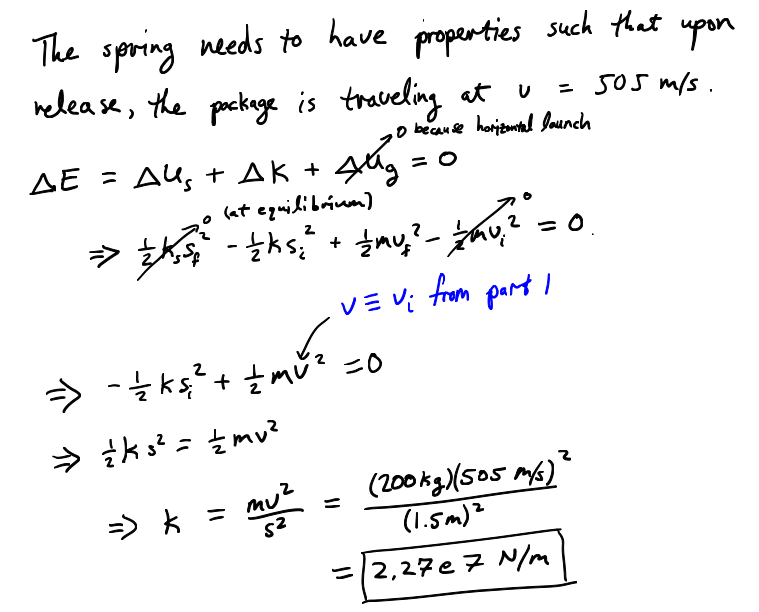
<p>delta E = 0, include delta K,U_gravity ,and U_spring, then single out k on one side.</p>
89
New cards
<p>Which direction will Bender rotate after tossing the plate, clockwise or counterclockwise? Explain using the angular momentum principle and the right hand rule.</p>

Which direction will Bender rotate after tossing the plate, clockwise or counterclockwise? Explain using the angular momentum principle and the right hand rule.

conservation of momentum where L_i = 0.
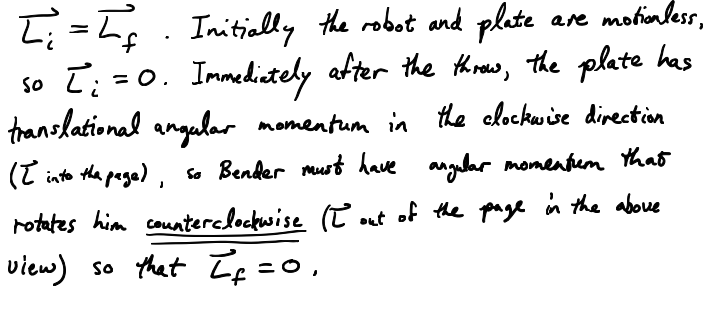
<p>conservation of momentum where L_i = 0.</p>
90
New cards
<p>If the speed of the plate is 5 m/s when Bender tosses it, and Bender’s fully-extended arm is one meter long, what would be Bender’s final angular momentum? Note that Bender’s moment of inertia is 150 kg m2, and that there’s an angle involved (see bottom part of the figure).</p>

If the speed of the plate is 5 m/s when Bender tosses it, and Bender’s fully-extended arm is one meter long, what would be Bender’s final angular momentum? Note that Bender’s moment of inertia is 150 kg m2, and that there’s an angle involved (see bottom part of the figure).

conservation of angular momentum where L_i = 0, so you can single out L_rot on one side.
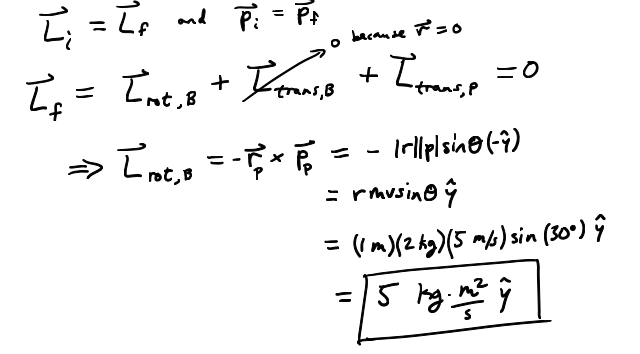
<p>conservation of angular momentum where L_i = 0, so you can single out L_rot on one side.</p>
91
New cards
<p>Bender’s getting dizzy and wants to stop spinning now. The remaining swag in the bag has a mass of 4 kg. How fast and in which direction should he toss the remaining swag so that he stops rotating altogether?</p>

Bender’s getting dizzy and wants to stop spinning now. The remaining swag in the bag has a mass of 4 kg. How fast and in which direction should he toss the remaining swag so that he stops rotating altogether?

conservation of angular momentum where L_i = 5 from a previous problem. swag has no angular momentum since its a point mass.
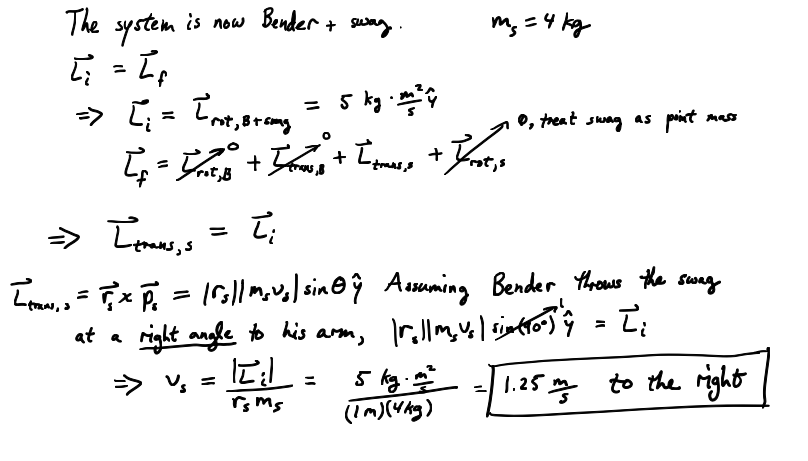
<p>conservation of angular momentum where L_i = 5 from a previous problem. swag has no angular momentum since its a point mass.</p>
92
New cards
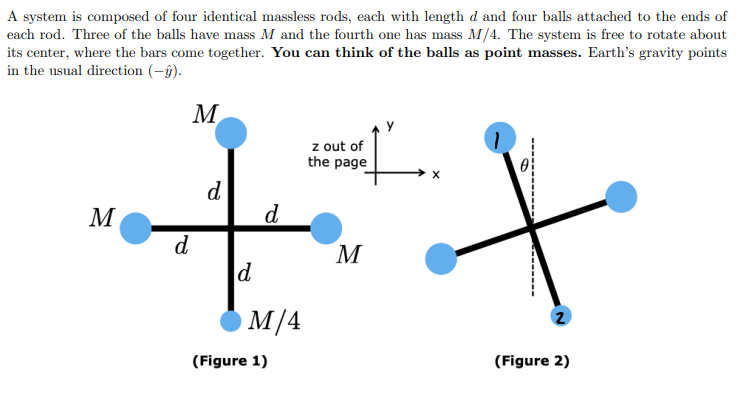
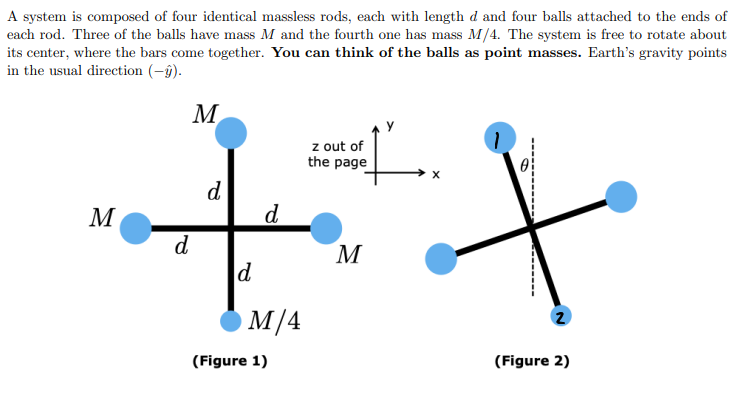
<p>What is the net torque on the system as shown in Figure 1, where the rods are oriented along the x and y axes?</p>

What is the net torque on the system as shown in Figure 1, where the rods are oriented along the x and y axes?

zero since horizontal bar’s torques exactly cancel.
93
New cards
<p>You hold the system at rest after rotating it by a small angle theta counterclockwise (as shown in Figure 2). Then you let go. What will happen to the system now? Use the angular momentum principle to justify your answer.</p>

You hold the system at rest after rotating it by a small angle theta counterclockwise (as shown in Figure 2). Then you let go. What will happen to the system now? Use the angular momentum principle to justify your answer.

tall ball’s torque is greater than the bottom ball, so it continues rotating cc.
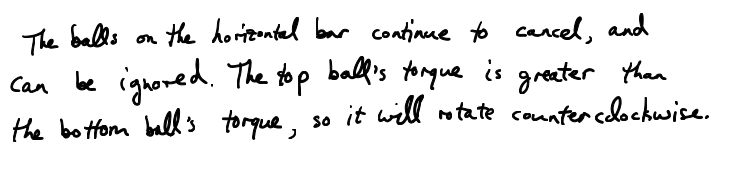
<p>tall ball’s torque is greater than the bottom ball, so it continues rotating cc.</p>
94
New cards
<p>Determine the final angular momentum of the system T seconds after letting it go from the initial configuration in Figure 2.</p>

Determine the final angular momentum of the system T seconds after letting it go from the initial configuration in Figure 2.

angular momentum update formula. remember horizontal torque’s cancel out when finding net torque.
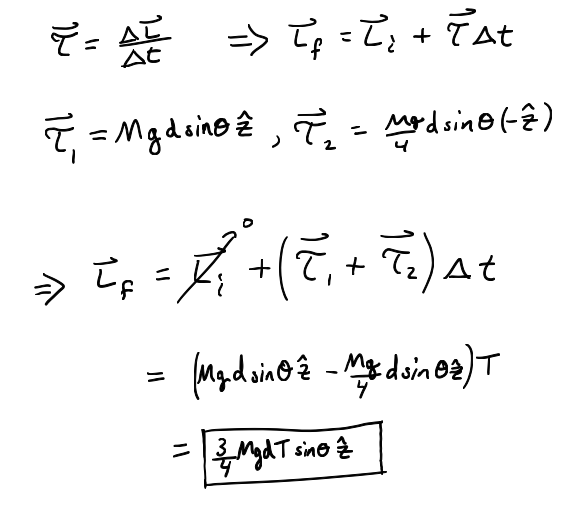
<p>angular momentum update formula. remember horizontal torque’s cancel out when finding net torque.</p>