Psych 1XX3
 Call Kai
 Learn
Learn Practice Test
 Spaced Repetition
 Match
Match Flashcards
 Knowt Play
1/299

Earn XP
Description and Tags
i lobe psych1xx3!
Name | Mastery | Learn | Test | Matching | Spaced | Call with Kai |
|---|
No analytics yet
Send a link to your students to track their progress
300 Terms
Development - define it
changes and continuities that occur within the individual between conception and death
Developmental psychologists are interested in how you change over time and stay the same
Maturation + Learning
Maturation: the biologically timed unfolding of changes within the individual according to that individual’s genetic plan
influenced by environmental conditions that shape the genetically determined process
Learning: relatively permanent changes in our thoughts, behaviours and feelings as a result of our experiences
Acquisition of neuronal representations of new information
learning processes allow you to permanently store information through neural connections in your brain
new representations guide strategies to respond to events + stimuli in the environment
learning can make once controlled processes automatic (e.g look both ways before crossing the street)
Interactionist Perspective
view that holds that maturation and learning interact during development
some essential systems must be in place before learning (e.g you need muscles before you can balance, and you can’t talk until your mouth and tongue develop)
learning from the environment also modulates maturation of human processes (e.g you need to interact with others and experience stimuli to have normal vision, speech motor and social skills)
Why do developmental psychologists focus on changes in infancy and childhood compared to any other time in the lifespan?
changes that occur earlier in life are much more dramatic than those occurring later in life
changes from birth - 5 yrs old are more noticeable compared to 40 yrs - 45 yrs
developmental changes that occur in early yrs play a role in shaping who you become
What are the four methods used to study an infant’s mind through sensory capabilities?
1) Habituation procedure
2) Event-Related Potentials (ERPs)
3) High Amplitude Sucking Method
4) Preference Method
Habituation Procedure
Question it answers: “Can the infant tell the difference between 2 stimuli?”
-infants are interested in novel objects in the environment
-first, repeatedly show the infant the same stimuli while measuring responses like heart rate, breathing, head or eye movements
-when novel stimulus is presented, the infant’s responses will show a burst in activity
-but after repeated exposure the infant will return to baseline level responses (they still perceive the stimulus, it is just no longer interesting)
BUT when the stimulus is changed, they will show another burst in activity
evidence of dishabituation, showing that infant is distinguishing the old and new stimulus
Example: can a child tell the difference between blue and green?
show blue repeatedly, until baseline response, then show green!
if they dishabituate, the infant can perceive the different stimuli
Habituation vs Dishabituation
Habituation: a decrease in responsiveness to a stimulus following its repeated
Dishabituation: and increase in responsiveness to a stimulus that is somehow different from the habituated stimulus
Event-Related Potentials (ERPs)
Question: how does the brain react to this stimulus?
a measure of the brain’s electrical activity evoked by the presentation of stimuli
Uses a special cap with array of electrodes
Can be tricky with an infant
electrodes detect changes in electrical activity across a population of neurons in the brain
particular behaviour being measured evokes changes in various brain regions of interest
e.g visual info → activity in occipital lobe, auditory info → activity in temporal lobe
Can be used with Habituation to provide behaviour and neural measures to understand infant sensory interactions with the environment
High-Amplitude Sucking
Question: does the infant like the stimulus?
infant can control the sucking behaviour to a certain extent, uses a special pacifier
first measure baseline sucking rate for the infant in the absence of stimuli
during shaping procedure, infant is given control over stimuli
if sucking is faster than baseline → switch activated, causes stimulus to be presented
can detect and LIKE stimulus = suck faster, to keep playing longer
DISLIKE = suck at baseline or slower, to end the presentation
Preference Method
Question: which of the two stimuli does the infant like more?
child is put in a looking chamber to observe two stimuli
researches can accurately measure the direction the infant is looking, to tell if more attention is being direction to one stimulus over the other
Overall, infants prefer —> big patterns, lots of black and white contrast and faces
Equal Attention (what does it mean?) —> could mean no preference or lack of discrimination
Preference method is often followed by Habituation procedure so we know that the stimuli can be discriminated
Competence-Performance Distinction
an individual may fail a task not because they lack those cognitive abilities, but because they are unable to demonstrate those abilities
e.g if you are unaware that a child is pre-verbal, you may wrongly assume that they have no preference between two toys
Two Types of Research Methods - Longitudinal (what is it, potential drawbacks)
Longitudinal:
researchers examine the ability abilities and characteristics of the SAME individuals repeatedly over some subset of their lifespan
test same people every year
track each person as they develop
uncover link between abilities earlier vs later in life
Find patterns common to all
Drawbacks:
1) Cost and Time — expensive and time consuming
2) Selective Attribution - some people may quit, become unfit to continue or die, resulting in biased samples that do not represent the OG population well
3) Practice Effects - changes in participants’ responses due to repeated testing, no natural development being studied
Two Types of Research Methods - Cross-Sectional Design (what is it, potential drawbacks)
a developmental research design in which individuals from different age groups are studied at the same time
doesn’t track over a lifespan
can still uncover age differences in memory by comparing performances across different groups of age
e.g 30 yr olds do better than 50 yr olds
Drawbacks:
1) Cannot distinguish age effects from generational effects
50 year olds had less training with numbers than 30 yr olds, resulting in decreased memory perfomance
2) cannot directly access individual developmental change
basically influences on trends in group data
What is the best type of developmental task?
Longitudinal + Cross-sectional = BEST
combines strengths and weaknesses of both design types
Zygotes, Chromosome, Genes
Zygote: sperm enters ovum, creating a zygote with 46 chromosomes (23 from each parent)
divides exponentially (2,4,16 cells)
Chromosome: thread-like structure made of deoxyribonucleic acid of DNA
Genes: segments of DNA which provide chemical code for development
Each parent can produce more than 8 million genetic combos with their gametes, therefore you are on of 64 trillion genetically distinct offspring that your parents could have had
Monozygotic vs Dizygotic twins
Monozygotic twins: genetically identical, same egg and ova from zygote (zygote splits into 2)
if two pairs of monozygotic twins had children, they will be cousins but FULL genetic siblings
50% identical
Dizygotic (fraternal) twins:
no more similar than siblings
share ~50% of genes
2 different sperm and ova, start as 2 different zygotes since conception
Genotype vs Phenotype
Genotype: an individual’s inherited genes
Phenotype: expression of an individual’s genotype in terms of observable characteristics
expression of a genotype into a phenotype can follow several patterns of inheritance (think how children can have different eye colours from their parents)
Canalization Principle
within a species, genotype restricts the phenotype to a small number of developmental outcomes
some developmental traits are buffered or protected from variability in the environment
All members of a species will share many phenotypic traits, even though they have different interactions with their surroundings
Range-of-Reaction Principle
genotype establishes a range of possible phenotypes in response to different kinds of individual life experiences
complex gene environment reactions
based on individual nutrition, exposure and genetics
Simple Dominant-Recessive Inheritance
pattern of inheritance in which the expression of a trait is determined by a single pair of alleles (an allele is a specific form of a gene)
Homozygous - 2 identical genes, Heterozygous - 2 different alleles of a particular phenotype (dominant one is expressed, recessive is inherited and suppressed)
Polygenic Inheritance
when expression of a trait is determined by the interaction of multiple genes
poly = multiple,
examples of traits —> height and weight are determined by a combination of genes
No singular gene can account for most complex behaviours
Codominance
When the expression of a trait is determined equally by 2 dominant alleles
Produces phenotype that is a compromise between the 2 genes
e.g blood type —> two dominant alleles can be expressed (AB = blood type AB)
Sex Linked Inheritance
when the expression of a trait is determined by genes on the X or Y chromosome
X chromozome is larger and contains more genetic info than the Y chromosome and there are more X linked sex traits + disorders that exist
Why X-linked are recessive alleles expressed more often in males?
females have 2 X chromosomes, so the phenotypic expression of the recessive allele occurs less frequently compares to males who only have one
females become genetic carriers
example of disorders: hemophilia (colour blindness)
Nature vs Nurture Debate - which contributes more?
Nurture:
Watson —> a behaviourist suggested that with the proper environment, anyone could become a Dr. Musician, etc.
Nature:
some scientists believe that who you are is predetermined by inherited genes and that the environment had a minimal effect
“If your parents are smart and attractive, you should be too”
Debate is a little obsolete
Scientists believe that genetics and environmental influences interact to produce complex traits
They both contribute
Genotype/Environment Correlations
Passive:
environment that parents choose to raise their child in is influenced by the parents’ own genes so it will likely complement the child’s genes
most influential during early years (childhood)
Evocative:
traits that we inherit affect how others react to and behave towards us
difficult temperament - more negative responses from caregivers
sunny disposition - more positive responses from caregivers
influential during all periods of life
Active Genotype:
our genotypes influence the kinds of environments we seek (e.g thrill seekers will find dangerous and active locations)
most influential later in life (more free-will, not surrounded by parents
Twin Studies with Intelligence
genes play a larger role than environment in determining intelligence (IQ)
Synapses - how does it change from the beginning of life to now?
We start with an excess which are later pruned
brain circuitry is not made permanent at any age - our brain has plasticity/malleability, as you can learn stuff later in life
Experience expectant brain growth vs Experience dependent brain growth
Expectant:
our brains have evolved to EXPECT a certain amount of environmental input, and with this input, out brains develop normally
auditory input, visual input etc.
sufficient stimulation leads to normal development
Experience:
our brains develop according to our own personal experiences
specific to each individual
reflect subtle changes in brain structure across individuals
unique to each person, can push you beyond normal development
Critical Period
a window of opportunity within an individual’s development in which particular environmental stimulation is necessary in order to see permanent changes in specific abilities
after the critical period, the same stimulation will not have the same benefits
example: with cats, if the kitten didn’t get exposure to visual stimulus in the first 6 weeks, it was unable to distinguish visual patterns
Not as widely accepted or used
Sensitive Period
developmental periods during which a specific type of learning takes place most easily
less rigid than critical periods — if period passes, learning can still occur, its just more difficult
flexibility in timing and type of stimulation is required for normal development
brain maintans some residual capacity for change and growth through adulthood
example: there is a sensitive period for languages skills
Lamb and Leurgans (1979) Experiment
Couples seem to have increased fertility after adopting a child
Is this true
Results:
895 couples “at risk” for pregnancy and adoption
~32% (adoption) vs ~43% (no adoption) of getting pregnant
Opposite of hypothesis
Chances of having a child by not adopting resulted in a greater chance of getting pregnant
Marshmallow Test Takeaways
Demonstrates development of Self-Regulation
High restraint correlated with higher SAT scores, working memory , decreased drug use, divorce rates, etc. (delayed gratification = more success)
Environment influences marshmallow test - children who were lied to, are lower socioeconomic status or are younger have a greater chance of eating the marshmallow
being watched or having a timer lowers chance of eating a marshmallow
Preference for faces
newborns will look at face shapes more than non face shapes
Innate genetic preference
Does excessive stimulation lead to greater success later in life?
even if you try to prove it, no benefit in keeping more neural connections alive because pruning occurs
reduce input is detrimental, but extra stimulation isn’t better
Also specifically - the Mozart effect isn’t real for babies (only tested in adults)
Describe the Brain
Brain is wrinkled, soft and wet
Size is abt a 3lb cantaloupe
Made up 87 billion neurons
makes up your personality, perception and memories
Rene Descartes vs our current understanding of the brain
Scientist + Philosopher
Believed mental processes of the mind are seperate from the physical processes of the brain
Update -→ brain is hardware driven by the software of the mind
Neuron
fundamental building block of the nervous system
specialized for communication
organized into signalling pathways to communicate via synaptic transmission
structure aids in function (receptive and transmission zone)
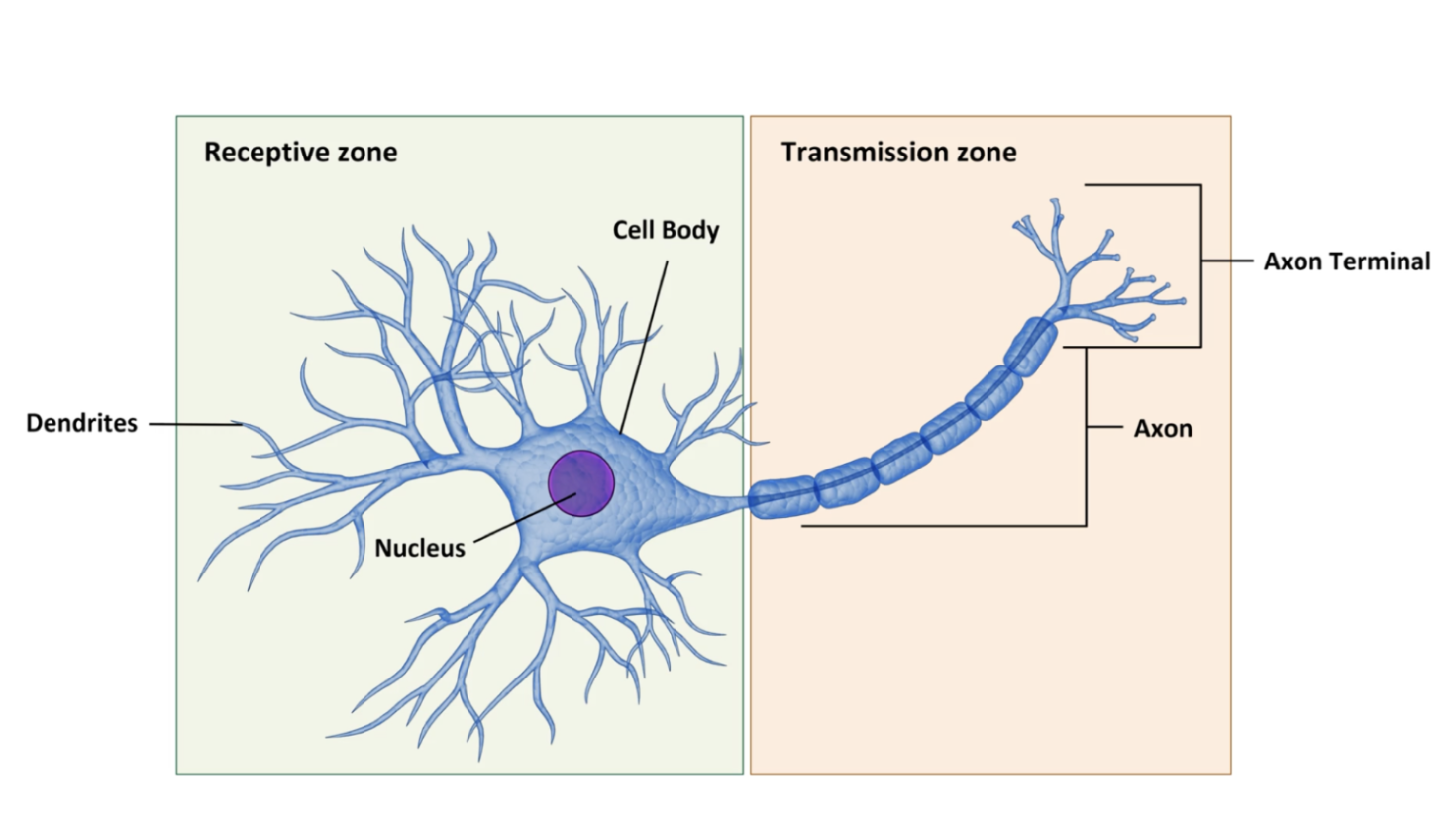
Describe the different regions of the neuron and their components
Receptive Zone:
comprised of the dendrites and cell body
dendrites → extend from core of neuron, reach out to other neurons to receive signals to be relayed through dendritic branch to the cell body
cell body → carries genetic information, maintains structure and provides energy to keep neuron functioning
Transmission Zone:
made of axon, axon terminal, terminal boutons
axon → long fibre, can vary in length
axon terminal → end of axon, another cluster of branches
terminal boutons → little feet that connect to another neuron’s receptive zone to move the signal further
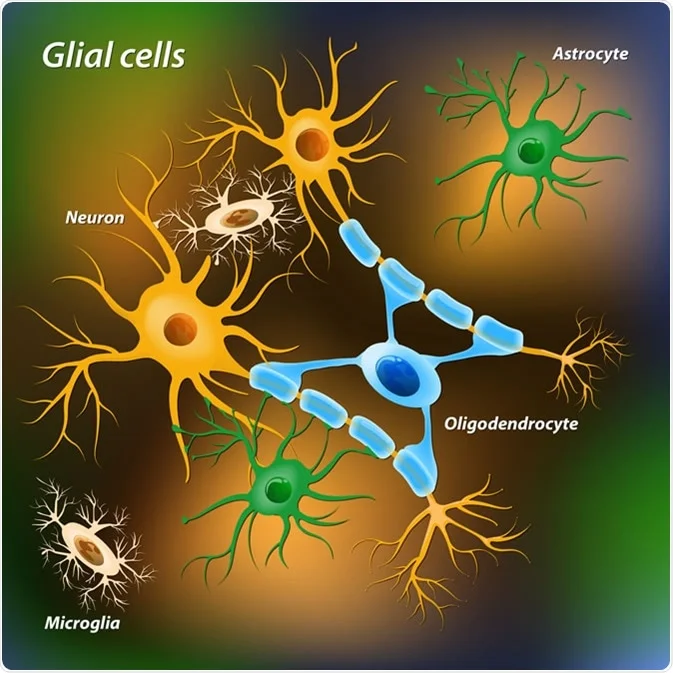
Glial Cell
provide structural support, nourishment, and insulation for nearby neurons - they make sure the neuron is function properly
work together with neurons
around neurons
rest in a bath of ions, chemicals and blood
Action Potential - what is it?
fundamental unit of communication for neurons
relies on selective movement of ions in and out of the neuron
Describe the Cell Membrane (in general, at resting potential)
selectively permeable — some ions can pass thru easily, others cannot
membrane has protein channels that allow ions to pass through
inside of neuron has a resting potential of -70mv relative to the outside
Describe the location of the 4 ions at resting potential - inside? outside?
Sodium - positively charged, mobile, start on the outside
Potassium - positively charged, mobile, start on inside
Negatively charged protein - immobile (too large), stay inside
Chloride - negatively charged, mobile, but stay outside because the negatively charged proteins repel them
Important Channels (3)
Voltage Gated Sodium Channel:
closed while resting
flow into the cell but only at low concentrations
Sodium mostly outside
Ligated Sodium Channel: - not that important
only open when interacting with chemical or lygon
Potassium Leak Channel:
“tap that’s always on”
allow positively charged potassium to pass thru the cell membrane and OUT of the neuron
major contributor to maintaining the resting potential - not the action potential
Voltage-Gated Potassium Channel:
important for driving action potential
What is the threshold for an action potential?
-50mV
all or nothing sensation
causes cascade of events to be triggered
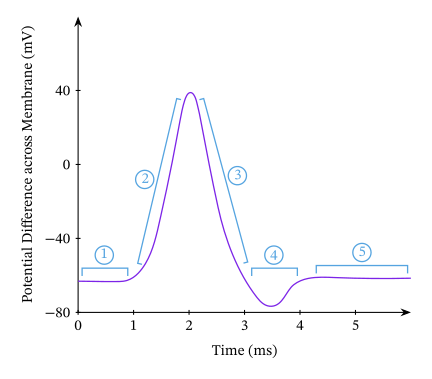
Describe what is happening at each stage of the action potential
1) threshold is reached
action potential begins
2) Depolarization (rising)
voltage gated channels open
sodium piles up on the outside of the cell, enters, via the force of diffusion
As sodium comes in, the electrostatic force begins to push positively charged potassium through the potassium lead channels
Positive charge builds up so much that voltage gated potassium channels also make potassium leave
At peak (+40mV), sodium channels close, and potassium channels remain open
3) Repolarization
Potassium channels stay open, continuing to leave
This decreases the positive charge in the cell
4) Hyperpolarization
Action Potential Undershoots the baseline (less than -70mV)
Voltage gated Potassium channels close
5) Return to resting state
cell goes back to -70mV
Potassium reenters thru the leak channel
Balancing the charge
Refractory Period — absolute vs relative
Refractory Period: until neuron recovers and settles, the neuron cannot fire another action potential
determines upper limit of frequency, or its maximum firing range
absolute: happens immediately once the AP is initiated and ends once the membrane dips back below -50mV
After voltage gated sodium channels close @ the peak of the action potential, they can’t be reopened for a short period of time
therefore, it’s impossible to initiate another action potential
relative:
after absolute refractory period ends, it lasts until the resting potential is reestablished
sodium channels can open again so a 2nd potential can occur
BUT the undershoot means that you need a stronger positive stimulus than normal to reach the threshold potential
harder but NOT impossible to initiate a new action potential
Sodium Potassium Pump
Removes Sodium and Potassium pump to maintain the ion concentration in/out of the cell
3 Sodium OUT, 2 Potassium IN
works slowly, uses a lot of energy
not important for action potentials, but maintains the ion balance of the neuron
Saltatory Conduction + Myelin Sheaths
process of cascading action potentials along the axon maintains the signal, but it can be too slow for the speed required for communication
special glial cells called myelin insulate the axons, leaving gaps between called nodes (which limit when the ions of AP can dissipate into the surrounding)
AP jumps from node to node, through a process called saltatory conduction
info can be passed without losing anything in the message
Action Potentials - Cascading Phenomenon
action potential begins in the receptive zone where cell body and axon connect
then it jumps down the axon, creating changes in other channels to create more APs
AP heads towards the terminal bouton to get passed on
Neuron encoding messages
APs are produced by given neuron identically in strength and duration
messages are encoded in frequency and pattern
how often the AP fires tells us how “STRONG” it is
strong - high frequency, weak - low frequency
The Synapse
Not a physical connection
Synapse can maintain multiple presynaptic or post synaptic neurons
Neurotransmitter
examples: serotonin, dopamine, glutamate
found at terminal end of presynaptic neuron
chemicals found within intracellular packages called vesicles
arrival of AP causes vesicles in a neuron to move toward the membrane of the presynaptic neuron
It fuses with the neuron’s membrane and opens, spilling the molecules into the synaptic cleft
Receptors on the post-synaptic neuron meet, continuing the process of signal transmission by a # of possible actions
Excitatory Post Synaptic Potential (EPSP)
modify ion channels on the post-synaptic cellular membrane
sodium channels open, allowing positive sodium ions to flow into the post-synaptic cell and moving the potential away from firing
-50mV to fire
Temporal Summation
Temporal Summation:
high frequency stimulation by one presynaptic neuron (over time)
same tap dripping water into the same cup
Spatial Summation:
simultaneous stimulation by several presynaptic neurons
many taps dripping water in the same cup
Spatiotemporal Summation
some EPSPs from one neuron or EPSPs from many neurons may not be sufficient to reach threshold
blend both types to reach signal
simultaneous, high frequency stimulation by several presynaptic neurons
Inhibitory post-synaptic potential
ensure neurons aren’t firing uncontrollably, resulting in more noise than signal
inhibits transmission of signal
Cl- channels open to Cl- can enter the cell to make it negative (hyperpolarize)
This makes the cell further from the threshold, so an AP is less likely to occur
Neural Development
1) Neurogenesis
brain starts as a neural plate, folding into a tube
neural plate folds at 18 days after conception, and tube is present at 28 days
founder cells within the neural tube begin to divide symmetrically and then later asymmetrically (creating founder cells and future glial/neurons)
2) Neural Migration
begins right after first neurons are born and continues until the last one is born
most neurons are born before glial cells
radio glial cells are produced before neurons → they extend from ventricular zone like scaffolding that ends at the cortex
neurons use the radio glial cells to move from ventricular zone to cortex (inside → out)
neurons born later have to travel further to push through the other neurons to reach their final destination
3) Neural Differentiation
neuron takes on a specific function depending on genetics and other factors
some neurons are prewired to be part of the visual cortex
BUT there is some flexibility
neural differentiation is influenced by input from connections with other neurons - if a neuron is connected to a visual neuron, it might process vision
environmental input shapes differentiation - if a neuron was needed to process binocular info and the person only has 1 eye, it wouldn’t develop properly so the neuron my be recruited for another task
4) Maturation
when final destination is reached, neurons make connections
neurons need neurotrophic factors from other neurons to stay alive, and the factors are limited so there is competition to make connections
if you don’t make a connection, you get pruned (love island??)
synapses double from 2-4mo of age and increase until 1 yr, and then decline till death
increases processing efficiency and retains only useful connections
Neuroscience in Writing - how does it affect our satisfaction?
We gave people two explanations – a good one or a bad one
Then another two explanations were included with neuroscience terms added
How satisfied were you with your explanation?
People were not satisfied with the poor explanation (no neuroscience)
But once neuroscience terms were added, everyone felt way more satisfied (even if it was bad)
Similar to how commercials use big words
The Matrix Problem - explain the “theory”
Robots have taken over, but we are in a simulation and we don’t know the difference
“Brain in a Jar”
Giving the brain action potentials so it doesn’t know the difference
Are we all in the matrix? Is my brain in a jar and we are being fed action potentials?
VR is going to get so realistic we won’t be able to tell the difference between real life and technology
Naïve realism
belief that we see reality as it really is: that the facts are plain for all to see; that rational people will agree with us; and that those who don't are either uninformed, lazy, irrational, or biased
Post-hoc rationalization leads to self-deception - explain cold water and healthy heart phenomenon
participants were lied to and told that cold sensitivity was related to heart health
So if holding the hand in the water = healthy heart, the people would hold it in longer
But if holding the hand in the water = unhealthy heart, the people would take it out sooner
We believe our own lies, and justify our actions
Free-Will
Freedom of humans to make choices that are not determined by prior causes or by divine intervention
We make choices and are responsible for those choices
Libet’s famous test of Free Will
o Move your wrist whenever you want
o Electrode on the wrist measures movement and an electrode on the motor cortex
o Participant has to judge when they moved their wrist and when they decided to move their wrist
o The participant is ~50ms off from when they said they moved their wrist from when they actually did
o ~200ms from when we decide to move our wrist vs when we actually move it
o 300-500ms your brain is already ramping up
Who is in charge here?
o Criticsm -> it could be an inaccurate process, adopts the idea that we are a by-product of our brains
Supports the idea of “free won’t”
Oligodendrocytes vs. Schwann Cells
Oligodendrocytes → found in central nervous system (brain and nervous system)
Schwann Cells → found in peripheral nervous system (all other nerves)
Describe the Neuraxis and the different anatomical directions.
Neuraxis - human nervous system axis
it “curves”, shifting the typical axis in four-legged animals
-listed in regards to the full body, and then brain respectively
Dorsal —> toward the back (think dorsal fin) or back upper part of the brain
Ventral —> toward your stomach or lower front part of the brain
Rostral —> towards the top of your head (rooster) or upper front part of the brain
Caudal —> towards your feet or lower back part of the brain
Medial —> towards the middle of the brain
Lateral —> towards the outside of the brain
Ways to Measure Brain Activity + brief description, + pros and cons (if any)
1) Lesion studies
tell us relationship between structure and function
think of Phineas Gage and his frontal lobe lesion, or tests on animals where they damage a part of the animal’s brain and observe the effects
Advantage: direct measure of a brain structure’s function
Disadvantage: hard to selectively target particular brain regions and draw conclusions
2) Targeted Electrical Stimulation
electrically stimulate a region of the brain and observe the result on beahviour to build a map related to function
used by Dr. Penfield
patients were under anesthetics and conscious
use thin wire to carry a charge to stimulate the brain, fire neurons and observe the effect
3) Single-Cell Recording Techniques
electrodes used to record ongoing electrical activity in the brain through single cell techniques
electrode is inserted into the nervous tissue of a live animal with the tip held just slightly outside
neural activity is recorded while stimulus is present
4) Structural and Functional Neuroimaging techniques
used to study large scale structures and functions
CT scan, PET Scan MRI Scan, FMRI, EEG
Differentiate on other card.
CT Scan
Used for structures and functions
Computed Tomography
x-ray slices of the brain are taken and pieced together to produce a quick and cheap picture of the brain
helpful for diagnosing
cons:
-low resolution, hard to examine fine brain anatomy, not used in neuroscience research
MRI Scan - Magnetic Resonance Imaging
more detailed structural image of the brain
Powerful magnetic fields are generated which align H+ atoms in the brain
With H+ atoms aligned, MRI can localize tissue very precisely
super clear images but takes a while and is expensive
PET Scan - Positron Emission Tomography
functional imaging technique
shows how brain function relates to cognitive task
How it works:
use radioactive tracer (glucose or oxygen) + inject into bloodstream
tracer goes to brain and used in metabolic processes
more active brain regions use more metabolic resources and an image is constructed
disadvantage → requires injection of radioactive tracer, invasive
FMRI - Functional Magnetic Resonance Imaging
functional (duh) - preferred method
produces clear brain image of its activity without a tracer
measures the blood oxygen dependent signal and uses same principles as MRI
measures relative use of oxygen throughout the brain and operates similar to PET
images are striking
Disadvantages:
oxygen used by brain spikes a few seconds later
lots can change in seconds so FMRI isn’t ideal for precise timing
Electroencephalogram (EEG)
Functional
brain activity is recorded through the scalp by wearing a cap of very sensitive electrodes
records from population of neurons to provide a rough image of brain activity
Different stimuli can have a consistent effect on the read out and this creates a characteristic signal that acts as a marker for neural processing
on surface of brain
3 Regions of the Brain
Hindbrain, Midbrain, Forebrain (contains limbic system)
Hindbrain
info in and out of the brain travels through the cranial nerves and spinal cord which connects here
evolutionarily, one of the oldest brain structures, found in every vertebrate species
regulates vital bodily functions
4 Regions of the Hindbrain
Reticular Formation: role in arousal, motivation, circadian rhythm, posture + balance
Cerebellum: facilitates coordinated movement
Medulla: responsible for breathing, digestion, heart rate, and autonomic reflexes
Pons: have a role in movement, auditory perception and emotional processing
Midbrain - what are the two major subdivisions and their functions
two major subdivisions - tectem and tegmentum
important for perception, arousal, and motor control
TECTUM:
superior colliculus: eye movements and visual reflexes
inferior colliculus: auditory integration
TEGMENTUM
red nucleus: contributes to motor control
substantia nigra: plays a role in reward related behaviours via release of dopamine (neurotransmitter)
Forebrain - functions
largest region of the brain
function —> emotion, memory, perception and thought
PHAT-H
Pituitary Gland
Hypothalamus
Amygdala
Thalamus
Hippocampus
Pituitary Gland - describe two substructures
Size of chickpea, regulates and releases vital hormones, called “master gland of the universe”
Anterior pituitary: recieves signals from the brain and releases stimulating hormones to regulate important endocrine glands
Posterior pituitary: extension of hypothalamus
releases oxytocin (helps with basic functions like lactation, uterine contractions, but also bonding and trust)
vasopressin (blood hormone that regulates lvls of thirst by interacting with kidneys)
Hypothalamus
directs stress response
regulates energy metabolism by inducing feeding, digestion and metabolic rate and regulating hormonal control of mating + pregnancy lactation
HYPE-othalamus
4 F’s - Fight, Flight, Feeding and Freaking
Amygdala
receives sensory information and plays a role in decoding emotions, like threatening stimuli
amygdala activates when stressed
amygdala malfunctions connect to PTSD and inability to react to fear responses
Thalamus
large structure near the centre of the brain, central relay station in the cerebral cortex
besides olfactory (smell), axons from every sensory modality synapse to the thalamus
thalamus processes and relays information selectively to areas of the cerebral cortex
output from cerebellum and limbic system also pass thru thalamus
Hippocampus
horseshoe shaped structure in the temporal lobe
intimately involved in the process of memory and is related to your ability to hold short term memories and transfer them to long-term memory
connected to amygdala (memories often trigger strong emotions)
plays a role in navigation
neurogenesis (birth of neurons) continues into adulthood
Cerebral Cortex
rigid structure
4 main lobes
folds over itself forming gyri and sulci
increase surface area of cortex - maximizes space for cortical processing
evolutionarily speaking, newest part of the brain
only about 5mm thick
Gyri vs Sulci
Gyri - ridges/bulges linked to specific mental functions
Sulci - intends that indicate where neural tissue responsible for one function ends and the next function begins
Deep sulcus is called a FISSURE and it divides major regions of the cortex responsible for distinct mental processes
Occipital Lobe
responsible for visual processing
contains primary visual cortex and other important visual areas
handles basic processing of visual info and some complex visual processing
If an individual has healthy eyes but a damaged occipital lobe, they may be blind
Temporal Lobe
at the sides of the brain (below sylvian fissure)
through projections from the occipital lobe, the temporal lobe contains areas responsible for processing the form and identity of visual stimuli
location of primary auditory cortex (basic auditory processing)
partially responsible for memory and language processing
damage results in issues with memory, auditory processing and production of speech
Partietal Lobe
infront of occipital lobe, above sylvian fissue, terminates rostrally at the central sulcus
connection between frontal and parietal lobe, forms the primary somatosensory cortex (which processes touch)
involved in visual and spacial functions (location and movement of visual objects)
contains spatial representation of the world that is involved in visual attention and guiding eye and body movements
Frontal Lobe
most complex but least understood lobe
along central sulcus
frontal and parietal meet where primary motor cortex is (motor commands originate here)
lobe also makes you human as its where decision making occurs
If your frontal lobe is damaged, you will have dysfunctions, and if your frontal lobe is underdeveloped, you will act recklessly
Broca’s Area
located in left frontal lobe
area vital for speech production
Broken Broca = broken words
You can understand speech but can’t speak properly
Wernicke’s area
damage to left temporal gyrus
can’t understand speech, speak through meaningless sentences - proper grammar and rhythm
Brain lateralization - is the brain symmetrical or asymmetrical
asymmetrical
neuroscientists have found cases of function specialized to one side of the brain
Corpus Callosum
carries info between 2 hemispheres
info crosses from one hemisphere to the contralateral or opposite side of the brain thru the corpus callosum
Split Brain Syndrome Case Study
two independent hemispheres
once info is carried to one side of the brain, it is trapped there and unable to make it to the other side
If object is placed in the right visual field:
you can name the object
info travels to left side of the brain (processes language)
but can’t comprehend that it is there spatially or feel it
left = language!
If object is placed in left visual field:
you can feel the object
info travels to right side of the brain (processes spatial representations of the world)
can’t name the object because left brain can’t perceive the object
Brain is expensive to create - what does this mean?
We have a very long childhood where we can’t really do anything independently
probably takes around 20 years until we are independent
human babies require a lot of investment, but then we develop into intelligent organisms (because of our big beautiful brain)
Theory of Mind
the ability to attribute mental states (beliefs, intents, desires, emotions, knowledge) to oneself, and to others, and to understand that others have beliefs, desires, intentions and perspectives that are different from one’s own
Essentially, ability to put ourselves in other people’s shoes
use box and basket comic strip
We aren’t born with it (develops around 4 years)
People who don’t have theory of the mind - under 4 years or autistic
How do we have empathy?
We have motor neurons that respond to self-actions
We also have mirror neurons that responds to the actions of ourselves and others
If we watched someone complete a task several times, the mirror neurons would fire, and create a pathway
Thus, if you were to perform the task on your own, the mirror neurons would be a little more established and the task would be easier
Rubber Hand Illusion and Phantom Limb Treatment - what do they prove?
Rubber Hand
our representation of our body is not as fixed as we think
we can connect something new (like the rubber hand) and believe that it is attached to us
Phantom Limb:
people experience limb pain (in a limb that isn’t there) - hand often feels clenched in amputated arms
use mirror visual feedback to treat a phantom limb that moves and feels
if you watch your arm clench and unclench, you will believe it is moving
Both demonstrate → “Believing is Seeing”
Imposter Syndrome Case Study
man got into a car accident and went into a coma
family visited (specifically dad), but the patient said it wasn’t his father in the room even though it looked like him
it had a connection to visual recognition
when we recognize faces, it has a corresponding emotional significance
Neurons in Fusiform Face Gyrus respond to faces and the amygdala accesses the emotional significance (areas communicate so faces trigger emotions)
Called Capgras delusion
brain creates a running narrative to explain - “if i don’t love this man, my dad must have a doppelganger”
Hemi Spatial Neglect
ignoring the left half of the world because there is damage in yoru right parietal lobe
only shaving right half of face, eat off right side of plate, etc.
not a visual issue, your brain is just not paying attention
What happens if you damage your left side of your brain vs on the right?
Left:
can’t see on right side, but other hemisphere attends to both so you are okay
Right
damage means you lose both sides, and only have attention on right side (left brain remains)