Language COG NRSC
 Call Kai
 Learn
Learn Practice Test
 Spaced Repetition
 Match
Match Flashcards
 Knowt Play
1/23

Earn XP
Description and Tags
This Week’s Learning Objectives: • Describe the major brain regions and pathways that support language comprehension and production. • Compare classical and contemporary models of language processing. • Explain how the brain processes meaning in spoken and written language, from words to sentences. • Understand how language disorders such as aphasia, dyslexia, and apraxia reveal how the system works. • Discuss how language organization varies across individuals, development, and evolution.
Name | Mastery | Learn | Test | Matching | Spaced | Call with Kai |
|---|
No analytics yet
Send a link to your students to track their progress
24 Terms
Human language is…
symbolic
rule-governed and generative
able to refer to the past, future, and hypothetical
built from hierarchical, recursive structure
suited for storytelling and complex social thought
It’s important to know that animals communicate through visual, auditory, tactile, and chemical signals.
Non-human primates don’t speak because…
They can’t produce human speech due to limited:
vocal anatomy
reduced fine motor control for speech
less voluntary control over vocalization
less precise breath control
They are still effective communicators as their calls are tied to specific emotional or social contexts.
Can apes learn human-like languages?
They can learn symbols or signs for objects, actions, and simple concepts but their communication is often…
short
tied to immediate context
limited in syntax and combinatorial complexity
However, they don’t show open-ended, generative structure of human language.
Language in the Brain System
• Human language may be a uniquely human cognitive system
• There is no clear animal model of full human language
• Neural basis is harder to study than vision or memory
• Knowledge comes from lesion studies, neuroimaging, and EEG
• Language is strongly lateralized in the brain
Evolutionary Clues about Language
Humans show strong connectivity in left perisylvian language networks, with major dorsal and ventral pathways linking temporal, parietal, and inferior frontal cortex
Similar pathways exist in other primates, but they are less extensive, with minimal projections into lateral and inferior temporal cortex
Aphasia
Partial or complete loss of language abilities caused by brain damage
Commonly from stroke
distinct from motor speech disorders such as dysarthria and apraxia of speech
Affects speaking, comprehension, reading, writing, and grammar
Severity depends on lesion location, size, and individual factors and different syndromes show different patterns of impairment
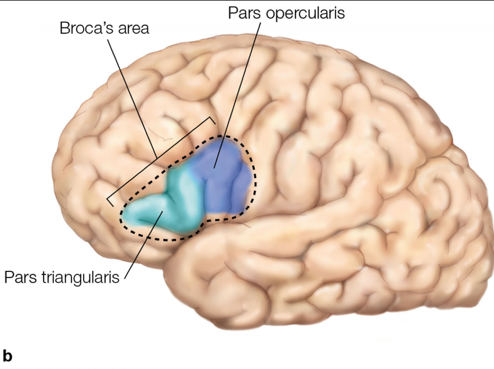
Broca’s Aphasia: Nonfluent/Expressive Language Impairment
Characterized by slow, effortful, telegraphic speech, and limited vocabulary
Speech articulation may be impaired, deficits to syntax and writing
Comprehension is generally preserved for simple sentences and impairs for syntactically complex ones
Patients are often aware of their language deficits
Most often associated with lesions in the left inferior frontal lobe (including Broca’s area…think of patient ‘tan‘)
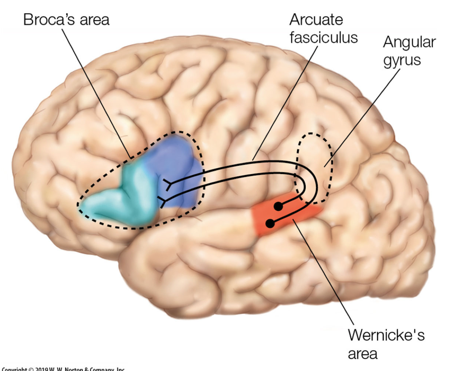
Wernicke’s Aphasia: Fluent/Receptive Speech with Impaired Comprehension
Speech well formed, but lacks meaningful content
Severe impairments in comprehension of spoken and written language
Patients are often unaware of their deficits
Associated with damage in the left posterior superior temporal cortex and underlying white matter