*( 6) Theories of Romantic Relationships: Social Exchange theory
 Call Kai
 Learn
Learn Practice Test
 Spaced Repetition
 Match
Match Flashcards
 Knowt Play
1/9

There's no tags or description
Looks like no tags are added yet.
Name | Mastery | Learn | Test | Matching | Spaced | Call with Kai |
|---|
No analytics yet
Send a link to your students to track their progress
10 Terms
What are the rewards, costs and profits that are used to explain this theory?
We form a relationship if it is rewarding
We wish to maximise rewards from a relationship (eg. love, sex, companionship, support) & minimise costs (time, effort, money spent, opportunities lost, risk involved)- HOWEVER these change over time
The rewards minus the costs equals the outcome
The goal is to achieve a situation of profit: where rewards exceed the costs
What is the comparison level?
To judge how one partner compares to another potential one on the profitability front which is based on memories of past experiences combined with expectations of what we want and can expect in the future
What are the comparisons for alternatives?
We weigh up the potential increase in rewards from an alternative partner against any costs associated with ending the current relationship
Stages of relationship development: sampling
We consider the potential rewards and costs of a relationship and compare it with other relationships available at the time
Stages of relationship development: bargaining
We give and receive rewards to test whether a deeper relationship is worthwhile.
Stages of relationship development: commitment
The relationship increases in predictability so each partner knows how to elicit rewards from the other, which lowers costs.
Stages of relationship development: institutionalisation
The relationship norms are developed which establishes the patterns of rewards and costs for each partner.
Evaluation: direction of cause and effect
Claims that dissatisfaction only arises
after a relationships stops being
profitable.
An alternative explanation suggests we
do not consider alternatives until after
we are dissatisfied
Evaluation: Vague concepts
SET deals in concepts that are vague and hard to quantify. Real world rewards are subjective and hard to define.
It is also unclear how a comparison level works
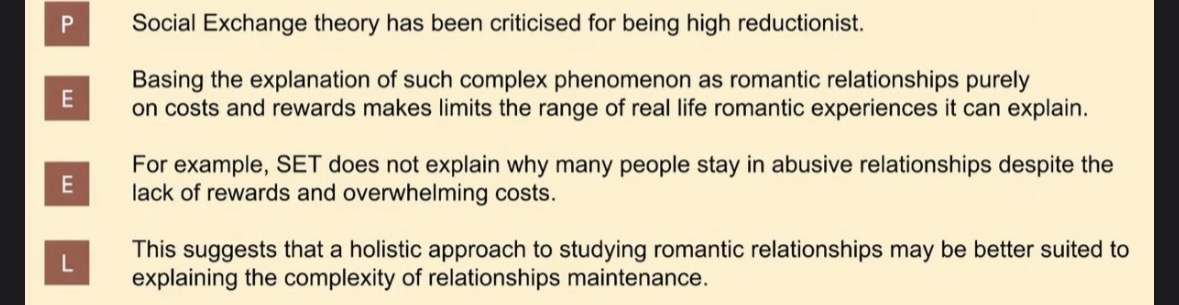
Evaluation: reductionism