first order logic
 Call Kai
 Learn
Learn Practice Test
 Spaced Repetition
 Match
Match Flashcards
 Knowt Play
1/27

There's no tags or description
Looks like no tags are added yet.
Name | Mastery | Learn | Test | Matching | Spaced | Call with Kai |
|---|
No analytics yet
Send a link to your students to track their progress
28 Terms
how can we split up contents of a sentence
names
predicates
quantifiers
names
a b c / 𝑎1, 𝑎2, 𝑎3
all names are unique
predicates
F G H / 𝐹1, 𝐹2, 𝐹3
eg ‘is an elephant’, ‘is a mammal’, ‘is an even number’ and ‘tells lies’
attaches before the name - Fa
variables
gaps created by removing names , placeholders for nothing
x y z / 𝑥1, 𝑥2, 𝑥3
These allow us to write open sentences:
Fx: x is a fox
Lxy: x loves y
logical connectives
¬ , ∧ , ∨ , → , ↔
quantifiers
∀x : “for all x”, “every x”
∃x : “there exists an x”, “some x”
the universal quantifier
Pa – Adam is physical
∀𝑥𝑃 𝑥 – Everything is physical
(𝐸𝑑 → 𝑀𝑑) If Dumbo is an elephant, then Dumbo is a mammal
∀𝑥(𝐸𝑥 → 𝑀𝑥) - All elephants are mammals
existential quantifier
Pa – Adam is physical
∃𝑥𝑃 𝑥 – some things are physical
(𝐸𝑑 → 𝑀𝑑) - If Dumbo is an elephant, then Dumbo is a mammal
∃𝑥(𝐸𝑥 ∧ 𝑀𝑥) - Some elephants are mammals
domains
we implicitly use domains so we dont refer to everyone, everywhere, from all times
In FOL, we make domains explicit:
the set of currently living people
The set of all people who have ever lived
The set of all natural numbers
The set {Prince William, Bonny Prince Charlie, Prince}
quantifiers and scope
A quantifier applies to the matching variables within its scope.
(∀𝑥𝐴𝑥 ∧ ∃𝑥𝑇 𝑥): everyone is alive and someone is talented
∀𝑥(𝐴𝑥 → 𝑇 𝑦): for anyone who is alive, y is talented (but what is y referring to?)
quantifiers and negation
the placement of a negation can seriously affect a quantifier:
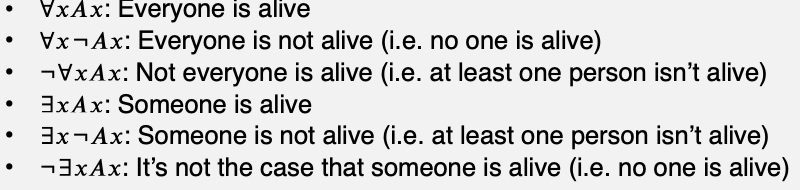
(∀𝑥 ¬𝐴𝑥) = (¬ ∃𝑥𝐴𝑥)
(¬ ∀𝑥𝐴𝑥) = (∃𝑥 ¬𝐴𝑥)
translating cheat sheet
“All Fs are Gs” = ∀𝑥(𝐹𝑥 → 𝐺𝑥)
“Some Fs are Gs” = ∃𝑥(𝐹𝑥 ∧ 𝐺𝑥)
“No Fs are Gs” = ¬ ∃𝑥(𝐹𝑥 ∧ 𝐺𝑥)
“Not all Fs are Gs” = ¬ ∀𝑥(𝐹𝑥 → 𝐺𝑥)
2 place predicates
relationship between 2 variables
Lxy: x loves y
Rxy: x is to the right of y
Sxy: x is shorter than y
(∀𝑥𝐿𝑥𝑥 → ∃𝑦𝐿𝑦𝑡): If everyone loves themselves, then someone loves Tom Hardy
multiple generality
two quantifiers affect one another, one within the scope of another:
∀𝑥 ∃𝑦𝐿𝑥𝑦 = “For each person, there is someone who they love”
∃𝑦 ∀𝑥𝐿𝑥𝑦 = “There is at least one person such that everybody loves them”
These are not equivalent!
order of construction matters because 1 quantifier is in the others scope
keeping track of variables
Different variables may pick out different objects (though they don’t need to!)
If you have the same variable within the quantifier’s scope, it must pick out the same object or objects:
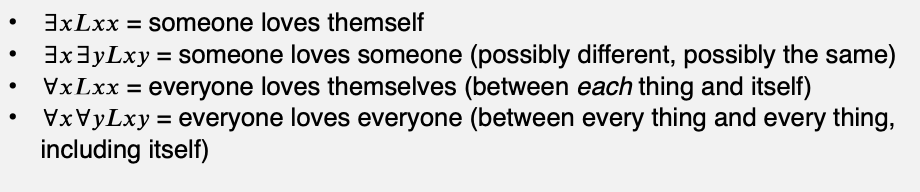
Basic check: if you have a variable in your sentence, there should be a quantifier featuring it which has the variable within its scope
equivalence
(∀𝑥 ¬𝐴𝑥) = (¬ ∃𝑥𝐴𝑥)
(¬ ∀𝑥𝐴𝑥) = (∃𝑥 ¬𝐴𝑥)
surface vs logical order
“All Fs are G” and “Some Fs are G” have:
The same form in English (surface form) - same language form
A different form in FOL (logical form) - ∀x(Fx→Gx) vs ∃x(Fx∧Gx)
“Some politicians are liars, and some politicians are not liars”
(∃x(Px∧Lx)∧∃y(Py∧¬Ly))
sometimes logic is strict and ordinary language is loose
“Or” can be inclusive/exclusive – “∨” is always inclusive
“And” sometimes implies temporal order – “∧” never does
“If/then” seems to commit to less than “→” does
“Some frogs are green”
“Some frog is green”
“∃x(Fx∧Gx)” is used for both - no distinction
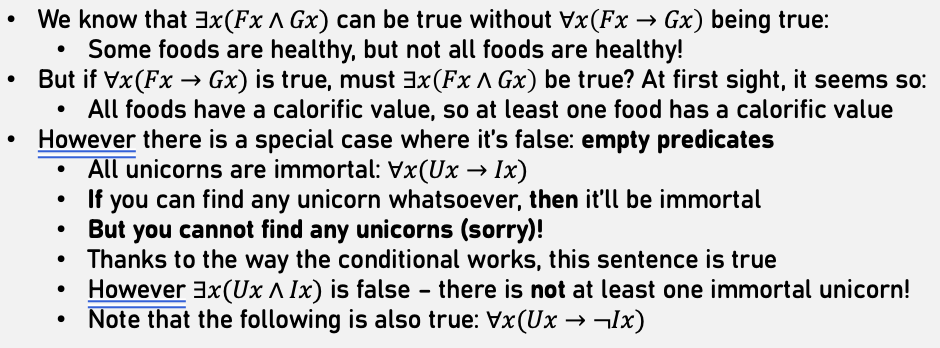
empty predicates
contraries vs contradictories
Hk = Karl is happy
¬Hk does NOT mean Karl is unhappy, it means he is not happy
can be not happy without being unhappy
happy and not happy = contradictories (cannot both be true or both be false)
happy and unhappy = contrary (cannot both be true, but they can both be false
syncategorematic terms
too many predicates
“Vladimir Putin is a Russian politician” = (Rv∧Pv)
“Vladimir Putin is a good politician” = (Gv∧Pv) – problem!
“good” is not an independent predicate, it modifies the other predicate, “politician”
When an English sentence reads “a is an [adjective 1] [adjective 2]”: If it can be paraphrased as “a is an [adjective 1] and a is an [adjective 2]”, you may represent it as (Fa∧Ga)
Otherwise, you must create a single predicate and write Ha
only
“Only animals have intelligence” = “The only things that have intelligence are animals” = “Anything that has intelligence is an animal”, so:
∀x(Ix→Ax)
all and only
“All Fs are Gs”: ∀x(Fx→Gx)
“Only Fs are Gs”: ∀x(Gx→Fx)
“All and only Fs are Gs”: (∀x(Fx→Gx)∧∀y(Gy→Fy))
We can represent this more simply, since we have a conditional that goes both ways:
“All and only Fs areGs”: ∀x(Fx↔Gx)
2 place predicates / binary relations
relations between more than 1 variable
‘Rishi Sunak knows Boris Johnson’
Bx: ‘x knows Boris Johnson’ (or ‘___ knows Boris Johnson’)
Rx: ‘Rishi Sunak knows x’ (or ‘Rishi Sunak knows x’)
Kxy: ‘x knows y’ (or ‘___1 knows ___2’) (2 place predicates)
combining quantifiers and relations
“Anisha respects Bethany” = Rab
“Anisha respects someone” = ∃xRax
“Everyone respects Bethany” = ∀xRxb
“No one respects Carlos” = ¬∃xRxc
“If everyone respects Bethany, Anisha respects Bethany = (∀xRxb→Rab)
“If Carlos respects himself, then someone respects Carlos = (Rcc→∃xRxc)
“Someone respects Bethany and Carlos” = ∃y(Ryb∧Ryc)
“Anisha respects anyone who respects her” = ∀x(Rxa→Rax)
multiple quantifiers
In all the below cases, we can either repeat the same variable or use a new one
“Either no one respects Carlos, or someone respects Carlos” = (¬∃xRxc∨∃yRyc)
“If everyone respects Anisha, then everyone respects Bethany” = (∀xRxa→∀xRxb)
“There’s someone Bethany respects, and someone she doesn’t = (∃yRby∧∃z¬Rbz)
Things get interesting where two uses of a quantifier depend on each other
“Someone respects someone else” = ∃x∃yRxy
“There is someone who respects everyone” = ∃x∀yRxy
quantifier shift fallacy
many sentences with multiple quantifiers are ambiguous
confusing 2 ambiguous readings is the quantifier shift fallacy
Everything aims at some good (or other). Therefore: there is some (one) good at which everything aims.
Translation: ∀x∃y(Axy∧Gy). Therefore: ∃y∀x(Axy∧Gy)
invalid