17.7 Wage Differentials
 Call Kai
 Learn
Learn Practice Test
 Spaced Repetition
 Match
Match Flashcards
 Knowt Play
1/36

There's no tags or description
Looks like no tags are added yet.
Name | Mastery | Learn | Test | Matching | Spaced | Call with Kai |
|---|
No analytics yet
Send a link to your students to track their progress
37 Terms
What is the basic reason wages differ across occupations?
Differences in labor demand and labor supply across occupations.
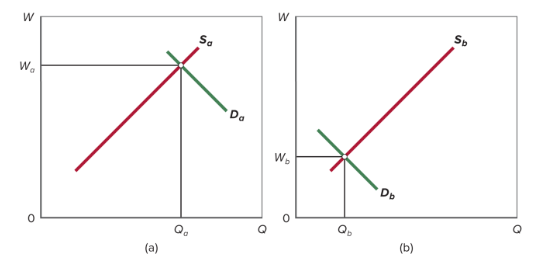
In Figures 17.9a and 17.9b, why do wages differ if supply curves are identical?
Because labor demand differs — strong demand → high wage; weak demand → low wage.
What does a strong labor demand curve (far right) imply?
High equilibrium wage because employers want many workers at high pay.
What does a weak labor demand curve (far left) imply?
Low equilibrium wage because employers want fewer workers at lower pay.
What is marginal revenue productivity (MRP)?
The extra revenue a worker adds to the firm by producing one more unit of output
How does MRP affect labor demand?
Higher MRP → stronger labor demand → higher wages.
Why do anesthesiologists earn far more than retail workers?
Their MRP is much higher, so labor demand for them is much stronger
Why do top professional athletes earn extremely high salaries?
They generate huge revenue (tickets, TV deals, merchandise), so their MRP is extremely high, creating very strong demand.
Why do many occupations have low wages?
Their workers generate modest revenue, so labor demand is low.
Why can wages differ within the same occupation (e.g., retail)?
Some workers (like commission-based top sellers) have much higher productivity, so they earn more.
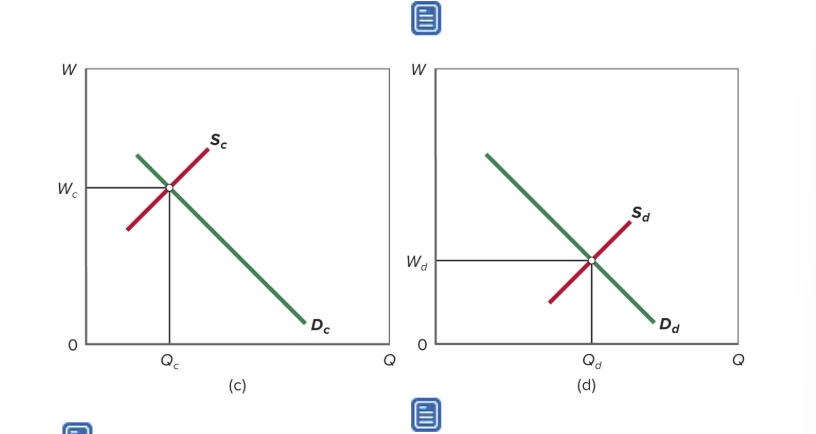
In Figures 17.9c and 17.9d, what stays the same?
Labor demand is identical in both markets.
If demand is the same, what causes the wage differences?
Differences in labor supply.
What happens when labor supply is low ?
Equilibrium wage is high because workers are scarce.
What happens when labor supply is high ?
Equilibrium wage is low because workers are abundant.
Why does low supply lead to high wages?
Firms must bid up wages to attract the few qualified workers.
Why does high supply lead to low wages?
Workers are easily replaceable, so firms don’t need to offer high pay.
What types of jobs typically have low supply?
Jobs requiring rare skills, long training, or special abilities.
What types of jobs typically have high supply?
Jobs requiring little training, common skills, or easy entry.
What is the main takeaway when demand is the same?
Wage differences come entirely from supply differences.
How do supply differences explain wage gaps like anesthesiologists vs. retail workers?
Few people can become anesthesiologists (low supply) vs. many can work retail (high supply).
What are noncompeting groups?
Groups of workers with different abilities, skills, or training who do not compete for the same jobs.
Why do noncompeting groups exist?
Because workers differ in mental ability, physical ability, education, and training.
How do noncompeting groups affect wages?
Groups with few qualified workers have low supply → high wages; groups with many qualified workers have high supply → low wages.
Why do brain surgeons, violinists, top athletes, and fashion models earn high wages?
Their abilities are extremely rare, so labor supply is very low relative to demand.
Do workers with rare abilities compete with other skilled workers?
No. A violinist doesn’t compete with a surgeon; each belongs to a different noncompeting group.
What is human capital?
A worker’s stock of knowledge, skills, and training that makes them productive.
Why do more educated workers earn higher wages?
(1) Fewer people have high education → limited supply
(2) More educated workers are more productive → higher demand
What are compensating wage differences?
Higher wages paid to compensate for unpleasant, risky, or undesirable job conditions.
What are market imperfections?
Factors that prevent workers from moving to higher‑paying jobs, causing wage gaps to persist.
How does lack of job information affect wages?
Workers may not know about better jobs, so labor supply doesn’t adjust, and wage gaps remain.
How does geographic immobility affect wages?
Workers are reluctant to move due to family, housing, and adjustment costs, so regional wage differences persist.
How do unions affect wage differentials?
Unions restrict entry (membership limits), keeping supply low and wages high.
How do government licensing rules affect wages?
Licensing restricts labor supply, preventing qualified workers from entering higher‑paying markets.
How do pensions, health insurance, and seniority affect mobility?
Workers may stay in lower‑paying jobs to avoid losing benefits, reducing labor mobility.
How can discrimination cause wage differentials?
Women and minorities may be paid less or crowded into low‑paying jobs, increasing supply there and lowering wages.
What is occupational segregation?
When discrimination pushes certain groups into specific low‑paying occupations, preventing access to higher‑paying jobs.
Does discrimination persist even with laws against it?
Yes — discriminatory practices can still lower wages for affected groups.