Science ok sus
 Call Kai
 Learn
Learn Practice Test
 Spaced Repetition
 Match
Match Flashcards
 Knowt Play
1/19

There's no tags or description
Looks like no tags are added yet.
Name | Mastery | Learn | Test | Matching | Spaced | Call with Kai |
|---|
No analytics yet
Send a link to your students to track their progress
20 Terms
Static Electricity
The build-up of electric charge on a source
Valence electrons
The outermost electrons of an atom, these require the least amount of force to be freed from an atom
Conductors
Elements with high conductivity, which have very mobile electrons. Examples are, copper, sliver, and gold
Insulators
Elements with low conductivity, they prevent the flow of electrons, examples are glass, rubber, plastic and air
Current electricity
Deals with the orderly flow of charge
Energy Source
The power source, supplies the electrons in the wire with the energy that is needed to move them around the circuit
Conducting Pathway
The wires, connect everything together allowing the movement of the electrons and the flow of current
Energy User
The load, objects and devices convert the energy that the electrons are delivering to them into another form of energy
Battery
Two terminals, positive and negative, inside are electrons that use a chemical reaction to forcefully sort them. It forces electrons to the negative terminal and strips them from the positive terminal leaving it empty. Also does not create new electrons into the circuit it provides the “push” to move electrons.
Voltage
The measurement of potential energy. Tells exactly how much “pushing force” the batter has to move those electrons through the wire. Measured in Volts
Potential energy
The difference between the electrons in the negative terminal to the positive terminal.
Short Circuit
Connect a copper wire from the negative terminal to the positive terminal with nothing in between
Load
Forces electrons to transform their potential energy into light or motion safely
The circuit
A closed, never-ending loop of conductive material like copper wire, cannot have any insulating gaps in them, any break in an electric circuit stops the flow for electrons and stops them from delivering their energy
Series Circuit
Electrons have no choices; the current must flow through every single component in a single loop to return to the source. Battery voltage must be shared across. If one component breaks, it creates a physical gap, and the whole circuit stops working
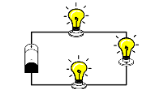
Parallel Circuit
The main pathway splits into junctions. The flow of electrons divides, taking different routes to get back to the battery. Each branch receives the full voltage of the batter
Electrostatic Force
The actual, physical push or pull created by charges interacting
The Golden rule
Like charges push apart. Opposite charges pull together
Conduction
Happens when electrons move from one object to another through direct contact. Mobile electrons take the first chance they get to go where they are most needed
Induction
Charging an object without actually touching it, causing a charge separation sim