Mechanisms - Chp 9
 Call Kai
 Learn
Learn Practice Test
 Spaced Repetition
 Match
Match Flashcards
 Knowt Play
1/69

There's no tags or description
Looks like no tags are added yet.
Name | Mastery | Learn | Test | Matching | Spaced | Call with Kai |
|---|
No analytics yet
Send a link to your students to track their progress
70 Terms
Rotary
turns around in a circle
Linear
moves in a straight line
Recipricating motion
moves forwards and backwards in a straight line
Oscillating motion
swinging along an arc aroung a central point
Mass
- the measure of the amount of matter in something
- measured in kilograms
Weight
the measure of the force of gravity exerted on an object
Weight calculation
mass x gravity
Work
the amount of mechanical energy transferred by a force to an object
Work Calculation
work = force x distance (metres)
Energy/work unit
joules or newton metres
Power
the amount of work done, or energy transferred, in a unit of time
Power calculation
power = work/time (seconds)
Power unit
watts
1 watt = 1 joule / second
Lever
a mechanism consisting of a rigid bar that can pivot around a fixed point called the fulcrum
Mechanical advantage
the ratio of the two forces, load and effort
Mechanical advantage calculation
mechanical advantage = load/effort
Advantages of levers
- allow us to move heavy loads by applying relatively small effort over a long distance, the greater the distance from the fulcrum the greater the mechanical advantage
- allow us to increase movement
Velocity ratio lever
the ratio betweena small movement on the side of the large load produces a large movement on the side of the small effort
Velocity ratio calculation lever
distance moved by effort speed of effort
------------------------------ = ------------------
distance moved by the load speed of load
Torque
force which causes a change in the rotational motion of an object around its fulcrum and axis, measured in n/m
Torque calculation
torque = distance form fulcrum x force
Classes of lever
F - Class 1 Fulcrum is in the centre - pliers
L - Class 2 Load is in the centre - wheelbarrow
E - Class 3 Effort is in the centre - tweezers
System
- a combination of parts of components, which work together to perform a task or activity
- a mechanical system uses one or more mechanisms to control input and output forcesp
Pneumatics
use of the power in compressed air
Hydraulics
the use of the power in compressed liquids
Advantages of using mechanisms
- reduces the amount of effort needed to do work
- are more efficient if properly designed
- are able to carry out a variety of tasks and are often the only possible way to achieve something
- reduces strain on a user's body
Disadvantages of using mechanisms
- sliding parts wear unless lubricated
- moving parts may be hazardous
- critical parts must be made with precision and can be expensive
Moment of force/Turning effect
the product of the force and the perpendicular distance between its line of action and the fulcrum
Law of the lever
states that if a lever is balanced, the clockwise moment must be equal to the anticlockwise moment
Equilibrium
a state in which opposing forces or influences are balanced.
Linkage
a mechanism that allows force or motion to be directed to where it is needed, consists of a system of levers connected to each other by pivots
Uses of linkages
- change direction of motion
- change the type of motion
- change the size of a force
- can make two things move at the same time or parallel to eachother
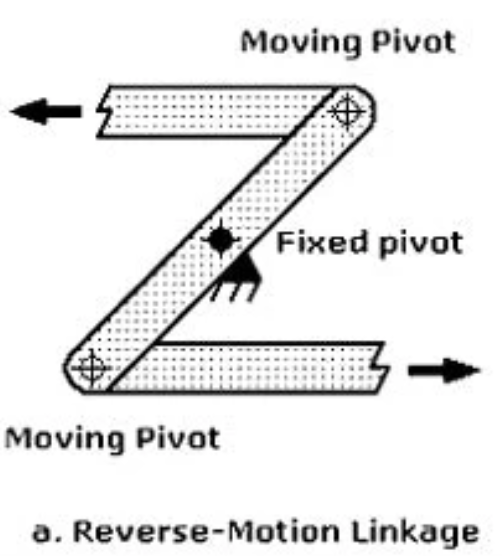
Reverse motion linkage
shaped like a Z, the middle rod moves around a fixed central pivot moving the top rod one way and the bottom rod the opposite way
used to make things move in opposite directions
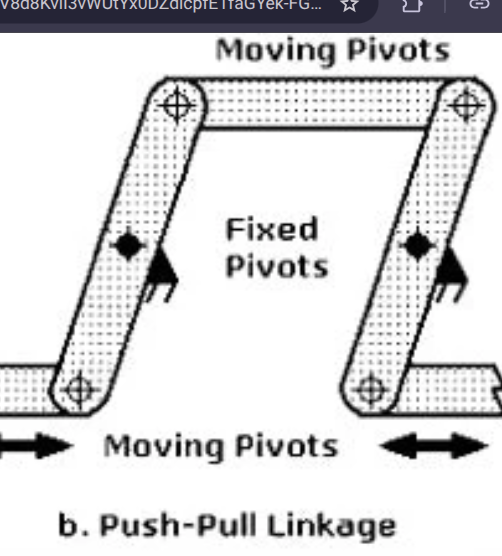
Push-pull linkage
- shaped like an N, two parallel rods move around two fixed central pivot points creating identical parallel motion at the other end of the linkage
- provides mechanical advantage when moving things back and forth
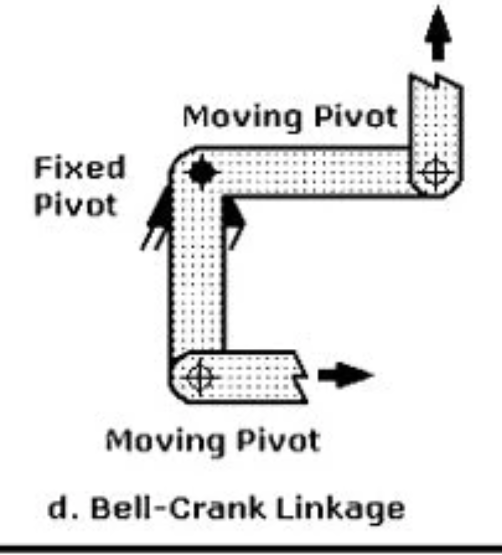
Bell crank linkage
changes the direction of movement by 90 degrees
used in bicycle brakes
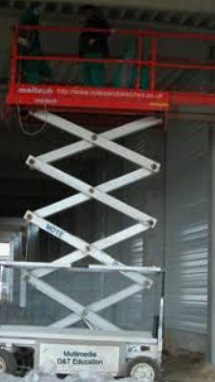
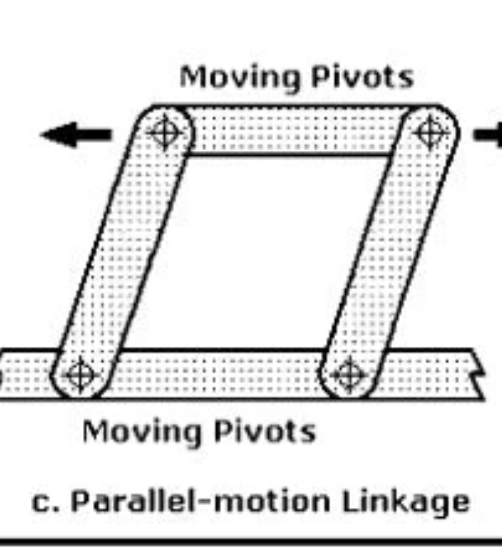
Parallel motion linkage
has the shape of a parallelogram, the links on opposite sides remain parallel when extended and retracted, retaining a vertical line
used to raise platforms up and down
Treadle linkage
- changes rotary motion to reciprocating motion in a push pull linkage, as the motor turns and the fixed central pivot points and move them back and forth
Spring
- an elastic object used to store mechanical energy, have the shape of a helix
- the coil of a spring changes shape when a load is applied and the springs back when the load is removed
Tension springs
stretches when a load pulls them
Compression springs
shorten as the load pushes them
Torsion springs
twist as torque turns them
Pulley
a mechanism providing mechanical advantage that makes it easier to lift heavier loads, consists of a rope or belt that runs around one or more wheels, one end of the rope is pulled which raises the other end
- provides great mechanical advantage, can transfer rotary motion, can be used to change the speed of the motion
Simple pulley system
consists of two pulley wheels each on a shaft, connected by a belt
Jockey pulley
an idler puller which helps retain tension in the pulley, otherwise they will slip, resulting in the effort and energy being lost
How does the size of the driver pulley affect speed?
- if the driver pulley is larger than the driven pulley the output speed will be greater than the input speed
- if the driver is smaller than the driven then the output speed will be less than the input
Speed of rotation unit
revolutions per minute / rpm
Velocity ratio gears
if the pulley wheels are different sizes the smaller one will spin faster than the larger one
Velocity ratio calculation gears
driver speed / driven speed
size of driven / size of driver
What is a pulley drive belt made from
usually synthetic fibres eg neoprene and polyurethane, with a v -shaped cross section
What is a movable pulley
a pulley with a free axle, which is free to move
How do you find the mechanical advantage of a pulley?
count the number of rope the weight is distributed across
How do you make the driver and the driven in a pulley system rotate in opposite directions?
cross the belt in an x shape
What are the different types of belts?
flat belt- completely flat, need to be tensioned correctly to prevent slipping
round belt- have a circular cross-section, run in a pulley with a circular groove
vee-belt- aka v-belt or wedge rope, fits in the v shape of the pulley, has better grip than the previous
toothed belt - aka notch or cog belts, have teeth which mamth with a toothed pulley, little to no slippage
Advantages of belt drives
reduced wear
no rusting
no need for lubricationg
inexpensive
Disadvantages of belt drives
loss of efficiency due to friction
can be damaged by oil or heat
noise levels are high
can slip resulting in a loss of effort and energy
Spur gears
gears that mesh together and are parallel to the axis of rotation
Gear train
an arrangement of several simple gears meshing together
Idler gears
does not affect gear ratio of output speed, ensures the driven and driver rotate in the same direction
What is the basic rule of gears?
if a larger gear drives a smaller gear, the output speed increases
is a smaller gear drives a bigger gear, the output speed decreases
What are compound gears?
two or more gears fixed on the same shaft rotating at the same speed
Worm and worm wheel gear
the worm is a gear with one long tooth threaded around a shaft
the worm wheel gear meshes with the worm at a 90o angle
after each rotation of the worm, the worm wheel gear only turns by one tooth, giving it a gear ratio of 50:1
the worm can turn the worm wheel gear but not vice versa
Bevel gears
transfer motion through 90o
Rack and pinion
changes rotary motion to linear motion or vice versa
Ratchet and pawl
as the ratcher wheel turns the pawl catches in the dip between the teeth, allows a wheel to turn in only one direction
Chain and sprocket
gear wheels joined by a linked chain
Cam and follower
can be used to change rotary motino into recipricating motion
Crank and slider
converts recipricating motion into rotary motion or vice versa
What is friction?
a force resistant to motion
How can friction be minimised?
lubrication
ball bearings
What is the moment of a force?
the product of the force and the perpendicular distance between its line of action and the fulcrum