T6 - IE1 - Oncology - Elsaid - Pharmacology of M-Phase Specific Agents
 Call Kai
 Learn
Learn Practice Test
 Spaced Repetition
 Match
Match Flashcards
 Knowt Play
1/55

There's no tags or description
Looks like no tags are added yet.
Name | Mastery | Learn | Test | Matching | Spaced | Call with Kai |
|---|
No analytics yet
Send a link to your students to track their progress
56 Terms
M-phase specific antineoplastic agents
Vinca Alkaloids
Taxanes
Ixabepilone
Eribulin
M-phase specific antineoplastic agents (Vinca Alkaloids, Taxanes, Ixabepilone, Eribulin) MOA and effect
These drugs inhibit key processes in the mitotic phase (by targeting microtubules) and this results in mitotic arrest
Work synergistically with DNA-damaging and S-phase antineoplastic drugs
M-phase specific antineoplastic agents (Vinca Alkaloids, Taxanes, Ixabepilone, Eribulin) MOA and effect: these drugs inhibit key processes in the ___________ phase (by targeting ___________), which results in mitotic arrest
- mitotic (phase)
- (targeting) microtubules
M-phase specific antineoplastic agents (Vinca Alkaloids, Taxanes, Ixabepilone, Eribulin) MOA and effect: these drugs inhibit key processes in the mitotic phase (by targeting microtubules), which results in ______________ ___________
During arrest, the cell cannot go into the G1 phase and thus leads to ____________
- (results in) mitotic arrest
- (leads to) apoptosis
M-phase specific antineoplastic agents (Vinca Alkaloids, Taxanes, Ixabepilone, Eribulin) MOA and effect:
These drugs inhibit key processes in the mitotic phase (by targeting microtubules) and this results in mitotic arrest
Work _______________ with DNA-damaging and S-phase antineopalstic drugs
- (Work) synergistically
M-phase specific antineoplastic agents (Vinca Alkaloids, Taxanes, Ixabepilone, Eribulin) MOA and effect: Work synergistically with ______-__________ and ____-________ ___________ drugs
- DNA-damaging
- S-phase antineoplastic (drugs)
M-phase specific agents: share the ________ __________ but have slightly ________ mechanism of action by affecting the __________ ___________
- (share the) same results
- (slightly) different (mechanism of action)
- (affecting the) microtubule dynamics
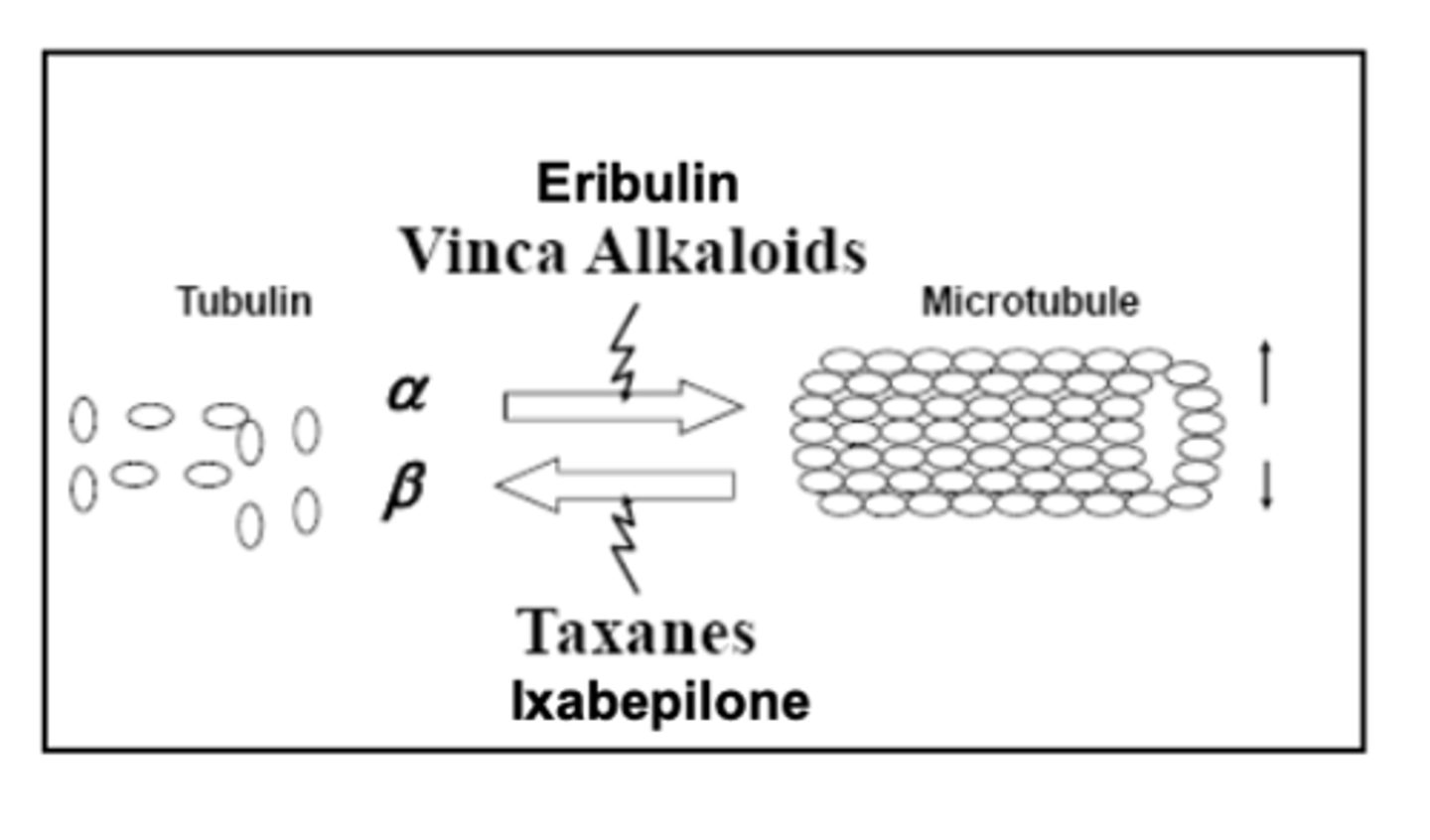
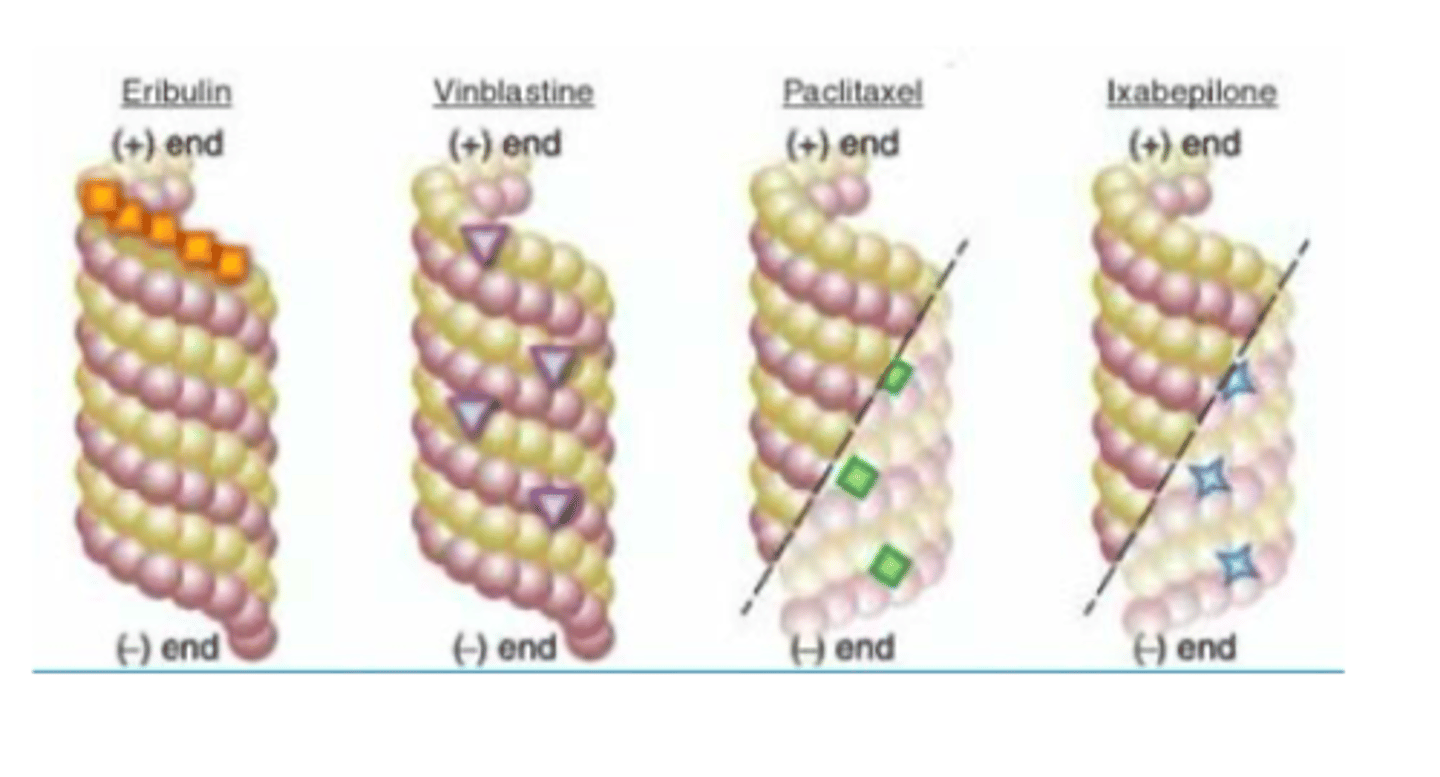
M-phase specific agents: _______ _________ and _________ are similar and function by inhibiting the growth of the positive end of microtubules
- Vinca alkaloids
- Eribulin (are similar)
Microtubule dynamics require constant growth and collapse - these drugs focus on inhibiting growth i.e., tubulin polymerization
M-phase specific agents: _____________ and __________ are similar and function by inhibiting microtubule collapse
- Taxanes
- Ixabepilone
Microtubule dynamics require constant growth and collapse - these drugs focus on inhibiting microtubule collapse, depolymerization
Taxanes drugs
Paclitaxel
Docetaxel
Cabazitaxel
Tubulin polymerization
is the growth of microtubule through the interaction of GTP on the positive end between α-tubulin and β-tubulin
Microtubule dynamics: microtubules are ________ tubes that are composed of a heterodimer of ___-______ and ___-________
- hollow (tubules)
- α-tubulin
- β-tubulin
Tubulin depolymerization
is the collapse of the microtubule through between the α-tubulin and β-tubulin
Tubulin depolymerization is required for microtubule dynamics
Microtubule dynamics: ___________ are hollow tubes that are composed of a ____________ of α-tubulin and β-tubulin
- microtubules (are hollow tubes)
- heterodimer (α-tubulin and β-tubulin)
Microtubules are unstable structures (that undergoes elongation and collapse) that are important in the process of mitosis
Microtubule dynamics: microtubules are unstable structures (that undergoes __________ and __________) that are important in the process of mitosis
- (undergoes) elongation
- collapse
Unstable structures a.k.a. "dynamic instability"
Microtubule dynamics: microtubules are ___________ structures (that undergoes elongation and collapse) that are important in the process of __________, the unstable nature is also known as _________ ________
- unstable (structures)
- (in the process of) mitosis
- (known as) dynamic instability
Microtubule dynamics: Microtubules have a ____ end (_____-_______ ________) and a __________ end (_)
- (+) (end)
- GTP-bound tubulin
- negative (end)
- (-)
Microtubule dynamics: the positive end of the microtubule is also known as the ______-_______ __________
The positive-end is used to _________
- GTP-bound tubulin
- (used to) grow
GTP gets hydrolyzed there is more growth
Microtubule dynamics: anti-microtubule drugs can be classified into drugs that __________ __________ (__________ ___________) or inhibit ____________ _________ (__________ ___________)
- inhibit growth (tubulin polymerization)
- (inhibit) microtubule collapse (tubulin depolymerization)
Polymerization is also known as elongation
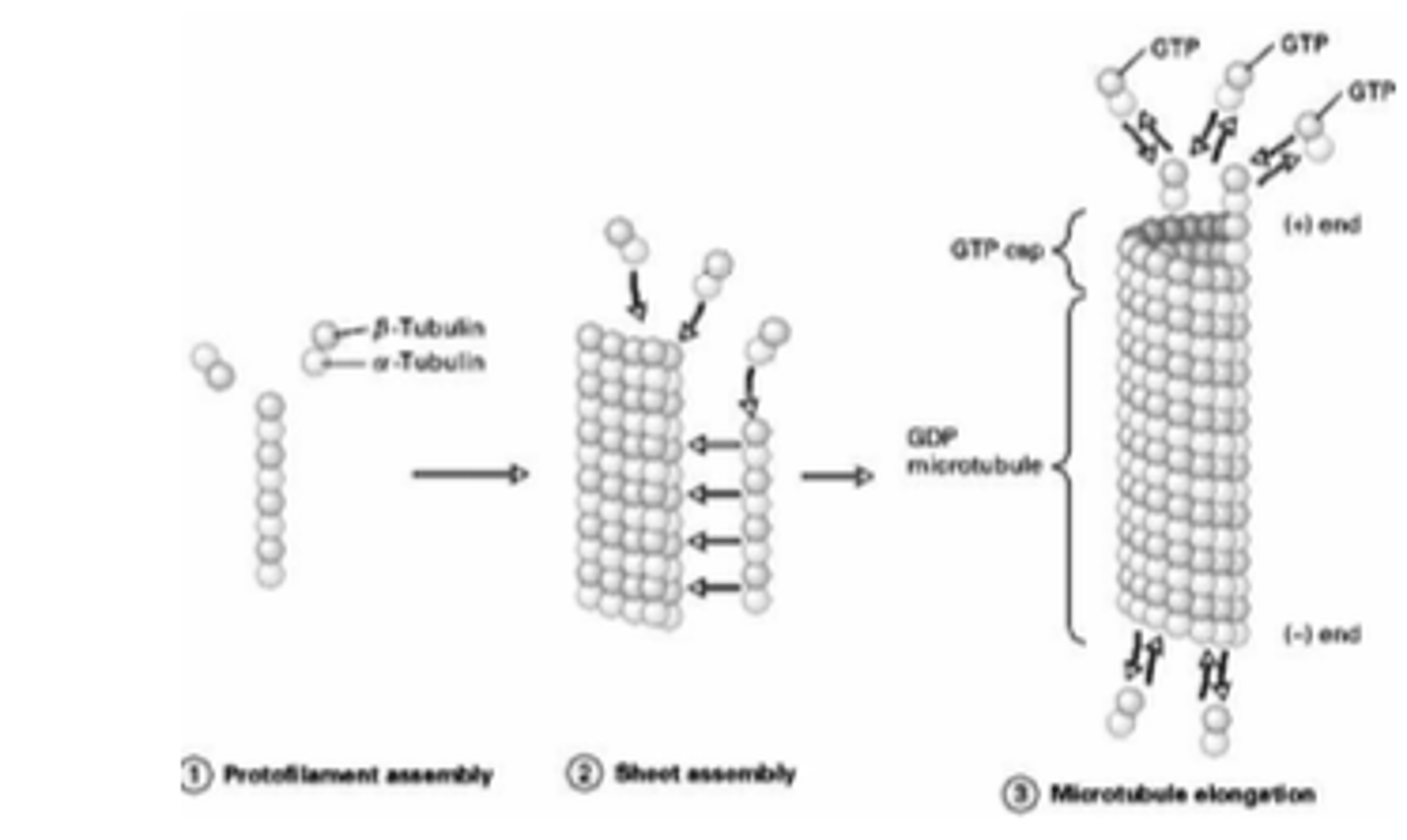
Microtubule assembly mechanism
1. protofilament assembly
2. sheet assembly
3. microtubule elongation
Microtubule dynamics: polymerization step is also known as ___________
- (also known as) elongation
Vinca alkaloid drugs
Vinblastine
Vincristine
M-phase specific antineoplastic agents categorization
Inhibit polymerization / growth / elongation
- Vinca Alkaloids
- Eribulin
Prevents depolymerization / collapse
- Taxanes
- Ixabepilone
Microtubule Dynamics Assembly Figure
Sites of Binding of Antimicrotublue Agents to Microtubules Figure
Binding of Antimicrotublue Agents to β-tubulin subunit figure
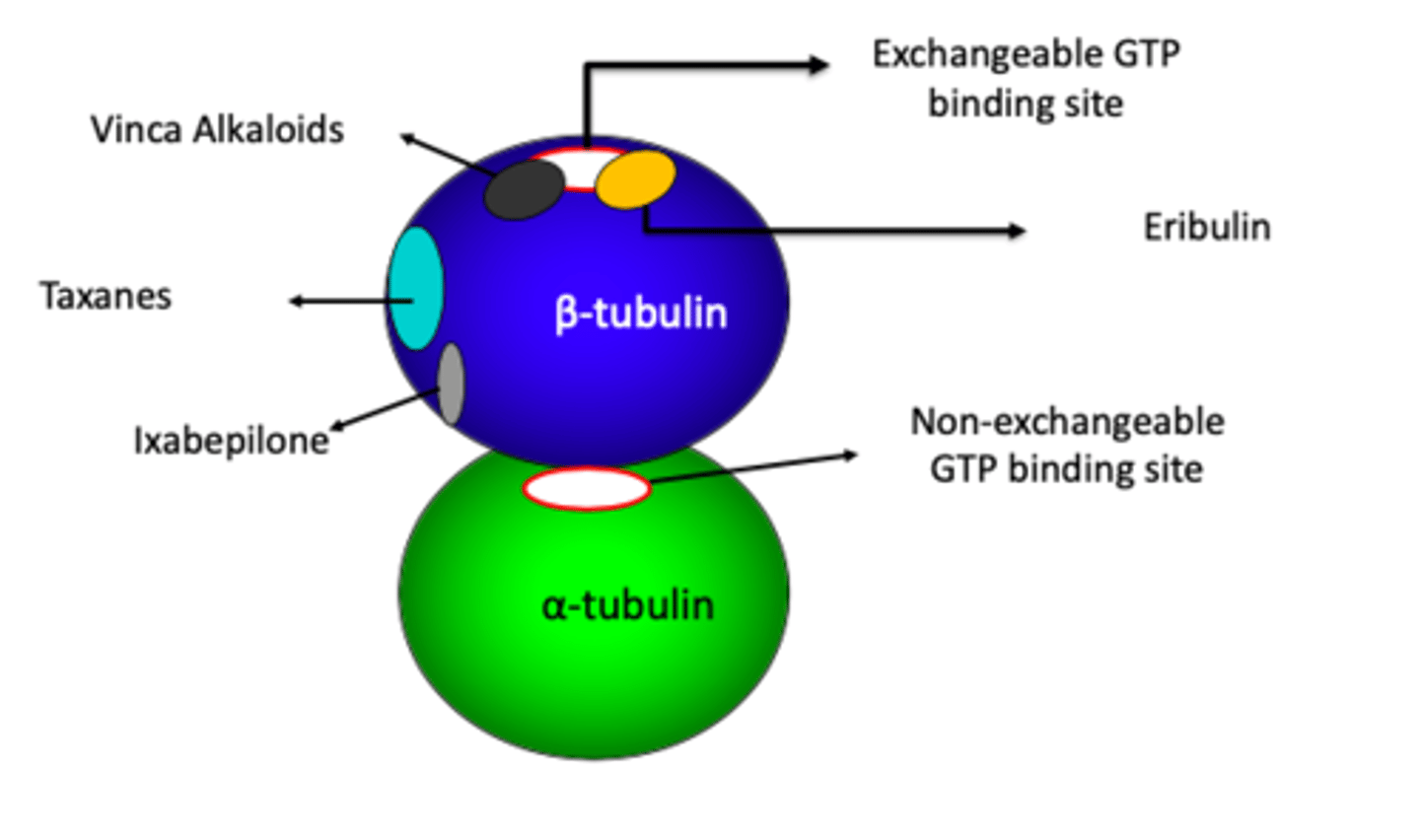
Antimicrotubule agents bind to the site of action located on the ____-___________ subunit, each of the drugs have __________ sites of action
However, in the end they all cause ___________ ________
- β-tubulin (subunit)
- different (sites of action)
- (all cause) mitotic arrest
i.e., Taxanes and Ixabepilone site of action is close to each other but not the same, it also inhibits collapse.
Antimicrotubule agent resistance: resistance is possible if the site of action becomes ___________, such as taxanes, however, due to the different sites of action
An antimicrotubule with a similar mechanism of action, such as __________ can still have the anti-cancer effect
- (becomes) mutated
- ixabepilone (can still have the anti-cancer effect)
In regards to the substitution of antimicrotubule agents for another, cancers are all ___________
Thus, some cancers may be _______ ____________ to preventing microtubule growth vs. tubulin depolymerization, although the mechanism of action may be similar, there is still different ____________ depending on the cancer
- (are all) different
- more susceptible
- (still different) efficacies
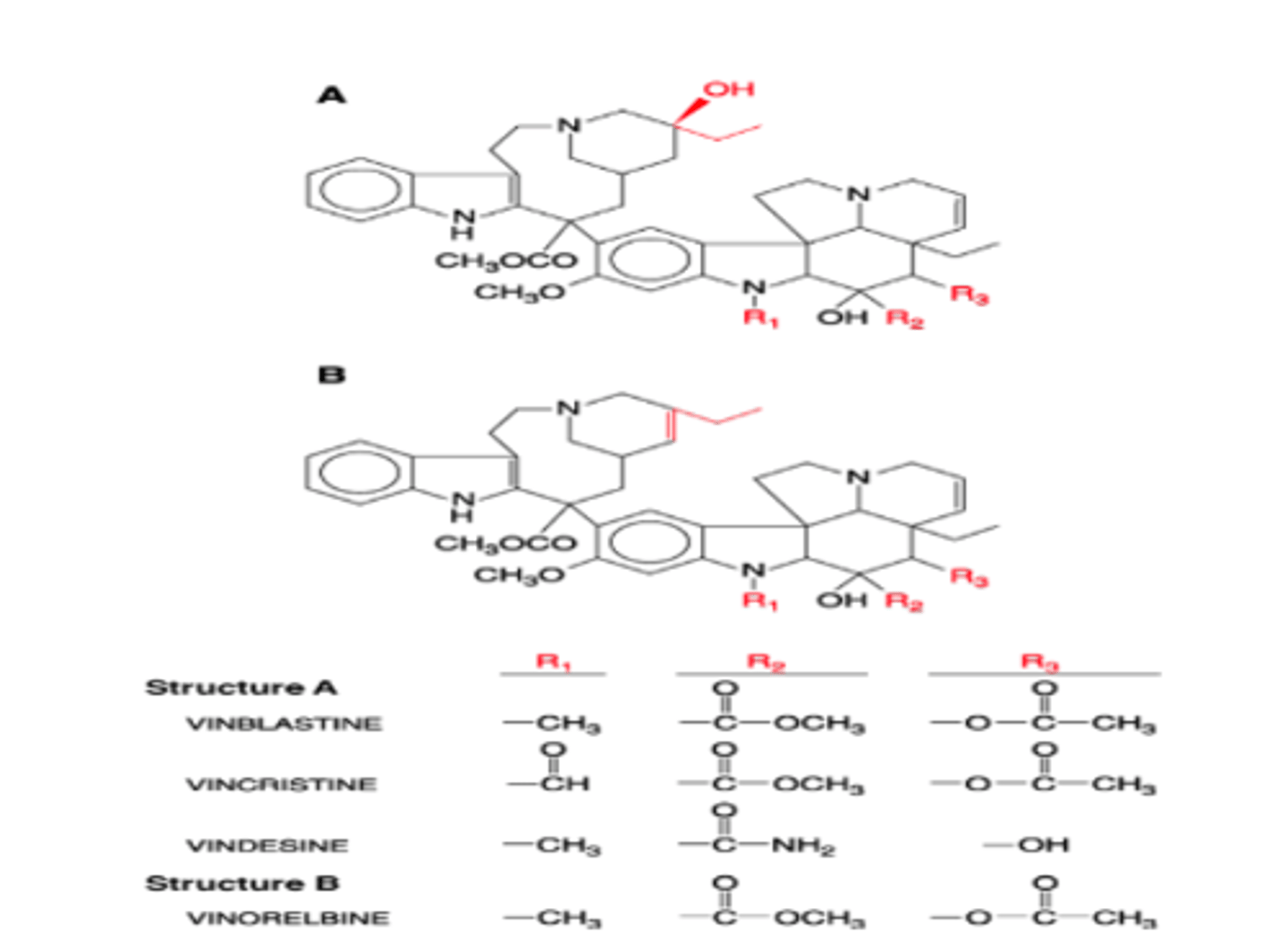
Vinca Alkaloids Structures
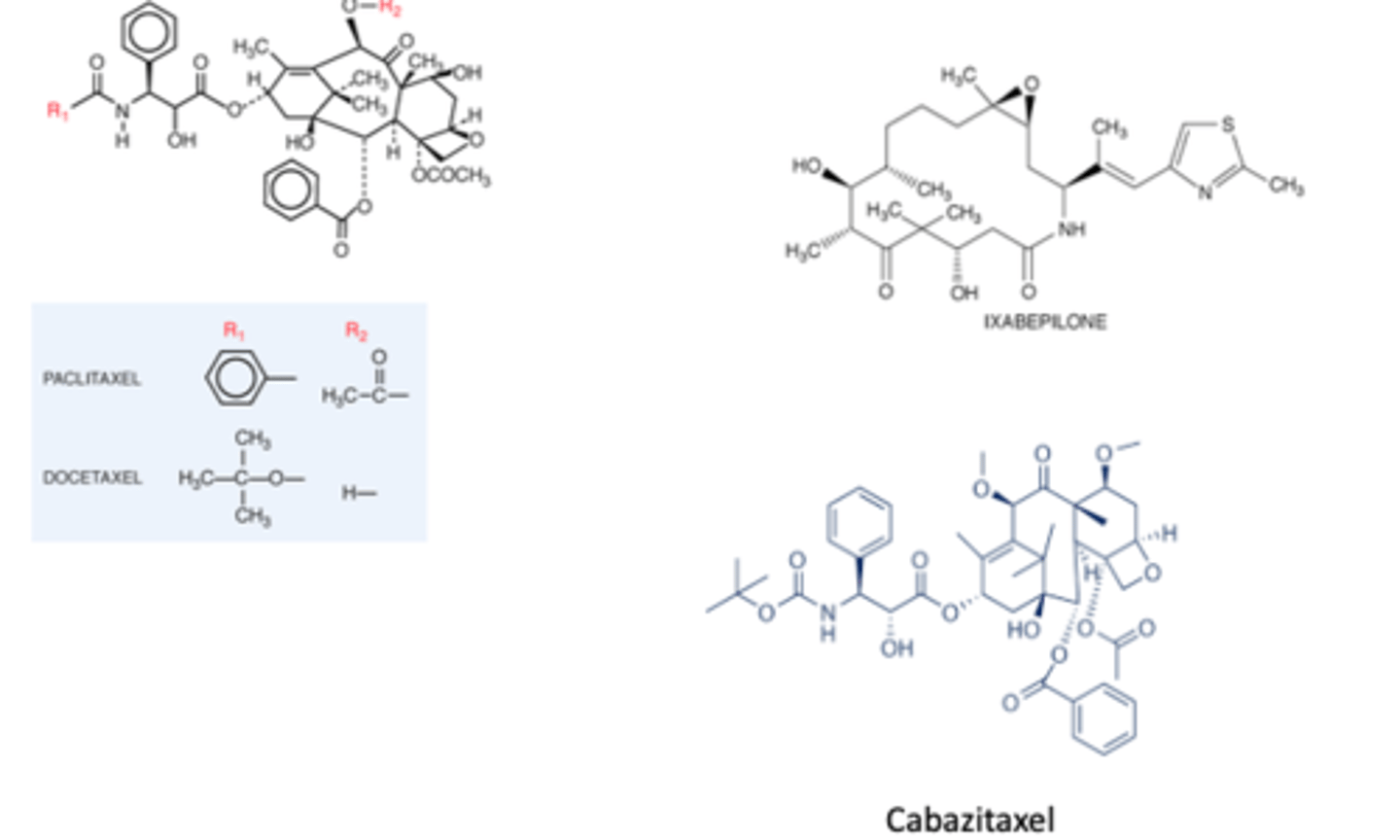
Taxanes and related drugs structures
Paclitaxel formulations
1st generation: Paclitaxel (TAXOL)
2nd generation: nab-paclitaxel (ABRAXANE)
Paclitaxel formulations - 1st generation
Paclitaxel (TAXOL)
Paclitaxel formulations - 2nd generation
nab-paclitaxel (ABRAXANE)
Paclitaxel formulations: paclitaxel (TAXOL) is very __________________ and had a very _________ excipient; ________________ _____ with _____________ _________ oil
- (very) lipophilic
- (very) oily (excipient)
- Cremophor El
- polyoxyethylated castor (oil)
This caused a lot of hypersensitivity reactions, which prevented higher doses that can be tolerated by the patient
Paclitaxel formulations: paclitaxel (TAXOL) is very lipohoilic thus it was difficult making it ___________ and had a very oily excipient; Cremophor El with polyoxyethylated castor oil
This caused a lot of __________________ reactions, which prevented ________ doses that can be _________ by the patient
- (making it) soluble
- hypersensitivity (reactions)
- (prevented) higher (doses)
- (that can be) tolerated (by the patient
Maximum tolerated dose of Taxol = 175 mg/m^2
Paclitaxel (TAXOL) maximum tolerated dose
175 mg/m^2
This is 40-50% less versus the second generation nab-paclitaxel (Abraxane), which allowed a higher tolerated maximum dose of 260 mg/m^2
Paclitaxel formulations: nab-paclitaxel (ABRAXANE) is a ___________ polymer that combines ______-_______ ______ _________ (_________) with paclitaxel
- biological (polymer)
- (combines) donor-derived human serum albumin (HSA)
Albumin is more hydrophilic and does not cause as much hypersensitivity reaction as 1st generation paclitaxel, thus there is a higher maximum tolerated dose, which allows better efficacy to treat certain caners
Paclitaxel formulations: nab-paclitaxel (ABRAXANE): is a biological polymer that combines paclitaxel with a donor-derived human serum albumin (HSA)
Albumin is more ____________ and does ______ ________ as much hypersensitivity reaction as 1st generation paclitaxel, thus there is a __________ maximum tolerated dose, which allows ________ efficacy to treat certain caners
- (more) hydrophilic
- not cause (as much hypersensitivity reaction)
- higher (maximum tolerated dose)
- better (efficacy to treat...)
Paclitaxel formulations: nab-paclitaxel (ABRAXANE) maximum tolerated dose
260 mg/m^2
Which is 40-50% higher maximum tolerated dose than first generation paclitaxel (TAXOL) of 175 mg/m^2
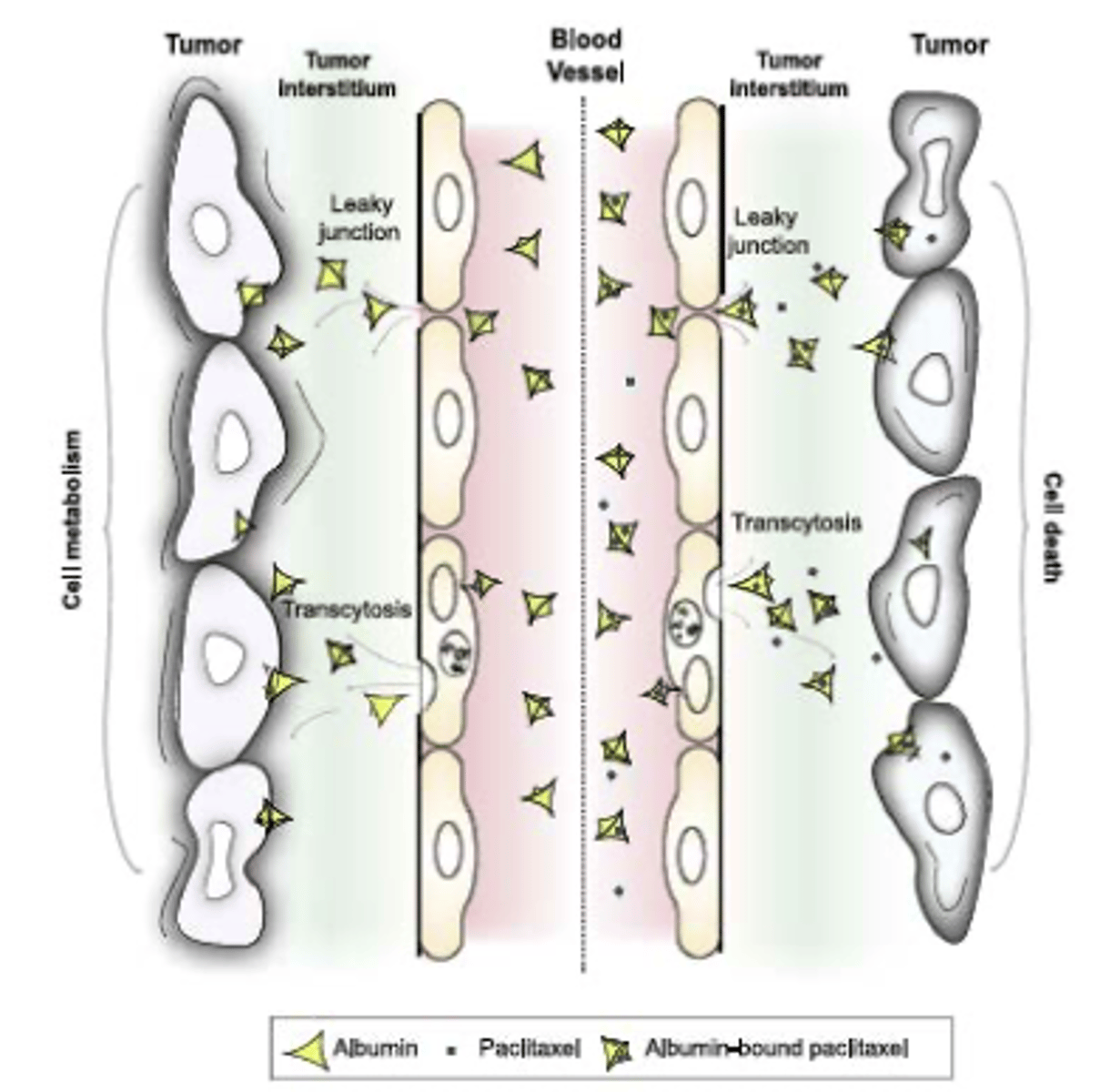
Nab-paclitaxel (ABRAXANE): conjugation of albumin to paclitaxel leads to several favorable outcomes
reduce Cremophor excipient concentration (responsible for hypersensitivity reaction with Paclitaxel [TAXOL])
Enhanced receptor-mediated transcytosis via endothelial cells due to the presence of albumin receptors on endothelial cells
EPR effect improves drug accumulation in the tumor
Reduction in off-target toxicity leads to an increase in maximum tolerated dose for Nab-paclitaxel compared to paclitaxel
EPR effect
Enhanced permeation and retention effect- happens in cancers where newly formed blood vessels are leaky, allowing for nanoparticles to pass through when they wouldn't permeate through normal blood vessels
Nab-paclitaxel (ABRAXANE): conjugation of albumin to paclitaxel leads to: ________ Cremophor excipient concentration (responsible for ___________ reaction with Paclitaxel [TAXOL])
- reduce (Cremophor excipient)
- hypersensitivity (reaction)
Nab-paclitaxel (ABRAXANE): conjugation of albumin to paclitaxel leads to: Enhanced receptor-mediated transcytosis via endothelial cells due to the presence of _____________ receptors on endothelial cells
- albumin (receptors on endothelial cells)
Nab-paclitaxel (ABRAXANE): conjugation of albumin to paclitaxel leads to: ___________ ________-_________ ____________ via endothelial cells due to the presence of albumin receptors on endothelial cells
- Enhanced receptor-mediated transcytosis
Nab-paclitaxel (ABRAXANE): conjugation of albumin to paclitaxel leads to: _______ ________ improves drug accumulation in the tumor
- EPR effect (improves drug accumulation)
Nab-paclitaxel (ABRAXANE): conjugation of albumin to paclitaxel leads to: Reduction in ______-_________ _______ leads to an _________ in maximum tolerated dose for Nab-paclitaxel compared to paclitaxel
- (Reduction in) off-target toxicity
- increase (in maximum tolerated dose)j
Nab-paclitaxel (ABRAXNE): enhanced receptor-mediated transcytosis figure
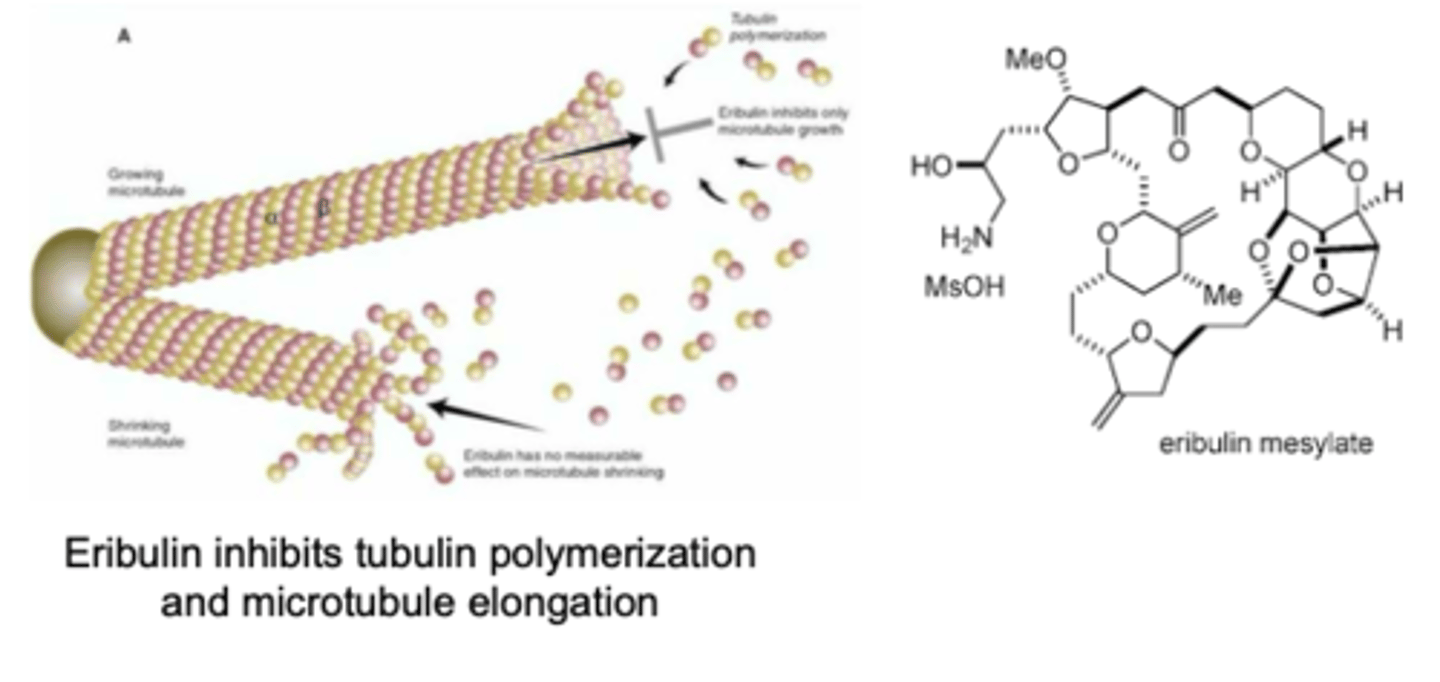
Eribulin mesylate: Eribulin inhibits ___________ _________ and _________ ________
- (Eribulin inhibits) tubulin polymerization
- microtubule elongation
Eribulin mesylate MOA figure
Mechanisms of resistance towards antimicrotubules: ____-_____________ of β-tubulin expression and/or ________ of β-tubulin binding sites
- up-regulation (of β-tubulin expression)
- mutation (of β-tubulin binding sites)
Mechanisms of resistance towards antimicrotubules: up-regulation of ___-_________ ______ and mutation in _____-_________ _______ _____
- (up-regulation of) β-tubulin expression
- (mutation in) β-tubulin binding sites
Mechanisms of resistance towards antimicrotubules: efflux pump ______-______________
- (efflux pump) over-expression
Efflux pump over-expression may cause multiple drug resistance (MDR)
Cabazitaxel is not a substrate of the efflux pump in contrast to paclitaxel or docetaxel
Mechanisms of resistance towards antimicrotubules
up-regulation of β-tubulin expression
mutation in β-tubulin binding sites
efflux pump over-expression
Mechanisms of resistance towards antimicrotubules: efflux pump over-expression, ___________ is not a substrate of the efflux pump in contrast to paclitaxel or docetaxel
- cabazitaxel (is not a substrate of the efflux pump)
Summary of effects of Antimicrobules figure