BIOCH 200 Unit 8 - Oxidative Phosphorylation (Terms)
 Call Kai
 Learn
Learn Practice Test
 Spaced Repetition
 Match
Match Flashcards
 Knowt Play
1/16

There's no tags or description
Looks like no tags are added yet.
Name | Mastery | Learn | Test | Matching | Spaced | Call with Kai |
|---|
No analytics yet
Send a link to your students to track their progress
17 Terms
Oxidative Phosphorylation
The pathway describing two separate phenomena of oxidation and phosphorylation that is the main way for organisms to produce the ATP needed to sustain daily activities
Oxidation
The stage in oxidative phosphorylation in which reduced electron carriers are re-oxidized by passing their electrons to O2, generating H2O
Phosphorylation
The stage in oxidative phosphorylation in which ADP is phosphorylated to ATP, driven by free energy released during oxidation
Coenzyme Q
A lipid soluble (hydrophobic) coenzyme that acts as a mobile electron carrier of complexes I, II, and III of the electron transport chain, able to accept 1 OR 2 electrons at once via the gain of hydrogen atoms
Cytochrome C
A peripheral membrane hemoprotein that acts as a mobile electron carrier of complexes III and IV of the electron transport chain, able to accept 1 at once via direct reduction of its heme group
ETC Complexes
4 integral membrane proteins found on the electron transport chain that are the sites of proton movement and electron transfer
Iron Sulfur Clusters
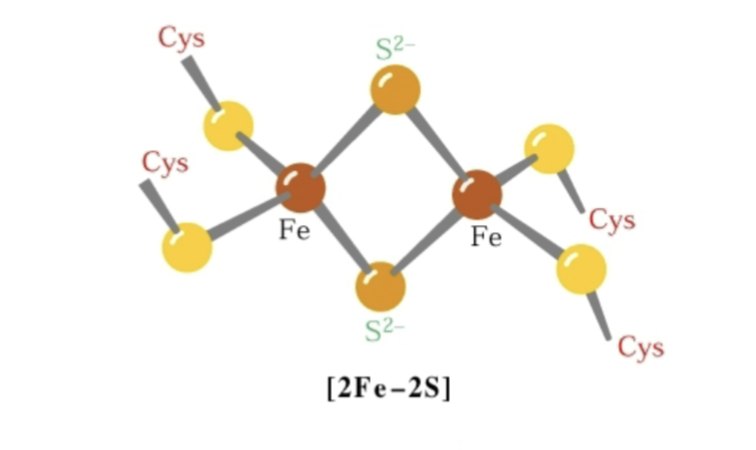
Cofactor groups made of 2 Fe atoms coordinated by 2 inorganic S atoms, able to accept 1 electron at once via the direct reduction of a metal ion (Fe3++ e- → Fe2+)
Cytochromes
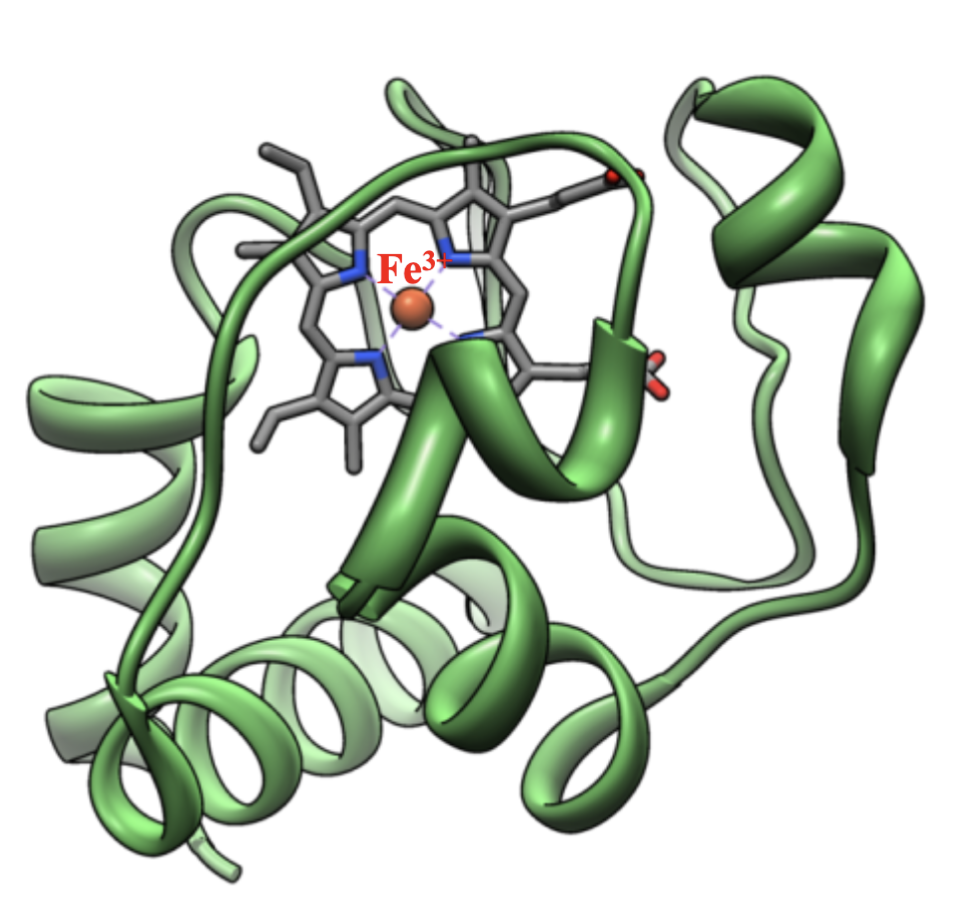
Hemoprotein cofactors that carry out electron transport, able to accept 1 electron at once via the direct reduction of a metal ion (Fe3++ e- → Fe2+)
Flavin Mononucleotide (FMN)
A nucleotide cofactor that is the first prosthetic group of complex I in the electron transport chain, able to accept 1 OR 2 electrons at once via the gain of hydrogen atoms
Flavin Adenine Dinucleotide (FAD)
A nucleotide cofactor that is the first prosthetic group of complex II in the electron transport chain, able to accept 1 OR 2 electrons at once via the gain of hydrogen atoms
ATP Synthase
An integral membrane protein found at the end of the electron transport chain containing two separate domains that undergo conformational changes to allow synthesis of ATP from a proton gradient
F1 (Catalytic Domain)
The domain of ATP synthase found within the matrix responsible for the catalytic transformation of ADP and an inorganic phosphate into ATP
F0 (Integral Membrane Domain)
The domain of ATP synthase found within the inner mitochondrial membrane that conducts H+ down its gradient, providing energy that triggers a conformational change in F1 to allow ATP production
Adenine Nucleotide Translocase
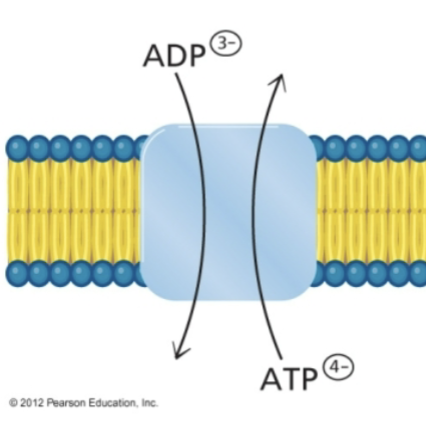
An antiporter for ATP and ADP located on the inner mitochondrial membrane that exports newly synthesized ATP produced in the mitochondrial matrix for use in the intermembrane space and imports ADP produced in the cytosol for use in the mitochondrial matrix
Pi - H+ Symporter
An symporter for inorganic phosphate and protons located on the inner mitochondrial membrane that imports inorganic phosphates produced in the cytosol and protons into the mitochondrial matrix for use
P/O Ratio
The ratio of ATP molecules synthesized compared to oxygen consumed for a certain molecule, measuring the relative efficiency of an electron carrier at producing ATP
Uncoupling
Separating coupled processes such that the energy created to power a coupled reaction can be used for a separate biological function