ANTA102 - Weather and Climate
 Call Kai
 Learn
Learn Practice Test
 Spaced Repetition
 Match
Match Flashcards
 Knowt Play
1/39

There's no tags or description
Looks like no tags are added yet.
Name | Mastery | Learn | Test | Matching | Spaced | Call with Kai |
|---|
No analytics yet
Send a link to your students to track their progress
40 Terms
define weather
day to day condition of the atmosphere
define meteorology
science dealing with weather especially its prediction
define climate
longer term integration of weather dealing with statistics of weather.
Can be defined as averaged weather.
define AMS
the slowly varying aspects of the atmosphere-hydrosphere-land surface system
What is slowly varying?
typical time scales may be as long as thousands of years, or as short as decades
define climatology
this is the science dealing with climate which looks at long data records, processes affecting climate and climate change
What aspects determine the state of the climate system?
1. Sun radiation
2. Earth's rotation rate and orbital
3. Composition of the atmosphere
4. Interactions between the atmosphere and the other components in the Earth system (ocean, biosphere, cryosphere)
What regions of the planet contribute the most to global warming?
Tropics and northern mid-latitudes
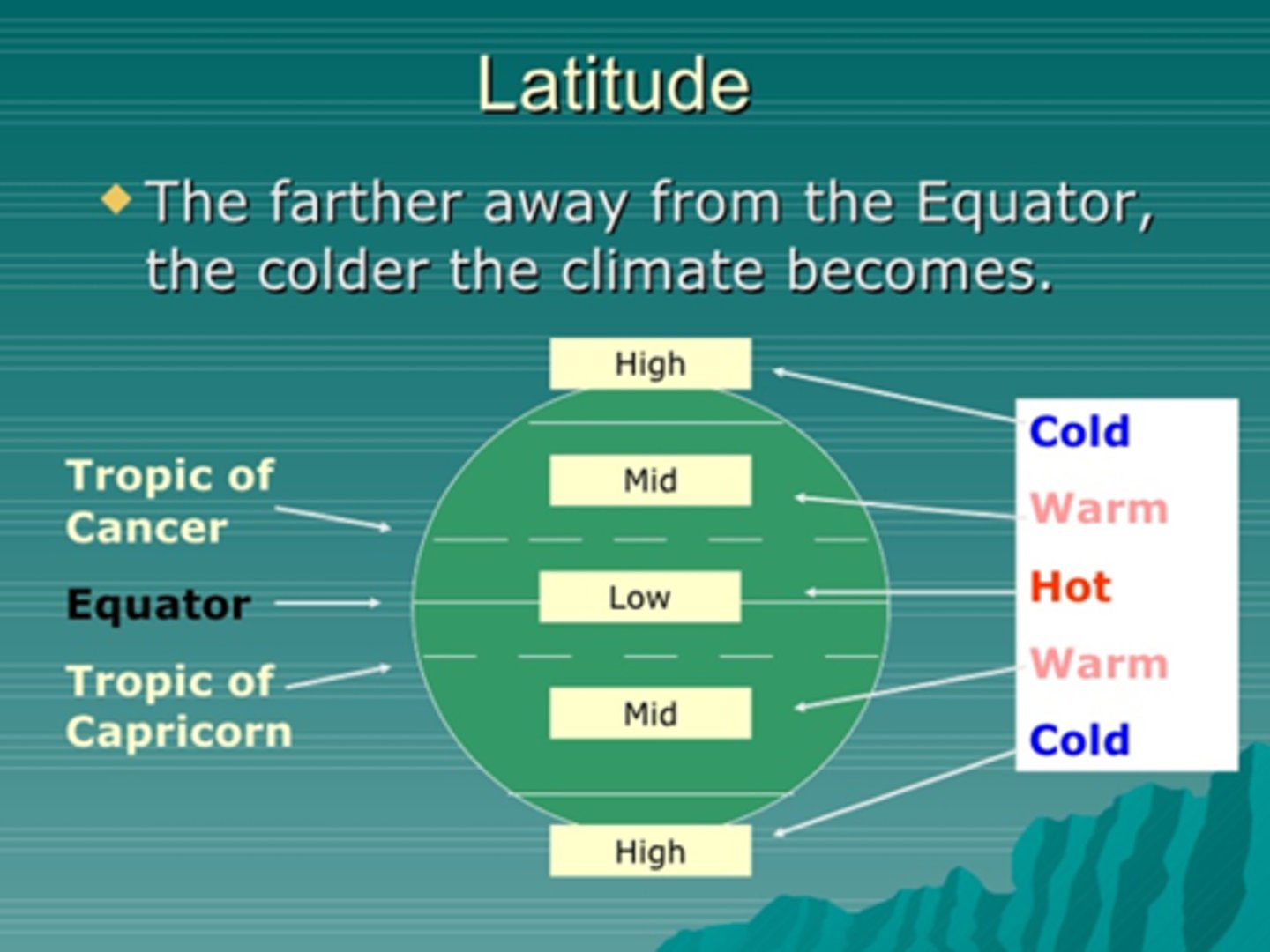
What are the differences in temperature and seasons between the Arctic and Antarctica?
The Arctic and Antartica have opposite summer and winter seasons.
Antarctica has less variation in temperature between the winter and summer months, compared to the Arctic. It also is much colder in Antarctica than the Arctic.
Whether solar radiation is absorbed or reflected by the Earth's surface is determined by what?
- Solar angle
- Sunlit duration
- Reflectivity (albedo)
Why is Antarctica much colder than the Arctic? Use albedo.
Antarctica has more snow and ice which reflects solar radiation, where the Arctic has oceans that absorb that radiation.
What determines surface temperatures?
- Advection
- Terrestrial radiation
- Elevation (colder at high elevation due to low pressure)
- Solar radiation and reflectivity/albedo
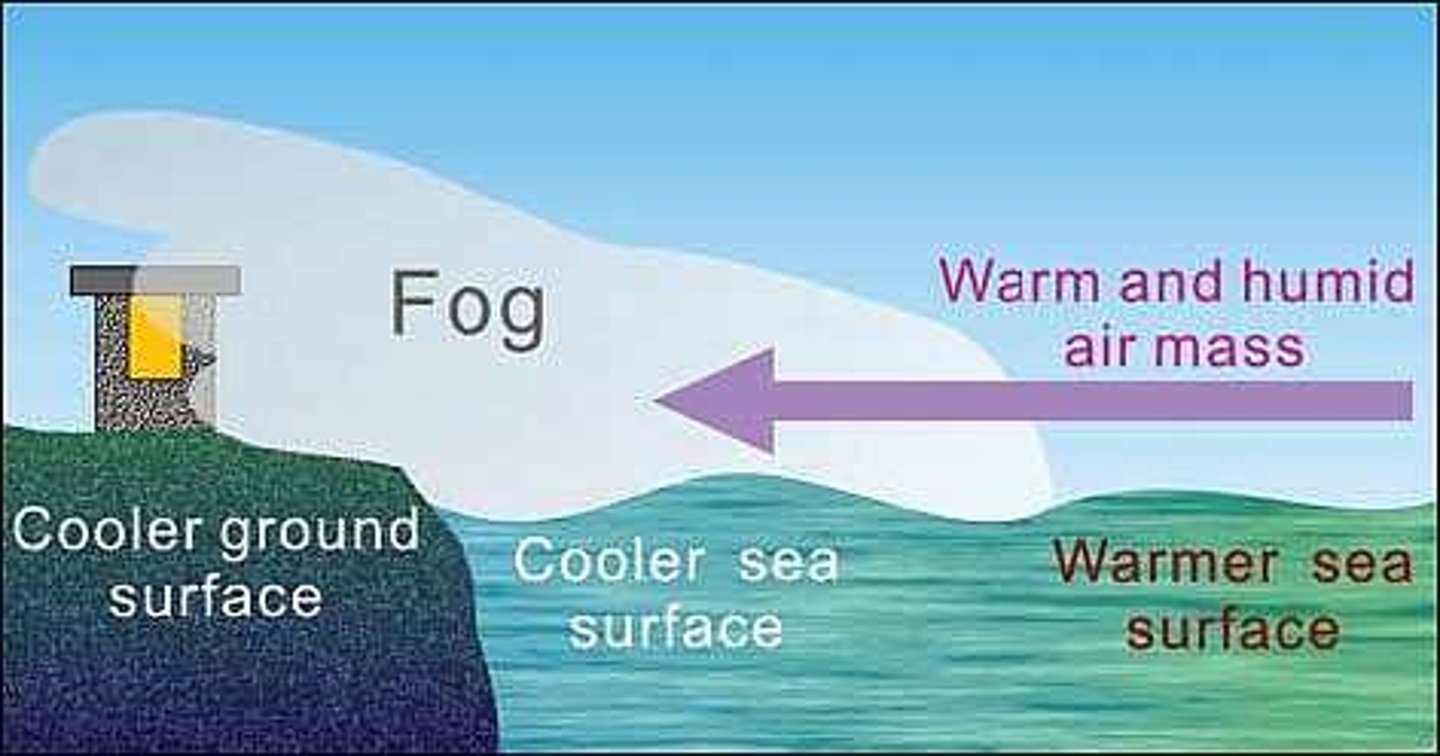
Define advection
Cooling that occurs when air rises horizontally
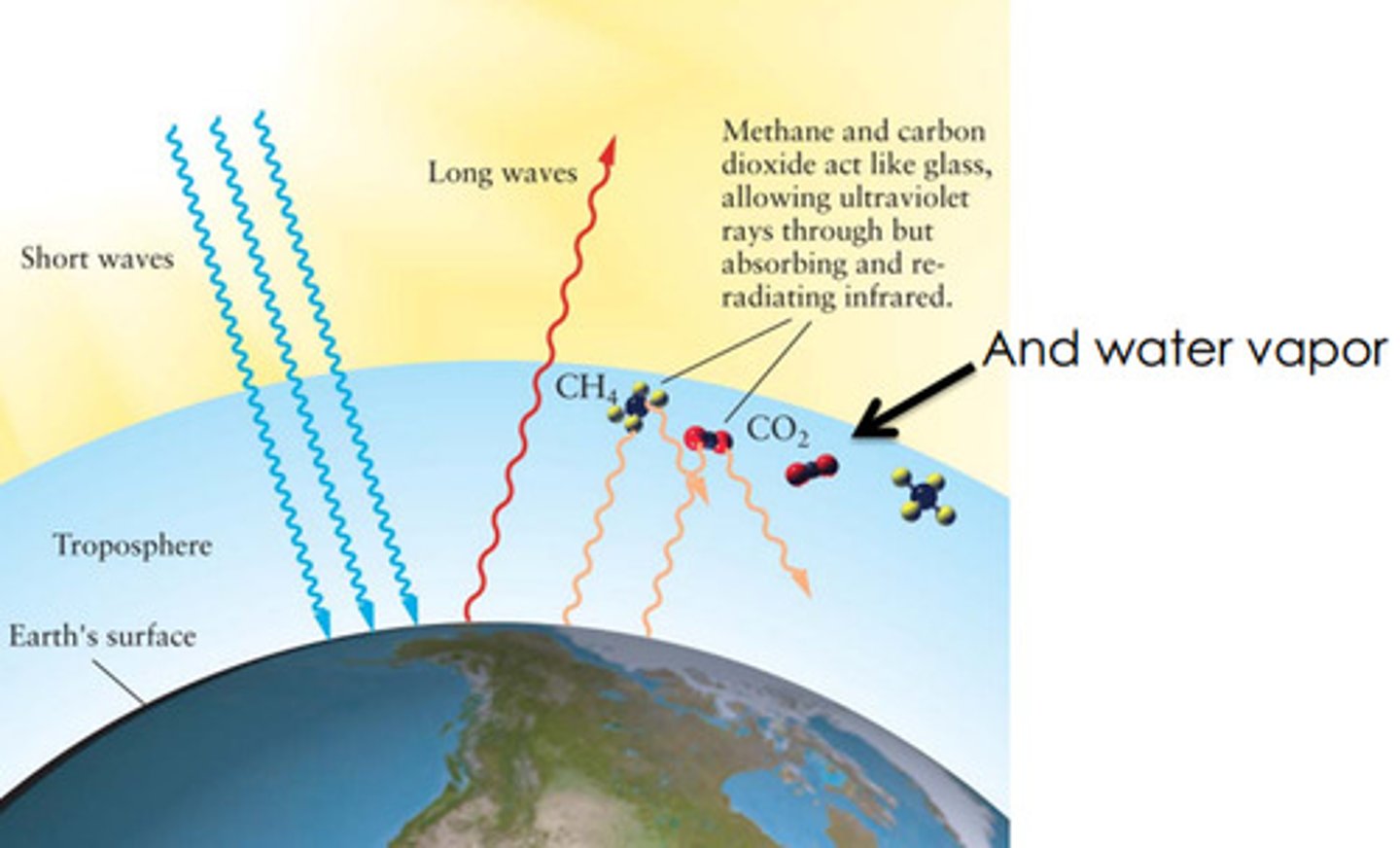
Define terrestrial radiation
Radiation given off by the earth
How can solar radiation intensity be reduced?
- spread over a larger area (b/c of angle), so larger spread closer to polar regions
- longer atmospheric path length
define albedo
the proportion of the incident light or radiation that is reflected by a surface.
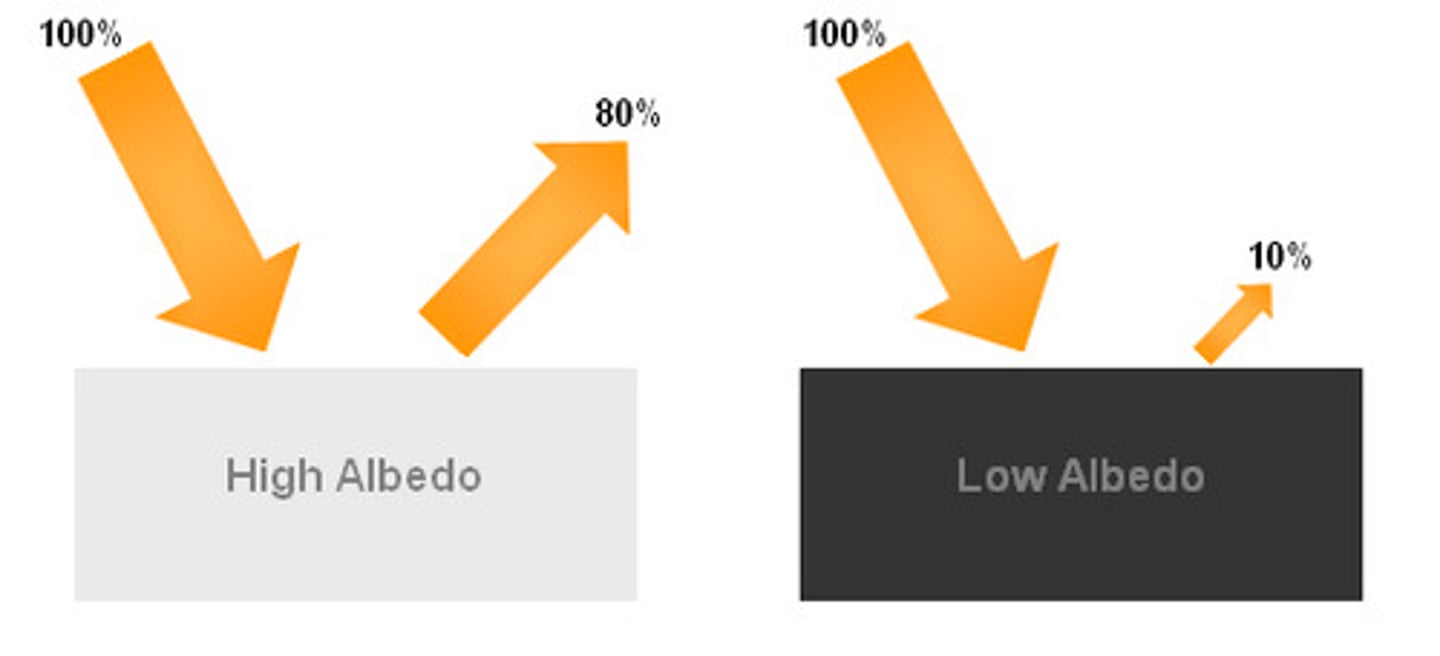
Variations in solar radiation at the same latitude is due to ______?
Variations in solar radiation at the same latitude is due to albedo
What things are good at increasing albedo?
- clouds
- snow
- ice
Why is their variations in solar radiation between seasons?
the earth is on a tilt so one half of the earth is angled away from the sun, thus increasing the distance the radiation has to travel
What is outgoing longwave radiation?
thermal radiation released by the earth's surface
What is absorbed more by earth, solar radiation or outgoing longwave radiation?
outgoing radiation
- trapped by clouds
What drives atmospheric and oceanic motion?
the imbalance between the net radiation of the globe. The equator has a surplus of radiation, and the poles have a deficit. The climate system is constantly trying to transport heat from the tropics towards the poles.
*The main function if the polar regions is therefore to act as a heat sink for the global climate system.*
To maintain heat balance, we require transport north and south from the equator. What transports this heat? How much heat transport by each? Why?
The atmosphere and the ocean. The atmosphere transports more heat because air moves much faster than water and is more effective.
Temperature is also impacted by elevation. What are the different vertical structures of the atmosphere and what are their qualities.
Troposphere - This region contains most of the water in the atmosphere and is the region closest to the Earth's surface.
Stratosphere - contains the ozone layer
Mesosphere & Thermosphere - these regions form the edge between the atmosphere and space. The air is very thin at these altitudes.
Where is the most snowfall in Antarctica? The least?
Most snow = coastlines
Least snow = furthest inland
Why is it super hard to measure snowfall in Antarctica?
brutal weather
limited weather stations
Where is the stormiest place on earth?
The Southern Ocean
Why is there more snowfall on the coastlines of Antarctica?
Storms spiral inward towards Antarctica. The storms hit the coastline causing moisture to be released as it hits the cold temperatures. Cold air cannot hold very much moisture.
Where does the water that's in this snow come from?
- Evaporation of water from the ocean
- air comes from 40 degrees South (2,000 km away)
- moisture comes from so far away b/c of the motion of the atmosphere to get rid of that surplus of heat
In Antarctica, the snow that lands there comes from extreme precipitation/extreme storms. These intense storms make up ___% of the total annual snowfall across the continent.
In Antarctica, the snow that lands there comes from extreme precipitation/extreme storms. These intense storms make up 40% of the total annual snowfall across the continent.
- not consistent snow
- accumulation only in extreme weather events
The connection between precipitation and extreme storms means this can be important for the future of Antarctic precipitation. There is also lots of ice sheet and shelf melting. Will there be more accumulation or more melting of the ice in Antarctica? Why?
Because more snow fall occurs due to the planet trying to send warmer temperatures towards the poles, there will be an increase of snow fall and storms. However, as the planet warms, ocean temperatures will increase causing more melting. It is hard to predict, but many estimate melting will outrun accumulation.
How does the Coriolis force effect wind?
Coriolis force is directly proportional to wind speed and latitude. It deflects winds to the left in the Southern Hemisphere and right in the Northern Hemisphere.
what is geostrophic approximation?
The balance between the distribution of pressure and Coriolis force (effect of the rotating earth) at large scales. It describes the familiar situation in which the wind blows parallel to the isobars (lines of constant pressure). This works roughly for all large-scale motions away from the equator.
Geostrophic winds go clockwise or anticlockwise around a low pressure cyclone?
Anticlockwise
Geostrophic winds go clockwise or anticlockwise around a high pressure anticyclone?
Clockwise
What are anti-cyclones?
low pressure systems and storms that circulate around the continent, and the areas where there are gaps
What is a katabatic wind?
A wind that flows downslope under the influence of gravity
- common in polar regions
- arctic and Antarctic have persistent low level winds caused by many processes
How do winds move off of Antarctica?
Winds move from plateau to coastline and go down through valleys and the steepest areas.
What can offset the effects of ice melt and sea level rise due to greenhouse gases in Antarctica?
Increased precipitation due to storms from the mixing of cold polar air and warm tropical air
Adverse impacts from human-caused climate change will continue to intensify. What are some adverse impacts?
- physical water availability
- agriculture/crop production
- animal and livestock health and productivity
- fisheries yields and aquaculture production
- infectious dieases
- heat, malnutrition, and harm from wildfire
- mental health
- displacement
- flooding
- infrastructure damages
When the isobars are closer together, what happens to the winds?
Closer isobars = stronger winds