AP Euro Chapter 11
 Call Kai
 Learn
Learn Practice Test
 Spaced Repetition
 Match
Match Flashcards
 Knowt Play
1/56

There's no tags or description
Looks like no tags are added yet.
Name | Mastery | Learn | Test | Matching | Spaced | Call with Kai |
|---|
No analytics yet
Send a link to your students to track their progress
57 Terms
What was the initial cause of the Hundred Years' War between England and France?
King Philip VI of France's seizure of Aquitaine
The bubonic plague is usually limited to
rats and other rodents.
The period of climate change in Europe between 1300 and 1450 is known as the
"little ice age"
In general, during the plague, the clergy
cared for the sick and buried the dead
How did the flagellants respond to the Black Death?
They whipped and scourged their bodies as penance, believing that the Black Death was God's punishment for humanity's wickedness.
How were the consequences of the "little ice age" experienced in Europe?
Economic disruptions in one region had serious implications for its trading partners in other, distant regions.
In which of the following ways did Charles VII of France expand his authority?
He expelled the English from all French soil except Calais
Between 1309 and 1376, a period known as the Babylonian Captivity, popes lived in
Avignon.
Who benefited from the Black Death?
Workers: Those who survived demanded high wages after the Black Death, increasing the standard of living for the broad mass of people.
Why did Jan Hus gain so many followers?
His attack on papal authority and his call for the translation of the Bible into Czech resonated with many people who were opposed to the church's wealth and were experiencing an emerging Czech nationalism.
The English public was convinced that the Hundred Years' War was waged to
secure for King Edward the French crown he had been unjustly denied.
One important mode of influencing public opinion, used by the English and French kings during the Hundred Years' War, was
instructing priests to deliver patriotic sermons
What English weapon provided an advantage against the mounted French knights in the battles of Poitiers and Agincourt?
The longbow
How did the English induce panic among the French troops at the Battle of Crécy?
By using the longbow to send a torrent of arrows into the French, followed by artillery from the ring of cannon
How did minority groups suffer during the subsistence crises of the fourteenth century?
Jews and lepers were accused of poisoning wells to kill Christians, and, as a result, many were killed, beaten, or heavily fined.
The Great Schism began with the deposition of _____________ by the College of Cardinals.
Urban VI
How does Dante's Divine Comedy demonstrate the tensions of the fourteenth century?
It is a deeply Christian poem but also harshly criticizes some church officials.
The establishment of new colleges and universities in the years following the Black Death
greatly weakened the international nature of medieval culture
How did the cannon affect the power of monarchies?
only central governments could afford cannons, enhancing the military power of the central states over its nobility
What was the typical goal of a woman pursuing a charge of rape?
To restore her honorable reputation
In issuing the Statute of Laborers (1351), what were English lords attempting to do?
Freeze salaries and wages at pre-1347 levels
The following is an excerpt from the transcript of the trial of Joan of Arc (Evaluating the Evidence 11.2):
"Asked whether she had heard her voice since Saturday, she answered: 'Yes, indeed, many times.' . . . Asked what it said to her when she was back in her room, she replied: 'That I should answer you boldly.' . . . Questioned as to whether it were the voice of an angel, or of a saint, or directly from God, she answered that the voices were those of Saint Catherine and of Saint Margaret. And their heads are crowned with beautiful crowns, most richly and preciously. And [she said] for [telling you] this I have leave from our Lord. . . ."
This exchange between Joan and her interrogators suggests which of the following?
That Joan believed herself to be in frequent communication with God and the saints
What was theologian John Wycliffe's main argument?
Scripture alone should determine church belief and practice
The following is an excerpt from an account of a speech given by the English rebel leader John Ball in the 1360s (Thinking Like a Historian):
"My good friends, matters cannot go on well in England until all things shall be in common; where there shall be neither vassals nor lords; when the lords shall be no more masters than ourselves. How ill they behave to us! For what reasons do they thus hold us in bondage? Are we not all descended from the same parents, Adam and Eve? When Adam delved and Eve span, who was then the gentleman? What reason can they give, why they should be more masters than ourselves? . . . Let us go to the King and remonstrate with him; he is young, and from him we may obtain a favorable answer, and if not we must ourselves seek to amend our condition."
Based on the evidence provided by this passage, John Ball was determined to
fight for social and economic equality.
Which of the following was one of the causes of the Hundred Years' War?
Disagreements over rights to land
What characteristic distinguished the English Parliament from other representative assemblies?
The frequency of the English Parliament's meetings established the sense and expectation that its authorization was required for certain types of legislation.
How did early-fourteenth-century French kings respond to the Great Famine and its consequences?
By attempting to stop grain speculation
Which of the following was an important difference between the plague that struck Europe in the fourteenth century and the one that struck India and China in the nineteenth century?
here are no reports of massive rat die-offs in fourteenth-century records.
"[N]ot only did talking to or being around the sick bring infection and a common death, but also touching of the sick or anything touched or used by them seemed to communicate this very disease to the person involved."
In this quote from Giovanni Boccaccio, what knowledge of the Black Death is he sharing?
Any contact with the sickened individual, or items that the sick had contact with, would result in the infection of those initiating the physical contact.
The following is an excerpt from Christine de Pizan's "Advice to the Wives of Artisans" (Evaluating the Evidence 11.3):
"She ought to oversee them to keep them from idleness, for through careless workers the master is sometimes ruined. And when customers come to her husband and try to drive a hard bargain, she ought to warn him solicitously to take care that he does not make a bad deal. She should advise him to be chary of giving too much credit if he does not know precisely where and to whom it is going, for in this way many come to poverty, although sometimes the greed to earn more or to accept a tempting proposition makes them do it."
This passage provides evidence in support of which of the following statements?
The significant involvement of the wives of artisans in their husbands' businesses
"Fur-collar crime" refers to
groups of nobles who roamed the English countryside stealing from the rich and poor and demanding protection money.
What sparked the peasant rebellions in Flanders that erupted in the 1320s?
The imposition of burdensome taxes
During the Hundred Years' War, the English kings were supported by some French barons because the latter
wanted to stop the French monarchy's centralizing efforts.
What were the achievements of the Avignon popes before the Great Schism?
They reformed the financial administration of the church and centralized its government.
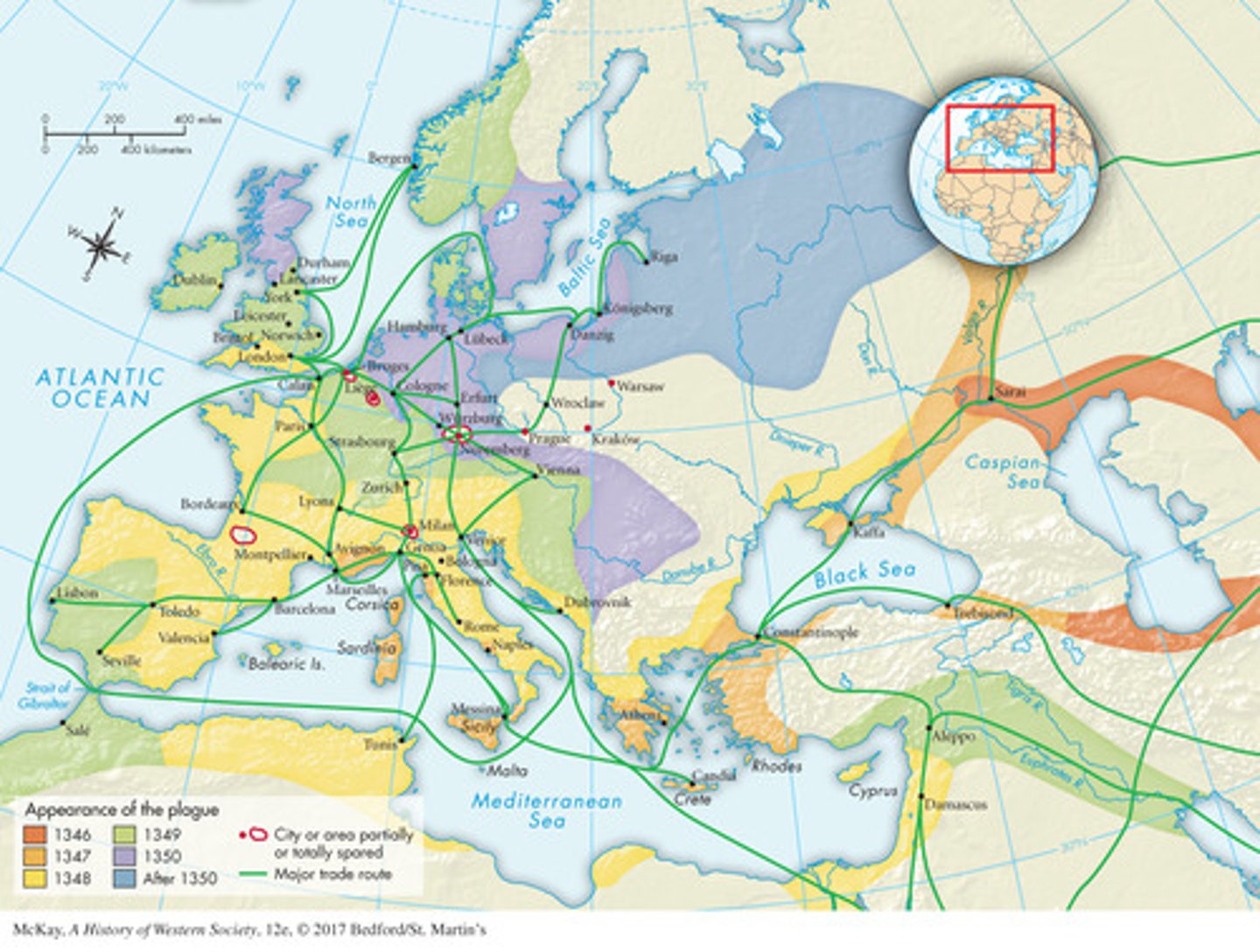
According to Map 11.1: The Course of the Black Death in Fourteenth-Century Europe, the plague spread through Europe following the expansion of what?
Trade and commerce routes
The period from about 1000 to about 1300 saw
a warmer than usual climate in Europe.
During the Great Schism, how did the powers of Europe align themselves?
Along traditional political alliances, with France and her allies supporting the French pope and the others favoring the Italian pope
The following is an excerpt from a poem by the French troubadour Raimon de Cornet written in the 1330s:
"Our bishops, too, are plunged in similar sin [to that of the pope],
For pitilessly they flay the very skin
From all their priests who chance to have fat livings.
For gold their seal official you can win
To any writ, no matter what's therein.
Sure God alone can make them stop their thievings."
Which of the following claims did Cornet make in this passage?
That church officials could be bribed to ignore their spiritual and moral obligations
Which of the following was characteristic of the rebellions that swept across Europe in the late fourteenth and early fifteenth centuries?
They involved both rural and urban laboring people.
How did attitudes toward same-sex relations change from the Early to High Middle Ages?
authorities in the early middle ages were little concerned with same-sex relationships, but in the high middle ages such relationships became capital crimes
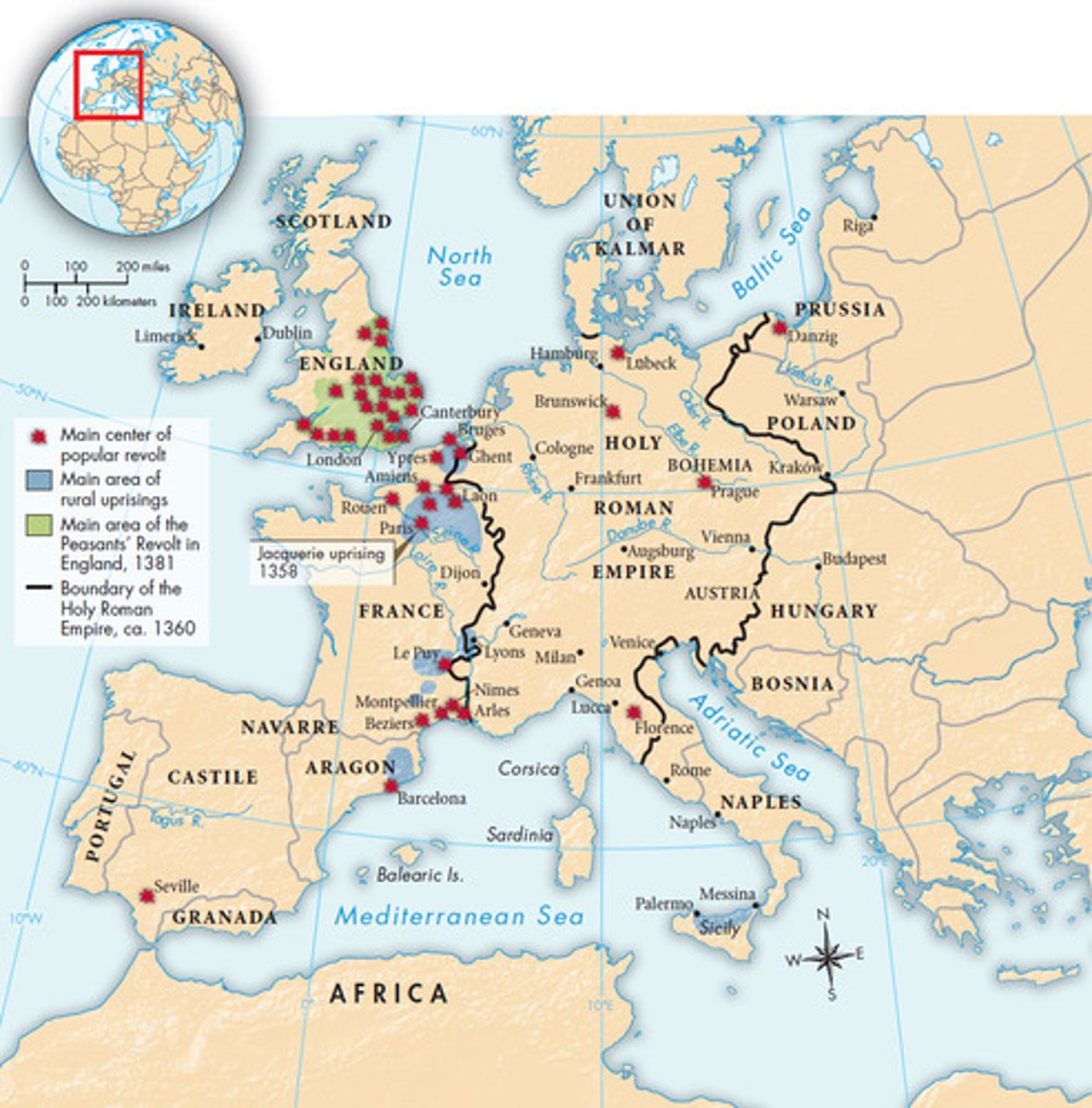
According to Map 11.3: Fourteenth-Century Revolts, where was the largest number of popular revolts during this period?
England and France
The immediate cause of the English peasant rebellion of 1381 was
the collection of a tax on all adult males, known as the head tax
Which of the following groups joined in the Jacquerie rebellion in France, killing nobles and destroying noble property?
Peasants and small merchants
What changes around 1300 permitted a significant expansion in the movement of goods?
Improvements in ship design permitted year-round shipping.
The highly infectious nature of the plague was enhanced by
urban congestion and lack of sanitation
The Statute of Kilkenny attempted to
maintain the ethnic purity of the english living in ireland by preventing intermarriage or cultural assimilation
What battle provided the English and King Edward III a tremendous victory over mounted French knights in 1346?
Crécy
The religious life of Bridget of Sweden demonstrates that
mystical experiences were an important part of medieval Christianity.
In the High Middle Ages, prostitution was
regulated by state authorities
The English treatment of the Irish was the great exception to
the legal dualism between natives and colonists.
All of the following groups of people joined in the Jacquerie rebellion in France, killing nobles and destroying noble property, except
knights
What was the punishment for rape in most of Europe?
The punishment was death, though actual sentences were more likely to be fines or brief imprisonment.
Confraternities were part of a movement in which
laymen and laywomen increasingly took control of parish affairs
The spread of literacy
was a response to the needs of commerce and government
What was the focus of the Avignon popes?
The Avignon popes focused on bureaucratic matters to the exclusion of spiritual objectives.
Which of the following best characterizes Joan of Arc's experience in the military?
The king made her co-commander of the army, and she led it to a string of victories
Most historians identify the disease associated with the Black Death as the bubonic Plague; however, some historians have asserted that it was a different disease, something like,
the Ebola virus