Physics Momentum study guide
 Call Kai
 Learn
Learn Practice Test
 Spaced Repetition
 Match
Match Flashcards
 Knowt Play
1/39

There's no tags or description
Looks like no tags are added yet.
Name | Mastery | Learn | Test | Matching | Spaced | Call with Kai |
|---|
No analytics yet
Send a link to your students to track their progress
40 Terms
If solving for the vf of an object after a collision but both objects are equal in mass then use the equation…
vf2= (vi1+vf2)-vf
If solving for the vf of an object after a collision but both objects are NOT equal in mass then use the equation…
(m1 x vi1) + (m2 x vi2) = (m1 x vf1) + (m2 x vf2)
what is Newtons 3rd law:
For every action there is an equal, opposite, and simultaneous reaction
If force is applied to an object by the same amount at the same time with the same magnitude then the impulse is…
the same for both objects just in opposite directions
The Term “Action/Reaction Pair” is used to describe what?
wo objects that apply a force on each other
An example of a “Action/Reaction Pair” is
Earth’s gravity pulls you down. At the same time you pull the Earth up.
A graph example of an “Action/Reaction Pair” is
this graph
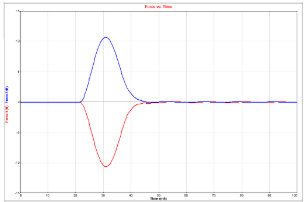
The Impulse of an action/reaction pair is…
equal but opposite due to the force being equal but opposite in direction.
When two objects collide they impart a force on each other with impulses that are equal and opposite or unequal and opposite?
equal but opposite impulses.
opposite impulses mean that the objects have an…
instantaneous change in momentum opposite to their initial direction of motion.
The velocity they move with is potentially different due to their ___ being potentially different.
masses
The phenomenon called recoil is
the momentum of the projectile forward is balanced by the momentum of the weapon backward
In recoil the time…
cancels because both objects experience the force for the same time.
As a result, the post collision velocity in recoil is a based on a…
proportion of the masses involved.
If the masses are equal, both objects will recoil with the…
same velocity
If masses are NOT equal in recoil then the velocity with a larger mass will…
recoil with a smaller velocity.
the recoil equation is
v1 = - (m2v2) / m1
Impulse def:
Force for a given amount of time that changes the acceleration (change in momentum)
Momentum:
The quantity of motion an object has. It's known as “ mass in motion". Meaning all objects that have mass and motion have momentum.
Collision:
When objects try to occupy the same space at the same time.
In an Inelastic Collision:
Kinetic energy is lost
In an Elastic Collision:
Kinetic energy is conserved
In an Explosion:
Kinetic energy is gained
In a Perfectly Inelastic Collision:
Kinetic energy is lost and objects have the same velocity
When is the only time an object does not have momentum?
When its not moving
What happens to the momentum of an object if the velocity the object is moving with increases?
Momentum will increase
If a larger force is applied then the time period is…
shorter
If a smaller force is applied then the time period is…
Longer
In an explosion what physically happens to the objects after the collision?
It breaks apart into multiple different objects
A 10 kg object is moving with a velocity of 20 m/s. What is the magnitude of the object’s momentum?
200 Ns
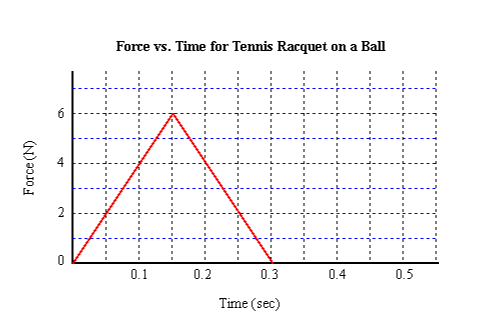
In this image what is the magnitude of impulse that the tennis racket imparts onto the tennis ball as shown by the graph?
0.9 N*s
How do you find impulse from a graph?
By finding the area under the curve
A 2 kg object is originally moving with a velocity of 10 m/s and comes to rest. What is the object’s change in momentum and what equation was used?
p = mv was used and the answer is -20Ns