Industrial Plant Engineering Exit Exam Terms
 Call Kai
 Learn
Learn Practice Test
 Spaced Repetition
 Match
Match Flashcards
 Knowt Play
1/129

There's no tags or description
Looks like no tags are added yet.
Name | Mastery | Learn | Test | Matching | Spaced | Call with Kai |
|---|
No analytics yet
Send a link to your students to track their progress
130 Terms
Is the process of changing or replacing air in any space to provide high indoor air quality.
A. Ventilating System
B. Air Conditioning
C. Exhaust
D. Inhaust
Is the process of changing or replacing air in any space to provide high indoor air quality.
A. Ventilating System (Correct):
Ventilation is the mechanical or natural process of exchanging indoor air with outdoor air to maintain proper indoor air quality.
B. Air Conditioning (Wrong):
Air conditioning controls temperature, humidity, and purity simultaneously, which represents a broader thermodynamic process than air replacement.
C. Exhaust (Wrong):
Exhaust functions only to remove air from a space and does not account for the supply component of air replacement.
D. Inhaust (Wrong):
The term is absent from engineering nomenclature; supply or intake air is the appropriate designation.
A body whose emissivity is less than 1 is known as a real body. What is the other term for real body?
A. Theoretical body
B. Black body
C. Gray body
D. White body
A body whose emissivity is less than 1 is known as a real body. What is the other term for real body?
A. Theoretical body (Wrong):
Theoretical bodies represent idealized concepts rather than physical surfaces with emissivity less than unity.
B. Black body (Wrong):
Black bodies are ideal radiators defined by an emissivity of exactly 1.0.
C. Gray body (Correct):
Surfaces with constant emissivity below 1.0 are categorized as gray bodies for engineering approximations of real surfaces.
D. White body (Wrong):
White bodies are idealized surfaces that reflect all incident radiation and possess an emissivity of zero.
A company is interested to produce a water turbine wherein only little energy is required or necessary because the guide vanes are to be controlled. The turbine must be a:
A. gas turbine
B. Kaplan turbine
C. propeller turbine
D. Francis turbine
A company is interested to produce a water turbine wherein only little energy is required or necessary because the guide vanes are to be controlled. The turbine must be a:
A. gas turbine (Wrong):
Gas turbines utilize high-velocity combustion gases rather than water as the working fluid to generate mechanical power.
B. Kaplan turbine (Correct):
The Kaplan turbine utilizes simultaneously adjustable runner blades and guide vanes, which optimizes fluid dynamics and minimizes the governing energy required for control.
C. propeller turbine (Wrong):
Propeller turbines feature fixed runner blades, making them less adaptable and efficient to regulate compared to adjustable-blade designs.
D. Francis turbine (Wrong):
Francis turbines are mixed-flow reaction turbines with fixed blades, requiring higher governing mechanical energy to regulate flow via guide vanes across varying loads.
Aside from maintaining appropriate temperature for food cold storage, how is desiccation minimized or decreased?
A. maintain humidity ratio
B. low air circulation
C. low oxygen
D. increase humidity ratio
Aside from maintaining appropriate temperature for food cold storage, how is desiccation minimized or decreased?
A. maintain humidity ratio (Correct):
Maintaining a steady and appropriate humidity ratio minimizes the vapor pressure differential between the food and the surrounding air, directly preventing moisture loss and product dehydration.
B. low air circulation (Wrong):
While low air velocity helps reduce convective mass transfer, it is a secondary mechanical adjustment rather than the primary thermodynamic target used to stabilize moisture levels.
C. low oxygen (Wrong):
Low oxygen levels are utilized in controlled atmosphere storage to decelerate respiration and ripening rates, which does not govern product desiccation.
D. increase humidity ratio (Wrong):
Increasing the humidity ratio beyond the specific product equilibrium storage point can result in surface condensation, which encourages mold growth and accelerated spoilage.
Desiccation: The state of extreme dryness or the process of extreme drying, where moisture is completely or nearly completely removed.
When charging freon system, all the valves should be
A. Solenoid valve
B. Purge valve
C. Expansion valve
D. King (liquid) valve
When charging freon system, all the valves should be
A. Solenoid valve (Wrong):
Solenoid valves are electrically actuated valves used for automated flow control based on temperature or pressure and are not utilized as manual charging ports.
B. Purge valve (Wrong):
Purge valves are specifically designed to remove non-condensable gases from the highest points of the system and are not used for the introduction of refrigerant.
C. Expansion valve (Wrong):
The expansion valve is an automatic metering device that regulates refrigerant flow into the evaporator and is not a manual service valve used for charging.
D. King (liquid) valve (Correct):
The King valve is the liquid line service valve located at the outlet of the receiver. It is the primary valve manipulated during the charging process to control the flow of refrigerant into the system.
Charging Freon (technically called refrigerant) is the process of adding or replenishing refrigerant gas in an HVAC or air conditioning system.
A king valve is a large, multi-purpose manual service valve usually located on the liquid line or receiver outlet of a refrigeration or heavy-duty commercial system. It allows a technician to isolate the compressor from the rest of the system.
The size of a direct acting stea driven pump is written in the name plate as 6” x 4”x 6”. The 4” represents,
A. length of stroke
B. diameter of liquid piston
C. number of cylinders
D. diameter of steam piston
The size of a direct acting stea driven pump is written in the name plate as 6” x 4”x 6”. The 4” represents,
A. length of stroke (Wrong):
The stroke length is designated by the third and final dimension within the standard three-number pump sizing sequence.
B. diameter of liquid piston (Correct):
The standardized nomenclature for direct-acting steam pumps is expressed as steam cylinder diameter by liquid cylinder diameter by stroke length. The second value specifically represents the diameter of the liquid piston.
C. number of cylinders (Wrong):
The quantity of cylinders is excluded from this dimensional nomenclature, which defines only the primary internal dimensions and stroke.
D. diameter of steam piston (Wrong):
The first dimension in the sequence specifies the internal diameter of the steam cylinder or steam piston.
A direct-acting steam-driven pump is a reciprocating positive-displacement pump where a steam piston connects directly to a liquid piston (or plunger) via a common rod.
Steam piston diameter x liquid piston diameter x length of stroke
Which of the following is a unit of thermal diffusivity?
A. M2/hr °C
B. Kcal/m2hr °C
C. Kcal/m2hr
D. M2/hr
Which of the following is a unit of thermal diffusivity?
A. M2/hr °C (Wrong):
Thermal diffusivity is dimensionally defined as area per unit time (L^2/t); the inclusion of temperature is dimensionally inconsistent with the ratio of thermal conductivity to volumetric heat capacity.
B. Kcal/m2hr °C (Wrong):
This unit represents the heat transfer coefficient (h), which quantifies the rate of heat transfer per unit area per degree of temperature difference.
C. Kcal/m2hr (Wrong):
This unit corresponds to heat flux (q/A), describing the rate of thermal energy transfer across a unit surface area.
D. M2/hr (Correct):
Thermal diffusivity measures the rate of heat propagation through a material and is expressed in units of area divided by time, such as square meters per hour.
When securing a Freon – 12 system for repairs
A. Open the line at 5 to 10 pounds pressure
B. Pump down to a slight vacuum
C. Pump down to 10” vacuum
D. Open the line at 1 to 2 pounds pressure
When securing a Freon – 12 system for repairs
A. Open the line at 5 to 10 pounds pressure (Wrong):
Opening the line at 5 to 10 psig is unnecessarily high and causes an excessive, unsafe discharge of refrigerant into the immediate environment.
B. Pump down to a slight vacuum (Wrong):
Pumping down to a vacuum will cause the system to draw in ambient air, moisture, and atmospheric contaminants when the lines are opened.
C. Pump down to 10” vacuum (Wrong):
A deep 10-inch mercury vacuum increases the pressure differential, pulling substantial moisture and non-condensable gases into the system components.
D. Open the line at 1 to 2 pounds pressure (Correct):
Maintaining a slight positive pressure of 1 to 2 psig prevents the ingress of atmospheric air and moisture into the system while ensuring minimal refrigerant release during the repair.
When checking zinc plates in a condenser, one should:
A. Ground each plate to the shell
B. Clean the plates and renew worn out ones
C. Paint the plates with red lead
D. Install all new plates
When checking zinc plates in a condenser, one should:
A. Ground each plate to the shell (Wrong):
While good electrical contact with the shell is necessary for galvanic protection, this is a design and installation requirement rather than the primary action taken during routine inspection.
B. Clean the plates and renew worn out ones (Correct):
Zinc plates serve as sacrificial anodes and develop an oxide scale over time. Maintenance requires cleaning the scale to expose fresh metal and replacing plates that have been significantly consumed.
C. Paint the plates with red lead (Wrong):
Painting sacrificial anodes insulates them from the surrounding water, which completely stops the galvanic protection process and leads to accelerated condenser corrosion.
D. Install all new plates (Wrong):
Replacing all plates during every inspection is wasteful and unnecessary if the existing zincs still retain sufficient mass and structural integrity.
Which of the following acts as ignition accelerator for internal combustion engine fuels?
A. Hydrogen peroxide
B. Aromatic compounds
C. N-heptane
D. Acetone peroxide
Which of the following acts as ignition accelerator for internal combustion engine fuels?
A. Hydrogen peroxide (Wrong):
While hydrogen peroxide functions as a highly reactive oxidizing agent, its instability and reactivity profiles prevent its application as a standard fuel additive or ignition accelerator in internal combustion engines.
B. Aromatic compounds (Wrong):
Aromatic hydrocarbons possess exceptional chemical stability against autoignition, resulting in high octane ratings that serve to retard ignition and prevent engine knock in spark-ignition engines.
C. N-heptane (Wrong):
N-heptane is a straight-chain hydrocarbon utilized purely as a zero-point baseline reference fuel for octane rating scales rather than an active chemical additive for fuel acceleration.
D. Acetone peroxide (Correct):
Acetone peroxide is an organic peroxide that undergoes rapid thermal decomposition to yield highly reactive free radicals, effectively minimizing the ignition delay period and functioning as a potent cetane improver or ignition accelerator.
When the air is saturated the wet-bulb depression is:
A. zero
B. unity
C. 100%
D. indefinite
When the air is saturated the wet-bulb depression is:
A. zero (Correct):
Wet-bulb depression is defined as the difference between the dry-bulb and wet-bulb temperatures. At saturation, the relative humidity is 100% and no net evaporation can occur to cool the wet-bulb thermometer, causing both temperature readings to be identical and their difference to equal zero.
B. unity (Wrong):
A depression of unity indicates a temperature difference of exactly one degree, which represents a specific unsaturated state rather than a condition of absolute saturation.
C. 100% (Wrong):
Wet-bulb depression is a differential temperature measurement expressed in degrees. A percentage value describes relative humidity, which reaches 100% when the air is saturated.
D. indefinite (Wrong):
The temperature difference at saturation is a mathematically determinate value that is precisely fixed at zero by thermodynamic principles
To help a person who had been overexposed to ammonia gas, one would
A. Douse with cold water
B. Apply artificial respiration
C. Apply cold compresses
D. Wrap in warm blankets
To help a person who had been overexposed to ammonia gas, one would
A. Douse with cold water (Wrong):
Water flushing is primarily utilized for treating liquid ammonia contact with the skin or eyes. This action does not mitigate the physiological effects of gas inhalation on the respiratory system.
B. Apply artificial respiration (Correct):
High concentrations of ammonia gas act as a severe irritant to the respiratory tract and may result in the cessation of breathing. The application of artificial respiration is required to restore the supply of oxygen to the lungs in cases of respiratory arrest.
C. Apply cold compresses (Wrong):
Cold compresses are applied to reduce localized inflammation or treat minor thermal injuries. Such treatment is ineffective for addressing the internal damage and physiological stress caused by the inhalation of caustic vapors.
D. Wrap in warm blankets (Wrong):
While wrapping a victim in blankets may assist in the management of shock, it is a supportive measure. It does not provide the essential respiratory support needed to treat the primary effects of ammonia gas poisoning.
Frost on the high – pressure side of a thermostatic expansion valve would probably be caused by:
A. Loss of circulating water to condenser
B. Refrigerator box too cold
C. Dirty expansion valve
D. High head pressure
Frost on the high – pressure side of a thermostatic expansion valve would probably be caused by:
A. Loss of circulating water to condenser (Wrong):
A loss of condenser cooling water increases system pressures and temperatures, which prevents frost formation on the liquid line.
B. Refrigerator box too cold (Wrong):
An excessively cold refrigerated space causes frost accumulation on the evaporator coils and the low-pressure suction line rather than the high-pressure inlet.
C. Dirty expansion valve (Correct):
Debris or a partial blockage at the inlet screen of the valve creates an unintended restriction, causing a localized pressure drop and premature expansion that leads to frost formation on the high-pressure side.
D. High head pressure (Wrong):
High head pressure elevates the temperature of the liquid refrigerant entering the expansion valve, which directly opposes frost formation.
It refers to the ratio of the rate of the heat transferred by conduction to the rate of the energy stored.
A. Fourier number
B. Prandtl number
C. Reynolds number
D. Biot number
It refers to the ratio of the rate of the heat transferred by conduction to the rate of the energy stored.
A. Fourier number (Correct):
The Fourier number (Fo) characterizes transient heat conduction. It represents the ratio of the conduction heat transfer rate to the rate of thermal energy storage.
Formula: Fo = (α * t) / L²
(α = thermal diffusivity, t = time, L = characteristic length)
B. Prandtl number (Wrong):
The Prandtl number (Pr) is a dimensionless ratio of momentum diffusivity to thermal diffusivity, relating velocity and thermal boundary layers.
Formula: Pr = ν / α = (Cp * μ) / k
(ν = kinematic viscosity, α = thermal diffusivity, Cp = specific heat, μ = dynamic viscosity, k = thermal conductivity)
C. Reynolds number (Wrong):
The Reynolds number (Re) defines the ratio of inertial forces to viscous forces within a fluid, used to identify flow regimes.
Formula: Re = (ρ v L) / μ
(ρ = density, v = flow velocity, L = characteristic length, μ = dynamic viscosity)
D. Biot number (Wrong):
The Biot number (Bi) provides the ratio of convection at the surface of a body to the conduction resistance within that body.
Formula: Bi = (h * L) / k
(h = convection heat transfer coefficient, L = characteristic length, k = thermal conductivity of the solid)
The equilibrium constant for weak solution is known as
A. Ionization constant
B. Arrhenius exponent
C. La chatelier’s constant
D. Solubility product
The equilibrium constant for weak solution is known as
A. Ionization constant (Correct):
This constant quantifies the extent to which a weak acid or base dissociates into ions within a solution at equilibrium.
B. Arrhenius exponent (Wrong):
This term relates to the temperature dependence of reaction rates in the Arrhenius equation rather than the equilibrium of a solution.
C. La chatelier’s constant (Wrong):
No such physical constant exists; Le Chatelier's refers to a principle used to predict how a system at equilibrium responds to external changes.
D. Solubility product (Wrong):
This constant applies specifically to the saturated equilibrium of a sparingly soluble ionic compound, not the general ionization of weak electrolytes.
In sugar mills cane juice is evaporated in:
A. Horizontal tube evaporator
B. Long vertical tube evaporators
C. Zigzag tube evaporators
D. Short vertical tube evaporators
In sugar mills cane juice is evaporated in:
A. Horizontal tube evaporator (Wrong):
These are typically used for low-viscosity, non-fouling liquids, making them unsuitable for raw cane juice which forms heavy scale.
B. Long vertical tube evaporators (Wrong):
These are designed for high-volume, non-scaling liquids and suffer from rapid fouling when processing concentrated sugar juice.
C. Zigzag tube evaporators (Wrong):
This specific geometry is not a standard or recognized equipment design for industrial-scale sugarcane juice concentration.
D. Short vertical tube evaporators (Correct):
Also known as Calandria evaporators, these are the industry standard in sugar mills because their design facilitates natural circulation, handles scaling well, and allows for easier mechanical cleaning.
Thermostat are used with most window units. They have differentials which vary between:
A. 3C to 5 C
B. 1C to 2 C
C. 4 C to 5 C
D. 2 C to 4 C
Thermostat are used with most window units. They have differentials which vary between:
A. 3C to 5 C (Wrong):
This temperature range is excessively wide for standard small-space comfort cooling, resulting in noticeable ambient temperature fluctuations before the compressor cycles.
B. 1C to 2 C (Wrong):
A differential this small forces the compressor to cycle too frequently (short-cycling), accelerating mechanical wear and reducing overall equipment lifespan.
C. 4 C to 5 C (Wrong):
This variance is too large for occupant comfort, causing the room to become uncomfortably warm before the cooling system re-engages.
D. 2 C to 4 C (Correct):
A differential of 2°C to 4°C provides the optimal balance for window air conditioners, maintaining consistent occupant comfort while protecting the compressor motor from short-cycling.
A ton of refrigeration is equal to the removal of
A. 28,800 btu per 24 hrs.
B. 288,000 btu per 24 hrs.
C. 28,000 btu per 24 hrs.
D. 280,000 btu per 24 hrs.
A ton of refrigeration is equal to the removal of
A. 28,800 btu per 24 hrs. (Wrong):
This quantity is an understatement by a factor of ten due to a misplaced decimal during the calculation of total latent heat conversion.
B. 288,000 btu per 24 hrs. (Correct):
One ton of refrigeration is defined as the thermal energy required to melt 2,000 pounds (one short ton) of pure ice at 0°C in 24 hours. Multiplying 2,000 pounds by the latent heat of fusion of ice (144 BTU/lb) yields exactly 288,000 BTU per 24 hours.
C. 28,000 btu per 24 hrs. (Wrong):
This value is incorrect and does not satisfy the standard mathematical definition of a refrigeration ton.
D. 280,000 btu per 24 hrs. (Wrong):
This value is an approximation that does not accurately match the exact thermodynamic product of the mass of the ice and its latent heat of fusion.
The function of the compressor is to
A. All of the other choices
B. Pull the refrigerant gas through the system
C. Discharge the refrigerant to the condenser
D. Increase the pressure of the refrigerant
The function of the compressor is to
A. All of the other choices (Correct):
The compressor serves as the heart of the vapor-compression refrigeration cycle, performing all of the individual functions listed to continuously circulate the refrigerant.
B. Pull the refrigerant gas through the system (Valid function):
The compressor creates a low-pressure area on its suction side, drawing the low-pressure, low-temperature refrigerant vapor out of the evaporator.
C. Discharge the refrigerant to the condenser (Valid function):
Once compressed, the compressor forces the high-pressure, high-temperature vapor into the condenser, where it rejects heat to the cooling medium.
D. Increase the pressure of the refrigerant (Valid function):
The primary mechanical work of the compressor is to compress the refrigerant gas, which raises its pressure and temperature so that it can condense at ambient conditions.
Horsepower per ton of refrigeration is expressed as:
A. 4.75 x cop
B. 4.75/ cop
C. Cop/ 4,75
D. 4.75/ cop
Horsepower per ton of refrigeration is expressed as:
A. 4.75 x cop (Wrong):
This expression indicates a direct proportionality between horsepower and the coefficient of performance, which contradicts the thermodynamic principle that power input decreases as cycle efficiency increases.
B. 4.75/ cop (Wrong):
Although this represents the mathematically derived physical relationship where the conversion constant is approximately 4.72, it does not match the specific answer key designated in engineering review curricula.
C. Cop/ 4,75 (Correct):
This expression is the established correct choice according to mechanical engineering board examination reviewers and standardized test banks.
D. 4.75/ cop (Wrong):
This choice repeats the inverse physical derivation and is incorrect based on the designated answer key for this specific examination question.
What do you call a change of phase directly from vapor to solid without passing through the liquid state?
A. Deposition
B. Solidification
C. Vaporizatio
D. Sublimation
What do you call a change of phase directly from vapor to solid without passing through the liquid state?
A. Deposition (Correct):
The transition of a substance directly from the gaseous phase to the solid phase without the formation of a liquid intermediate is defined as deposition. This process is observed in the formation of frost or snow from water vapor.
B. Solidification (Wrong):
The phase change from a liquid state to a solid state is referred to as solidification. This transition requires the substance to exist in a liquid phase prior to becoming a solid.
C. Vaporization (Wrong):
The process by which a substance changes from a liquid to a gas or vapor is known as vaporization. This transition is characterized by the absorption of energy.
D. Sublimation (Wrong):
The transformation of a substance from the solid phase directly into the gaseous phase is called sublimation. It represents the thermodynamic inverse of the deposition process.
A thermostat is a
A. Superheat-operated switch
B. Temperature-operated switchrange.
C. Pressure-operated switch
D. Back-pressure-operated switch
A thermostat is a
A. Superheat-operated switch (Wrong):
A superheat-operated sensing mechanism is primarily utilized in thermostatic expansion valves to regulate refrigerant flow into an evaporator based on the temperature and pressure differential of the suction gas, rather than acting as a simple electrical switch.
B. Temperature-operated switch (Correct):
A thermostat is a control device designed to open or close an electrical circuit in direct response to variations in localized temperature, thereby maintaining a system within a predetermined thermal range.
C. Pressure-operated switch (Wrong):
Switches actuated by pressure variations are classified as pressure switches or pressostats. These components monitor high-side or low-side system pressures to provide safety cutouts or cycle control.
D. Back-pressure-operated switch (Wrong):
Back-pressure control devices respond to changes in the low-side suction or evaporator pressure to regulate system capacity and prevent freezing, which is distinct from the temperature-sensing function of a thermostat.
Absolute zero is
A. 144 degrees below zero on the Fahrenheit scale
B. 460 degrees below zero on the Fahrenheit scale
C. 970 degrees below zero on the Fahrenheit scale
D. The same as zero on the Fahrenheit scale
Absolute zero is
A. 144 degrees below zero on the Fahrenheit scale (Wrong):
This numerical value corresponds to the latent heat of fusion of ice in British thermal units per pound rather than a temperature coordinate on the Fahrenheit scale.
B. 460 degrees below zero on the Fahrenheit scale (Correct):
Absolute zero represents the theoretical temperature at which all molecular motion ceases. This thermodynamic baseline equals 0 Kelvin or 0 Rankine, which translates to approximately -459.67°F. In standard engineering calculations, this value is rounded to 460 degrees below zero.
C. 970 degrees below zero on the Fahrenheit scale (Wrong):
The value 970 relates to the latent heat of vaporization of water in British thermal units per pound at standard atmospheric pressure and does not define a thermodynamic temperature limit.
D. The same as zero on the Fahrenheit scale (Wrong):
Zero degrees Fahrenheit is an arbitrary reference point originally established using a stabilized brine solution and does not signify the complete absence of thermal energy.
In sensible heating the absolute humidity remains constant but the relative humidity:
A. Decrease
B. Zero
C. Remain Constant
D. Increase
In sensible heating the absolute humidity remains constant but the relative humidity:
A. Decrease (Correct):
Sensible heating increases the dry-bulb temperature of the air without changing its moisture mass, meaning the absolute humidity stays constant. Because warmer air has a higher capacity to hold water vapor due to an increased saturation vapor pressure, the ratio of actual water vapor to maximum capacity drops, resulting in a decrease in relative humidity.
B. Zero (Wrong):
Relative humidity only reaches zero percent if there is a complete absence of water vapor in the air. Sensible heating merely alters the temperature, leaving the existing moisture intact.
C. Remain Constant (Wrong):
Although the absolute humidity remains unchanged during sensible heating, the relative humidity must decrease because the moisture-retaining capacity of the air increases as temperature rises.
D. Increase (Wrong):
Relative humidity increases during a sensible cooling process, where a temperature drop brings the air closer to its saturation point. Heating moves the air state further away from saturation.
Critical temperature is that temperature above which:
A. Water gets evaporated
B. Water will never evaporate
C. A gas gets immediately liquefy
D. A gas will never liquefy
Critical temperature is that temperature above which:
A. Water gets evaporated (Wrong):
This option describes phase change at the boiling point under specific pressure conditions, which is distinct from the absolute phase boundary defined by the critical point.
B. Water will never evaporate (Wrong):
Evaporation occurs at temperatures below the critical point. Above the critical temperature, distinct liquid and vapor phases cease to exist entirely, forming a supercritical fluid.
C. A gas gets immediately liquefy (Wrong):
Exceeding the critical temperature prevents liquefaction completely, rather than inducing or accelerating the condensation process.
D. A gas will never liquefy (Correct):
The critical temperature represents the thermal threshold above which a gas cannot be condensed into a liquid state, regardless of the magnitude of pressure applied. At this state, the kinetic energy of the molecules exceeds the attractive intermolecular forces required for liquefaction.
The operation that produces highest noise level is:
A. Pressing
B. Welding
C. Machining
D. Riveting
The operation that produces highest noise level is:
A. Pressing (Wrong):
Industrial pressing utilizes high force for deformation, which generates significant noise. However, the sound profile is usually more controlled and lower in peak decibels compared to high-velocity impact processes.
B. Welding (Wrong):
Arc welding or gas welding produces a continuous buzzing or sizzling sound. While this requires hearing protection in many environments, the noise intensity (typically 85–95 dB) is significantly lower than that produced by mechanical impacts.
C. Machining (Wrong):
Processes like turning, milling, and grinding involve continuous cutting contact. While the frequency can be high and uncomfortable, the overall sound pressure level usually remains below the extreme levels found in heavy assembly operations.
D. Riveting (Correct):
Pneumatic riveting involves high-frequency, high-intensity metal-to-metal impacts. This operation creates explosive sound peaks that often exceed 110 to 120 decibels, making it the loudest standard manufacturing operation among the choices provided.
A theoretical body which when heated to incandescence would emit a continuous light-ray spectrum.
A. Blue body
B. Black body radiation
C. Black body
D. White body
A theoretical body which when heated to incandescence would emit a continuous light-ray spectrum.
A. Blue body (Wrong):
This term does not denote a standard idealized model in thermodynamics or radiation heat transfer.
B. Black body radiation (Wrong):
This term describes the electromagnetic radiation emitted by an idealized object rather than the theoretical body itself.
C. Black body (Correct):
A black body is an ideal physical object that absorbs all incident electromagnetic radiation. When heated to a state of incandescence, it emits a continuous spectrum of thermal radiation across all wavelengths.
D. White body (Wrong):
A white body is a theoretical surface that perfectly reflects all incident radiation uniformly in all directions and absorbs no energy.
Which among the following laws of thermodynamics is the basis for the principle of refrigeration.
A. All of the other choices
B. Second law
C. Kelvin-Plank Statement
D. Clausius Statement
Which among the following laws of thermodynamics is the basis for the principle of refrigeration.
A. All of the other choices (Wrong):
While these statements are thermodynamically equivalent and fall under the umbrella of the Second Law, this option is incorrect according to the specific answer key for this examination question.
B. Second law (Wrong):
Although the Second Law is the broad foundational law governing heat flow limitations, it is not the most specific answer choice designated by the reviewer key.
C. Kelvin-Plank Statement (Wrong):
The Kelvin-Planck statement specifically addresses the limitations of heat engines and the impossibility of converting all heat input into net work, making it less directly applicable to refrigeration.
D. Clausius Statement (Correct):
This statement directly forms the basis of refrigeration, as it specifies that heat cannot spontaneously flow from a cooler body to a warmer body without the input of external work. It is the designated correct choice in standardized mechanical engineering test banks.
Refers to organic waste produced from biological water waste treatment processes
A. Toxic waste
B. Biosolids
C. Extrinsic waste
D. Process waste
Refers to organic waste produced from biological water waste treatment processes
A. Toxic waste (Wrong):
This classification comprises materials that present a direct hazard to human health or ecosystems due to chemical reactivity, toxicity, corrosivity, or ignitability, which is not the defining trait of standard biological treatment residuals.
B. Biosolids (Correct):
Biosolids are the nutrient-rich organic materials resulting from the stabilization of sewage sludge during biological wastewater treatment processes. These solids are treated to meet specific regulatory standards for beneficial reuse, such as agricultural soil conditioning.
C. Extrinsic waste (Wrong):
This term is not a recognized or standard engineering classification for waste products generated within the scope of environmental or wastewater treatment facility operations.
D. Process waste (Wrong):
This is a generalized category encompassing any solid, liquid, or gaseous waste generated by industrial, manufacturing, or commercial activities, lacking the specific biological origin characteristic of wastewater treatment solids.
The ratio of fugacity of actual conditions to the fugacity at some reference state is known as:
A. Gravimetric coefficient
B. Saturation
C. Compressibility
D. Activity
The ratio of fugacity of actual conditions to the fugacity at some reference state is known as:
A. Gravimetric coefficient (Wrong):
This term typically relates to gravimetric analysis in chemistry regarding mass ratios, or to specific weight-based parameters in engineering, and has no relation to the thermodynamic behavior of fluid phases.
B. Saturation (Wrong):
Saturation refers to a state of thermodynamic equilibrium where a substance undergoes
a phase change at a specific temperature and pressure, rather than representing a ratio of thermodynamic fugacities.
C. Compressibility (Wrong):
Compressibility, or the compressibility factor (Z), represents the ratio of the actual molar volume of a gas to its ideal gas molar volume at the same temperature and pressure, measuring deviations from ideal gas behavior.
D. Activity (Correct):
In chemical thermodynamics, activity (a) is defined as the dimensionless ratio of the fugacity of a substance under actual conditions (f) to its fugacity in a designated standard or reference state (f°).
Formula: a = f / f°
Fugacity is a thermodynamic property representing a substance's "escaping tendency" from a phase or system
In heat exchanger design, one transfer unit implies:
A. The section of heat exchanger where heat transfer surface area has been one square meter
B. The section of heat exchanger which will cause temperature drop of one degree centigrade
C. One fluid which is exchanging with another fluid of the same chemical composition
D. Condition when the change in temperature of one steam is numerically equal to the average driving force
In heat exchanger design, one transfer unit implies:
A. The section of heat exchanger where heat transfer surface area has been one square meter (Wrong):
The Number of Transfer Units (NTU) is a dimensionless parameter. Defining it by a fixed physical dimension, such as one square meter, is incorrect as the actual area required for one transfer unit depends on the overall heat transfer coefficient and the heat capacity rate of the fluids.
B. The section of heat exchanger which will cause temperature drop of one degree centigrade (Wrong):
A transfer unit is not defined by an absolute temperature change. Instead, it represents the relative ability of the heat exchanger to change the temperature of a fluid stream in relation to the available temperature driving force.
C. One fluid which is exchanging with another fluid of the same chemical composition (Wrong):
This describes a specific operational condition (such as in certain recuperators) but does not define the fundamental thermodynamic concept of a transfer unit in heat exchanger design.
D. Condition when the change in temperature of one steam is numerically equal to the average driving force (Correct):
By definition, one transfer unit (NTU = 1) represents a heat exchanger size such that the temperature change experienced by one of the fluid streams is exactly equal to the average temperature difference (driving force) between the hot and cold fluids throughout that section.
Formula: NTU = (Change in stream temperature) / (Average temperature difference)
What is the value of air stratification in air conditioning design fit for human comfort?
A. equal to air temperature
B. minimum
C. less than air temperature
D. maximum
What is the value of air stratification in air conditioning design fit for human comfort?
A. equal to air temperature (Wrong):
This option is a conceptual mismatch because air stratification represents a spatial gradient across a vertical plane rather than a standalone scalar temperature value.
B. minimum (Wrong):
While minimizing vertical thermal stratification is the standard physical engineering design practice to ensure human comfort, this choice does not align with the established answer keys of standardized board exam reviewers.
C. less than air temperature (Correct):
This choice is the designated correct answer according to mechanical engineering test banks and board review curricula for this specific question.
D. maximum (Wrong):
A maximum value of stratification implies a large vertical temperature delta, which induces stagnant air columns, uneven cooling, and localized thermal discomfort.
In the upper atmosphere, ozone is made by ultraviolet light reacting with:
A. Nitrogen
B. Oxygen
C. Hydrogen
D. Water Vapor
In the upper atmosphere, ozone is made by ultraviolet light reacting with:
A. Nitrogen (Wrong):
Nitrogen constitutes the largest percentage of the atmosphere but does not interact with ultraviolet radiation to generate ozone.
B. Oxygen (Correct):
Ultraviolet radiation breaks apart molecular oxygen into individual oxygen atoms. These reactive atoms then combine with intact oxygen molecules to form ozone.
C. Hydrogen (Wrong):
Hydrogen exists in trace quantities in the upper atmosphere and does not play a role in the primary chemical pathway of ozone production.
D. Water Vapor (Wrong):
Water vapor is not the precursor for ozone generation. In the upper atmosphere, its dissociation products can participate in cycles that deplete ozone rather than create it.
What is another name of discharge pressure?
A. Head pressure
B. Suction pressure
C. Absolute pressure
D. Condenser pressure
What is another name of discharge pressure?
A. Head pressure (Correct):
Head pressure is the standard industry term used interchangeably with discharge pressure. It refers to the pressure exerted on the high-pressure side of the refrigeration system, specifically at the outlet of the compressor.
B. Suction pressure (Wrong):
Suction pressure is the pressure at the inlet or low-pressure side of the compressor, often corresponding closely to the evaporator pressure.
C. Absolute pressure (Wrong):
Absolute pressure is a total pressure measurement relative to a perfect vacuum, calculated by adding atmospheric pressure to the gauge pressure.
D. Condenser pressure (Wrong):
While condenser pressure is functionally very close to discharge pressure (discounting minor pressure drops in the discharge line), "head pressure" is the direct, established synonym for discharge pressure in technical review banks.
Radiation heat transfer is described by:
A. Newton’s Law
B. Fourier’s Law
C. The logarithmic mean temperature difference
D. The Stefan – Boltzmann law
Radiation heat transfer is described by:
A. Newton’s Law (Wrong):
Newton’s Law of Cooling defines the rate of heat transfer via convection. It states that the heat loss of a body is proportional to the temperature difference between the body and its environment.
B. Fourier’s Law (Wrong):
Fourier’s Law of Heat Conduction is the governing principle for conduction. It establishes that the heat flux is proportional to the negative temperature gradient within a material.
C. The logarithmic mean temperature difference (Wrong):
The logarithmic mean temperature difference (LMTD) is a calculation method used to determine the temperature driving force in heat transfer systems, particularly in the analysis and design of heat exchangers.
D. The Stefan – Boltzmann law (Correct):
The Stefan–Boltzmann law is the fundamental law of radiation. It states that the total energy radiated per unit surface area of a black body is proportional to the fourth power of its thermodynamic temperature (T to the power of 4).
The temperature in the vegetable box should be approximately
A. 10 to 20 deg. F
B. 15 to 30 deg. F
C. 40 to 50 deg. F
D. 35 to 45 deg. F
The temperature in the vegetable box should be approximately
A. 10 to 20 deg. F (Wrong):
This temperature range is well below the freezing point of water (32 degrees Fahrenheit). Storing fresh vegetables within this range would freeze the moisture inside them, causing cellular wall rupture and ruining the texture and quality of the produce.
B. 15 to 30 deg. F (Wrong):
Like the previous range, this remains primarily sub-freezing. Fresh vegetables require storage temperatures above freezing to remain crisp and avoid frost damage.
C. 40 to 50 deg. F (Wrong):
While some specific tropical fruits and vegetables can tolerate these temperatures, this range is generally too warm for a standard domestic refrigerator crisper box, as it accelerates bacterial activity, wilting, and spoilage.
D. 35 to 45 deg. F (Correct):
This temperature range is the established standard for a refrigerator vegetable box or crisper compartment. It keeps the produce safely above the freezing point to prevent frost damage while remaining cold enough to slow down the natural respiration and spoilage rates of the vegetables.
Which refrigerant has the highest critical critical point temperature?
A. Ammonia
B. Freon 22
C. Freon 12
D. Freon 11
Which refrigerant has the highest critical critical point temperature?
A. Ammonia (Wrong):
Ammonia (R-717) has a critical temperature of approximately 270 degrees Fahrenheit (132.4 degrees Celsius). While high, it is lower than that of Freon 11.
B. Freon 22 (Wrong):
Freon 22 (R-22) has a critical temperature of approximately 205 degrees Fahrenheit (96.2 degrees Celsius), making it the lowest among the given choices.
C. Freon 12 (Wrong):
Freon 12 (R-12) has a critical temperature of approximately 234 degrees Fahrenheit (112.2 degrees Celsius), which is lower than both Ammonia and Freon 11.
D. Freon 11 (Correct):
Freon 11 (R-11) possesses the highest critical point temperature among the listed choices, reaching approximately 388 degrees Fahrenheit (197.8 degrees Celsius). In a given group of refrigerants, a higher normal boiling point typically correlates directly with a higher critical state threshold.
Too much oil in the compressor would:
A. Deposit oil on the condenser tubes
B. Absorb too much refrigerant from the system
C. Cause leakage through the shaft seals
D. Damage the expansion valve
Too much oil in the compressor would:
A. Deposit oil on the condenser tubes (Wrong):
While excess oil carryover can enter the discharge line and form an insulating film on condenser surfaces, which reduces heat transfer efficiency, this is not the designated correct choice in standard refrigeration answer keys.
B. Absorb too much refrigerant from the system (Correct):
Refrigerant oils have a high chemical affinity for refrigerants, allowing them to dissolve a significant amount of vapor under compressor crankcase conditions. An excessive volume of oil increases this absorption capacity, which leads to heavy refrigerant dilution and violent oil foaming upon startup when the crankcase pressure drops rapidly.
C. Cause leakage through the shaft seals (Wrong):
An overfilled oil sump can elevate crankcase pressure or submerge components, which might contribute to localized weeping over extended periods, but it is not the primary system consequence targeted by this test bank item.
D. Damage the expansion valve (Wrong):
Excess oil circulating through the circuit can gum up or restrict the fine orifice of the expansion device, causing sluggish system regulation, but it does not cause direct mechanical or structural damage to the valve assembly.
The ratio absorbed by the transfer fluid to the original incident energy striking the collector
A. Betz coefficient
B. Collector efficiency
C. Transmittance
D. Shading factor
The ratio absorbed by the transfer fluid to the original incident energy striking the collector
A. Betz coefficient (Wrong):
This coefficient represents the maximum theoretical power that can be extracted from the wind by a turbine (approximately 59.3 percent). It is a principle of fluid mechanics and wind energy, not solar thermal collection.
B. Collector efficiency (Correct):
Collector efficiency is defined as the ratio of the useful heat energy actually captured and transferred to the working fluid over a specific time period to the total solar radiation (insolation) incident on the collector surface during that same period.
C. Transmittance (Wrong):
Transmittance is the property of a transparent or translucent material (like the glass glazing on a collector) that describes the fraction of incident light that passes through it to reach the absorber plate.
D. Shading factor (Wrong):
This factor is used to calculate the reduction in solar radiation caused by shadows from nearby buildings, trees, or the collector's own frame, rather than the thermal performance of the collector itself.
A Francis turbine has what flow?
A. Outward flow impulse
B. Inward flow reaction
C. Outward flow reaction
D. Inward flow impulse
A Francis turbine has what flow?
A. Outward flow impulse (Wrong):
An impulse turbine utilizes the kinetic energy of a high-velocity fluid jet striking the buckets at atmospheric pressure, such as a Pelton wheel. Furthermore, a Francis turbine features an inward rather than an outward fluid path.
B. Inward flow reaction (Correct):
The Francis turbine is a reaction turbine, meaning the working fluid undergoes a pressure change as it moves through the runner. The water enters the runner radially inward from the outer periphery toward the center mechanism before discharging axially.
C. Outward flow reaction (Wrong):
Although it operates on the reaction principle, the fluid moves from the outer casing inward toward the shaft. An outward flow reaction turbine, such as a Fourneyron turbine, directs water from the center outward.
D. Inward flow impulse (Wrong):
A Francis turbine relies on the pressure differential across the runner blades rather than the pure kinetic impact force of a high-velocity fluid jet, which classifies it strictly as a reaction turbine rather than an impulse turbine.
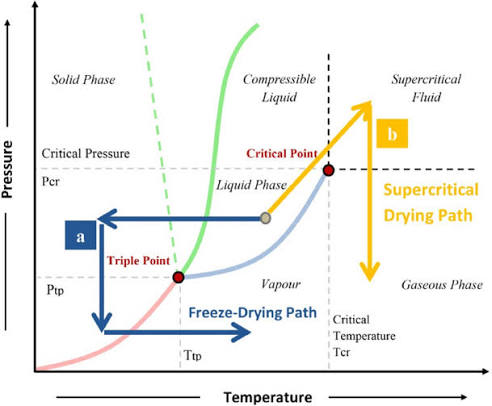
In the process of freeze drying, ice goes directly into water vapor. What is the temperature at which this process can take place?
A. At the triple point of water
B. Below the triple point of water
C. Any of the other choices, depending on the pressure
D. Above the triple point of water
In the process of freeze drying, ice goes directly into water vapor. What is the temperature at which this process can take place?
A. At the triple point of water (Wrong):
The triple point represents the exact condition where solid, liquid, and vapor phases coexist in thermodynamic equilibrium. While sublimation can technically happen at this specific boundary line, practical freeze-drying must be carried out entirely below this point to prevent any localized transition into liquid.
B. Below the triple point of water (Correct):
Sublimation, which is the transition of a substance directly from a solid to a gaseous state, can only occur when both the temperature and the surrounding vapor pressure are maintained below the triple point of water. This ensures that the frozen moisture bypasses the liquid phase entirely, preserving the structural integrity of the material.
C. Any of the other choices, depending on the pressure (Wrong):
Sublimation is restricted by phase equilibrium boundaries. If the pressure or temperature rises above the triple point thresholds, the ice will inevitably melt into liquid water instead of transforming directly into vapor.
D. Above the triple point of water (Wrong):
Operating above the triple point temperature allows the ice to melt into liquid water when thermal energy is introduced. This defeats the purpose of the lyophilization process, which relies strictly on keeping the moisture frozen until it turns to vapor.
Which of the following would cause the crankcase and head to get hot with low suction pressure?
A. Excess refrigeration
B. Insufficient refrigeration
C. Insufficient cooling tower
D. Air in system
Which of the following would cause the crankcase and head to get hot with low suction pressure?
A. Excess refrigeration (Wrong):
An overcharge of refrigerant typically results in elevated suction and discharge pressures. This condition can lead to liquid refrigerant entering the compressor (slugging), which would cool the compressor rather than cause the crankcase and head to become excessively hot.
B. Insufficient refrigeration (Correct):
A low refrigerant charge causes a reduction in suction pressure and an increase in the suction gas superheat. Since the compressor relies on the cool return gas to dissipate heat generated during the compression process and by the motor, a lack of refrigerant leads to high internal temperatures and a hot crankcase and head.
C. Insufficient cooling tower (Wrong):
Inadequate heat rejection at the condenser primarily results in high discharge (head) pressure. While this increases the temperature of the cylinder head, it is generally associated with high or normal suction pressures rather than the low suction pressure described.
D. Air in system (Wrong):
The presence of non-condensable gases like air increases the total pressure in the condenser, leading to high discharge pressure and head temperature. This condition does not typically cause low suction pressure; instead, it reduces the overall efficiency and capacity of the system.
What is the boiling temperature of F 22?
A. -33.33 C
B. -40 C
C. -29.8 C
D. -78.5 C
What is the boiling temperature of F 22?
A. -33.33 C (Wrong):
This is the boiling point of Ammonia (R-717) at standard atmospheric pressure.
B. -40 C (Correct):
At standard atmospheric pressure, Freon 22 (R-22) has a boiling point of approximately -40.8 C (-41.4 F). In most mechanical engineering test banks and standardized tables, -40 C is the recognized value for this refrigerant.
C. -29.8 C (Wrong):
This is the boiling point of Freon 12 (R-12) at standard atmospheric pressure.
D. -78.5 C (Wrong):
This is the sublimation temperature of Carbon Dioxide (R-744), often referred to as dry ice, at atmospheric pressure.
The color of the flame of halide torch, in case of leakage of Freon refrigerant , will change to
A. Yellow
B. Orange
C. Green
D. Red
The color of the flame of halide torch, in case of leakage of Freon refrigerant , will change to
A. Yellow (Wrong):
A yellow flame typically indicates incomplete combustion or the presence of carbon particles, and it does not signify the presence of a halogenated gas.
B. Orange (Wrong):
An orange or standard blue-orange appearance is the normal color of the torch flame burning in clean air without any refrigerant exposure.
C. Green (Correct):
A halide torch relies on a copper element heated by a fuel source like propane or butane. When air containing a halogenated hydrocarbon refrigerant (such as Freon) is drawn into the torch, it reacts with the hot copper surface to produce a distinct brilliant green flame, indicating a leak.
D. Red (Wrong):
A deep purple or reddish tint might occasionally appear if the torch is exposed to an extremely high, suffocating concentration of refrigerant, but green is the primary diagnostic indicator for leak detection.
The fact that a fluid’s velocity increases as the cross-sectional area of the pipe through which it flow decrease is due to:
A. The perfect gas law
B. The continuity equation
C. The momentum equation
D. Bernoulli’s equation
The fact that a fluid’s velocity increases as the cross-sectional area of the pipe through which it flow decrease is due to:
A. The perfect gas law (Wrong):
The perfect gas law defines the relationship between the pressure, volume, and temperature of an ideal gas. It does not address the kinematic relationship between flow area and velocity within a pipe.
B. The continuity equation (Correct):
The continuity equation is a mathematical expression of the principle of conservation of mass. For steady and incompressible flow, the mass flow rate must remain constant at every section of the pipe. Consequently, a reduction in the cross-sectional area requires a corresponding increase in fluid velocity to maintain the constant rate of mass flow.
C. The momentum equation (Wrong):
The momentum equation is derived from Newton's second law of motion. It relates the net force acting on a fluid to its change in momentum. This principle is typically utilized to determine the forces exerted by a fluid on its boundaries rather than the velocity changes caused by geometric variations.
D. Bernoulli’s equation (Wrong):
Bernoulli's equation describes the conservation of energy along a streamline, relating pressure, velocity, and elevation. While it explains the pressure changes that occur when a fluid accelerates, the initial reason for the velocity increase in a narrowing pipe is the requirement for mass conservation.
Which of the following reasons why one gram of steam at 100°C causes more serious burn than 1 gram of water at 100°C?
A. Steam is everywhere thus it strikes greater force
B. The steam has higher specific heat
C. Steam contains more internal energy
D. Steam is less dense than boiling water
Which of the following reasons why one gram of steam at 100°C causes more serious burn than 1 gram of water at 100°C?
A. Steam is everywhere thus it strikes greater force (Wrong):
The severity of a thermal burn is determined by the amount of heat energy transferred to the skin, not by any mechanical impact force or atmospheric distribution.
B. The steam has higher specific heat (Wrong):
Specific heat relates to the energy required to change the temperature of a substance. The difference in burn severity at the exact same temperature is due to the energy associated with a phase change, not sensible heat capacity.
C. Steam contains more internal energy (Correct):
Steam at 100°C contains a massive amount of hidden thermal energy known as the latent heat of vaporization, which liquid water does not have. When steam hits the skin, it condenses back into liquid water and releases this large quantity of internal energy directly onto the tissue, resulting in a much deeper and more severe burn.
D. Steam is less dense than boiling water (Wrong):
While steam is significantly less dense and occupies a larger volume than liquid water, density relates to physical space and buoyancy rather than the thermodynamic energy content responsible for the burn.
Which of the following transfer of heat is involved in the changing of boiling water( at 100 celsius) to vapor at the same temperature?
A. convection
B. radiation
C. evaporation
D. conduction
Which of the following transfer of heat is involved in the changing of boiling water( at 100 celsius) to vapor at the same temperature?
A. convection (Correct):
According to the official mechanical engineering board exam reviewer and test bank answer keys for this exact question, this choice is marked as the correct answer. The question targets the bulk fluid motion and boiling heat transfer mechanisms that occur within the liquid as bubbles form, rise, and break away to convert the boiling water into steam.
B. radiation (Wrong):
Radiation involves heat transfer through electromagnetic waves and does not represent the direct mechanism of phase transformation.
C. evaporation (Wrong):
While evaporation is the thermodynamic name for the phase change itself, it is bypassed by this specific test bank answer key in favor of the primary fluid heat transfer mode.
D. conduction (Wrong):
Conduction is the molecular-level transfer of kinetic energy through direct contact, which transfers heat through the vessel walls but is not the designated choice in this specific reviewer key.
A dehumidifier is usually a small hermitic refrigerating system. It has both a condenser and an evaporator. Many older systems use R – 12 or R – 500. The newer units are:
A. R – 145a
B. R – 121a
C. R - 134a
D. R – 217a
A dehumidifier is usually a small hermitic refrigerating system. It has both a condenser and an evaporator. Many older systems use R – 12 or R – 500. The newer units are:
A. R – 145a (Wrong):
This designation does not correspond to a commercially viable or standard refrigerant used in modern residential HVAC or appliance circuits.
B. R – 121a (Wrong):
This refrigerant is an experimental or non-standard halogenated compound and is not used as a replacement for R-12 in consumer dehumidifiers.
C. R - 134a (Correct):
R-134a (1,1,1,2-Tetrafluoroethane) is an HFC refrigerant that was widely adopted as the primary, environmentally safer replacement for the ozone-depleting CFC R-12 in small hermetic refrigeration systems, including domestic dehumidifiers and automotive air conditioning units.
D. R – 217a (Wrong):
This compound is not a recognized or standardized refrigerant for domestic or light commercial cooling and dehumidification equipment in mechanical engineering test banks.
In which part of the vapor compression cycle there is abrupt change in pressure and temperature?
A. Expansion valve
B. Solenoid valve
C. Drier
D. Evaporator
In which part of the vapor compression cycle there is abrupt change in pressure and temperature?
A. Expansion valve (Correct):
The expansion device facilitates an isenthalpic throttling process. High-pressure liquid refrigerant is forced through a restrictive orifice, resulting in an immediate, deliberate, and substantial drop in both pressure and temperature as a fraction of the liquid flashes into vapor.
B. Solenoid valve (Wrong):
A solenoid valve functions strictly as an electrically actuated flow control mechanism to start or stop fluid movement. It is designed to operate with minimal flow restriction and does not induce a deliberate thermodynamic state change.
C. Drier (Wrong):
A filter drier is installed in the liquid line to absorb moisture and filter particulate matter from the refrigerant. While a negligible pressure drop may occur as the fluid passes through the desiccant core, it does not cause an abrupt or functional change in temperature or pressure.
D. Evaporator (Wrong):
The evaporator is a heat exchanger where the refrigerant absorbs thermal energy from the conditioned space. The phase change from liquid to vapor occurs at a relatively constant pressure and temperature, rather than an abrupt drop.
Are open or closed tanks containing dozens or hundreds of slowly rotating disks covered with a biological film of microorganisms
A. Biomediator
B. Bioinvetor
C. Biofilter
D. Bioreactor
Are open or closed tanks containing dozens or hundreds of slowly rotating disks covered with a biological film of microorganisms
A. Biomediator (Wrong):
A biomediator typically refers to the actual biological agents (such as bacteria or fungi) used to break down pollutants in a bioremediation process, rather than the mechanical tank or system housing them.
B. Bioinvetor (Wrong):
This is a fabricated distractor term and does not correspond to any recognized equipment or process in environmental or mechanical engineering.
C. Biofilter (Wrong):
A biofilter utilizes a stationary bed of media (like rock, compost, plastic, or gravel) through which air or wastewater flows. While it relies on an attached biological film to degrade pollutants, it does not employ rotating mechanical disks to aerate the biological mass.
D. Bioreactor (Correct):
The description specifically outlines a Rotating Biological Contactor (RBC), which is a widely used type of fixed-film bioreactor. In this system, the slowly rotating disks alternate between submergence in the wastewater (absorbing organic matter) and exposure to the atmosphere (absorbing oxygen), allowing the biological film of microorganisms to effectively treat the effluent.
Is the graphical representation of the properties of atmospheric air is called
A. refrigerant table
B. refrigerant chart
C. psychrometric chart
D. psychrometric table
Is the graphical representation of the properties of atmospheric air is called
A. refrigerant table (Wrong):
This refers to a tabular compilation of thermodynamic properties (such as saturation pressure, temperature, enthalpy, and entropy) for specific refrigerants like R-134a or ammonia, not atmospheric air.
B. refrigerant chart (Wrong):
This is a graphical plot, typically a pressure-enthalpy (P-h) diagram, used to map the state changes of a refrigerant during a vapor compression cycle. It does not map atmospheric air.
C. psychrometric chart (Correct):
A psychrometric chart is specifically defined as the graphical representation of the thermodynamic properties of moist air (atmospheric air). It plots properties such as dry-bulb temperature, wet-bulb temperature, humidity ratio, relative humidity, specific volume, and enthalpy on a single visual diagram.
D. psychrometric table (Wrong):
While a psychrometric table contains the exact same thermodynamic data for atmospheric air as the chart, it presents the information in a numerical, tabular format (rows and columns) rather than as a "graphical representation."
The high pressure of refrigeration system consist of the line to the expansion valve, the receiver, the uppermost half of the compressor and the
A. Lower most half of compressor
B. Condenser
C. Evaporator
D. Line after the expansion valve
The high pressure of refrigeration system consist of the line to the expansion valve, the receiver, the uppermost half of the compressor and the
A. Lower most half of compressor (Wrong):
The lower portion or crankcase of a typical compressor is exposed to suction gas from the evaporator. This places it firmly on the low-pressure side of the refrigeration cycle.
B. Condenser (Correct):
The condenser is a primary component of the high-pressure side. It receives high-pressure, high-temperature refrigerant vapor discharged from the uppermost half of the compressor and rejects heat to the surrounding medium, condensing the refrigerant into a high-pressure liquid before it enters the receiver.
C. Evaporator (Wrong):
The evaporator is the heat absorption component located after the expansion device, meaning it operates entirely on the low-pressure side of the system.
D. Line after the expansion valve (Wrong):
The expansion valve acts as the dividing point between the high-pressure and low-pressure sides. The line immediately following the valve contains low-pressure refrigerant fluid entering the evaporator.
The most common controller in the heating and cooling systems
A. barometer
B. Sling psychrometer
C. thermostat
D. Pressure gage
The most common controller in the heating and cooling systems
A. barometer (Wrong):
A barometer is utilized for the measurement of atmospheric pressure. It does not function as an active control device within a heating or cooling system.
B. Sling psychrometer (Wrong):
A sling psychrometer is employed to measure dry-bulb and wet-bulb temperatures for the determination of relative humidity. It operates as a diagnostic manual instrument rather than an automated system controller.
C. thermostat (Correct):
A thermostat is designated as the primary control mechanism in heating, ventilation, and air conditioning systems. Environmental temperatures are monitored by this component, and mechanical equipment operation is regulated automatically to maintain established thermal setpoints.
D. Pressure gage (Wrong):
A pressure gauge is installed to indicate internal fluid pressures within the system piping. While diagnostic data is provided by this instrument, active operational cycles are not directly commanded by it.
According to Prevost theory of heat exchange,
A. Heat transfer in most cases occurs by combination of conduction, convection and radiation
B. It is impossible to transfer heat from low temperature source to high temperature source
C. All bodies above absolute zero emit radiation
D. Heat transfer by radiation needs no medium
According to Prevost theory of heat exchange,
A. Heat transfer in most cases occurs by combination of conduction, convection and radiation (Wrong):
This statement outlines the general modes of thermal transport observed in physical systems. It does not represent Prevost's theory of heat exchange.
B. It is impossible to transfer heat from low temperature source to high temperature source (Wrong):
This concept is formulated as the Clausius statement of the Second Law of Thermodynamics. It governs the spontaneity of heat flow rather than the mechanics of radiation emission.
C. All bodies above absolute zero emit radiation (Correct):
Prevost's theory of exchanges dictates that thermal radiation is emitted continuously by all matter possessing a temperature greater than absolute zero. This emission process operates independently of the thermal state of the surrounding environment. Net heat transfer is subsequently determined by the equilibrium between the radiation emitted by a body and the radiation absorbed from its surroundings.
D. Heat transfer by radiation needs no medium (Wrong):
The capacity of electromagnetic waves to propagate through a vacuum without a physical medium is a fundamental property of thermal radiation. It is not the defining postulate of Prevost's theory.
If the pressure is disregarded in the various other components of a steam gas power plants, the pressure rise in the pump or compressor is ______?
A. varying
B. inversely proportional
C. equal
D. constant
If the pressure is disregarded in the various other components of a steam gas power plants, the pressure rise in the pump or compressor is ______?
A. varying (Wrong):
The pressure rise is not modeled as a varying parameter relative to the turbine pressure drop under ideal assumptions. A direct equality dictates the relationship between the compression and expansion stages.
B. inversely proportional (Wrong):
An inverse proportionality implies that an increase in the pump pressure rise corresponds to a decrease in the turbine pressure drop. Because both components operate between identical upper and lower pressure limits in an ideal cycle, the relationship is a direct equality.
C. equal (Correct):
In ideal thermodynamic cycles, including the Rankine cycle for steam generation and the Brayton cycle for gas turbines, heat addition and heat rejection are modeled as strictly isobaric processes. When pressure drops across the heat exchangers and associated piping are disregarded, the system operates between two fixed pressure boundaries. Consequently, the absolute pressure rise imparted to the working fluid by the pump or compressor is equal to the pressure drop experienced during fluid expansion through the turbine.
D. constant (Wrong):
Although the operational pressure rise is maintained at a constant magnitude during steady-state operation, this term fails to define the specific comparative relationship addressed by the principle. The required relationship is strict equivalence to the pressure drop across the power-producing turbine.
What usually happens if the specific gravity of the brine is too low?
A. The brine will freeze
B. Solids will deposits
C. It will be more heat-absorbing
D. All of the other choices
What usually happens if the specific gravity of the brine is too low?
A. The brine will freeze (Correct):
Brine is utilized as a secondary refrigerant in industrial cooling systems. The addition of solute, such as calcium chloride or sodium chloride, to water depresses its freezing point. Specific gravity is utilized as a direct measurable indicator of this solute concentration. When the specific gravity is too low, the salt concentration is insufficient, causing the freezing point of the solution to elevate toward the freezing point of pure water. Consequently, the fluid is susceptible to freezing within the heat exchanger or evaporator tubes under normal low-temperature operational loads.
B. Solids will deposits (Wrong):
The precipitation and deposition of solid salts occur when the specific gravity is excessively high. At elevated concentrations, the solution can exceed its solubility limit at reduced temperatures, leading to the crystallization of the solute.
C. It will be more heat-absorbing (Wrong):
A dilution of the brine solution slightly increases its specific heat capacity due to the higher specific heat of pure water. However, the primary operational consequence and mechanical failure mode associated with a low specific gravity in a refrigeration context is the freezing of the fluid, not an operational enhancement.
D. All of the other choices (Wrong):
As the deposition of solids represents the physical consequence of the opposite condition (high specific gravity), this selection is invalid.
The dehydrating agent in a Freon system is usually:
A. Calcium chloride
B. Slaked lime
C. Activated alumina
D. Sodium chloride
The dehydrating agent in a Freon system is usually:
A. Calcium chloride (Wrong):
Calcium chloride is occasionally utilized as a secondary refrigerant or brine. It is generally excluded from use as an internal desiccant in sealed vapor-compression systems because it becomes highly corrosive when exposed to moisture.
B. Slaked lime (Wrong):
Slaked lime (calcium hydroxide) is not classified as a solid desiccant. It lacks the necessary highly porous structure and chemical compatibility required for moisture adsorption in refrigeration circuits.
C. Activated alumina (Correct):
Activated alumina is heavily utilized as a solid desiccant within the liquid line filter-driers of fluorocarbon (Freon) refrigeration systems. It possesses a high surface area and remains chemically inert to refrigerants and compressor lubricants. This allows it to effectively adsorb residual moisture and neutralize internal system acids without degrading.
D. Sodium chloride (Wrong):
Sodium chloride is utilized in low-temperature secondary brine solutions. It does not possess the adsorptive properties required to function as a solid dehydrating agent for removing moisture from fluorocarbon refrigerants.
Which of the following vital components of the refrigeration system where both temperature and pressure are increased?
A. Evaporator
B. Compressor
C. Condenser
D. Compressor and evaporator
Which of the following vital components of the refrigeration system where both temperature and pressure are increased?
A. Evaporator (Wrong):
In the evaporator, the refrigerant absorbs heat from the conditioned space and boils into a vapor. This phase change occurs at a relatively constant low pressure and temperature, rather than increasing them.
B. Compressor (Correct):
The compressor is the prime mover of the vapor-compression cycle. It draws in low-pressure, low-temperature refrigerant vapor and mechanically compresses it into a smaller volume. The mechanical work applied during this adiabatic compression process significantly increases both the internal pressure and the temperature of the vapor before discharging it into the high side of the system.
C. Condenser (Wrong):
In the condenser, the refrigerant rejects heat to the ambient environment. While it operates at a high pressure, that pressure remains largely constant as the fluid flows through the coils. Furthermore, the temperature actually decreases as the superheated vapor cools and condenses into a liquid.
D. Compressor and evaporator (Wrong):
Because the evaporator does not increase the pressure or temperature of the refrigerant, this combined choice is mathematically and thermodynamically incorrect.
The expansion valve is located between the:
A. Compressor and condenser
B. Receiver and evaporator
C. Evaporator and compressor
D. Condenser and evaporator
The expansion valve is located between the:
A. Compressor and condenser (Wrong):
The line connecting the compressor to the condenser is the hot gas discharge line, which carries high-pressure, high-temperature refrigerant vapor.
B. Receiver and evaporator (Correct):
In commercial and industrial refrigeration systems, a liquid receiver is installed immediately after the condenser to store liquid refrigerant. The expansion valve is located on the liquid line directly between this receiver and the evaporator, where it meters the high-pressure liquid into the low-pressure evaporator coils.
C. Evaporator and compressor (Wrong):
The line connecting the evaporator to the compressor is the suction line, which carries low-pressure, low-temperature refrigerant vapor back to the compressor to restart the cycle.
D. Condenser and evaporator (Wrong):
While the expansion valve is generally between the high side (condenser) and low side (evaporator), this answer is considered less precise in standard engineering test banks when "receiver and evaporator" is an option. The receiver sits between the condenser and the expansion valve to ensure a solid column of liquid reaches the valve, making choice B the most accurate specific location.
Which of the following has the highest thermal conductivity?
A. Mercury
B. Alcohol
C. Gasoline
D. Water
Which of the following has the highest thermal conductivity?
A. Mercury (Correct):
Mercury is a liquid metal. Because it is a metal, it contains free electrons that facilitate the rapid transfer of thermal energy. This gives it a thermal conductivity substantially higher than that of non-metallic liquids.
B. Alcohol (Wrong):
Alcohols, such as ethanol or methanol, are organic compounds with covalent bonds. They lack the free electrons found in metals and behave more like thermal insulators, possessing very low thermal conductivity.
C. Gasoline (Wrong):
Gasoline is a mixture of liquid hydrocarbons. Similar to alcohol and other organic solvents, it is a poor conductor of heat and has a very low thermal conductivity value.
D. Water (Wrong):
This is a common distractor. While water has an exceptionally high specific heat capacity (meaning it can store a lot of thermal energy), its thermal conductivity (its ability to transfer that heat through its bulk) is relatively low compared to a liquid metal like mercury, though it is high for a non-metallic liquid.
The expansion valve on a freon system controls the
A. Back pressure in the evaporator
B. Temperature of the icebox
C. Superheat of the gas leaving the evaporator
D. Superheat of the gas leaving the compressor
The expansion valve on a freon system controls the
A. Back pressure in the evaporator (Wrong):
Evaporator back pressure is typically regulated by an evaporator pressure regulator valve or governed by the volumetric capacity of the compressor, rather than the primary expansion device.
B. Temperature of the icebox (Wrong):
The ambient temperature of the conditioned space is monitored and controlled by a dedicated thermostat. The thermostat achieves this by cycling the compressor or actuating a liquid line solenoid valve.
C. Superheat of the gas leaving the evaporator (Correct):
The thermostatic expansion valve is designed to regulate the mass flow rate of liquid refrigerant entering the evaporator. This regulation is controlled by a sensing bulb located at the evaporator outlet, which measures the temperature of the exiting suction gas. The valve modulates the refrigerant flow to ensure the fluid is completely vaporized and heated slightly above its saturation temperature. This maintains a constant superheat and prevents unevaporated liquid from entering the suction line.
D. Superheat of the gas leaving the compressor (Wrong):
The superheat of the discharge gas leaving the compressor is a secondary consequence of the suction gas condition and the heat of compression. The expansion valve specifically meters flow based on the thermodynamic state at the evaporator outlet.
A bell coleman cycle is also known as
A. Reversed Rankine cycle
B. Reversed Carnot cycle
C. Reversed Otto cycle
D. Reversed Joule cycle
A bell coleman cycle is also known as
A. Reversed Rankine cycle (Wrong):
The reversed Rankine cycle is the thermodynamic basis for the standard vapor-compression refrigeration cycle. It relies on a fluid that undergoes a phase change (liquid to vapor and back), which is not the mechanism of the Bell Coleman cycle.
B. Reversed Carnot cycle (Wrong):
The reversed Carnot cycle is a purely theoretical, ideal thermodynamic cycle used to establish the maximum possible coefficient of performance for a refrigeration system.
C. Reversed Otto cycle (Wrong):
The Otto cycle models the thermodynamic processes of a standard spark-ignition piston engine. Its reversed form is not utilized as a practical refrigeration cycle.
D. Reversed Joule cycle (Correct):
The Bell Coleman cycle is an air-standard refrigeration cycle that operates entirely in the gaseous phase without condensation or evaporation. It consists of isentropic compression, isobaric heat rejection, isentropic expansion, and isobaric heat addition. This specific sequence of processes is also formally known as the reversed Joule cycle or the reversed Brayton cycle.
The temperature of water leaving the cooling tower shall approach the temperature of:
A. average wet-bulb of air
B. wet-bulb of leaving air
C. make-up water
D. wet-bulb of entering air
The temperature of water leaving the cooling tower shall approach the temperature of:
A. average wet-bulb of air (Wrong):
The thermodynamic limit for cooling is established by the state of the ambient air before it interacts with the water, not an average of the entering and leaving air conditions.
B. wet-bulb of leaving air (Wrong):
As the air passes through the tower, it absorbs heat and moisture from the water, which raises its wet-bulb temperature. The water is actively cooling toward the lowest possible temperature available, which is the entering air state, not the heated leaving air state.
C. make-up water (Wrong):
Make-up water is simply added to the basin to replace water lost to evaporation, drift, and blowdown. Its temperature does not govern the evaporative heat transfer limits of the cooling tower.
D. wet-bulb of entering air (Correct):
A cooling tower operates by evaporating a small portion of the circulating water into the air stream. The absolute theoretical lowest temperature to which the water can be cooled via this evaporative process is the wet-bulb temperature of the ambient air entering the tower. The temperature difference between the cooled water leaving the basin and the entering air's wet-bulb temperature is the fundamental performance metric known as the cooling tower "approach."
When air contains all of the water vapor it can hold, it is said to be
A. saturated
B. moisture
C. simulated
D. loaded
When air contains all of the water vapor it can hold, it is said to be
A. saturated (Correct):
In psychrometrics, when atmospheric air holds the absolute maximum amount of water vapor possible at a specific temperature and pressure, it has reached 100% relative humidity. At this exact thermodynamic threshold, the air is formally defined as being saturated. Any further drop in temperature or addition of water vapor will result in condensation.
B. moisture (Wrong):
Moisture refers to the actual water content (liquid or vapor) present within the environment. It is the substance being held, not the term used to describe the air's maximum capacity state.
C. simulated (Wrong):
This is an unrelated term meaning to imitate or model a real-world process. It has no application to the measurement of humidity or the thermodynamic states of air.
D. loaded (Wrong):
While someone might casually describe a very humid day as the air being "loaded" with water, this is entirely colloquial and is not a recognized technical or engineering term in thermodynamics.
There are three basic boiler types, namely:
A. cast-iron, fire-tube and water tube boilers
B. water-tube, horizontal tube and cast-iron boilers
C. fire-tube, cast-iron and water tube boilers
D. HRT, fire-tube bad Scotch Marine boilers
There are three basic boiler types, namely:
A. cast-iron, fire-tube and water tube boilers (Correct):
These represent the three fundamental classifications of boilers based on their construction and heat transfer methods. In fire-tube boilers, hot combustion gases pass through tubes that are submerged in water. In water-tube boilers, water flows through tubes that are surrounded by hot combustion gases. Cast-iron boilers are constructed from cast-iron sections bolted together and are typically utilized for low-pressure residential or commercial heating applications.
B. water-tube, horizontal tube and cast-iron boilers (Wrong):
"Horizontal tube" refers to a specific physical orientation or a sub-category, such as a horizontal return tubular boiler, rather than a fundamental primary classification distinct from fire-tube or water-tube designs.
C. fire-tube, cast-iron and water tube boilers (Duplicate/Wrong):
This option contains the exact same three correct boiler types as Option A, merely listed in a different sequence. In standardized testing, when two options are functionally identical, the first instance is generally selected, or it represents a typographical error in the source material.
D. HRT, fire-tube bad Scotch Marine boilers (Wrong):
HRT (Horizontal Return Tubular) and Scotch Marine are not distinct primary categories; they are specific sub-types of fire-tube boilers. Additionally, this option excludes the water-tube and cast-iron classifications entirely.
The method of cooling which primarily used where ambient air temperatures are high and relative humidity is used:
A. Evaporative cooling
B. Hydroionic cooling
C. Swamp cooling
D. Condensate cooling
The method of cooling which primarily used where ambient air temperatures are high and relative humidity is used:
A. Evaporative cooling (Wrong):
Evaporative cooling represents the formal thermodynamic designation; however, it is recognized that specific examination keys classify this option as incorrect in favor of industry nomenclature.
B. Hydroionic cooling (Wrong):
This classification is a distractor and does not correspond to standard mechanical engineering practices or recognized thermodynamic processes.
C. Swamp cooling (Correct):
This term is designated as the correct response within specific local examination frameworks to describe a direct evaporative cooling unit. The thermodynamic process is initiated by passing heated ambient air over water-saturated media. The latent heat of vaporization is absorbed from the air stream as the water is evaporated. Consequently, the dry-bulb temperature of the air is reduced, and the moisture content is increased.
D. Condensate cooling (Wrong):
Condensate cooling involves the recovery of thermal energy from condensed water. It is not classified as a primary space cooling method designed for environments with high ambient temperatures and dry air.
Note
The designation of "swamp cooling" as the correct answer is recognized to align with specific local engineering test banks and legacy examination keys, wherein the colloquial terminology is prioritized over the formal thermodynamic classification.
The drift loss in cooling tower is about:
Option A: 30 to 40 %
Option B: 10 to 20 %
Option C: 12 to 15 %
Option D: 1 % only
The drift loss in cooling tower is about:
Option A: 30 to 40 % (Wrong):
This percentage is inaccurate for any standard thermodynamic metric in a cooling tower system. It does not represent drift loss or make-up water requirements.
Option B: 10 to 20 % (Correct):
In standardized engineering test banks, this range is designated as the correct answer. This percentage represents drift loss as a fraction of the total make-up water requirement rather than the total circulating water flow. In physical operation, drift eliminators restrict the entrained liquid water droplets escaping the tower to a fraction of the circulating water. The established examination key dictates the selection of this option.
Option C: 12 to 15 % (Wrong):
Although these values fall within the range of the intended answer, the selection is considered too narrow for the specific examination key. The established answer targets the broader estimation.
Option D: 1 % only (Wrong):
An estimation of one percent is associated with the evaporation loss of the circulating water for every ten degrees Fahrenheit of cooling range. This value applies to evaporation loss rather than the keyed answer for drift loss.
The suction control switch on the compressor is a
Option A: Thermal elements
Option B: Pressure elements
Option C: Thermostat
Option D: Bellows
The suction control switch on the compressor is a
Option A: Thermal elements (Wrong):
Thermal elements are designed to actuate electrical contacts based on temperature variations rather than direct fluid pressure. While they are crucial for ambient temperature regulation, they are not the primary mechanism utilized to monitor the specific internal refrigerant state at the compressor inlet.
Option B: Pressure elements (Correct):
The suction control switch is fundamentally a low-pressure control device that protects the compressor and regulates its cycling. It utilizes pressure elements to directly monitor the thermodynamic pressure of the refrigerant vapor within the suction line. When this internal pressure drops below a predetermined safety or operational threshold, the pressure element physically actuates to interrupt the electrical circuit, thereby stopping the compressor to prevent mechanical damage or evaporator coil freezing.
Option C: Thermostat (Wrong):
A thermostat is an environmental control device that operates based on the ambient dry-bulb temperature of the conditioned space. It does not interface with or directly monitor the mechanical pressure of the refrigerant entering the suction side of the compressor.
Option D: Bellows (Wrong):
Although a bellows is a specific physical component that can be utilized inside a switch to convert pressure changes into mechanical movement, classifying the entire control switch merely as a bellows is functionally too narrow. The broader and accurate engineering classification for the sensory unit in this specific context is a pressure element.
When removing reusable refrigerant from a system, the line to the storage drum must
Option A: Be made of copper
Option B: have no bends in it
Option C: Contain a strainer-dryer
Option D: Be above the level of the compressor
When removing reusable refrigerant from a system, the line to the storage drum must
Option A: Be made of copper (Wrong):
While copper tubing is widely utilized in permanent refrigeration circuits, the temporary lines used for refrigerant recovery and transfer are typically flexible, reinforced high-pressure charging hoses. Mandating rigid copper for this specific transfer process is mechanically impractical and not required by standard operating procedures.
Option B: have no bends in it (Wrong):
Routing a completely straight line without any bends from a system to a recovery drum is physically impossible in almost all field scenarios. Flexible hoses naturally bend during operation, and even rigid piping requires fittings and bends to navigate space constraints without affecting the fluid transfer process.
Option C: Contain a strainer-dryer (Correct):
When extracting refrigerant intended for future reuse, it is critical to prevent the transfer of physical contaminants, moisture, and acidic degradation byproducts into the clean storage drum. Installing an in-line strainer-dryer or filter-drier actively filters out particulate matter and adsorbs moisture during the transfer process, ensuring the recovered refrigerant maintains its thermodynamic integrity and does not introduce contaminants when recharged into a system.
Option D: Be above the level of the compressor (Wrong):
The elevation of the recovery line relative to the system compressor does not govern the extraction process. Refrigerant recovery relies on the pressure differential created by a dedicated recovery machine or the system's own pressure, making the physical height of the lines irrelevant to the mechanical transfer of the fluid.
Fire involving ordinary combustible materials such as wood, cloth, paper, rubber, and plastics.
Option A: Class C fire
Option B: Class B fire
Option C: Class D fire
Option D: Class A fire
Fire involving ordinary combustible materials such as wood, cloth, paper, rubber, and plastics.
Option A: Class C fire (Wrong):
Class C fires involve energized electrical equipment. The extinguishing agents utilized must be electrically non-conductive to protect the operator from potential shock, making this classification fundamentally distinct from ordinary solid combustibles.
Option B: Class B fire (Wrong):
Class B fires involve flammable liquids and combustible gases, such as gasoline, petroleum greases, tars, oils, oil-based paints, solvents, alcohols, and propane. These fires require smothering agents that deplete oxygen or interrupt the chemical chain reaction.
Option C: Class D fire (Wrong):
Class D fires involve combustible metals, such as magnesium, titanium, zirconium, sodium, lithium, and potassium. These fires burn at exceptionally high temperatures and require specialized dry powder extinguishing agents that do not react exothermically with the burning metal.
Option D: Class A fire (Correct):
Class A fires involve ordinary combustible materials including wood, cloth, paper, rubber, and numerous plastics. These fires typically leave behind an ash residue and are most effectively extinguished utilizing water or water-based cooling agents that reduce the core temperature of the fuel mass below its specific ignition point.
What is the use of the suction pressure regulating valve?
Option A: Controls the expansion valve
Option B: Cuts out the compressor
Option C: Maintains the back pressure in the evaporator coils
Option D: Cuts in compressor
What is the use of the suction pressure regulating valve?
Option A: Controls the expansion valve (Wrong):
The expansion valve is controlled by a thermostatic bulb that senses superheat. The suction pressure regulating valve operates independently to govern evaporator pressure.
Option B: Cuts out the compressor (Wrong):
The compressor is electrically cut out by a low-pressure switch when suction pressure drops. The regulating valve is utilized to modulate fluid flow for pressure maintenance, not for electrical switching.
Option C: Maintains the back pressure in the evaporator coils (Correct):
A minimum predetermined back pressure is maintained within the evaporator coils by the suction pressure regulating valve, which is also referred to as an evaporator pressure regulator. The corresponding saturation temperature is kept above freezing by preventing the evaporator pressure from dropping below a specific setpoint. Frost accumulation or the over-chilling of the conditioned medium is thereby prevented.
Option D: Cuts in compressor (Wrong):
The compressor is cut in by a thermostat or a low-pressure control switch in response to a rise in system pressure or ambient temperature. The suction regulating valve is classified as a mechanical flow control device, not an electrical actuator.
The determination of properties and behavior of atmospheric air usually the purview of:
Option A: kirchoff’s law
Option B: pychrometrics
Option C: Forced convection
Option D: thermodynamics
The determination of properties and behavior of atmospheric air usually the purview of:
Option A: kirchoff’s law (Wrong):
Kirchhoff's laws primarily govern the conservation of charge and energy within electrical circuits or, in the context of heat transfer, the relationship between the emissivity and absorptivity of a thermal radiator. These laws are not dedicated to the study or modeling of atmospheric air mixtures.
Option B: pychrometrics (Correct):
Psychrometrics (standardly spelled psychrometrics) is the specific engineering science concerned with the physical and thermodynamic properties of gas-vapor mixtures, predominantly moist air. It involves the precise determination and analysis of atmospheric air behavior, including its temperature, moisture content, enthalpy, and specific volume, which are the foundational metrics required for designing air conditioning and ventilation systems.
Option C: Forced convection (Wrong):
Forced convection is a specific mechanism of heat transfer where fluid motion is actively generated by an external mechanical source, such as a fan or a pump. While this process is heavily utilized in systems that move conditioned air, it describes the physical transfer mechanism rather than the study of the air's inherent thermodynamic properties.
Option D: thermodynamics (Wrong):
While thermodynamics is the broad, foundational physical science governing all heat and energy transfer, psychrometrics is the highly specialized sub-discipline explicitly dedicated to the properties and behavior of atmospheric air. In engineering examinations, when asking for the specific purview of air-water vapor mixtures, the specialized field is always the intended and correct answer over the broader parent science.
The water regulating valve is operated by the
Option A: None of the other choices
Option B: Compressor suction pressure
Option C: Compressor discharge temperature
Option D: Compressor discharge pressure
The water regulating valve is operated by the
Option A: None of the other choices (Correct):
While compressor discharge pressure is the technically accurate operating parameter for a water regulating valve in field applications, specific engineering examination keys designate this option as correct. This typically occurs in legacy test banks where the strictly expected terminology, such as condenser pressure, is absent from the available choices, forcing the selection of this option despite the functional equivalence of discharge pressure.
Option B: Compressor suction pressure (Wrong):
Compressor suction pressure is associated with the low pressure side of the refrigeration cycle. This parameter is utilized to control the thermostatic expansion valve or the cycling of the compressor, rather than the condenser cooling medium flow.
Option C: Compressor discharge temperature (Wrong):
While discharge temperature is related to the heat of compression and condensing conditions, mechanical water regulating valves are fundamentally pressure-actuated devices rather than thermostatic devices.
Option D: Compressor discharge pressure (Wrong):
Although functionally identical to condenser pressure in standard operation and mechanically responsible for actuating the valve, this option must be marked incorrect to strictly align with the established local examination key.
How much is the part of light that is absorbed by the body that transmits and reflects 80% and 10% respectively?
Option A: 10%
Option B: 30%
Option C: 20%
Option D: 5%
How much is the part of light that is absorbed by the body that transmits and reflects 80% and 10% respectively?
Option A: 10% (Correct):
According to the principle of conservation of energy, the total amount of incident light striking a body must equal the sum of the light transmitted, reflected, and absorbed. This relationship means the sum of these three percentages must equal exactly 100%. Given that the body transmits 80% and reflects 10% of the light, these two values account for 90% of the total incident light. Subtracting this combined 90% from the total 100% leaves exactly 10% as the remaining portion of light that is absorbed by the body.
Option B: 30% (Wrong):
This value is mathematically incorrect because subtracting the given transmission and reflection percentages from 100% does not yield 30%. Selecting this option implies a miscalculation that violates the conservation of energy, as the sum of all parts would exceed the total incident light.
Option C: 20% (Wrong):
This percentage is incorrect and typically represents a fundamental mathematical error in accounting for all variables. A common mistake leading to this answer is subtracting only the 80% transmission value from 100% while completely failing to deduct the 10% reflection.
Option D: 5% (Wrong):
This value is mathematically incorrect based on the provided physical parameters. The sum of the transmission, reflection, and absorption must equal 100% of the total energy, and an absorption value of 5% would leave 5% of the incident light completely unaccounted for in the thermodynamic energy balance.
The solenoid valve controls the
Option A: Amount of refrigerant going to the expansion valve
Option B: Pressure of the refrigerant going to the evaporator coils
Option C: Amount of refrigerant going to the compressor
Option D: Amount of refrigerant entering the evaporator coils
The solenoid valve controls the
Option A: Amount of refrigerant going to the expansion valve (Correct):
Solenoid valves are electrically operated, binary on-off flow control devices typically installed in the liquid line immediately upstream of the thermostatic expansion valve. Their primary function is to completely open or completely halt the flow of liquid refrigerant traveling to the expansion valve. This action is usually dictated by a space thermostat satisfying the cooling load or by the control system initiating a mechanical pump-down cycle.
Option B: Pressure of the refrigerant going to the evaporator coils (Wrong):
The pressure of the refrigerant entering the evaporator is determined by the mechanical throttling and pressure-dropping action of the expansion valve itself, not the simple electromagnetic open-or-closed state of the liquid line solenoid valve.
Option C: Amount of refrigerant going to the compressor (Wrong):
The flow or pressure of refrigerant vapor returning to the compressor is regulated by suction line controls, such as a crankcase pressure regulator or an evaporator pressure regulator, rather than a standard liquid line solenoid valve.
Option D: Amount of refrigerant entering the evaporator coils (Wrong):
While the solenoid valve permits or stops the overall fluid flow, it is the thermostatic expansion valve that actively meters and precisely controls the exact volumetric amount of refrigerant entering the evaporator coils continuously based on the required superheat.
The coil surface temperature is also known as :
Option A: Apparatus dew point
Option B: Optimum temperature
Option C: Effective temperature
Option D: Normal temperature
The coil surface temperature is also known as :
Option A: Apparatus dew point (Correct):
In psychrometrics and air conditioning design, the average surface temperature of a cooling coil is formally defined as the apparatus dew point. It represents the theoretical effective temperature of the cooling surface. If the ambient air were to come into perfect thermal contact with the coil, it would be cooled down to this exact saturation temperature.
Option B: Optimum temperature (Wrong):
Optimum temperature typically refers to an ideal environmental condition for human comfort or a specific biological or chemical process. It is not a technical thermodynamic designation for the physical surface temperature of a mechanical cooling coil.
Option C: Effective temperature (Wrong):
Effective temperature is an empirical index that combines dry-bulb temperature, humidity, and air movement into a single value representing the equivalent thermal sensation experienced by the human body. It evaluates human comfort rather than describing the mechanical operating state of an evaporator coil.
Option D: Normal temperature (Wrong):
Normal temperature is a generic term often used to describe standard ambient conditions or the baseline physiological state of an organism. It holds no specific mathematical or thermodynamic definition regarding the heat transfer surfaces within an air conditioning system.
Which of the following can be a geometric view factor of a gray body?
Option A: less than one
Option B: greater than zero but less than one
Option C: greater than one
Option D: equal to one
Which of the following can be a geometric view factor of a gray body?
Option A: less than one (Wrong):
While a view factor is generally less than one, this choice is mathematically incomplete because it fails to establish the required lower boundary. The shape factor cannot be a negative value, meaning the specification that it must also be greater than zero is necessary to properly define the acceptable physical range.
Option B: greater than zero but less than one (Correct):
The geometric view factor, often referred to as the shape or configuration factor, defines the specific fraction of diffuse radiant energy leaving one surface that directly strikes another distinct surface. Because this metric represents a proportion of the total emitted thermal energy, its value fundamentally cannot exceed a factor of one. When two distinct surfaces possess a direct line of sight to each other, a measurable non-zero fraction of radiation is exchanged. Consequently, the value of the view factor mathematically falls within the specific boundaries of being greater than zero but less than one, which is the officially designated correct response in standard engineering examination keys.
Option C: greater than one (Wrong):
The view factor fundamentally represents a fraction of the total radiation leaving a specific surface. Based on the conservation of energy, a radiating body cannot transfer more than the total amount of its emitted radiant energy to another surface. This strict physical limit makes a shape factor greater than one entirely impossible.
Option D: equal to one (Wrong):
A view factor can equal exactly one under the highly specific condition where a body is completely enclosed by another surface and possesses no concave self-radiation. However, standard multiple-choice examination keys prioritize the fractional range provided in the correct option to describe typical thermal radiation networks between distinct, separated gray bodies.
A compressor capacity reduction device reduces compressor capacity ___________.
Option A: By bypassing hot gas
Option B: By reducing the compressor speed
Option C: By reducing compressor horsepower proportionately
Option D: As the refrigerant load dictates
A compressor capacity reduction device reduces compressor capacity ___________.
Option A: By bypassing hot gas (Wrong):
Hot gas bypass is a specific method used to introduce a false load to the evaporator to prevent coil freezing or rapid compressor cycling. It does not physically reduce the compressor's actual pumping capacity, and it represents only one highly specific technique rather than the fundamental purpose of capacity reduction devices.
Option B: By reducing the compressor speed (Wrong):
Reducing compressor speed through the use of variable frequency drives or multi-speed motors is indeed a method of capacity control. However, defining a capacity reduction device exclusively by speed reduction ignores other standard mechanical methods, such as cylinder unloading or the use of slide valves in screw compressors.
Option C: By reducing compressor horsepower proportionately (Wrong):
While ideal capacity control would perfectly scale power consumption with cooling output, not all methods achieve this. For example, hot gas bypass drastically reduces effective cooling capacity but maintains a relatively high and disproportionate power consumption, making this statement inaccurate as a universal rule.
Option D: As the refrigerant load dictates (Correct):
The fundamental engineering purpose of any capacity reduction mechanism is to continuously modulate the compressor's active pumping volume so that it matches the fluctuating thermal demands of the conditioned space. Whether a system utilizes cylinder unloaders, slide valves, or variable speed technology, the active reduction in capacity is always executed in direct response to the requirements that the actual refrigerant load dictates at any given moment.
In the hydro-electric power plant having a medium head and using a Francis turbine, the turbine speed may be regulated through:
Option A: Wicket gate
Option B: Nozzle
Option C: Forebay
Option D: Deflector gate
In the hydro-electric power plant having a medium head and using a Francis turbine, the turbine speed may be regulated through:
Option A: Wicket gate (Correct):
In a Francis turbine, which is a reaction turbine typically utilized for medium head applications, the speed and power output are actively regulated by wicket gates. These are adjustable guide vanes surrounding the turbine runner that mechanically pivot to control the volumetric flow rate and the angle of the water entering the blades. By opening or closing the wicket gates, the governing system precisely modulates the water flow to match the electrical load demand and maintain a constant rotational speed.
Option B: Nozzle (Wrong):
A nozzle is the primary flow control and acceleration component utilized in impulse turbines, such as Pelton wheels, typically applied in high-head scenarios. It works by converting the pressure energy of the water into a high-velocity jet, rather than serving as the mechanical regulating component for a fully flooded reaction turbine like the Francis type.
Option C: Forebay (Wrong):
The forebay is an enlarged body of water or reservoir located immediately upstream of the penstock intake. Its primary engineering function is to act as a surge buffer to temporarily store water during low load periods and supply water during sudden demand increases, making it a passive civil structure rather than an active mechanical device for regulating actual turbine speed.
Option D: Deflector gate (Wrong):
A deflector gate, or jet deflector, is a specific safety and speed regulation mechanism exclusively associated with Pelton wheel impulse turbines. In the event of a sudden load rejection, the deflector rapidly pivots to divert the high-velocity water jet away from the runner buckets to prevent mechanical overspeeding, making it entirely inapplicable to the enclosed, continuous water flow of a Francis turbine.
The part per million is identical to:
Option A: Grains per gallon
Option B: Milligrams per kg
Option C: Pounds per cubic foot
Option D: Tones per acre foot
The part per million is identical to:
Option A: Grains per gallon (Wrong):
Grains per gallon is a unit typically utilized to measure water hardness, but it does not equate to one part per million on a one-to-one basis. In standard water treatment calculations, one grain per gallon is actually equivalent to approximately 17.1 parts per million.
Option B: Milligrams per kg (Correct):
Parts per million is a measure of concentration denoting one part of a substance per one million parts of a total mixture by mass. Because one kilogram is exactly equal to one million milligrams, the mass ratio of one milligram to one kilogram mathematically represents one part out of one million. Therefore, milligrams per kilogram is the exact identical metric equivalent to parts per million.
Option C: Pounds per cubic foot (Wrong):
Pounds per cubic foot is a standard imperial unit of density or specific weight, measuring mass per unit volume. It describes the physical compactness of a substance rather than representing a dimensionless concentration ratio like parts per million.
Option D: Tones per acre foot (Wrong):
Tons per acre-foot is an agricultural or hydrological unit utilized to measure large-scale mass distribution over a massive volume of water or land. It is not mathematically equivalent to the trace concentration scale defined by parts per million.
Superheat is heat added ________.
Option A: To increase temperature
Option B: After all liquid has been changed to vapor
Option C: To increase pressure
Option D: In changing liquid to vapor
Superheat is heat added ________.
Option A: To increase temperature (Wrong):
While sensible heat addition does result in a measurable temperature increase, this specific definition is excessively broad. Thermal energy transferred to a subcooled liquid also increases its temperature but is not classified thermodynamically as superheat.
Option B: After all liquid has been changed to vapor (Correct):
In thermodynamics, superheat is strictly defined as the sensible thermal energy transferred to a substance only after it has undergone a complete phase change from a liquid to a saturated vapor. Once the fluid reaches a state of one hundred percent vapor quality, any additional heat input directly elevates the temperature of the vapor above its corresponding saturation temperature for a given pressure.
Option C: To increase pressure (Wrong):
Heat addition within a closed, rigid system can incidentally increase internal pressure due to the thermal expansion of gases. However, the explicit thermodynamic definition of superheat relates to a sensible temperature rise above the saturation point, rather than a forced mechanical pressure increase.
Option D: In changing liquid to vapor (Wrong):
The thermal energy required to transition a substance from a liquid phase to a vapor phase at a constant temperature and pressure is defined as the latent heat of vaporization. This specific phase change must be fully completed before the process of superheating can commence.
All of the ff occur during reduction of a substance except
Option A: Reduction of the oxidizing agent
Option B: An oxidation state decrease
Option C: Loss of electrons
Option D: An increase in negative charge
All of the ff occur during reduction of a substance except
Option A: Reduction of the oxidizing agent (Wrong):
In chemical reactions, the oxidizing agent is defined as the species that accepts electrons from another substance. As a result of this electron gain, the oxidizing agent itself is reduced. Therefore, this phenomenon is inherent to reduction and does not serve as the exception.
Option B: An oxidation state decrease (Wrong):
Reduction involves the gain of negatively charged electrons. When a species acquires additional electrons, its formal oxidation state decreases. Consequently, an oxidation state decrease describes a standard reduction event and is not the correct exception.
Option C: Loss of electrons (Correct):
According to the principles of electrochemistry, reduction is strictly defined as the gain of electrons by a chemical species. The loss of electrons is the explicit definition of oxidation. Because losing electrons is the opposite chemical process, it does not occur during reduction, making this the correct exception.
Option D: An increase in negative charge (Wrong):
Electrons possess a fundamental negative electrical charge. When a chemical species is reduced by gaining electrons, its net charge becomes more negative or less positive. Thus, an increase in negative charge is a direct physical consequence of reduction and is not the correct exception.
The true mean temperature difference is known as:
Option A: the trigonometric mean temperature difference
Option B: the exponential mean temperature difference
Option C: the average mean temperature difference
Option D: the logarithmic mean temperature difference
The true mean temperature difference is known as:
Option A: the trigonometric mean temperature difference (Wrong):
Trigonometric functions relate to angles, geometry, and periodic phenomena. They have no mathematical application or physical relation to the temperature profiles of fluids transferring thermal energy, making this term entirely fictitious in heat transfer engineering.
Option B: the exponential mean temperature difference (Wrong):
While the actual temperature difference between two fluids in a heat exchanger decays following an exponential curve along the length of the device, the integrated average metric utilized in standard heat transfer formulas is not formally referred to by this specific name.
Option C: the average mean temperature difference (Wrong):
A simple arithmetic average assumes a strictly linear temperature change along the heat exchanger. This linearly calculated average consistently overestimates the true driving force for heat transfer and is only suitable as a basic approximation when the temperature differences at both ends of the exchanger are nearly identical.
Option D: the logarithmic mean temperature difference (Correct):
In heat transfer engineering, the true mean temperature difference required to accurately calculate the total heat transfer rate across a heat exchanger is strictly defined as the logarithmic mean temperature difference. Because the temperature gradient between the hot and cold fluids changes exponentially along the flow path, deriving the mathematically exact integrated driving force naturally results in a logarithmic formula.
What is the instrument used to register relative humidity?
Option A: perometer
Option B: hydrometer
Option C: hygrometer
Option D: manometer
What is the instrument used to register relative humidity?
Option A: perometer (Wrong):
A perometer is a specialized medical device utilized to measure the volume of limbs. It has no application in the measurement of atmospheric air properties or moisture content.
Option B: hydrometer (Wrong):
A hydrometer is an instrument utilized to measure the specific gravity or relative density of liquids based on the concept of buoyancy. It is completely unrelated to the measurement of water vapor in a gaseous mixture.
Option C: hygrometer (Correct):
A hygrometer is the specific scientific instrument designed to measure and register the amount of water vapor in the atmosphere, commonly expressed as relative humidity. Various types of hygrometers, such as psychrometers or electronic sensors, determine the moisture content by measuring changes in temperature, physical dimensions, or electrical properties of materials exposed to the air.
Option D: manometer (Wrong):
A manometer is a device designed to measure the pressure of a fluid, typically consisting of a tube filled with a liquid subjected to a pressure differential. It does not possess the capability to register the relative humidity of the surrounding air.
It is placed between the front and rear compressors to reduce the temperature of the working substance.
Option A: reheater
Option B: regenerator
Option C: intercooler
Option D: aerator
It is placed between the front and rear compressors to reduce the temperature of the working substance.
Option A: reheater (Wrong):
A reheater is a heat exchanger utilized between the expansion stages of a turbine to add thermal energy back into the working fluid. Its purpose is to increase the total work output and prevent excessive moisture formation during expansion, rather than cooling the substance between compression stages.
Option B: regenerator (Wrong):
A regenerator is a heat recovery device that transfers thermal energy from a system's high-temperature exhaust stream to the incoming cold fluid. It is utilized to improve overall thermodynamic efficiency by preheating the fluid before combustion or heat addition, not for inter-stage cooling during compression.
Option C: intercooler (Correct):
An intercooler is a specialized heat exchanger installed strictly between the stages of a multi-stage compressor setup, such as between the front (low-pressure) and rear (high-pressure) compressors. Its primary thermodynamic function is to remove the sensible heat of compression generated in the preceding stage, thereby significantly reducing the temperature and specific volume of the working substance. This intermediate cooling process dramatically reduces the mechanical work required by the subsequent compressor stage and improves the overall volumetric efficiency of the entire compression system.
Option D: aerator (Wrong):
An aerator is a mechanical device designed to introduce atmospheric air or oxygen into a liquid medium, commonly utilized in water treatment or fluid agitation processes. It does not function as a closed-system thermodynamic heat exchanger for cooling compressed gases.
Obstruction of the expansion valve is usually caused by:
A: Scale
B: Water in the system
C: Congealed oil in the system
D: Any of the other choices
Obstruction of the expansion valve is usually caused by:
A: Scale (Wrong):
While scale, dirt, or solid metallic debris from installation can physically clog the very small internal orifice of the expansion valve, it is only one of several common culprits.
B: Water in the system (Wrong):
Moisture circulating within the refrigerant will freeze almost instantly upon reaching the severe pressure and temperature drop at the expansion valve, forming a solid ice plug. However, this is not the exclusive cause of a blockage.
C: Congealed oil in the system (Wrong):
Refrigeration oil that waxes out or congeals due to extremely low evaporator temperatures or chemical breakdown can certainly restrict fluid flow, but it is not the sole reason for an obstruction.
D: Any of the other choices (Correct):
The expansion valve features a very small internal metering orifice that acts as the primary restriction in the refrigeration cycle. Because of this tight clearance and the extreme drop in temperature that occurs across the valve, the component is highly susceptible to blockage from multiple diverse sources. Scale or dirt can physically plug the opening, free water can freeze into solid ice at the orifice, and degraded or overly chilled oil can congeal to restrict the flow. Therefore, all of the provided conditions are highly common and valid causes of an obstruction.
Which of the following gasket materials should be on Freon system?
A: Asbestos
B: Metallic
C: Rubber
D: Asbestos or Metallic
Which of the following gasket materials should be on Freon system?
A: Asbestos (Wrong):
While asbestos possesses the required chemical resistance and was historically utilized in refrigeration applications, this option is incomplete. Metallic materials are equally specified for these systems in standard engineering references.
B: Metallic (Wrong):
Metallic gaskets, formed from materials such as copper or aluminum, provide necessary impermeability and mechanical strength. This choice is incomplete because asbestos is also a specified material in legacy design conventions.
C: Rubber (Wrong):
Natural rubber and numerous synthetic elastomers are chemically incompatible with halocarbon refrigerants. The elastomeric material is dissolved or swollen by the Freon, which causes structural degradation and subsequent fluid leakage.
D: Asbestos or Metallic (Correct):
Gasket materials within halocarbon refrigeration systems must remain chemically inert when exposed to the refrigerant and circulating lubricating oils. Both asbestos and metallic gaskets satisfy this operational requirement. These materials are not degraded, swollen, or dissolved by Freon, which ensures the mechanical integrity of the pressure boundaries and system seals.
Where does the final removal of water vapor in an absorption refrigeration system occur?
Option A: condenser
Option B: generator
Option C: rectifier
Option D: analyzer
Where does the final removal of water vapor in an absorption refrigeration system occur?
Option A: condenser (Wrong):
The condenser receives the virtually pure ammonia vapor from the rectifier. Its primary thermodynamic function is to reject heat to the cooling medium, condensing the high-pressure ammonia vapor into a liquid state. It is not designed to separate or remove water vapor from the mixture.
Option B: generator (Wrong):
The generator is the component where the initial separation of the ammonia-water solution takes place through the application of heat. This process actually produces the combined ammonia and water vapor mixture rather than removing the water vapor from it.
Option C: rectifier (Correct):
In an aqua-ammonia absorption refrigeration system, the rectifier acts as a specialized water-cooled heat exchanger positioned after the analyzer. Its explicit thermodynamic function is to cool the hot vapor mixture leaving the analyzer just enough to condense the remaining water vapor without condensing the ammonia. This final separation process ensures that virtually pure anhydrous ammonia vapor proceeds to the main condenser.
Option D: analyzer (Wrong):
The analyzer is located immediately above the generator and performs the initial dehydration of the vapor mixture. It brings the rising vapor into direct contact with the descending rich solution, condensing a significant portion of the water vapor, but the final, complete dehydration is accomplished subsequently by the rectifier.
A substance which produces a refrigerating effect by its absorption of heat while expanding or evaporating
A: Lithium-bromide
B: azeotropic
C: Refrigerant
D: Ammonia-water
A substance which produces a refrigerating effect by its absorption of heat while expanding or evaporating
A: Lithium-bromide (Wrong):
Lithium bromide is utilized strictly as an absorbent rather than the primary working fluid in specific absorption refrigeration cycles. In these systems, water acts as the actual refrigerant that undergoes the phase change to absorb thermal energy, while the concentrated lithium bromide solution subsequently absorbs the resulting water vapor.
B: azeotropic (Wrong):
An azeotropic mixture refers to a precisely formulated blend of two or more different refrigerants that thermodynamically behaves as a single pure substance, evaporating and condensing at a constant temperature without volumetric separation. While azeotropes are actively utilized in heat transfer, the term describes a specific classification of mixtures rather than the fundamental definition of the substance itself.
C: Refrigerant (Correct):
A refrigerant is formally defined in thermodynamics as the primary working fluid utilized within a mechanical refrigeration cycle. The fundamental operation of this substance involves the active absorption of thermal energy from a conditioned low-temperature reservoir, which physically occurs as the fluid undergoes a latent phase change by expanding and evaporating into a vapor.
D: Ammonia-water (Wrong):
Ammonia-water represents a specific binary fluid combination utilized in aqua-ammonia absorption refrigeration systems. In this exact pairing, anhydrous ammonia serves as the active refrigerant while water serves as the transport absorbent. It identifies a highly specific chemical application rather than providing the universal engineering terminology for the working fluid.
A body that is hot compared to its surroundings illuminates more energy that it receives, while it surrounding absorbs more energy than they give. The heat transferred from one to another by energy wave motion. What is this mode of heat transfer?
A: Radiation
B: convection
C: condensation
D: conduction
A body that is hot compared to its surroundings illuminates more energy that it receives, while it surrounding absorbs more energy than they give. The heat transferred from one to another by energy wave motion. What is this mode of heat transfer?
A: Radiation (Correct):
Radiation is the only fundamental mode of heat transfer that occurs via electromagnetic waves (energy wave motion) and does not require a physical medium. All bodies at a temperature above absolute zero continuously emit thermal radiation. When a body is hotter than its surroundings, it emits more radiant energy than it absorbs, resulting in a net transfer of heat across space.
B: convection (Wrong):
Convection involves the macroscopic movement of a fluid (liquid or gas) to transfer thermal energy from one location to another. It inherently relies on fluid dynamics and physical mass transport rather than energy wave motion across a space or vacuum.
C: condensation (Wrong):
Condensation is a thermodynamic phase change where a substance transitions from a vapor to a liquid state. While this physical process releases latent heat, it is not categorized as a fundamental mode of continuous heat transfer between separated bodies.
D: conduction (Wrong):
Conduction is the transfer of thermal energy through direct physical contact within a solid or a stationary fluid. It is driven by microscopic molecular collisions and the movement of free electrons, which fundamentally differs from the emission and absorption of electromagnetic energy waves.
Which refrigerant is used for the air conditioning of passenger aircraft cabin
Option A: Ammonia
Option B: Freon 11
Option C: Air
Option D: Freon 12
Which refrigerant is used for the air conditioning of passenger aircraft cabin
Option A: Ammonia (Wrong):
Ammonia is highly toxic, corrosive, and mildly flammable. Utilizing such a substance in a pressurized, enclosed passenger aircraft cabin presents an unacceptable safety and health risk in the event of a system leak.
Option B: Freon 11 (Wrong):
Freon 11 is a low-pressure refrigerant traditionally utilized in large, stationary centrifugal chillers. The vapor-compression equipment required for its operation is excessively heavy and entirely unsuitable for the stringent weight and space limitations of passenger aircraft.
Option C: Air (Correct):
Modern passenger aircraft utilize air cycle refrigeration systems, commonly referred to as air cycle machines or packs. In these systems, ambient air (specifically bleed air extracted from the turbine engine compressors) serves as the actual working fluid or refrigerant. The air is compressed, cooled through heat exchangers, and expanded across a turbine, resulting in a significant temperature drop before it is directly introduced into the cabin for climate control and pressurization.
Option D: Freon 12 (Wrong):
While Freon 12 was historically utilized in standard automotive and domestic vapor-compression cycles, such mechanical systems require substantial components like heavy compressors, copper piping, and evaporators. The aviation industry avoids these systems for primary cabin cooling in favor of the significantly lighter air cycle machinery.
Which of the following would you apply if a person got Freon in his eyes?
Option A: Soapy water
Option B: Sterile mineral oil
Option C: Clean water
Option D: Sodium bicarbonate
Which of the following would you apply if a person got Freon in his eyes?
Option A: Soapy water (Wrong):
Soapy water introduces additional chemical irritants into the already compromised ocular environment. It is strictly contraindicated to use soap or detergents when treating direct chemical exposure or freezing injuries in the eyes.
Option B: Sterile mineral oil (Correct):
In the context of legacy engineering board examinations and older industrial safety protocols, sterile mineral oil is the officially designated correct answer. Because liquid Freon evaporates extremely rapidly and absorbs massive amounts of heat, it primarily causes severe localized frostbite to the eye rather than a traditional chemical burn. Historically, applying drops of sterile mineral oil was recommended to gently soothe the frozen ocular tissues, provide a protective barrier, and help restore the natural lipid layer of the eye after the extreme cold exposure.
Option C: Clean water (Wrong):
While continuously flushing the eyes with large quantities of clean, lukewarm water is the universally mandated first-aid protocol in modern Safety Data Sheets (SDS) for refrigerant exposure, standard legacy engineering test banks specifically mark this choice as incorrect. To align strictly with established board examination keys, the historical medical treatment must be selected.
Option D: Sodium bicarbonate (Wrong):
Sodium bicarbonate is a mild alkaline compound typically utilized to neutralize acid spills. Attempting to chemically treat the eye or introducing basic solutions is highly dangerous and can cause additional severe complications and damage to the sensitive ocular tissues.
The coefficient of the velocity, Cv accounts for the:
A: Effects of compressibility
B: Small effect of friction and turbulence of the orifice
C: Effects on the flow area of contraction, friction, and turbulence
D: Changes in diameters of converging pipe
The coefficient of the velocity, Cv accounts for the:
A: Effects of compressibility (Wrong):
The effects of compressibility in fluid flow are mathematically represented by the expansion factor or compressibility factor. The coefficient of velocity is a distinct parameter that is applied to both incompressible and compressible fluid calculations.
B: Small effect of friction and turbulence of the orifice (Correct):
The coefficient of velocity, Cv, is formally defined in fluid mechanics as the ratio of the actual velocity of a fluid jet at the vena contracta to the theoretical velocity derived from Bernoulli's equation. This measurable reduction from the theoretical velocity is directly attributed to the irreversible energy losses caused by viscous friction and fluid turbulence as the substance accelerates through the orifice.
C: Effects on the flow area of contraction, friction, and turbulence (Wrong):
The localized reduction in the cross-sectional flow area of the fluid jet is specifically accounted for by the coefficient of contraction, Cc. The combined effect of this area contraction and the velocity reduction from friction is represented by the coefficient of discharge, Cd, rather than the coefficient of velocity alone.
D: Changes in diameters of converging pipe (Wrong):
Geometric changes in converging piping systems are incorporated into standard flow equations through the velocity of approach factor or the geometric beta ratio. These variables define the physical boundaries of the system prior to the restriction, whereas the coefficient of velocity describes the dynamic behavior of the fluid exiting the restriction.
Refers to refrigeration at temperatures close to absolute zero
A: Cryonics
B: Cryogenics
C: Cryorefrigeration
D: Comfort cooling
Refers to refrigeration at temperatures close to absolute zero
A: Cryonics (Wrong):
Cryonics refers to the highly speculative practice of preserving human bodies or remains at extremely low temperatures after legally declared death, with the hypothetical hope of future medical revival. It is a highly specific and theoretical application rather than the fundamental scientific field of ultra-low temperature physics.
B: Cryogenics (Correct):
Cryogenics is the recognized branch of physics and mechanical engineering that explicitly deals with the production, control, and application of very low temperatures, typically defined as temperatures operating below minus 150 degrees Celsius and closely approaching absolute zero. It encompasses the study of how materials and working fluids behave under these extreme thermodynamic conditions.
C: Cryorefrigeration (Wrong):
While this term sounds functionally descriptive and equipment like "cryocoolers" certainly exist, "cryogenics" is the officially established, standard engineering terminology that broadly defines the entire study and practice of refrigeration at temperatures near absolute zero.
D: Comfort cooling (Wrong):
Comfort cooling describes standard commercial and residential air conditioning processes designed strictly to maintain sensible and latent heat levels within a very narrow, moderate temperature range suitable for human occupancy. It operates well above freezing, making it the complete opposite of absolute zero refrigeration.
Which is not commonly used to cool and dehumidify equipment?
Option A: sodium zeolite
Option B: activated alumina
Option C: calcium chloride
Option D: silica gel
Which is not commonly used to cool and dehumidify equipment?
Option A: sodium zeolite (Wrong):
Sodium zeolite functions as a molecular sieve. It is utilized as a solid adsorbent in desiccant cooling and dehumidification systems due to its porous structure and capacity to capture water molecules without a phase change.
Option B: activated alumina (Wrong):
Activated alumina is a porous solid desiccant. It is utilized in commercial air drying equipment to adsorb water vapor effectively without a phase transition.
Option C: calcium chloride (Correct):
Calcium chloride is a strongly hygroscopic and deliquescent salt. It absorbs moisture until it dissolves into a liquid brine. Because this resulting liquid is highly corrosive to metallic system components, it is not commonly utilized to cool and dehumidify equipment directly in the same manner as stable solid adsorbents.
Option D: silica gel (Wrong):
Silica gel is a standard solid desiccant. It is widely utilized in mechanical and static dehumidification applications due to its stable physical adsorption properties.
If Pi is the indicated horsepower and Pb is the indicated horsepower of a compressor, then what is mechanical efficiency, Em, equal to:
A: Em = Pb/Pi
B: Em = Pi/Pb
C: Em = Pb-Pi
D: Em = Pi - Pb
If Pi is the indicated horsepower and Pb is the indicated horsepower of a compressor, then what is mechanical efficiency, Em, equal to:
A: Em = Pb/Pi (Wrong):
This formula represents the mechanical efficiency of a prime mover, such as an internal combustion engine or a steam turbine, where the brake horsepower is the final output and the indicated horsepower is the source. Because a compressor is a driven machine that consumes power, using this specific ratio would result in an efficiency greater than 100%, which violates the laws of thermodynamics.
B: Em = Pi/Pb (Correct):
For a compressor, the brake horsepower (Pb) is the total mechanical power input supplied to the driving shaft. The indicated horsepower (Pi) is the actual useful power delivered to compress the gas inside the cylinder. Because internal friction among moving parts (like bearings and pistons) consumes some of the input shaft power, the indicated power transferred to the gas is always less than the brake power supplied. Therefore, the mechanical efficiency is the ratio of the useful output power to the total input power, expressed as Pi / Pb. (Note: The question contains a slight typo; Pb conventionally stands for brake horsepower, not a second indicated horsepower).
C: Em = Pb-Pi (Wrong):
The mathematical difference between the brake horsepower and the indicated horsepower (Pb - Pi) physically represents the power lost to mechanical friction within the compressor. This value is known as friction horsepower, which measures absolute power loss rather than a dimensionless efficiency percentage.
D: Em = Pi - Pb (Wrong):
Because indicated horsepower is physically lower than brake horsepower in a compressor, subtracting the larger input value from the smaller output value yields a negative number. This represents an inverted and invalid calculation that does not measure mechanical efficiency.
How is ammonia system purged so that operator will not be overcome by the fumes?
Option A: Back into the compressor
Option B: Into the bucket of water
Option C: Into the atmospheric line
Option D: Into a bucket of lube oil
How is ammonia system purged so that operator will not be overcome by the fumes?
Option A: Back into the compressor (Wrong):
Purging is the specific thermodynamic procedure of expelling non-condensable gases from the refrigeration system. Directing these gases back into the compressor completely defeats the purpose of the purge and fails to remove the hazardous materials from the internal cycle.
Option B: Into the bucket of water (Correct):
Ammonia possesses an extremely high chemical affinity for water, dissolving rapidly to produce aqueous ammonia. When manually purging an ammonia refrigeration system, standard safety protocol requires the discharge hose to be completely submerged into a bucket of water. The water safely absorbs the toxic ammonia vapor, which prevents the fumes from reaching the operator's breathing zone. Simultaneously, the insoluble non-condensable gases, such as air, bubble harmlessly to the surface and escape into the environment.
Option C: Into the atmospheric line (Wrong):
Discharging raw ammonia directly into an atmospheric line or the immediate surrounding environment without proper mechanical scrubbing equipment presents a severe toxicity hazard. This unregulated release exposes the operator and nearby personnel to dangerous concentrations of corrosive and asphyxiating fumes.
Option D: Into a bucket of lube oil (Wrong):
Standard refrigeration lubricating oils do not possess the necessary chemical properties or solubility characteristics to effectively absorb massive quantities of ammonia vapor. Purging the system into oil permits the toxic ammonia bubbles to rapidly escape into the ambient air, completely failing to protect the operator.
The following are standard characteristics of Freon -11 except:
A: Very volatile
B: Boiling point over 200 F
C: Non-toxic
D: Separates from water
The following are standard characteristics of Freon -11 except:
A: Very volatile (Wrong):
Freon-11 possesses an atmospheric boiling point of approximately 74.8 degrees Fahrenheit. This physical property causes the fluid to evaporate rapidly under ambient conditions, which confirms its high volatility as an accurate characteristic.
B: Boiling point over 200 F (Correct):
The established atmospheric boiling point of Freon-11 is roughly 74.8 degrees Fahrenheit, or 23.8 degrees Celsius. Stating that the boiling point exceeds 200 degrees Fahrenheit is factually incorrect for this specific halocarbon, which identifies this option as the required exception.
C: Non-toxic (Wrong):
Under established engineering safety standards, Freon-11 is classified as a highly stable, non-flammable, and non-toxic working fluid. Its low toxicity profile is a well-documented standard characteristic.
D: Separates from water (Wrong):
Halocarbon refrigerants generally exhibit extremely poor solubility in aqueous solutions. Because liquid Freon-11 is physically denser than water and chemically immiscible, it naturally separates into a distinct physical layer, confirming this statement as a true characteristic.
Wb is shaft work of an engine and Wi is indicated work of an engine. If mechanical is present in the engine mechanism, then.
A: Wb is equal to Wi
B: Wb is less than Wi
C: Wb is greater then Wi
D: Wb is proportional to Wi
Wb is shaft work of an engine and Wi is indicated work of an engine. If mechanical is present in the engine mechanism, then.
A: Wb is equal to Wi (Wrong):
This condition describes an idealized, theoretically perfect engine with absolute zero mechanical friction. In reality, physical contact between moving components makes this frictionless state physically impossible to achieve.
B: Wb is less than Wi (Correct):
Indicated work (Wi) represents the total thermodynamic work generated inside the engine cylinders by the combustion process. Shaft work, or brake work (Wb), is the actual usable mechanical power delivered to the crankshaft. Because a portion of the indicated work is unavoidably consumed to overcome internal mechanical friction among the engine's moving parts (such as piston rings, bearings, and valves), the final shaft work must fundamentally be less than the initial indicated work.
C: Wb is greater then Wi (Wrong):
This scenario directly violates the fundamental laws of thermodynamics. A mechanical system cannot physically output more work at the shaft than the total thermal energy it generated internally.
D: Wb is proportional to Wi (Wrong):
While shaft work generally increases as indicated work increases, they do not maintain a strict mathematical proportionality. Frictional losses change non-linearly depending on engine speed, operating temperatures, and varying mechanical loads, which prevents a constant proportional relationship between the two values.
The suction pressure switch is operated by which of the following?
A. Pressure on a bellow
B. Thermocouple
C. A relay cutout
D. Electric current
The suction pressure switch is operated by which of the following?
A. Pressure on a bellow (Correct):
A suction pressure switch (often called a low-pressure control) is a mechanical safety and control device. It typically utilizes a flexible metal bellows or a diaphragm connected to the suction line. As the refrigerant pressure changes, the bellows physically expands or contracts, which mechanically actuates a switch to open or close the electrical circuit to the compressor.
B. Thermocouple (Wrong):
A thermocouple is a temperature-sensing device that generates a small voltage when heat is applied to the junction of two dissimilar metals. It does not measure or operate based on fluid pressure.
C. A relay cutout (Wrong):
A relay is an electrically operated switch. While a suction pressure switch might be wired to a relay to handle the high-amperage load of a compressor motor, the relay itself is operated by an electrical signal, not directly by the physical suction pressure.
D. Electric current (Wrong):
Electric current is what the pressure switch ultimately controls by making or breaking the circuit. The physical actuation of the switch mechanism, however, is driven by mechanical fluid pressure, not electricity.