Chapter 20. Blood Vessels. Saladin.
 Call Kai
 Learn
Learn Practice Test
 Spaced Repetition
 Match
Match Flashcards
 Knowt Play
1/151

There's no tags or description
Looks like no tags are added yet.
Name | Mastery | Learn | Test | Matching | Spaced | Call with Kai |
|---|
No analytics yet
Send a link to your students to track their progress
152 Terms
Which type of blood vessel carries blood back to the heart?
Vein
What are the three basic types of blood vessels?
arteries, veins, capillaries
_______ are microscopic, thin-walled blood vessels that connect the smallest arteries to the smallest veins.
Capillaries
The innermost layer of a blood vessel wall is the ______.
tunica interna
Which are functions of the endothelium?
Acts as selectively permeable barrier to materials entering or leaving the bloodstream
Secretes chemicals that stimulate dilation or constriction of the vessel
Repels red blood cells and platelets to retain flow
By definition, arteries are blood vessels that do which of the following?
Carry blood away from the heart
Arteries, capillaries, and veins are the three primary categories of blood __________.
vessels
Which layer of the artery wall is usually the thickest?
Tunica media
Which category includes the smallest blood vessels?
Capillaries
Which term refers to the outermost layer of vein and artery walls?
Tunica externa
The walls of arteries and veins are composed of three layers called tunics. Place the tunics in order (top to bottom), starting with the innermost layer, and ending with the outermost layer.
Tunica interna
Tunica media
Tunica adventitia
Which term refers to the small blood vessels that nourish the walls of larger vessels?
Vasa vasorum
Which acts as a selectively permeable barrier to materials moving between the capillaries and the interstitial fluid?
Endothelium
Which type of blood vessel carries blood away from the heart?
Arteries
Which of these is an artery?
B
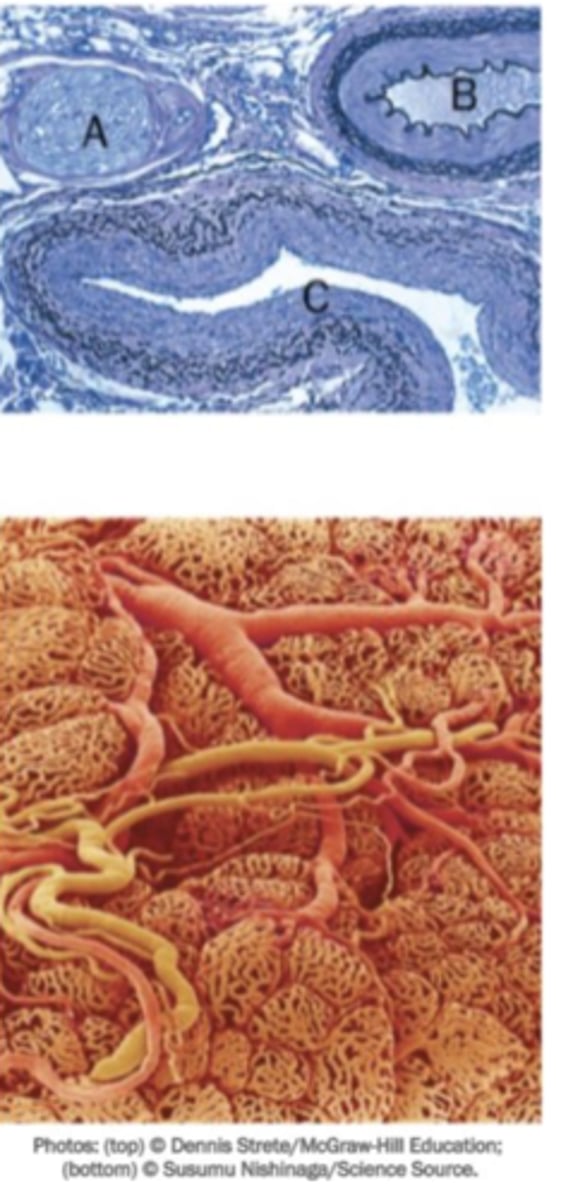
The vasa vasorum are small vessels that comprise the blood supply to which of the following?
The walls of large blood vessels
Arrange the three classes of arteries in order from largest to smallest.
Largest: Conducting
Medium: Distributing
Smallest: Resistance
The endothelium is made of which type of epithelial tissue?
Simple squamous
Which type of artery is the largest?
conducting
True or false: Arteriosclerosis (the stiffening of arteries with age) increases the risk of aneurysms.
True
The layer of the vein wall that contains smooth muscle is called the tunica _______.
media
Which of these is a vein?
C
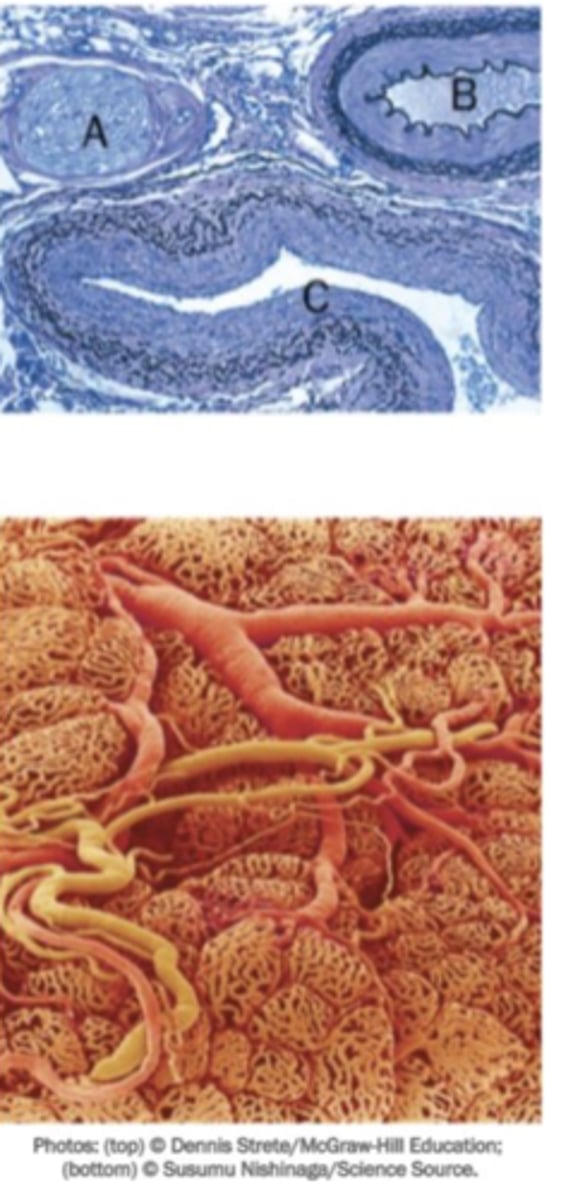
Arteries that are muscular or medium sized arteries that deliver blood to specific organs are called ______ arteries.
distributing
The smallest of the resistance arteries are called ______.
arterioles
Which is another name for conducting arteries?
Elastic arteries
Why is it important for conducting arteries to maintain elasticity?
Their expansion reduces systolic stress on smaller arteries.
Their expansion and recoil helps keep the blood flowing during diastole.
Their recoil helps maintain blood pressure between heartbeats.
A(n) ______ is a weak, bulging sac in the wall of an artery that pulsates with each beat of the heart and which may eventually
aneurysm
The brachial, femoral, renal, and splenic arteries are examples of ______ arteries.
distributing
Which term refers to a small vessel that empties into a capillary?
Arteriole
Which term refers to short vessels that link arterioles to capillaries?
Metarterioles
Which is an example of a sense organ found within an artery?
Carotid sinus
Which term refers to a weak, bulging point in the wall of a heart chamber or blood vessel?
aneurysm
_________ arteries deliver blood to specific organs.
distributing
The carotid sinuses are located in which blood vessels?
Internal carotid arteries
Arterioles are the smallest of which type of artery?
Resistance
Sensory signals travel from the aortic bodies to the brainstem via which cranial nerve?
Vagus nerve
In some places, short vessels called _________ link arterioles to capillaries or provide shortcuts that bypass the capillaries.
metarteriole
Arterial sense organs monitor blood chemistry and blood pressure in order to help regulate which of the following?
Respiration rate
Heart rate
Baroreceptors that monitor blood pressure are found in specialized regions of the internal carotid arteries called the carotid_______.
sinus
Where are carotid bodies located?
Near the branch of the common carotid arteries.
Sensory signals travel from the carotid bodies to the brainstem via which cranial nerve?
Glossopharyngeal nerve
Which are chemoreceptors that are located in the aortic arch?
Aortic bodies
Where does most of the exchange of nutrients, wastes, and hormones between the blood and body fluids occur?
Capillaries
Receptors in the carotid bodies that monitor O2, CO2, and pH levels are examples of which type of sensor?
Chemoreceptor
What is the function of the aortic bodies?
Monitor blood chemistry to help regulate respiratory rate
The term microvasculature (or microcirculation) refers to which of the following?
Capillaries
Arterioles
Venules
Why are capillaries sometimes called the exchange vessels of the cardiovascular system?
Most exchange between the blood and the tissue fluid occurs across capillary walls.
Which term refers to the chemoreceptors located in the carotid artery?
Carotid bodies
Which term refers to the arterioles, capillaries, and venules?
Microvasculature
True or false: The diameter of some capillaries is even smaller than the diameter of a red blood cell.
True false question.
True
The term microvasculature (or microcirculation) refers to which of the following?
Capillaries
Venules
Arterioles
The capillary wall consists of which of the following layers?
Basal lamina
Endothelium
Identify the structure labeled 'C' in the picture.
Intercellular cleft
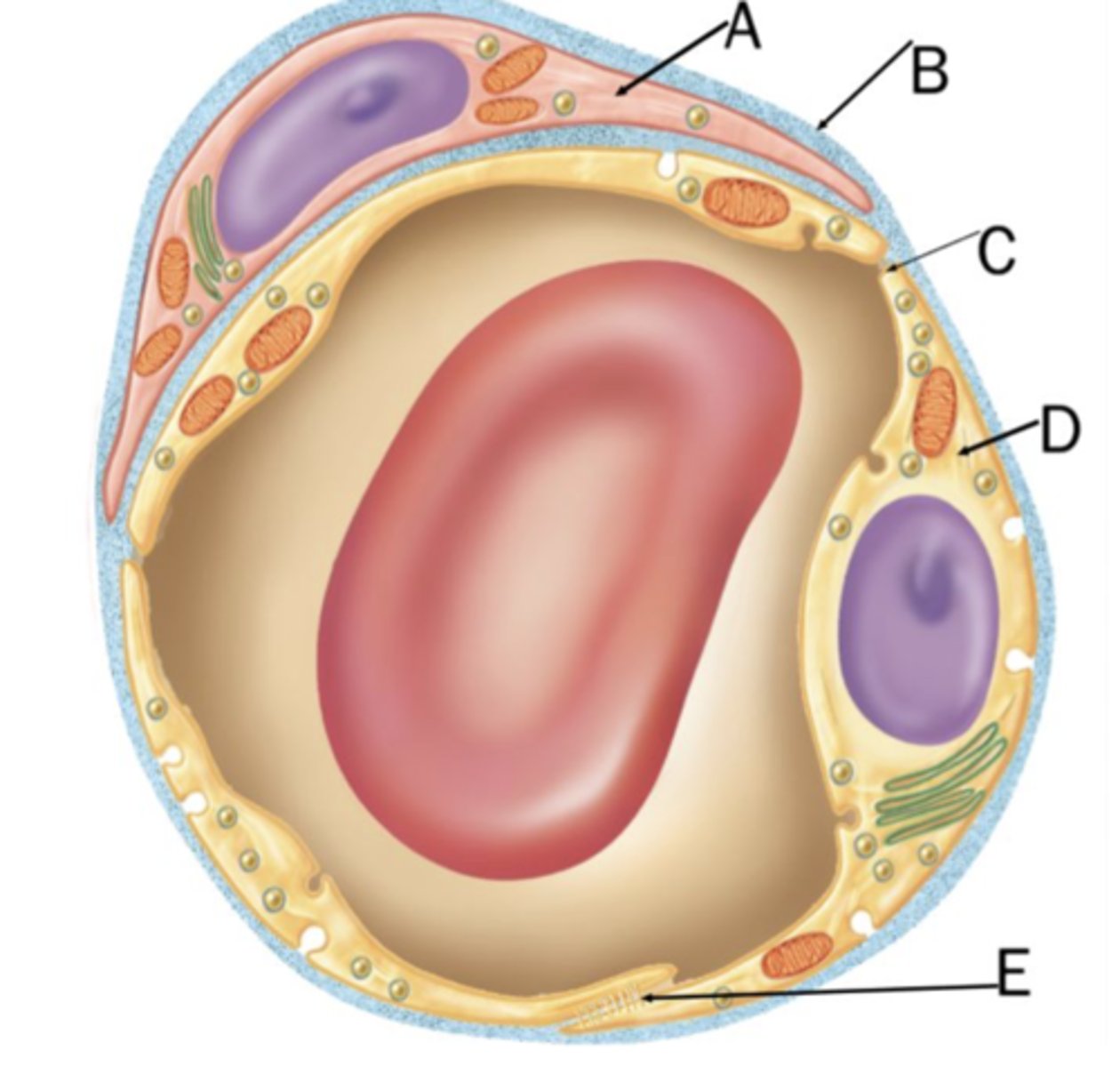
The basal _______ is the non-cellular, proteinaceous material that surrounds the capillary endothelium and separates it from adjacent connective tissue.
lamina
The terms continuous, fenestrated, and discontinuous are used to describe the three types of what?
Capillaries
In continuous capillaries, cells called ______ contribute to vessel growth and repair by retaining the ability to differentiate into endothelial and smooth muscle cells.
pericytes
In continuous capillaries, the endothelium forms a continuous tube held together by _________ junctions
tight
Which term refers to the non-cellular, proteinacious material that surrounds the capillary endothelium and separates it from adjacent connective tissue?
Basal lamina
Match each type of capillary to its most likely location.
Continuous capillaries > Most tissues (e.g. skeletal muscle)
Fenestrated capillaries > Organs that engage in rapid absorption or filtration of small molecules (e.g. small intestine, kidneys)
Sinusoids > Areas where large proteins and cells need to enter or leave the bloodstream (e.g. liver and spleen)
Which may regulate blood flow through the capillaries, and contribute to vessel growth and repair?
Multiple choice question.
Pericytes
Which type of capillary is especially important in organs that engage in the rapid absorption or filtration of small molecules, such as the intestine and kidney?
Fenestrated
Large molecules, such as clotting proteins and albumin synthesized by the liver, enter the blood through which of the following?
Sinusoids
Arrange the three types of capillaries in order from the least permeable (only the smallest solutes can pass through) to the most permeable (largest solutes can pass through).
1/continuous capillaries
2/fenestrated capillaries
3/sinusoids
Capillaries are organized into networks called which of the following?
Capillary beds
________ capillaries are especially important in organs that engage in rapid absorption or filtration.
Fenestrated
Blood flow into capillary beds is regulated by smooth muscle structures called _________ sphincters which surround the openings to the capillaries.
precapillary
Identify the structure labeled 'A' in the picture.
Pericyte
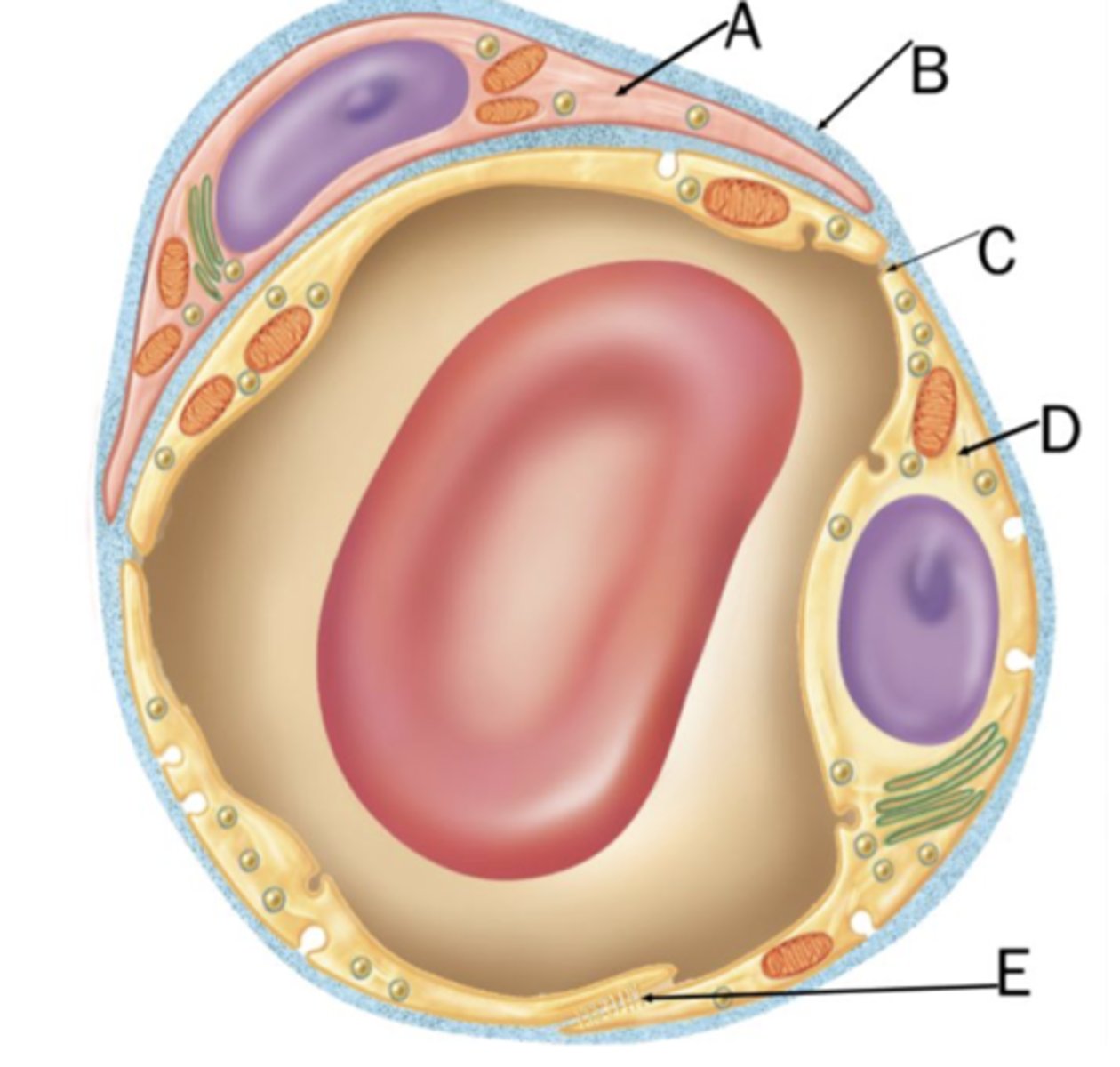
Which are regarded as the capacitance vessels because they expand easily to accommodate an increased volume of blood?
Veins
______ are irregular blood-filled spaces in the liver, bone marrow, spleen, and some other organs.
Sinusoids
Which type of vessel receives blood from capillaries directly or by way of the distal ends of the thoroughfare channels?
Postcapillary venules
Which best defines a capillary bed?
A network of capillaries supplied by a single arteriole or metarteriole
Which of these is the smallest type of vein?
Postcapillary venules
Blood flow into capillary beds is regulated by which of the following?
Precapillary sphincters
________ venules receive blood from the postcapillary venules.
Muscular
The type of blood vessel regarded as capacitance vessels are
veins
Valves that direct blood towards the heart are formed by infoldings of which layer of the vein wall?
Tunica interna
Newly formed blood cells enter circulation from the bone marrow and lymphatic organs by passing through the walls of which of the following?
Sinusoids
______ are veins with especially thin walls, large lumens, and no smooth muscle.
Venous sinuses
_______ venules receive blood from capillaries.
post capillary
Which would be classified as large veins?
Superior venae cavae
Renal veins
Pulmonary veins
Internal jugular veins
Rank the types of veins from smallest to larges
1/postcapillary venules
2/muscular venules
3/medium veins
4/venous sinuses
5/large veins
Which term refers to a varicose vein of the anal canal?
Hemorrhoid
Which type of venule receives blood from the postcapillary venules?
Muscular
Veins have ________ that ensure the one way flow of blood.
valves
portal systems occur in which of the following?
kidneys, between the intestines and liver, between the hypothalamus and anterior pituitary.
Which type of vein is incapable of vasomotion?
Venous sinuses
Which term refers to a circulatory route in which blood flows from an artery directly into a vein, thereby bypassing the capillary?
Arteriovenous anastomosis
The venae cavae, pulmonary veins, internal jugular veins, and renal veins are classified as which of the following?
large veins
Venous anastomoses provide which of the following?
Alternative routes of drainage from an organ
Veins that have become permanently distended and convoluted due to a loss of competence of the venous valves are known as ______ veins.
varicose
An anatomical convergence where two blood vessels merge and combine their bloodstreams is known as a(n) _______
anastomosis
True or False: The femur has greater blood flow but less perfusion than the ovary.
True
Which refers to a circulatory route in which blood flows through two consecutive capillary networks before returning to the heart?
Portal system
Which term refers to all of the physical principles governing blood flow?
Hemodynamics
What is the physiological benefit of an arteriovenous shunt in the fingers and toes?
It reduces heat loss in cold weather
Arterial anastomoses provide which of the following?
Collateral routes of blood supply to a tissue
______ blood pressure is the arterial blood pressure attained during ventricular relaxation.
Diastolic
The flow of blood per given volume or mass of tissue is known as
perfusion
Hemodynamics are based mainly on which of the following?
pressure and resistance
The difference between systolic and diastolic blood pressure is called _______ (one word) pressure.
pulse