Plant Transport
 Call Kai
 Learn
Learn Practice Test
 Spaced Repetition
 Match
Match Flashcards
 Knowt Play
1/47

Earn XP
Description and Tags
eduqas alevel biology
Name | Mastery | Learn | Test | Matching | Spaced | Call with Kai |
|---|
No analytics yet
Send a link to your students to track their progress
48 Terms
What is transpiration
water loss through leaves
Root hairs
where most of the water is absorbed. They provide a large surface area and are freely permeable
How does water enter root hair cells
soil water contains a weak solution of mineral salts and so has a high water potential. The vaculose of the root hair cells has a strong solution of dissolved substances so has a low water potential. This means water moves down the water potential gradient from soil water to root hair cell by osmosis.
Label and draw a typical dicotyledon root.
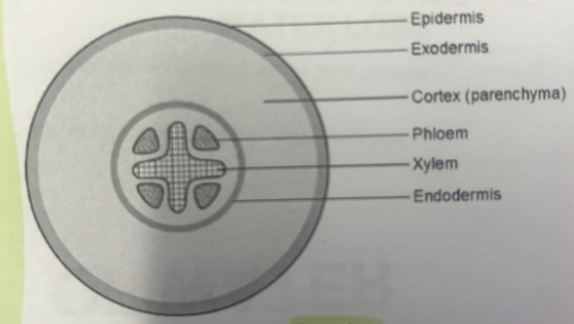
What are the three ways water moves through the cortex of the root
-apoplast pathway
-symplast pathway
-vacuolar pathway
Apoplast pathway
soil solution is absorbed into the epidermal cell wall then through adjacent cell walls or spaces between cells
Symplast pathway
water moves through the plasma membrane by osmosis then through the cytoplasm of cells via the plasmodemata
vacuolar pathway
water moves by osmosis from the cell vacuole and through all the membranes in between
what is the casparian band
a waterproof suberin waxy compound going around the walls of the endodermis . This blocks the apoplastic pathway so water must use one of the other two. Since xylem have no cell content water then goes back to apoplast
Structure of xylem
vessels, tracheids and fibres all become lignified and loose their cell contents. The parenchyma stays living
adaptations of xylem
-collumns joined from end to end
-no cell content and end walls break down for continous water transport
-water goes in one direction
different stages of lignification
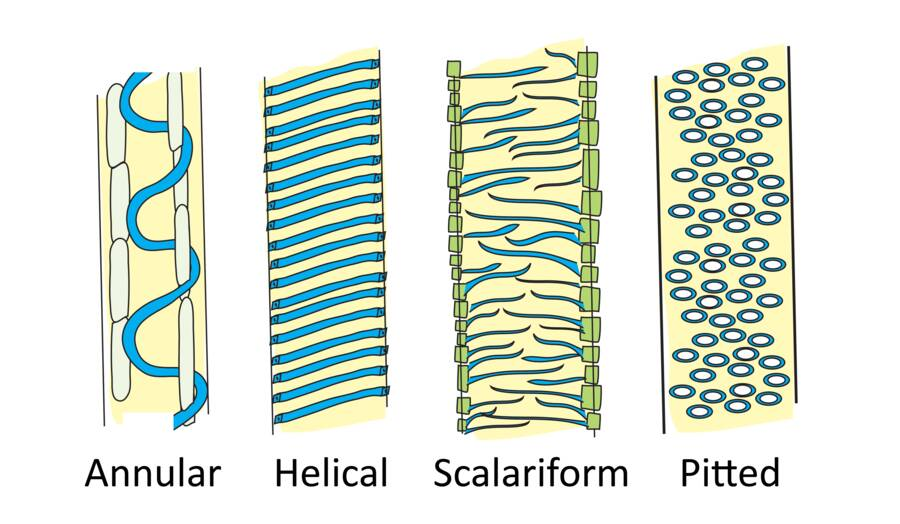
function of pits in xylem
pits allow rapid transport from cell to cell horizontally incase individual cells become blocked
where are xylem in roots and why
in the middle to resit vertical stress and help with anchorage
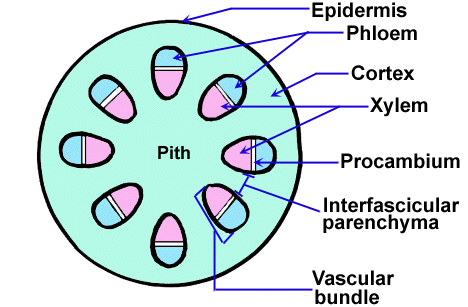
where are xylem in cells and why. draw it
ring of vascular bundles to give flexible support but alos resistance to bending strains
xylem in leaf
vascular bundles in midrib and the veins to flexible strength and resistance
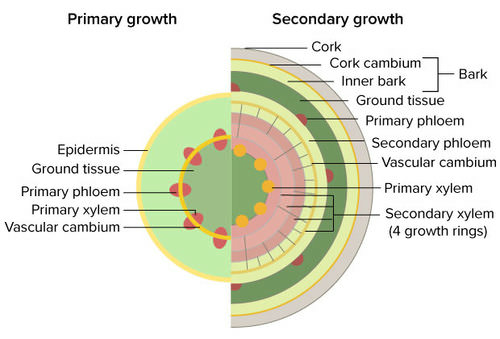
development of secondary xylem and phloem as plant matures
transpiration stream
as water diffuses out of the xylem in the vein of the leaf a pulling force is created which pulls water up from the roots through the xylem in a continous stream known as the transpiration pull
cohesion tension theory
columns of water in thre xylem are help up by cohesive force between water molecules and the adhesive force between water molecules and the hydrophilic lining of the xylem vessels
What is capillary action
strong rigid walls are able to withstand tension created by the pull of the columns of water inside. The tubes are narrow in diameter creating a small upward force of capillarity
external factors effecting transpiration
-temperature
-humidity
-airmovements
other factors effecting transpiration
-number of leaves
-surface area of the leaves
-number and size of stomata
-thickness of waxy cuticel
How are minerals transported
Absorbed and transported through root hairs by diffusion and active transport as ions with the water
What factors effect transport of minerals?
-O2 concentration (ATP)
-water logging- less air space so less O2
-Temperature for rate of diffusion
-respiratory inhibitors
What is a Xerophyte?
“dry loving”
What is a mesophyte?
middle loving
What is a hydrophyte?
Water loving
Adaptations needed for xerophytes?
prevent excessive water loss which would cause leaves to wilt or drop and reduce surface area needed for photosynthesis
problems with Marram grass
water drains rapidly through sand and they are exposed to high salty winds
adaptations or marram grass
-leaves arte rolled into cylandrical shape to reduce surface area and the upper epidermis with the stomata is inside the cylendar.
-lower epidermic has no stomata and a thicker waxy cutitcle
-When traspiration rates are high specialised hinge cells on upper epidermis cause leaf to roll tighter
-upper epidermal hairs trap humid air
-stomata are in sunken pits which increases humiditt by trapping water vapour
Other xeromorphic adaptation
-shedding leaves when water is in short supply
-extra thick waxy cuticle
-swollen stems
-superficial root system
water lily adaptations
-stomata on upper surface for gas exchange and none on submerged lower surface
-elongated lignified cells between upper and lwper epidermis to stop leaf from rolling and covering stomata
-thick palisade mesophyll layer
-long petioles (leaf stalks) to help leaf float
-little to no cuticlr
-large air spaces for gas reserviour and bouyancy
no need for support or transport tissue
water milfoil adapatiations
-reduces vascular and supporting tissue
-not cuticle or stomata
-reduces root system
-air spaces/ bladders for buoyancy for best photosynthesis position
-small leaves with disected lamina to prevent damage by water
water crowfoot adaptations
-aerial and submerged leaves
-water leaves are small and disected without cuticle or stomata
-aerial leaves have broad lamina and a cuticle and stomata
What does the phloem transport?
sucrose
What is the structure of the phloem?
sieve tube elements, companion cells, fibres and parenchyma. Sieve tubes and companion cells are linked by plasmodemata
companion cells structure and function?
have all their cell contents and a large number of mitochondria with many plasmodesmata connecting them to the sieve tubes. They provide energy for the sieve tube elements
What are sieve pores?
similar to plasmodesmata but undergo structural changes during development of sieve tubes often involving callose
sieve tube elements
living cells linked end to end to form sieve tubes. The end walls of each element are perforated by sieve plates.
During developments they loose its nucleus, ribosomes and vaculoar membrane and remaining organelles are pushed to the edges
cytoplasmic filaments
contizn phloem proteins and extend from sieve cell to sieve cell through pores in sieve plates
possible function of companion cells
movement of solutes in and out of sieve tubes
Mass flow hypothesis
sucrose is translocated from SOURCE to SINK passivley
Sucrose produced in leaves which is actively loaded Into Phloem which lowered water potential so water moved into phloem by osmosis from xylem. Hydrostatic pressure in source increases and moves sucrose from source to sink. Sucrose is unloaded and water potential increases and water moves out and lowers hydrostatic pressure
What could be responsible for the bidirectional movements in plants?
cytoplasmic streaming
Ringing experiment?
Bark and underlying soft tissue is removed from a branch, leaving the xylem intact. After a couple weeks the tissue above the strip will be swollen, but not below, showing the accumulation of sucrose as it tries to move from source to sink
Aphids
feed on plants by inserting their stylets into the phloem tissue. some of the content exudes from the aphid which can be removed and tested
Aphids for radioactive tracers
a leaf can be supplied with radioactive carbon dioxide. When the plant photosynthesises the 14C becomes part of the sucrose. Parts of thye steam can be taken and frozen and rate and position of14C movement can be tracked. Alternatively, Aphids can be made to feed on this plant before being given anaesthetics and their bodies are cut off, leaving stylets in the phloem. The pressure inside the phloem forces sap out which can be analysed for 14C
Shows translocation is too rapid for diffusion
Isotopes and autoradiography
when a radioactive elemnt is applied to a plant its position and movement can be tracked by placiung the plant in ohotographic film in the dark for 24 hours. the 14C will appear dark. This can be repeated over time and we can track how far the 14C has transported and to where
What is root pressure?
Root pressure is the active uptake of mineral ions into the xylem in roots, which lowers the water potential and causes water to enter by osmosis, generating a positive pressure that pushes water up the plant.