Chapter 16
 Call Kai
 Learn
Learn Practice Test
 Spaced Repetition
 Match
Match Flashcards
 Knowt Play
1/86

There's no tags or description
Looks like no tags are added yet.
Name | Mastery | Learn | Test | Matching | Spaced | Call with Kai |
|---|
No analytics yet
Send a link to your students to track their progress
87 Terms
Barriers to Treatment
Uncertainty whether one qualifies for help
Stigma about mental illness
Gender roles
Expense and availability of treatment
Gender roles
Men under-report mental health problems
Mental Health Providers
Counseling psychologists:
Clinical psychologists:
Psychiatrists:
Counseling Psychologists
Address common problems such as stress, coping, and mild forms of anxiety and depression
Clinical psychologists:
mental health professionals with doctoral degrees who diagnose and treat problems ranging from the everyday to the chronic and severe
Psychiatrists:
physicians who specialize in mental health, and who diagnose and treat mental disorders primarily through prescribing medications that influence brain chemistry
Work with psychologists to provide biopsychosocial interventions
Residential Treatment Centers
Provide psychotherapy and life skills training so that the residents can reintegrate into society to the greatest extent possible
Range from low to high level centers with varying restrictions
Community Psychology
Focuses on how mental health is influenced by the neighborhood, economics, social groups, and other community-based variables
Public awareness campaigns
Educational programs
Subsidized therapy
Community psychology (types)
Public awareness campaigns
Educational programs
Subsidized therapy
EVIDENCE BASED THERAPIES
Empirically Supported Treatments
Bibliotherapy
Empirically Supported Treatments
Most psychological interventions have been tested and evaluated using sound research designs
Limitations (EST)
No double-blind procedures
Ethical considerations for control groups
Cannot standardize therapeutic alliance
Bibliotherapy
The use of self-help books and other reading materials as a form of therapy
Minor effects
Questionable source material
Historical Insight Therapies
Dialogue between client and therapist for the purposes of gaining awareness and understanding of psychological problems
Types (Historical Insight Therapies)
Psychodynamic therapies
Humanistic-existential psychotherapy
Psychodynamic therapies
forms of insight therapy that emphasize the need to discover and resolve unconscious conflicts
Humanistic-existential psychotherapy
Phenomenological approach:
Phenomenological approach:
therapist listens empathetically and addresses the clients’ subjective feelings and thoughts as they unfold in the present moment
Unconditional positive regard
Modern Insight Therapies
Object relations therapy:
Emotion-focused therapy:
Therapeutic Alliance
Group and Family Therapies
Object relations therapy: (Mod.T)
a variation of psychodynamic therapy that focuses on how childhood experiences and emotional attachments influence later psychology
Emotion-focused therapy: (Mod.T)
a variation of humanistic-existential psychotherapy based on the belief that it is better to face and accept difficult emotions and thoughts rather than to ignore them
Therapeutic Alliance
Relationship between therapist and client is the best predictor of therapy success regardless of the type of insight therapy used
Group and Family Therapies (Mod.T)
Less expensive
Organized to fit needs
Provides social support and practice
Gives therapist a more realistic account of patient’s behaviour
Systems approach (G & FT)
an orientation toward family therapy that involves identifying and understanding what each individual family member contributed to the entire family dynamic
Behavioural Therapies
Address problem behaviours and thoughts, and the environmental factors that trigger them, through conditioning
Aversive conditioning
Aversive conditioning: (Be.T)
involves replacing a positive response to a stimulus with a negative response, typically by using punishment
Exposure Therapies
Systematic desensitization:
Flooding:
Systematic desensitization: (Exp.T)
gradually exposing an individual to stressful stimuli such that the aversive response extinguishes
Flooding: (Exp.T)
individual is immersed in stress-inducing situations
Virtual Reality Exposure
Virtual reality technology can enhance exposure therapies by generating immersive environments that would not otherwise be possible to reproduce
PTSD treatment for soldiers
COGNITIVE- BEHAVIOURAL THERAPIES
Cognitive-Behavioural Therapy (CBT)
Mindfulness-Based Cognitive Therapy
Cognitive-Behavioural Therapy (CBT)
Not only addresses problematic behaviours, but also the distorted cognitions underlying them
Types (CB.T)
Cognitive restructuring:
Stress inoculation training:
Requires commitment from therapist and client
Cognitive restructuring: (CB.T)
changing negative cognition into more realistic and rational thought patterns
Stress inoculation training: (CB.T)
helps client put traumatic memories into perspective
Mindfulness-Based Cognitive Therapy
Combines mindfulness meditation with standard cognitive-behavioural therapy
Decentering
Decentering:
occurs when one is able to ‘step back’ from one’s normal consciousness and observe one’s thoughts more objectively
Drug Treatments
Psychopharmacotherapy:
Psychopharmacotherapy:
the process of treating psychological disorders with drugs
Psychotropic drugs
What do drugs have to pass through to get to the brain?
Blood-Brain barrier
Blood-brain barrier:
a network of tightly packed cells that only allow specific types of substances to move from the bloodstream to the brain
Mood Stabilizers
Drugs that prevent or reduce the manic side of bipolar disorder
Lithium
Lithium: (Mood.S)
reduces severity/frequency of manic phases
What was lithium replaced by?(Mood.s)
Replaced by anticonvulsant medications
anticonvulsant medications
drugs used to stabilize mood, often prescribed for bipolar disorder.
When does mood stabilizers become difficult
Treatment compliance often a problem during mania
Antianxiety Drugs
Alleviate nervousness and tension, and to prevent and reduce panic attacks
What does antianxiety drugs do?
Promote activity of GABA, an inhibitory neurotransmitter, thereby reducing neural activity
Problem with antianxiety drugs
Short-term effects and high potential for abuse
MDMA-Assisted Therapy
Early evidence that MDMA (ecstasy) may facilitate therapy for individuals with PTSD
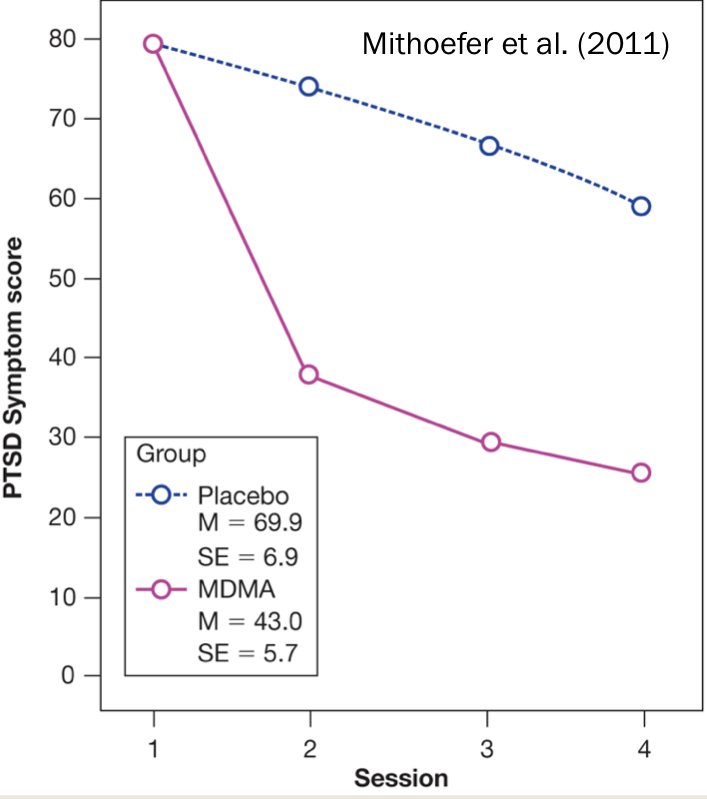
What does MDMA increase?
Increases norepinephrine, serotonin, and dopamine
What does MDMA facilitate?
Facilitates concentration and trust during therapy so as to better contextualize traumatic memories
Antipsychotic Drugs
Prescribed for disorders such as schizophrenia and severe mood disorders
Antipsychotic Drugs
First Generation
Tardive Dyskinesia
Atypical antipsychotics (second-generation)
First-generation: Antipsychotics
blocked dopamine receptors
Tardive Dyskinesia: Antipsychotics
Parkinsonian-like symptoms marked by involuntary movements and facial tics
long-term use of first-generation antipsychotics.
Atypical antipsychotics (second-generation):
reduces dopamine and serotonin
Depression and Neurotransmitters
Monoamine theory of depression:
Monoamine theory of depression:
underactivity at serotonin and norepinephrine synapses
Upregulation of serotonin/ norepinephrine receptors in autopsies studies
Most effective drugs target monoamines
Antidepressants
Monoamine oxidase inhibitors (MAOIs)
Tricyclic antidepressants:
selective serotonin reuptake inhibitors (SSRIs)
Monoamine oxidase inhibitors (MAOIs):
deactivates monoamine oxidase, an enzyme that breaks down serotonin, dopamine, norepinephrine
Tricyclic antidepressants:
block reuptake of serotonin/norepinephrine
Tricyclic antidepressants replaced by
selective serotonin reuptake inhibitors (SSRIs)
selective serotonin reuptake inhibitors (SSRIs)
which primarily increase serotonin levels.
Mechanisms of Action (Antidepressants)
Antidepressant drugs take weeks to months before producing a clinical effect
Down-regulation of serotonin receptors (5HT1A)
Down Regulation: An Update
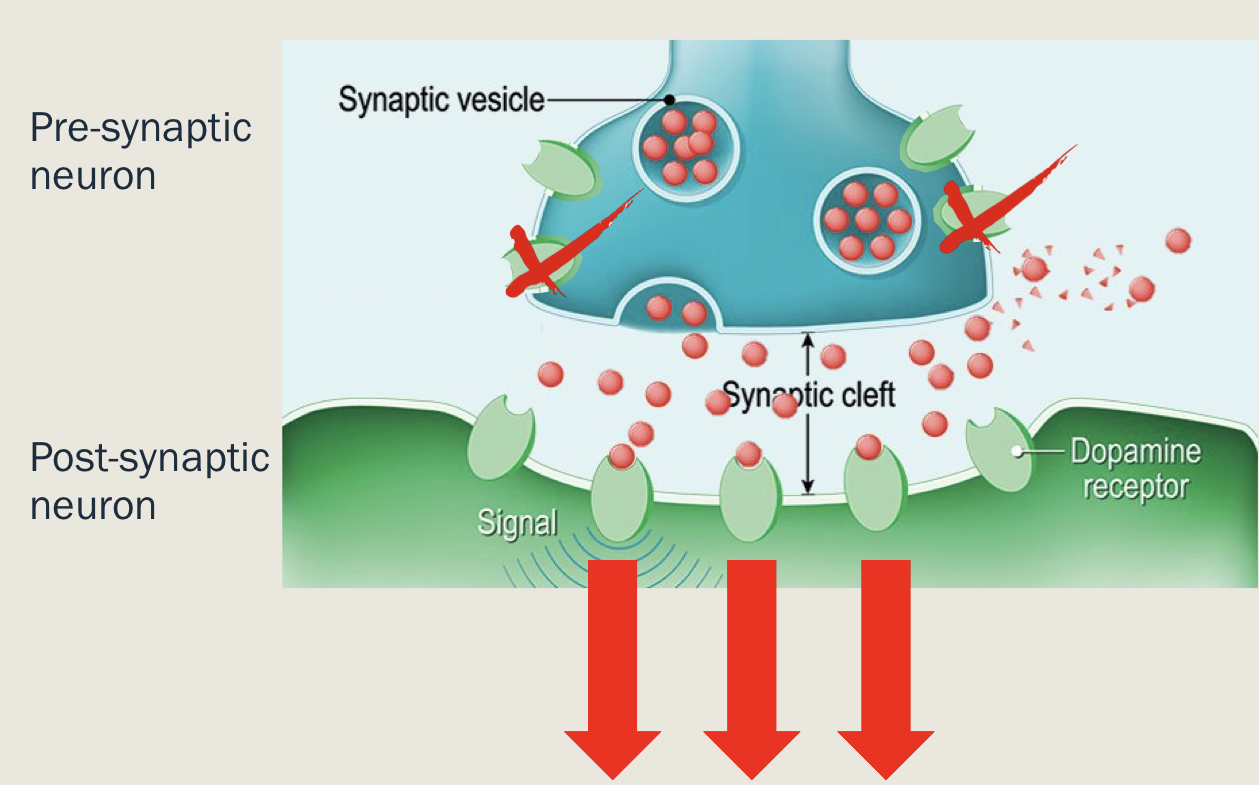
Action of antidepressants (SSRIs)
stimulate release of BDNF which promotes neurogenesis in the hippocampus
Hippocampus helps regulate HPA axis and reward circuitry, involved in contextualizing fear memories, and supports new learning and memories
Hippocampus and depression
helps regulate HPA axis and reward circuitry, involved in contextualizing fear memories, and supports new learning and memories
ARE DRUGS A CURE ALL?
No
Evaluating Drug Therapies
Response vs remission
Similar efficacy between CBT and antidepressants
Lower relapse rate with CBT
Exercise
Response vs remission
Response refers to any improvement in symptoms, while remission indicates the absence of significant symptoms.
results of comparing CBT and antidepressants
Similar efficacy between CBT and antidepressants
Lower relapse rate with CBT
Exercise vs medication
can be as effective as SSRIs for some
Stimulates release of endorphins and BDNF
Positive side effects
Combining Therapies
Drugs most effective when combined with other therapies
Therapeutic approach needs to be tailored to each person
Early Surgical Methods
Neurologists in 1800s and 1900s experimented with removing regions
Leucotonomy
Prefrontal lobotomy with “ice pick”
Leucotomy:
Wire loop to destroy frontal lobe
Prefrontal lobotomy with ‘ice pick’
A surgical procedure involving inserting an ice pick-like instrument through the eye socket to sever connections in the prefrontal cortex.
When were these early surgical methods eliminated?
Eliminated in U.S. by 1970s
Modern Surgical Methods
Focal lesions:
Focal lesions:
small, specific damage applied to a cluster of nerve cells
When are modern surgical methods used?
For severe psychiatric problems when all other methods failed
Electroconvulsive Therapy (ECT)
Treatment in which an electrical current is passed through the brain to induce a temporary seizure
Used in severe cases unresponsive to other treatments
Mild side effects such as temporary confusions and amnesia for events around time of treatment
Side effects (ECT)
Mild side effects such as temporary confusions and amnesia for events around time of treatment
Repetitive Transcranial Magnetic Stimulation (rTMS)
A technique in which a powerful magnetic field is used to either stimulate or inhibit brain activity
No anesthesia or seizure
Reduces symptoms in treatment resistant depression
Benefits of (rTMS)
No anesthesia or seizure
Deep Brain Stimulation (DBS)
A technique that involves electrically stimulating highly specific regions of the brain
Thin electrode-tipped wires inserted into brain
Instantaneous results
Benefits of (DBS)
Instantaneous results