Biology: Topic 3: Cell Membrane
 Call Kai
 Learn
Learn Practice Test
 Spaced Repetition
 Match
Match Flashcards
 Knowt Play
1/25

There's no tags or description
Looks like no tags are added yet.
Name | Mastery | Learn | Test | Matching | Spaced | Call with Kai |
|---|
No analytics yet
Send a link to your students to track their progress
26 Terms
What is diffusion?
Molecules in high concentration will move to areas of low concentration
Not by repelling each other, but because they are moving around and eventually will disperse
What makes the cell membrane fluid?
neither solid or liquid - fluid
Fluidity means it can flow around the cell as it changes shape
Molecules within the membrane are free to move
Double bonds in fatty acid tails of phospholipids
Sterols (cholesterol in animal cells, phytosterols in plant cells) - pack between fatty acid tails
What is the fluid mosaic model?
describes that the membrane is a fluid phospholipid bilayer with a mosaic of proteins that move
What are the functions of membrane proteins?
Enzymes - catalyse reactions, substrates may be on either side of membrane
Signal transduction- signalling molecule bind to protein receptor to pass the information along
Cell - cell recognition- cells recognise glycoproteins or glycolipids (carbohydrates) to know what other cells are around them (own and foreign)
Intercellular joining- binds cells for organisation and strength
Attachment to the cytoskeleton (eukaryotic) and extracellular matrix (animal cells)- provide strength to flimsy membrane, and organisation
Transport- allows passage of charged and hydrophilic solutes, with or without energy
Why is membrane fluidity important?
helps small molecules cross (O2)
Enables proteins to move to where they’re needed
Helps proteins in the membrane undergo conformational change (for transport and enzymes)
Helps the entire membrane move around/change shape
What is simple diffusion?
no energy
Solute passes directly through the membrane
Solute diffuses down its OWN conc gradient, from high to low
Small uncharged solutes and large hydrophobic solutes
Rate is dependent on OWN concentration gradient (difference in conc)
Slow
What is facilitated diffusion?
no energy
Solute passes through a transport protein (usually specific for a solute)
Faster than simple diffusion
Solute diffuses down its OWN conc gradient, from high to low
Large, charged solutes and hydrophilic solutes
Rate is dependent on concentration gradient (difference in conc) - until plateau because proteins are saturated and working at their maximum rate
Transport proteins:
Channel proteins - open channel
Ion channels- channel protein that transports ions
Carrier proteins- changes shape to allow solute to pass
What is active transport?
needs energy from ATP
Moves solute from low concentration to high concentration
Against their concentration gradient
Proteins used: carrier only
Primary active transport: uses ATP to directly move ions (Na/K pump, H+ pump)
Secondary active transport: primary active transporter (e.g. H+ pump) sets up conc gradient that a cotransporter uses to move transport of a second solute against its gradient
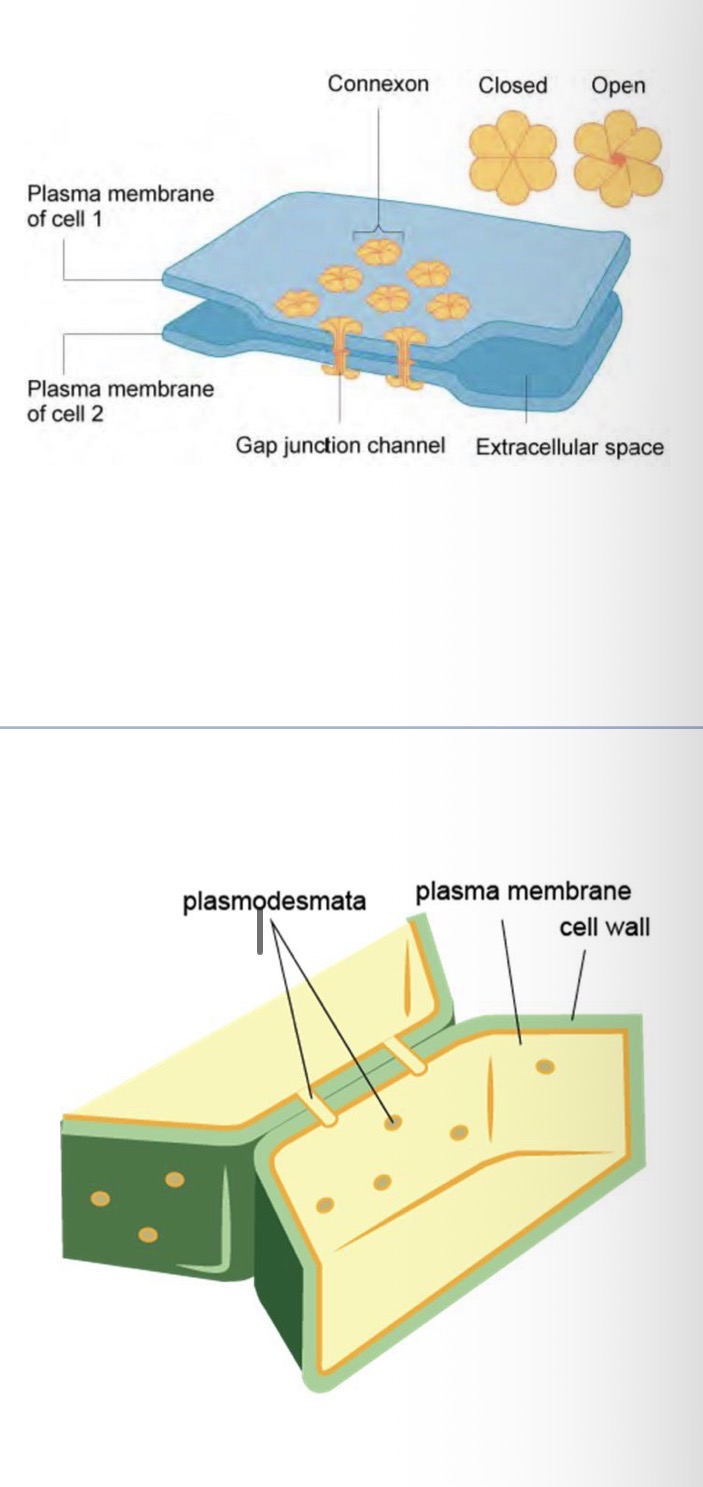
What is a cytoplasmic connection between cells?
Animal cells- Cell cytoplasms are connected by gap junction channels (proteins that span the gap junction) that can be opened and closed to allow small molecules and ions to move from one cell to another
Plant cells- cell cytoplasms are connected by plasmodesmata (channels lined with cell membrane) to allow passage of small and large solutes (proteins and mRNA) from one cell to another
What is osmosis?
diffusion of free water (water that is not bound to solutes or surfaces) across a membrane
Define moles vs molarity
mole - 6×10²³ - to compare concentrations - 6×10(23) glucose molecules in 1 L of sol is a 1 mol/L glucose solution
Molarity - measure of concentration
Define moles vs osmoles
Some solutes dissociate (NaCl) so 1 mol of NaCl becomes 2 mol of solute particles - osmolarity takes this into account
Osmolarity - measure of the total concentration of solute particles in a solution
What is osmosis?
Water flows across a membrane from a region of low solute concentration to a region of high solute concentration
What is an aquaporin?
Protein channel that water passes through to enter the cell - much faster than diffusing directly across the membrane
How does tonicity impact animal cells
Hypotonic solution - lower solute conc outside the cell- water moves into the cell - it bursts
Isotonic solution - equal solute conc outside- no net movement of water - normal cell
Hypertonic - higher solute conc outside the cell - water moves out of the cell - it shrivels
How does tonicity impact plant cells
hypotonic- lower solute conc outside the cell - water moves into the cell - cell is turgid (preferred)
Isotonic- equal conc of solutes - no net movement - cells lose turgor - is flaccid
Hypertonic- higher solute conc outside the cell - water moved out of the cell - cell becomes plasmolysed
What is plasmolysis?
Plant cells - cell shrinks, membrane pulls away from the cell wall
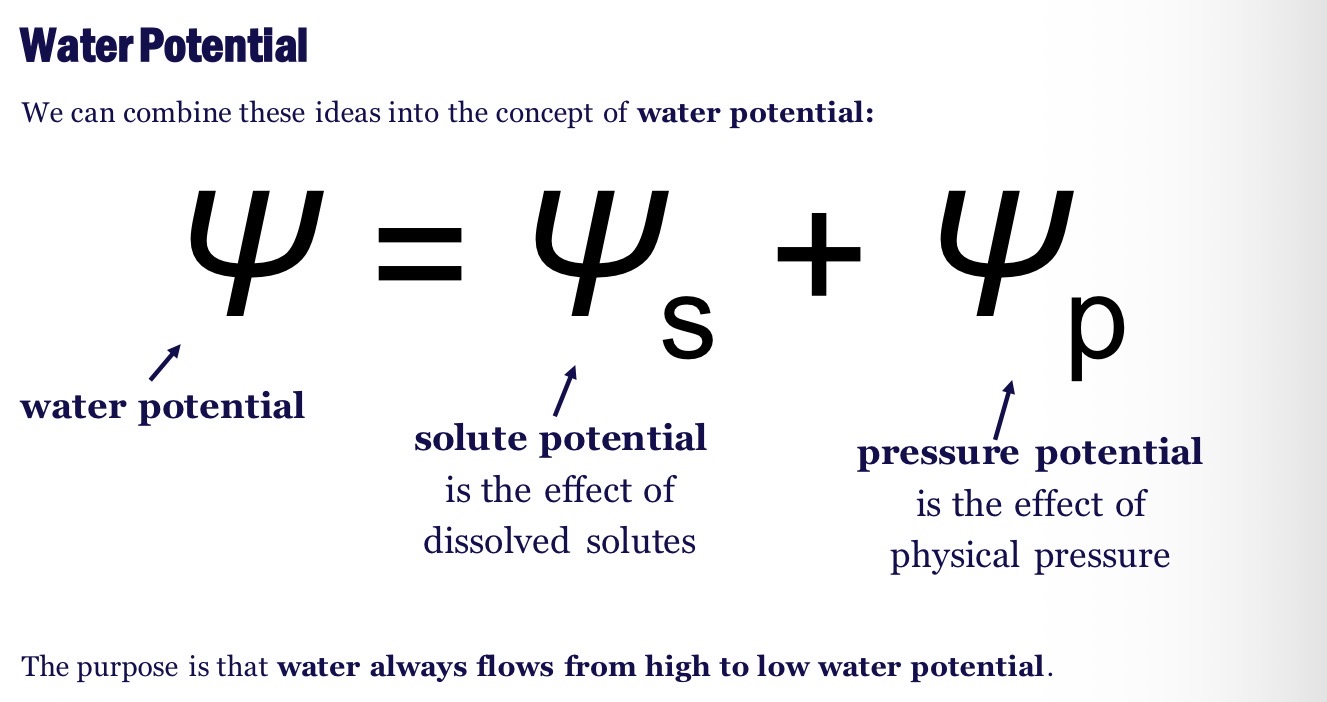
What is water potential?
the physical property that predicts the direction in which water will flow
Measured in MPa (megaPascals)
Water potential = solute potential (osmotic potential) + pressure potential
In osmosis: water moves from high water potential to low water potential
What water potential does pure water open to the atmosphere have?
0 MPa
What is solution potential and how does it impact water potential?
the effect of dissolved solutes on water potential
Water flows toward higher solute concentration, and flows from high to low water potential
Solutes make solute potential negative
What is pressure potential and what effect does it have on water potential?
the physical pressure that squeezes water
Makes pressure potential positive
What is membrane potential?
membrane potential is the voltage across a membrane
Inside the cell is negative and outside is positive due to the unequal distribution of ions
Affects the traffic of all charged substances across the membrane - Favours the passive transport of cations into the cell and anions out of the cell
What is the electrochemical gradient?
the overall force that drives the diffusion of ions across a membrane
Chemical force: the ions own concentration gradient
Electrical force: effect of membrane potential on the ions movement
How does electrochemical gradient impact an ions movement across membranes?
Ions (CHARGED) diffuse down their electrochemical gradient (not just concentration gradient - UNCHARGED)
If both forces act in the same direction- the ions own concentration can move passively
If the electrical forces oppose the simple diffusion down the conc gradient - active transport is used
What is an electrogenic pump?
Transport protein that generates voltage across a membrane - like a proton pump (important in cellular respiration for plants, fungi, bacteria)
What is a cotransporter?
A transport protein that can couple the downhill diffusion of the solute to the uphill transport of a second substance against its own concentration gradient (uses energy)