RAD BIOLOGY MODULE 2
 Call Kai
 Learn
Learn Practice Test
 Spaced Repetition
 Match
Match Flashcards
 Knowt Play
1/358

Earn XP
Description and Tags
Chapters 6, 7, 8, 9
Name | Mastery | Learn | Test | Matching | Spaced | Call with Kai |
|---|
No analytics yet
Send a link to your students to track their progress
359 Terms
In a DNA macromolecule, the sequence of ___ determines the characteristics of every living thing
Nitrogenous organic bases
How many base pairs are there in the human genome?
2.9 × 10⁹ (2.9 billion base pairs)
Radiation-induced chromosome damage may be evaluated during which Mitosis subprocess?
Prophase
Metaphase
Anaphase
Telophase
Metaphase
If exposure to ionizing radiation damages the components involved in molecular synthesis beyond repair, cells do what?
Function abnormally or die
What produces antibodies?
erythrocytes
lymphocytes
platelets
thrombocytes
lymphocytes
Water comprises ___% of the weight of the human body
80-85 %
Which must the human body provide to ensure efficient cell operation?
food as source of raw material for release of energy
oxygen to help break down food
water to transport inorganic substances in/out of cell
all of the above
Which human cell component controls cell division and multiplications as well as biochemical reactions that occur within the cell?
Nucleus
What term is used to describe chemical secretions that are manufactured by various endocrine glands & carried by the bloodstream to influence activities of other parts of the body?
Hormones
Somatic cells divide through the process of:
Mitosis
The primary function of _____ appears to be the breaking down of unwanted large molecules that either penetrate into the cell through microscopic channels or are drawn in by the cell membrane itself.
Lysosomes
_____ metabolism is the oxidation of smaller molecules to release enrgy
Oxidative
__ are chemical compounds resulting from the action of an acid with a base
salts
Salts are referred to _____
electrolytes
The ___ is the fundamental element of structure, development, growth, & life processes in the human body
cell
Proper cell function enables the body as a whole to maintain ____ equilibrium
homeostasis
The biomolecules that constitute protoplasm are formed from 4 elements:
carbon
hydrogen
oxygen
nitrogen
Proteins are formed when organic compounds called ___ ___ combine into, long chain-like molecular complexes
amino acids
If radiation damage is excessive because of large delivered EqD, the cellular harm will be too severe for ____ ____ to have enough positive effect
repair enzymes
_____ regulate body functions such as growth & development
hormones
Although carbs are found throughout the human body, they are more abundant in ____ & in ____ tissue
liver; muscle
The arrangements of amino acids are determined by succession of adenine-thymine & cytosine-guanine base pairs in the ___ macromolecule
DNA
Retaining the correct proportion of water in the cell causes ___ pressure to be maintained
osmotic
Dizygotic twins are also called ____ twins
dizygotic
Water, a solvent, will preferentially move across cell surfaces or membranes into area with ____ concentration of ions
high
By controlling its concentration of potassium ions, the cell regulates the amount of ___ passing through its membrane & consequently the amount of ___ it contains
water; fluid
_____ enables the cell to synthesize proteins & produce energy
metabolism
The primary purpose of carbohydrates is to provide fuel for cell ______
metabolism
____ manufacture (synthesize) the various proteins that cells require by using the blueprints provided by mRNA
ribosomes
Both the ___ & ____ capabilities of enzymes are of vital importance to the survival of the cell
catalytic; repair
Lipids are organic _______ made from smaller chemical
macromolecules
By directing protein synthesis, the ___ plays an essential role in active transport, metabolism, growth, & heredity
nucleus
the ____ _____ transports food & molecules from one part of the cell to another
endoplasmic reticulum
Nucleic acids (DNA,RNA) carry genetic info necessary for cell ______
replication
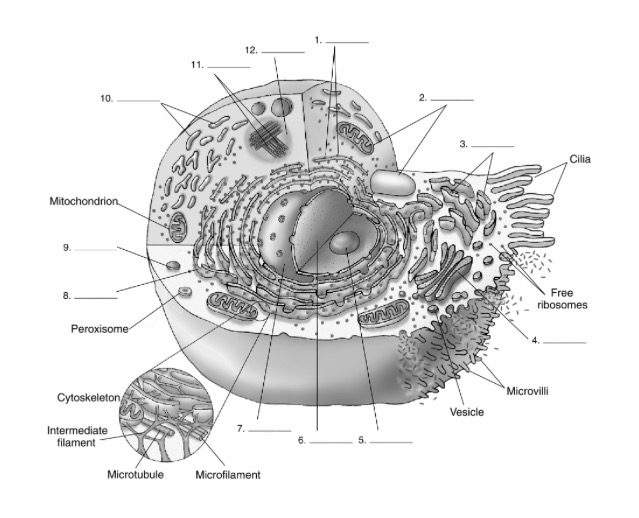
Label-12
Ribosome
Mitochondria
Smooth endoplasmic reticulum
Golgi apparatus
Nucleolus
Nucleus
Nuclear envelope
Rough endoplasmic reticulum
Lysosome
Smooth endoplasmic reticulum
Centrioles
Centrosome
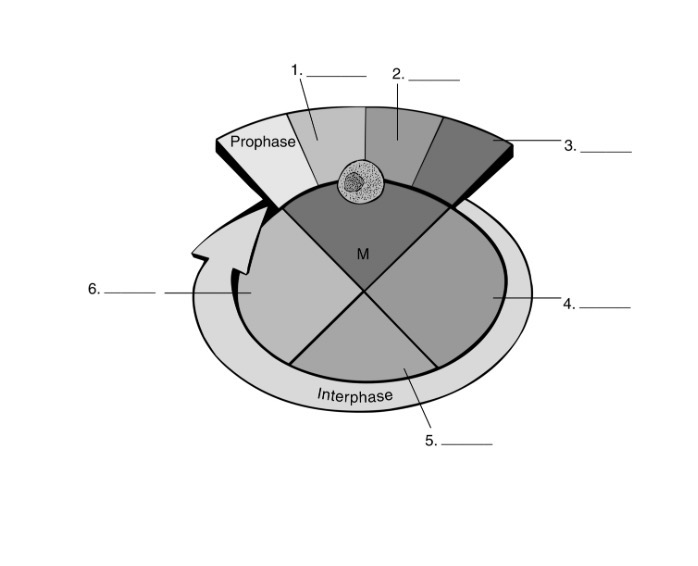
Label 1-6
Metaphase
Anaphase
Telophase
G1
S
G2
The ___ is known as the “plastic storage bag” or barricade protects cellular contents from environments, controls ins & outs of cell, eliminates waste, and breakdowns materials
Cell membrane
The ____ ____ is known as the “highway” which enables the cell to communicate with extracellular environment & transfers food from different parts of the cell
Endoplasmic reticulum
The ____ ____ is known as the “freight hauling” and unites large carb molecules with proteins to form glycoproteins, transports enzymes & hormones through membrane to exit cell & enter bloodstream
Golgi Apparatus
Cells are the basic units of all living ___ and are essential for life
matter
Proteins, carbohydrates, lipids & nucleic acids are the 4 major classes of ___ compounds, contain carbon
organic
What type of enzymes can mend damaged molecules and therefore help the cell recover from a small amount of radiation-induced cancer
repair enzymes
In a DNA macromolecule, adenine (A), cytosine (C), guanine (G), and thymine (T) are the four ______ organic bases
nitrogenous
What is the process of locating and identifying genes in the human genome called?
mapping
The large, double-membrane, oval- or bean-shaped structures that function as the powerhouse of the cell are called:
mitochondria
When somatic cells divide, they undergo:
mitosis
During which subphase of the cell division can radiation-induced chromosal damage be evaluated?
metaphase
What function do ribosomes perform in the cell?
synthesize the proteins that cell require
Approx how many genes are contained in all 46 chromosomes?
30,000
If exposure to ionizing radiation damages the components involved in molecular synthesis beyond repair what will happen?
abnormal function or death of cells
Protein synthesis involves __ different amino acids
22
What is formed from a nitrogen containing organic base, a 5 carbon sugar molecule, and a phosphate molecule?
nucleotide
What serves as a prototype for mRNA?
DNA
What is the protoplasm outside of the cell’s nucleus called?
Cytoplasm
____ is the period of cell growth that occurs before actual mitosis
interphase
____ act as a reservoir for long-term storage of energy, insulate and guard the body against environment, and support/protect organs such as the eyes & kidneys
lipids
The ____ located in the cytoplasm, AKA “power-generating stations”, produce energy for cellular activity by breaking down nutrients through a process of oxidation
mitochondria
_______’s are AKA “garbage bags w/ poison pills” that dispose of bacteria/food, carbohydrates, cell itself if lysosome membrane breaks, and the hydrolytic enzymes that break down/digest proteins
lysosome
______’s are AKA “manufacturing facilities” that create the various proteins that cells require
ribosomes
______’s are AKA “spindle weaver” and organize the function of mitotic spindle during cell division
centrosome
The ____ is AKA “information processing center of cell” containing genetic or hereditary material, DNA, and proteins, nucleulous. It controls cell division & multiplication & biochemical reactions that occur in the cell & directs protein synthesis
nucleus
____ is AKA “blueprints” and contains the genetic material that controls cell division/multiplication & biochemical reactions within cell
DNA
The ____ is AKA “RNA copy center” and holds larges amount of RNA and synthesizes ribosomes
nucleolus
Cells can:
Move, grow, react
Repair damage, regulate life processes, & reproduce
Protect themselves
All of the above
In a DNA macromolecule, the sequence of ___ determines the characteristics of every living thing
Nitrogenous organic bases
Which produces antibodies?
Thrombocytes
Erythrocytes
Platelets
Lymphocytes
Lymphocytes
Which term describes chemical secretions that influence other bodily functions?
Hormones
Cytosine bond only with which nitrogenous organic base?
Guanine
Protoplasm is:
The chemical building material for all living things
Made of organic compounds
Made of inorganic materials
All of the above
Inorganic materials:
Contain carbon
Do not contain carbon
Are water and mineral salts
2 & 3
Water has roles of:
Acts as a medium for acids, bases and salts to dissolve
Maintains body temp, provides cushion and lubricates
Functions as a solvent & transport vehicle
All of the above
____ are macromolecules that are made of strings of amino acids (22 for humans)
Proteins
___ _____ are found in muscle and are a source of heat and energy
Structural proteins
_____ _____ control the cell’s physiologic activities
Enzymatic proteins
____ ____’s can help a cell recover from small radiation doses and can mend damaged molecules
Repair enzyme
Antibodies are protein molecules produced by cells in the ___. They attack foreign invaders
Bone marrow
Carbs are:
Referred to as saccharides, make up 1% of the cell
Include starches & sugars & provide energy to the cell
Most abundant in the liver & muscle tissue
All of these
Macromolecules, fats, oils, fatty acids, 2% of cell content, long term energy, insulate are ____
Lipids
What are the rungs of DNA that are complementary chemicals called?
Pairs of nitrogenous bases
Purines are:
Adenine (A) & (Guanine) G
Cytosine (C) & Thymine (T)
1
The master chemical:
Contains all the information the cell needs to function
Carries genetic info necessary for cell
Called DNA, direct protein synthesis
All of the above
Single strand, leaves nucleus, transmit, genetic info outside the cell, has your cell not thymine is:
mRNA
Received genetic code from mRNA, linked with its matching amino acid to produce protein is :
Transfer RNA
Tiny, rod shaped body that humans have 46 of which are composed into 23 pairs:
Chromosomes
Direct cytoplasmic activity, basic unit of heredity, control, self growth, and development are:
Genes
Mapped in 2001, uncovered the entire sequence of DNA base pairs in the human genome which is ____ billion base pairs and approx ____ genes
2.9 billion; 30,000
Ribosomes can synthesize ____ and attach to ____ _____
Proteins; endoplasmic reticulum
The ____ _____ is the highway, transfers food, & enables cell communication
Endoplasmic reticulum
The process where the nucleus divides first, followed by cytoplasm, and is the process of somatic cell division is:
Mitosis
The process of reduction, cell division, occurs when genetic cells divide, and reduces the number of chromosomes is
Meiosis
____ is when chromatids strung out along mitotic spindle- middle of cell
Metaphase
High LET would be what Wr
>1
Low LET would be what Wr
=1
A biologic reaction is produced by 7 Gyt of a test radiation. It takes 21 Gyt of 250 kVp x-rays to produce the same biologic reaction, what is the RBE of the test radiation?
3 RBE (3x more effective at producing biologic reaction)
What kinds of molecules in the human body does ionizing radiation most often act directly to produce molecular damage through an indirect action?
Water
Radiosensitivity of individual cell growth governs the radiation dose required to cause _____
apoptosis (programmed cell death)
Define LET and how is it described?
Average energy deposited per unit length of track
units: keV/micro m
What is the oxygen effect?
What describes the effect numerically?
Oxygen in a cell makes it more radiosensitive
OER
The action of ionizing radiation is ____ when ionizing particles interact with a vital biologic macromolecule such as DNA
direct