Evoulutionary biology Modules 1-10
 Call Kai
 Learn
Learn Practice Test
 Spaced Repetition
 Match
Match Flashcards
 Knowt Play
1/91

There's no tags or description
Looks like no tags are added yet.
Name | Mastery | Learn | Test | Matching | Spaced | Call with Kai |
|---|
No analytics yet
Send a link to your students to track their progress
92 Terms
Explain and discuss the difference between population thinking and typological thinking. Give some examples that show the differences between those two approaches. Explain why population thinking is important to understanding evolution.
Population thinking is the understanding that organisms of the same species are individually unique, even though they do share some characteristics. The variation within populations is the raw material on which natural selection acts, and the result is populations that change over generations. For example, the Rainbow Trout in a lake share a genetic relatedness and share some characteristics that distinguish them from other trout species, but each individual fish is genetically and phenotypically unique and because of this, genes and traits of the population will change in future generations.
Typological thinking is the idea that individuals of a species are identical, meaning for example, that every Rainbow Trout has the same traits that distinguish them from other trout species, and that the Rainbow Trout in the past and future would be expected to maintain those characteristics.
Which of the following represents variation within a biological population?
-the plants on a mountain
-the microorganisms in a pond
-the many species of fish in the Gulf of Mexico
-the eastern diamondback rattlesnakes in a forest
-more than one of the above is correct
the eastern diamondback rattlesnakes in a forest |
Tides, seasons, and latitude all influence biological populations, and result in organisms becoming adapted to these conditions. These physical conditions result from...
-phylogeny
-large scale spacial relationships
-small scale temporal relationships
-taxonomic relationships
-small scale spacial relationships
large scale spacial relationships
What term most accurately refers to the classification system for living organisms?
-nomenclature
-phylogeny
-natural selection
-evolution
-taxonomy
-ecology
taxonomy |
Which of the following is NOT a biological population?
-the birds on the Xavier campus
-the Red-headed woodpeckers in St. Bernard Parish
-the Southern flying squirrels in an Alabama woodland
-the silver maples of a Pennsylvania forest
-all of the above are biological populations
the birds on the Xavier campus
Why would the study of evolutionary biology be a good strategy to understand the spread of Covid and other viral diseases into new populations and species?
-Only evolutionary biologists understand the way that viruses can bypass the immune system.
-Viruses are rarely transmitted between species.
-Evolutionary biologists work on understanding how populations (the viruses) adapt to new environments (the hosts).
-Evolutionary biologists were already studying how diseases affect animals that carry coronaviruses.
-Evolutionary biology does not concern itself with the ethics of medical research.
Evolutionary biologists work on understanding how populations (the viruses) adapt to new environments (the hosts).
According to Ernst Mayr, ? is the real essence of a biological population, while ? is/are only a statistical phenomenon
-the type / variation
-variation / the typical characteristics
-variation / the genotype
-the ideal / variation
variation / the typical characteristics
All the birds in a local area belong to the same population because they are all birds and because they are likely to encounter each other.
-True
-False
False
Which of these best describes biological evolution?
-the belief that each organism has an essence indicative of its design.
-random changes in populations.
-directed change of organisms towards greater complexity.
-change in the properties of groups of organisms over the course of generations.
-change in the properties of organisms over the course of development.
change in the properties of groups of organisms over the course of generations.
Who proposed the idea that population growth exceeds the food supply
-Simpson
-Darwin
-Mendel
-Lyell
-Wallace
-Malthus
Malthus
John Scopes was…
-Convicted
-Not convicted
-Dismissed without trial
Convicted
The most important feature of scientific hypotheses is that they
-rely on data collected from high-tech instrumentattion
-rely solely on reason
-cannot be disproved
-are testable
-are mathematical
are testable
Who developed independently of Darwin, the principle of natural selection?
Wallace
Which of these is NOT one of darwin’s major contributions?
-natural selection
-a mechanism for biological change
-decent with modification
-diverging biological lineages
-explanation of the origin of life
diverging biological lineages
In which state was Scopes tried for teaching evolution?
Tennessee
Darwin sailed on the HMS…
Beagle
Which of the following is true regarding public schools in the united states?
-They are legally prohibited from teaching about religion.
-Creationism can legally be taught in science classrooms. if the school board approves.
-they have to give balanced treatment to evolution and creationism.
-Schools can teach about religion in certain settings as long as they don’t promote one belief over another and are not conducting religious observances.
-students are not permitted to pray in school.
Schools can teach about religion in certain settings as long as they don’t promote one belief over another and are not conducting religious observances.
Discuss the issues regarding the teaching of the subjects of evolution and religion in public schools in the united states. Include discussion of what can or cannot be taught about those subjects under current law and court rulings.
Public schools can teach evolution as science, but they cannot teach religious explanations like creationism or intelligent design as scientific alternatives. Religion can only be discussed in an objective, educational context—not promoted or endorsed.
Religion, on the other hand, cannot be taught as truth or promoted in public schools. However, it can be taught in an academic way, such as in history or social studies classes, where students learn about different religions and their cultural impact. Schools must remain neutral and cannot favor one religion over another or encourage religious beliefs.
Which observation about a population would not violate the assumptions of the Hardy-Weinberg principle?
-UV radiation induces new mutations at a high frequency.
-Cold tolerance differs by genotype, and the population experiences a frost.
-The population size is smaller than 100 individuals.
-Inbreeding is present.
-Individuals migrate from nearby populations but die prior to breeding.
individuals migrate from nearby populations but die prior to breeding.
Gene duplication can result from…
-unequal crossing over
-frameshift mutations
-chromosomal fusions
-any of the above
unequal crossing over
When we say that mutation is random, we mean that
-the chance that a mutation occurs is influenced by whether or not an organism is in an environment in which that mutation would be advantageous.
-all conceivable mutations are equally likely to occur.
-environmental factors cannot affect mutation rates.
-we cannot predict which gene copy will undergo a mutation, and environments do not induce adaptive mutations.
-all loci are equally mutable.
we cannot predict which gene copy will undergo a mutation, and environments do not induce adaptive mutations.
Brachydactyly is a dominant condition, and therefore it is common in the human population.
-True
-False
False
Inbreeding is a form of…
-natural selection
-heterosis
-mutation
-nonrandom mating
nonrandom mating
Which of these can be expected to result in an increase in homozygosity in a population?
-drift
-inbreeding
-migration
-selection
inbreeding
Because they cannot make a conscious choice of a mate, plant populations never mate non-randomly.
-True
-False
False
Variant forms of a protein that can be distinguished by electrophoresis are known as...
-isomers
-enzymes
-isotopes
-allozymes
-ions
allozymes
Explain the assumptions of the Hardy-Weinberg model and explain how the model helps us understand the processes of evolution.
Hardy and Weinberg are two different people.
Hardy-Weinberg explains the ways that evolution can occur when the assumptions are not met. These factors will result in changing allele frequencies over generations. It describes mathematically the relationship between allele frequencies and genotype frequencies in a population.
Explain how natural selection results in adaptation.
Natural selection leads to adaptation by favoring individuals with traits that improve survival and reproduction in a specific environment.
Within any population, there is variation—individuals have different traits (like size, color, or behavior). Some of these traits are heritable, meaning they can be passed from parents to offspring. Because environments have challenges (predators, climate, food availability), not all individuals survive or reproduce equally.
Individuals with advantageous traits are more likely to survive and reproduce. Over time, they pass those beneficial traits to their offspring. As generations continue, these traits become more common in the population.
This gradual increase in helpful traits results in adaptation, which means the population becomes better suited to its environment.
Which of these is a component of fitness?
-viability
-mating success
-fecundity
-fertilization success
-all of the above
all of the above
Which of the following describes evolutionary fitness?
-The viability of a genotype
-The quality of being able to fulfill a particular role or task
-The overall fertility of a genotype, including its contribution to the future makeup of the population
-The condition of being physically fit and healthy
The overall fertility of a genotype, including its contribution to the future makeup of the population
Why did industrial melanism in the peppered moth provide evidence that the intensity of natural selection can be very strong?
-Natural selection maintained constant proportions of the color alleles in the population,
-Birds were unable to prey on the moths once they acquired their color adaptations.
-The dark-colored form drove the light-colored form to extinction.
-The moth population exploded, covering England with moths during the Industrial Revolution.
-The dark-colored allele increased in frequency very rapidly in multiple populations and later decreased rapidly after the environment changed.
The dark-colored allele increased in frequency very rapidly in multiple populations and later decreased rapidly after the environment changed.
Within a population, different heritable phenotypes have varying levels of fertility.
selection, natural selection, fitness
In some cases, heterozygotes are less fit than homozygotes, a condition known as...
-underdominance
-stabilizing selection
-panmixia
-overdominance
-dominance
underdominance
Which of these is an example of an evolutionary trade-off?
-Changing ocean temperatures result in a selective advantage for fish with expanded
-An ash tree may invest its energy in either growth or reproduction, both of which enhance fitness.
-A giraffe has seven neck vertebrae, just like almost all other mammals.
-Blue whales lack the genetic variation necessary to adapt to other food sources.
An ash tree may invest its energy in either growth or reproduction, both of which enhance fitness.
what selection occurs when intermediate phenotypes have reduced fitness.
-diversifying
-directional
-stabilizing
-artificial
diversifying
Which form of evolution is most likely to result in adaptation?
-drift
-nonrandom mating
-gene flow
-natural selection
natural selection
Consider a population of Galápagos finches that varies in bill size. If the population average is near the optimum size for eating the seeds found on the island, what would we expect to occur if their main seed resource goes extinct, and another plant with much larger seeds replaces it?
-Extinction of the new plant as finches each all its seeds
-Directional selection reducing seed size so the finches will be better adapted to the new plant species.
-Stabilizing selection maintaining the population average
-Disruptive selection increasing phenotypic variance for bill size
-Directional selection increasing bill size towards a new optimum
Directional selection increasing bill size towards a new optimum
In the Origin of Species, Darwin extensively discussed artificial selection in what group of birds?
pigeons, doves
Asexual reproduction would be most advantageous in...
-an environment that changes unpredictably
-a environment with several predator species
-a uniform stable environment
-a patchy environment
-any environment
a uniform stable environment
In biology, altruism can best be defined as...
-an increase in fitness in individuals that give warning calls for other members of their population.
-a behavior that increases the overall fitness of a population or species, but decreases the fitness of the individual exhibiting that behavior.
-selfish behavior
-The quality that makes one species more fit than another.
-a practice or moral behavior that results from feelings of charity towards others.
a behavior that increases the overall fitness of a population or species, but decreases the fitness of the individual exhibiting that behavior.
If an organism warns other members of the population of a predator...
-other individuals in the population will be more likely to mate with the altruistic individual
-its species will be less likely to go extinct, and so the behavior will be maintained in the population
-the population is more likely to survive, and so the genetic traits that favor that behavior will increase in frequency.
-the individual that gives the warning decreases its own fitness, but benefits because it increases the fitness of close relatives that share many of its alleles.
the individual that gives the warning decreases its own fitness, but benefits because it increases the fitness of close relatives that share many of its alleles.
A bower is used for...
-courtship
-nesting
-defense
-more than one of the above
courtship
If the tail feathers of a peacock were artificially shortened, we would expect that the fitness of the peacock would...
-depend on the length of the peahen’s feathers
-decrease
-increase
-remain the same
decrease
Whether an altruistic trait increases or decreases in a population is a function of (1) the cost in fitness to the individual; (2) the benefit the behavior gives to the individual's relatives, and (3) the degree of relatedness.
The statement above describes...
-Mendel's Rule
-the Hardy-Weinberg principle
-Hamilton's Rule
-sexual selection
-sexual dimorphism
Hamilton's Rule
Which of these best explains why females are often the "choosy" sex?
-Sperm are more costly in energy than eggs.
-The males invest more energy in reproduction.
-Males are altruistic.
-Eggs are more costly in energy than sperm.
-Kin selection favors the females.
Eggs are more costly in energy than sperm.
Inclusive fitness is important in the process of...
-kin selection
-group selection
-gene flow
-artificial selection
-mutation
kin selection
Discuss the difficulty in explaining the evolution of altruistic behavior. Describe the concept of inclusive fitness and how it relates to altruistic behavior.
Altruism is hard to explain because it seems to go against natural selection—why help others if it hurts your own survival?
Inclusive fitness (from W. D. Hamilton) explains this by saying you can pass on your genes not just through your own offspring, but by helping relatives who share your genes.
So, helping family can still benefit your genes, even if it costs you something.
Inclusive fitness includes the fitness of close relatives, not the whole population. Remember that gene flow from other populations will counterbalances any overall fitness of the group.
Discuss the various forms of genetic drift and the effects they have on populations
Genetic drift is the random change in allele frequencies in a population, and it has the strongest effects in small populations. Unlike natural selection, it happens by chance rather than because traits are beneficial. Two main forms are the bottleneck effect, where a population is drastically reduced and loses genetic diversity, and the founder effect, where a small group starts a new population with limited variation. Overall, genetic drift reduces genetic diversity, can lead to the loss of important alleles, increases inbreeding, and makes populations less able to adapt to environmental changes.
you would be most likely to see an example of the founder effect in
-a tropical rainforest
-China
-Nebraska
-Central Africa
-The Hawaiian Islands
The Hawaiian Islands
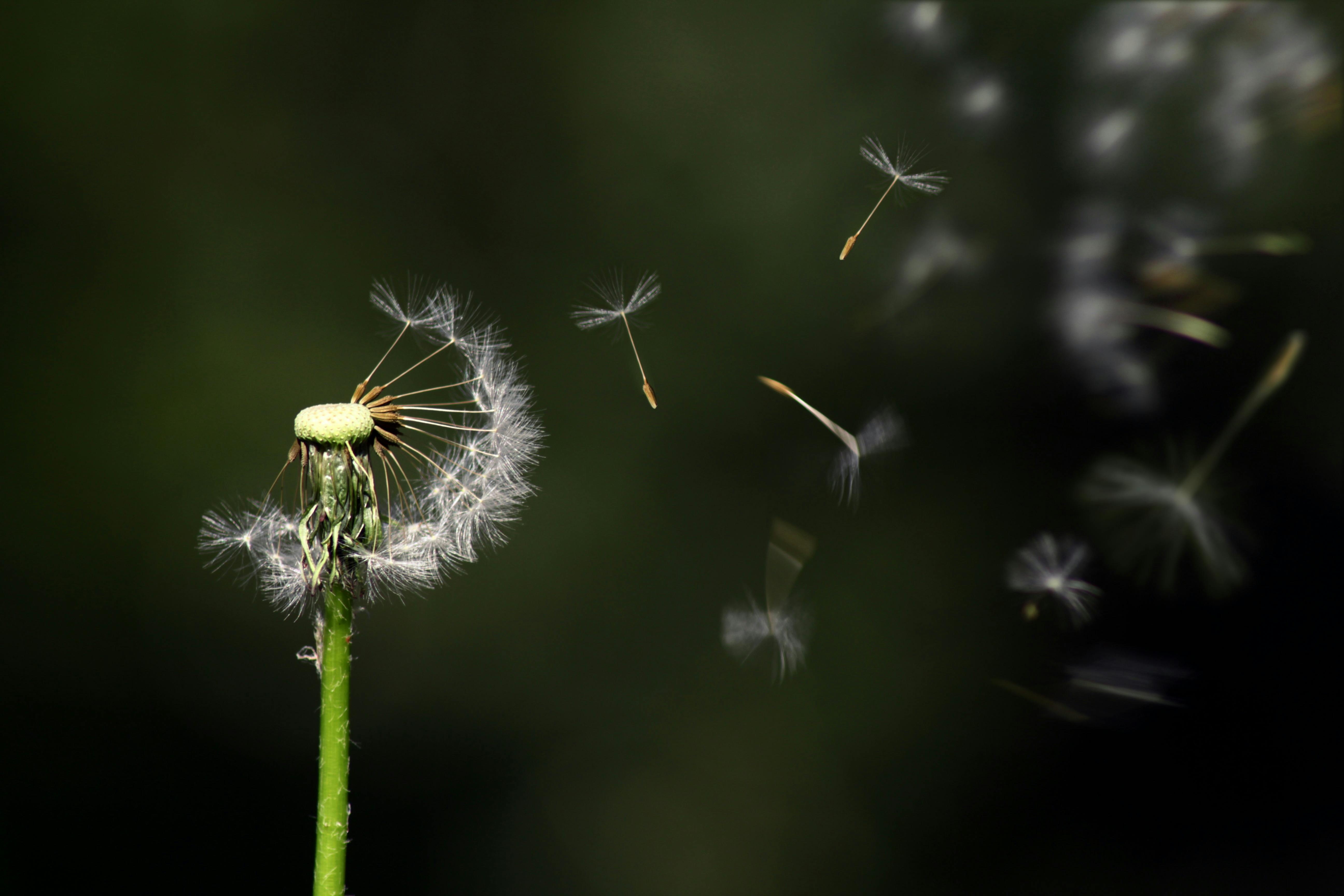
the fruit of a flowering plant is a mature ovary of the pistil. The fruit carries the seed (or seeds) that matured from the ovules within the ovary.
the photograph shows the fruit of the dandelion plant. The dandelion fruit (like most other fruits) facilitates which forms of evolution?
-Mutation
-Genetic drift
-Natural selection
-Nonrandom mating
-Artificial selection
-Gene flow
Gene flow
A small population will undergo a form of evolution known as ?
Genetic drift
Which of these statements is true regarding genetic drift
-Genetic drift increases the occurrence of rare alleles
-Genetic drift results in biological adaptation.
-Slightly disadvantageous alleles can sometimes increase in frequency, due to genetic drift.
-New mutations that are neutral are less likely to be fixed in small populations than in large populations
-Evolution by random genetic drift proceeds faster in large populations than in small populations
Slightly disadvantageous alleles can sometimes increase in frequency, due to genetic drift.
The migration of breeding individuals between populations causes a corresponding movement of alleles, which is referred to as…
-mutations
-gene flow
-natural selection
-genetic drift
gene flow
What is the term for a gradual geographic change in phenotype or allele frequency?
Cline
The entire natural range of the devil’s hole pupfish (Cyprinodon diabolis) Is shown in the photograph below. The three fourth inch long species is restricted to this 6 X 18-foot desert pool fed by underground springs in southern Nevada not far from Death Valley. The equipment in the photograph Is used by ichthyologists to monitor the water level and other environmental conditions. The entire population of the species is not known to exceed a few hundred individuals, and the population sometimes fluctuates between 100 individuals
Which of the following would you expect to be true of this species?
-Cyprinodon diabolis probably has few rare alleles compared to related species of pupfish
-The fish probably experience a high rate of mutation.
-There is likely to be substantial gene flow into the population
-The fish probably mate randomly
Cyprinodon diabolis probably has few rare alleles compared to related species of pupfish
if pollen is carried to another plant of the same species, thousands of miles away, the result would be…
-Natural selection
-Random mating
-Gene flow'
-A disruption of Hardy weinburg equilibrium
-2 of the above is correct
-all of the above is correct
2 of the above is correct
What species concept do you think would be most appropriate for bacteria and why would you choose that one instead of other plausible alternatives?
The best species concept for bacteria is the phylogenetic species concept because it groups organisms based on their evolutionary relationships and DNA. This works better than the biological species concept, since bacteria don’t reproduce sexually, and better than the morphological species concept, because many bacteria look very similar even if they are genetically different.
Species whose ranges overlap, but do not interbreed because they are found in different environments within the range, are said to exhibit ? between the two species.
-environmental isolation
-habitat isolation
-biological isolation
-temporal isolation
-evolutionary isolation
habitat isolation
The prevention of genetic exchange between two species because they reproduce at different times of the day, season, or year is called...
-sexual isolation
-mechanical isolation
-genetic isolation
-hybrid sterility
-temporal isolation
temporal isolation
Mules are an example of
-hybrid sterility
-microevolution
-hybrid inviability
-hybrid breakdown
hybrid sterility
The offspring of a lion and a tiger (two different species) survive poorly in the wild. Which class of isolating mechanism is most likely involved?
-geographic isolation
-premating barrier
-temporal isolation
-postzygotic barrier
-prezygotic barrier
postzygotic barrier
The biological species concept is based on the idea of...
-morphological differences
-genetic distance
-geographic isolation
-reproductive isolation
reproductive isolation
What is the term that describes the form of speciation that occurs when populations occupy the same geographic area?
sympatric, sympatric speciation
Reproductive isolation mechanisms that prevent fertilization are termed...
-prezygotic barriers
-ecological barriers
-postzygotic barriers
-zygotic barriers
-biological barriers
prezygotic barriers
According to the biological species concept, a species consists of one or more...
-communities
-types
-genera
-populations
-genes
populations
The plural of phylum is...
-phyli
-phyla
-phylums
-phylum
phyla
Which of these statements is NOT correct?
-Because Linnaeus used physical characters for classification, the Linnaean taxonomic system can only be used with physical, morphological traits, and not with molecular or behavioral data.
-Subgenus is a taxonomic rank.
-In modern taxonomy, classification is intended to reflect phylogenetic relationships.
-Normally, the oldest published name for a taxon is considered valid.
-All the above statements are correct.
Because Linnaeus used physical characters for classification, the Linnaean taxonomic system can only be used with physical, morphological traits, and not with molecular or behavioral data.
Linnaeus developed the concept that every species name consists of two parts. This principle is known as…
binomial nomenclature, binominal nomenclature
The taxon Poaceae would be a(n)
-phylum
-It is impossible to determine from the information given.
-order
-plant family
-animal family
-genus
plant family
The plural of genus is
genera
Which of these is a taxon?
-genus
-clade
-Homo sapiens
-order
-more than one answer is correct
Homo sapiens
The term taxonomy refers to...
-the classification of organisms into taxa.
-a clade
-the naming of species according to Linnaeus' principles
-the evolutionary history of organisms and the pattern of their decent from common ancestors.
the classification of organisms into taxa.
The type specimen...
-identifies which organisms a species name is applied to.
-illustrates a specimen that has the most representative characteristics of the species.
-the ideal representation of the species.
-more than one of the above is correct.
identifies which organisms a species name is applied to.
Explain the Linnaean system of taxonomy, including binomial nomenclature.
The Linnaean system of taxonomy, developed by Carl Linnaeus, is a way of classifying and naming living organisms based on shared characteristics. It organizes life into a hierarchy of groups, from broad to specific: domain, kingdom, phylum, class, order, family, genus, and species.
A key part of this system is binomial nomenclature, which gives every species a two-part scientific name. The first part is the genus (capitalized), and the second is the species (lowercase). For example, Homo sapiens is the scientific name for humans.
This system is useful because it gives every organism a unique, standardized name that scientists around the world can use, avoiding confusion from common names.
A clade is a ____ group
-paraphyletic
-diphyletic
-monophyletic
-polyphyletic
monophyletic
If you are attempting to infer relationships among birds, mammals, snakes, and turtles, the presence of feathers would be a(n) ? character state
-homoplastic
-plesiomorphic
-autapomorphic
-primitive
autapomorphic
A shared derived character state is called a(n)
-synapomorpy
-plesiomorphy
-homoplasy
-autapomorphy
synapomorpy
Turtles, snakes, lizards, and crocodilians all have epidermal scales and are cold-blooded, which distinguishes them from other amniotes. Which of the following is true?
-These are shared, derived characters, and provide evidence that these organisms form a clade.
-These are primitive characters, so they cannot be used as evidence that these organisms form a clade.
-These are derived characters, and do not provide any phylogenetic information.
-These are primitive characters, and demonstrate that reptiles form a clade distinct from mammals and birds.
These are primitive characters, so they cannot be used as evidence that these organisms form a clade.
Suppose you are trying to determine the phylogenetic relationship among species A, B, C, D, E, and F. Those species would collectively be referred to as the_?_
In Group
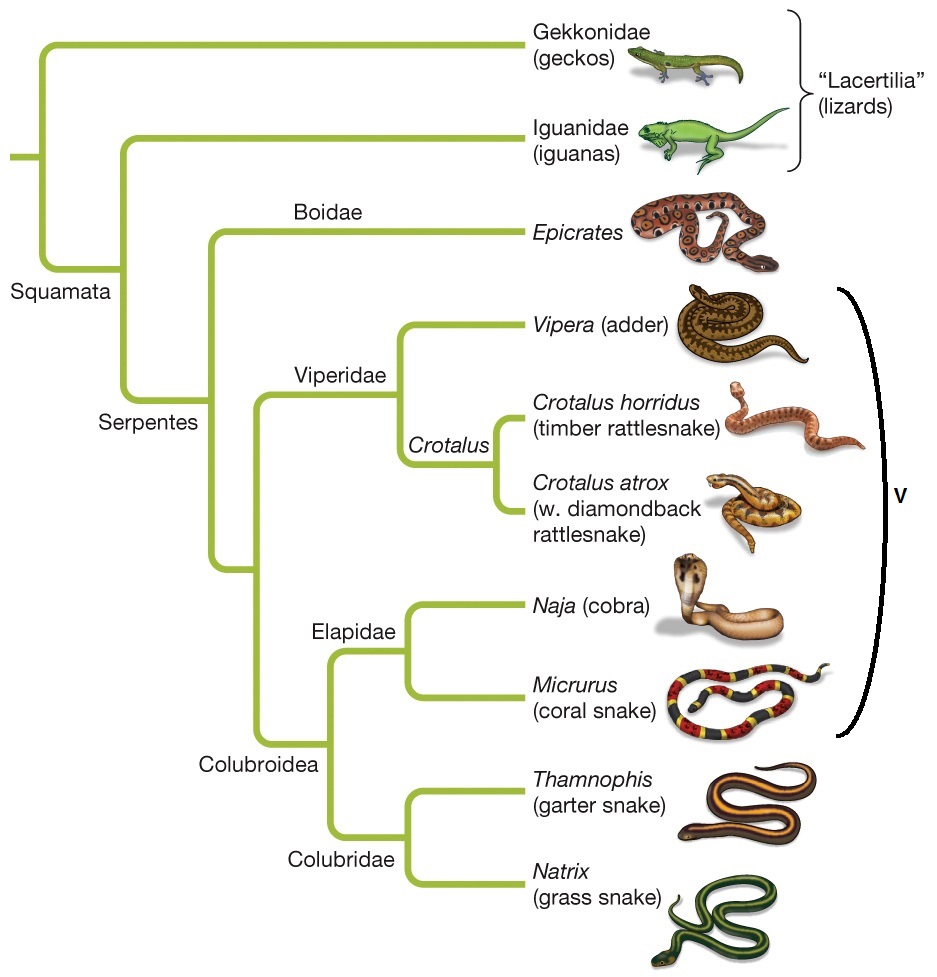
Refer to the figure showing a phylogenetic tree of some snakes and lizards.
Based on the information shown in the figure, which statement is true?
-Lacertilia (lizards) is a monophyletic taxon.
-The venomous snakes (indicated by the bracket marked "V") are all closely related to each other.
-Serpentes is paraphyletic.
-Family Viperidae is monophyletic.
-More than one of the above is correct.
Family Viperidae is monophyletic.
As traditionally defined, "reptiles" (turtles, snakes, lizards, and crocodilians) represent a ____ group, because birds are not included.
paraphyletic, paraphyly
The outgroup is used to determine…
-apomorphy
-primitive states
-parsimony
-homonymy
primitive states
Explain why primitive character states cannot be used to determine phylogenetic relationships.
Primitive character states (also called ancestral traits) can’t be used to determine phylogenetic relationships because they are traits shared by many different groups simply because they were inherited from a very distant common ancestor. Since these traits are widespread and not unique to a specific evolutionary branch, they don’t help show how closely related organisms actually are.
In other words, primitive traits don’t provide useful information about recent evolutionary history because they don’t distinguish between more closely related groups. Instead, scientists use derived character states (newer traits that evolved in specific lineages) because those are more helpful for identifying shared evolutionary paths and building accurate phylogenetic trees.
Explain radiometric dating, including Potassium-Argon dating and Carbon-14 dating. Explain how each is used, how the decay of radioisotopes provides information on age, and the general time ranges for which they are useful.
Radiometric dating works by measuring radioactive decay to estimate age. Carbon-14 dating is used for younger, once-living materials, while Potassium-Argon dating is used for much older rocks. Both rely on predictable decay rates to determine how long it has been since a material formed.
The Pleistocene epoch is part of the ? Era.
-Mesozoic
-Cenozoic
-Quaternary
-Cambrian
-Permian
-Jurassic
Cenozoic
Potassium-argon dating methods can be used to directly determine the age of…
-sedimentary rocks
-amber
-igneous rocks
-animals that have been frozen for hundreds of years
-none of the above
igneous rocks
Organisms that have been dead for a few thousand years can be dated by:
-K-Ar dating
-radiocarbon (carbon-14) dating
-uranium-238 dating
-Any of the above
radiocarbon (carbon-14) dating
Which geological epoch comes after the Paleocene?
eocene
The geologic principle that older sedimentary rocks appear on the bottom and younger at the top is called...
-superposition
-superimposition
-stratification
-sedimentation
superposition
Which of these rocks is most likely to contain a fossil?
-slate
-sandstone
-basalt
-schist
-granite
-gneiss
sandstone
Which of these is a metamorphic rock?
-shale
-sandstone
-schist
-amber
-basalt
-granite
schist
99% of the carbon atoms in your body is which isotope?
Carbon-12, C-12, carbon 12, C 12, 12C, 12, C12, C-12