9.3 Employment and Unemployment
 Call Kai
 Learn
Learn Practice Test
 Spaced Repetition
 Match
Match Flashcards
 Knowt Play
1/35

There's no tags or description
Looks like no tags are added yet.
Name | Mastery | Learn | Test | Matching | Spaced | Call with Kai |
|---|
No analytics yet
Send a link to your students to track their progress
36 Terms
What is full employment
The level of employment corresponding to when all those willing and able to work at the prevailing wage rate are employed, except for frictional unemployment.
- Often considered to be achieved when unemployment falls to 3%
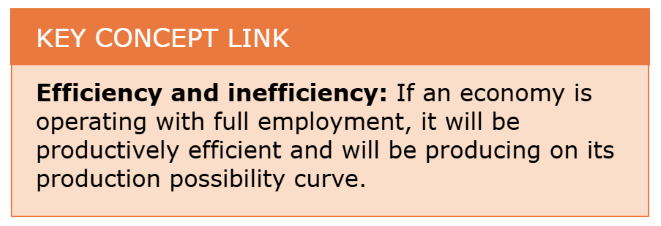
Key concept link - if an economy is operating with full employment, what and where will it be
Does full employment mean 0% unemployment
No. There is always some natural unemployment due to frictional and structural factors.
What is the unemployment rate formula
Unemployment rate = (Number of unemployed ÷ Labour force) × 100.
What is equilibrium unemployment (+3)
Unemployment that occurs when the labour market clears (meaning is in equilibrium AD=AD ), including only natural unemployment (frictional + structural + voluntary).
• Occurs when the labour market clears (supply = demand)
• Includes natural unemployment only: frictional + structural + voluntary
• Real wages may be sticky, but the labour market is generally balanced - no pressure for the real wage rate to change
How is equilibrium unemployment shown on a diagram + explanation (5)
ADL matches ASL at a real wage rate of W
ALF includes those prepared to prepared to work at the real wage rate of W and able to find a job, also including natural unemployment
Shows that at a wage rate of W, Y number of workers are employed.
There is unemployment of YZ workers - these are workers experiencing voluntary, frictional and structural unemployment
In this case, unemployment is arising due to problems on the supply-side
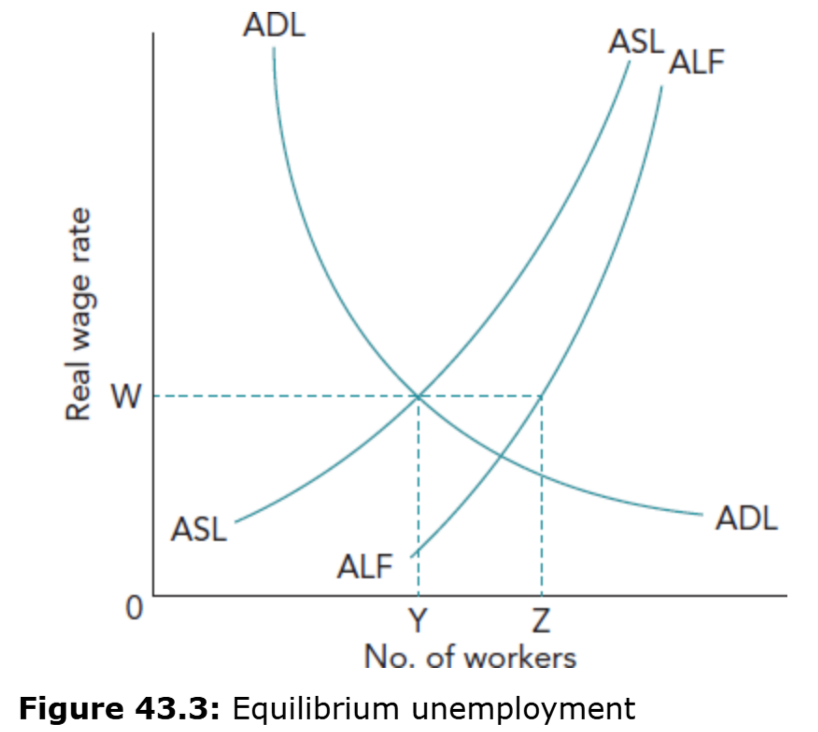
Why does the ALF curve move closer to the ASL curve as the real wage rate rises
Because a higher proportion of the labour force will be willing to accept the wage rate
What is natural unemployment
The level of employment when the economy has only voluntary, frictional and structural unemployment (no cyclical unemployment), i.e. when the labour market is in long-run equilibrium.
What is disequilibrium unemployment (+3)
Unemployment that arises when there is excess supply of labour at the current wage, often caused by wage rigidity or minimum wages.
• Occurs when there is excess supply of labour at current wages
• Can result from minimum wages, trade unions, or wage rigidity
• Equivalent to cyclical unemployment
How is equilibrium unemployment shown on a diagram + explanation
Keynesian economists argue that the labour market can be in disequilibrium for long periods of time
Shows unemployment of XY arising from the ASL exceeding the ADL
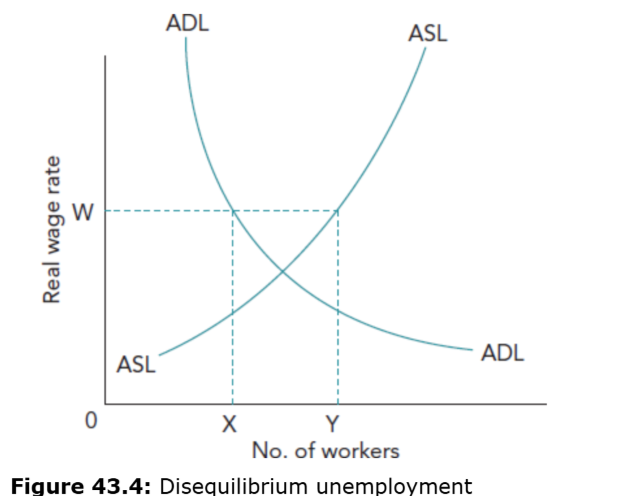
The wage rate can stay above the equilibrium level for a number of reasons (2), which are
The ADL fell but the real wage rate remained unchanged because workers resist wage cuts
The wage rate might have been pushed up above equilibrium level by trade union or by the government setting minimum wage
Why can disequilibrium unemployment not be solved by lowering the real wage rate
Because lowering the rate could result in lower aggregate demand and, in turn, lower aggregate demand for labour.
- A downward spiral could be created.
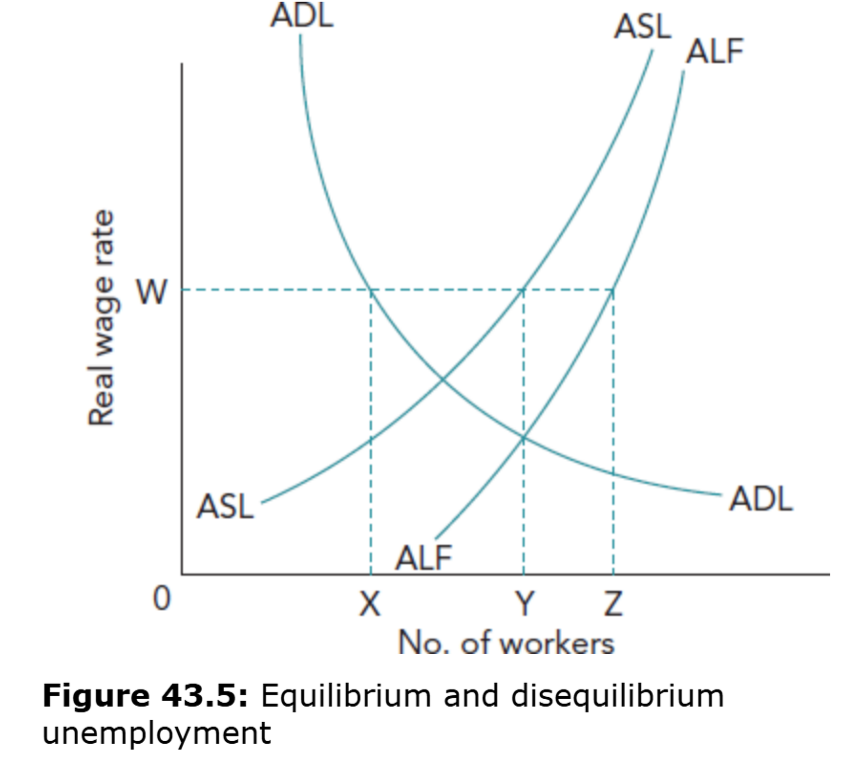
It is possible that, at any particular time, an economy may experience both equilibrium and disequilibrium unemployment simultaneously. How is this shown on a graph
XZ= total unemployment
XY = disequilibrium unemployment
YZ = equilibrium unemployment
What is voluntary unemployment and what is it due to
Unemployment that arises when workers are not willing to work at the current wage
- Meaning they could be employed but choose not to be
Often due to benefits, lifestyle choices, or waiting for better jobs.
What is involuntary unemployment
Occurs when workers want to work at the current wage but cannot find a job
Often caused by economic downturns or rigid labour markets.
What is the natural rate of unemployment
The rate of unemployment when the labour market is in equilibrium (ADL = ASL at current wage rate and price level), including only frictional and structural unemployment.
- The rate at which new classical economists think the economy will move back in the long-run, and which is consistent with a constant inflation rate.
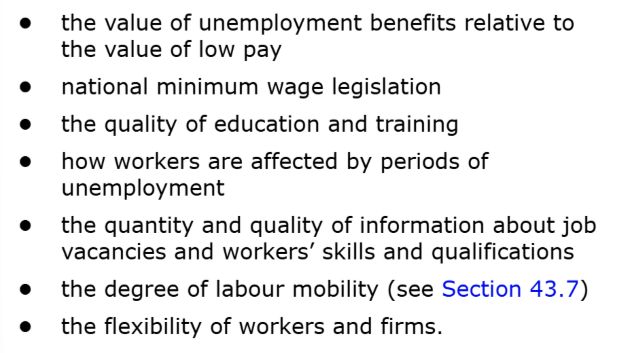
What factors (supply-side) determine the natural rate of unemployment (7)
What is hysteresis
Long-term unemployment that permanently increases the natural rate of unemployment, often due to skill loss or worker discouragement due to being out of work for so long.
What will the government do to reduce the natural rate of unemployment
Seek to increase both the willingness and ability of workers to work at the current wage.
What are the policy approaches and tools used to reduce the natural rate of unemployment (6)
Increase incentives to work: widen gap between benefits and low pay (cut benefits and/or income tax).
Wage flexibility: remove wage restrictions; minimum wage may prevent firms reducing wages instead of jobs.
Education & training: improve skills to reduce structural unemployment; retraining helps prevent hysteresis and long‑term unemployment.
Better job-market information: improves matching of workers to vacancies, reducing frictional unemployment.
Improve labour mobility: helps unemployed workers fill vacancies more easily.
Greater labour market flexibility: reduce trade union power and minimum wage laws to allow wages to adjust to equilibrium and increase employment.
What does it mean to be long-term unemployed
Out of work for a year or longer
What are the patterns and trends in unemployment (4)
Higher in declining industries and in declining occupations
Can vary between regions within a country due to transport, infrastructure and housing costs
Youth vs adult unemployment - may be higher among young workers if firms are reluctant to employ them due to lack of experience e.g. in several European countries - Greece, Sweden, Spain
Discrimination against certain groups e.g. women, people with health conditions or impairments and those from ethnic minorities - may have a higher than average unemployment rate
📌 Exam tip: Use current statistics or case studies in evaluation questions.
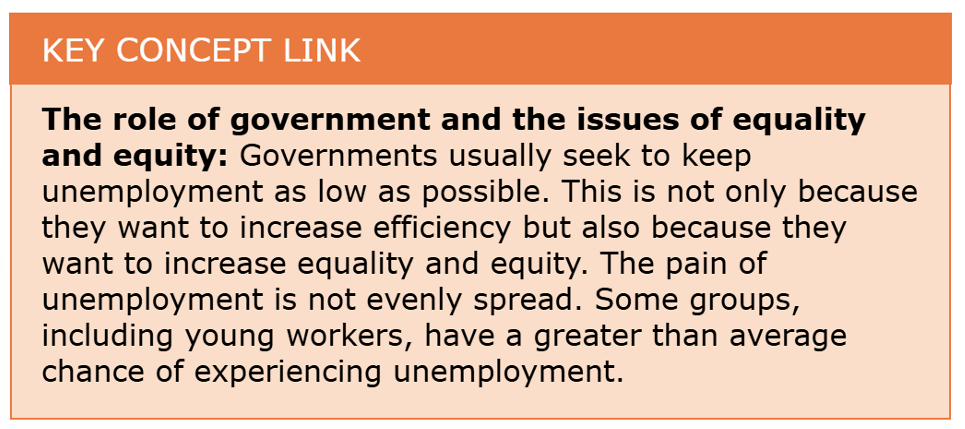
Key concept link - Governments usually seek to keep unemployment as low as possible, not only to increase efficiency but also because…
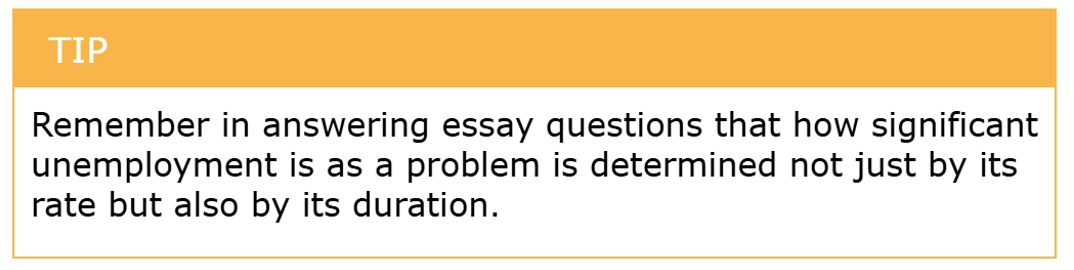
Tip - unemployment as a problem is determined not just by its rate but also by its….
What are the patterns and trends in employment (7)
Industrial structure: development shifts employment from primary → secondary → tertiary sectors.
Women in the labour force: rising participation due to higher pay, more opportunities, better qualifications, childcare provision, and less discrimination.
Employed vs self‑employed: most work for employers, but self‑employment is increasing.
Full‑time vs part‑time: proportions change over time; part‑time may be voluntary or due to lack of full‑time jobs (especially in downturns).
Formal vs informal economy: formal jobs have legal protection; informal jobs lack minimum wage, union representation, and benefits.
Secure vs insecure employment: growth of gig economy with uncertain hours/income and limited benefits.
Private vs public sector employment: varies by country; privatisation has increased private sector employment in many economies.
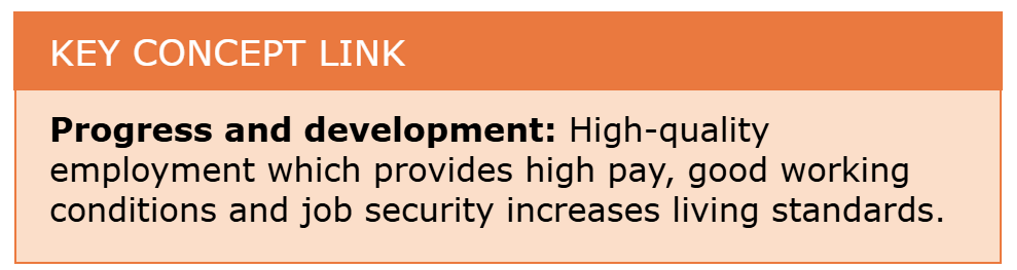
Key concept link - why is high-quality employment so important
What is labour mobility
The ability of workers to move to where it is most needed, either geographically or occupationally.
What is geographical labour mobility
The ability of workers to move between regions for employment.
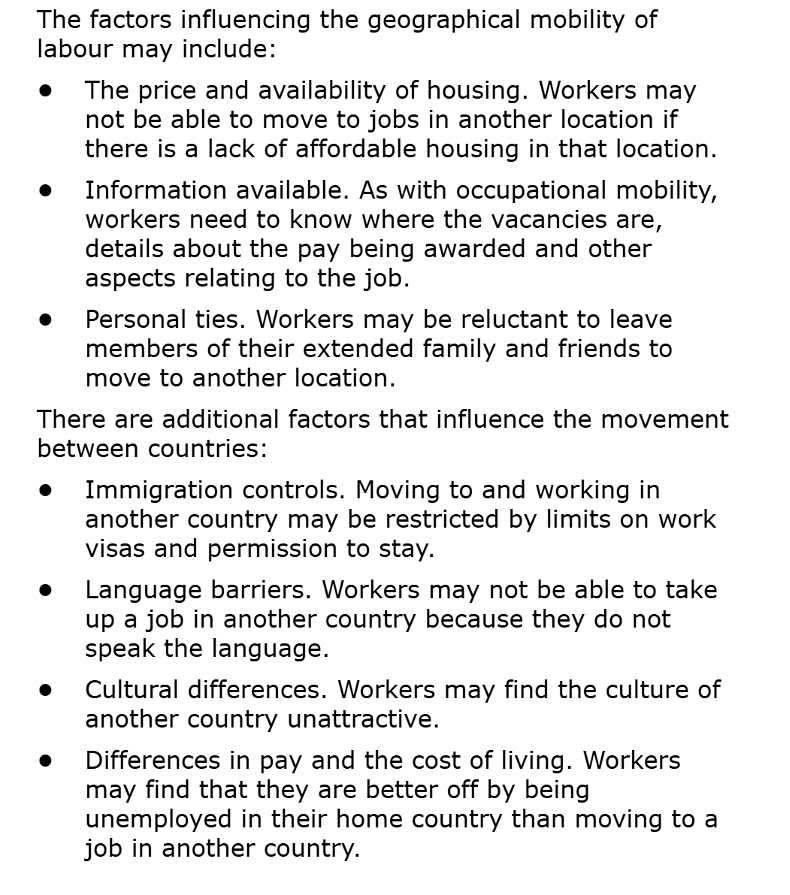
What factors affect geographical mobility (7)
What is occupational labour mobility
The ability of workers to move between industries or job types (from one occupation to another)
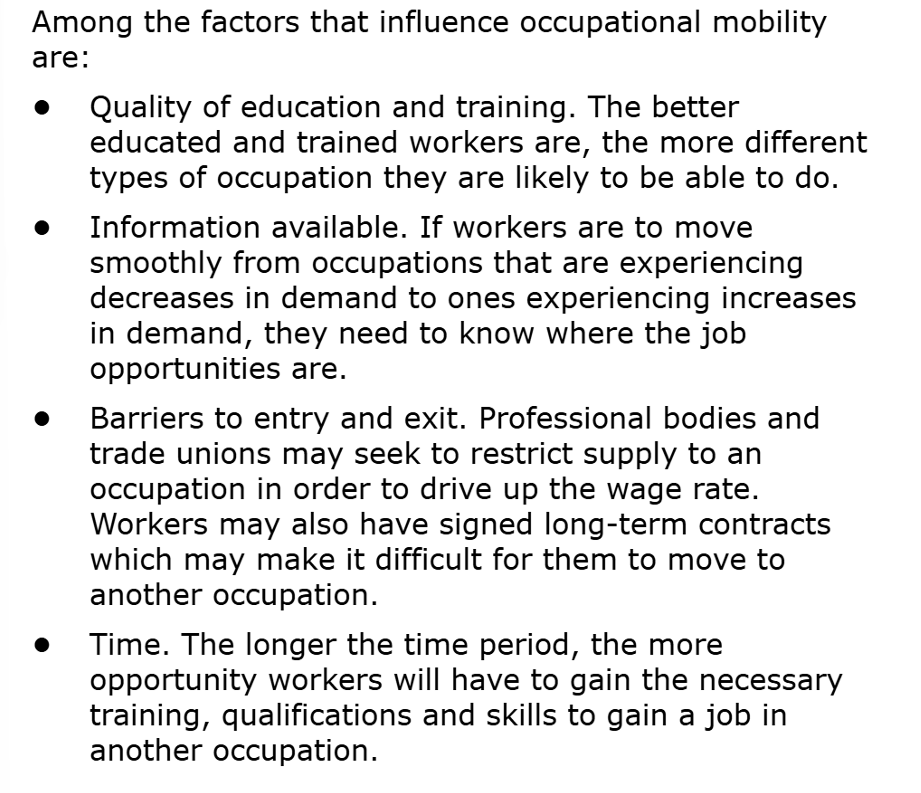
What factors affect occupational mobility (4)
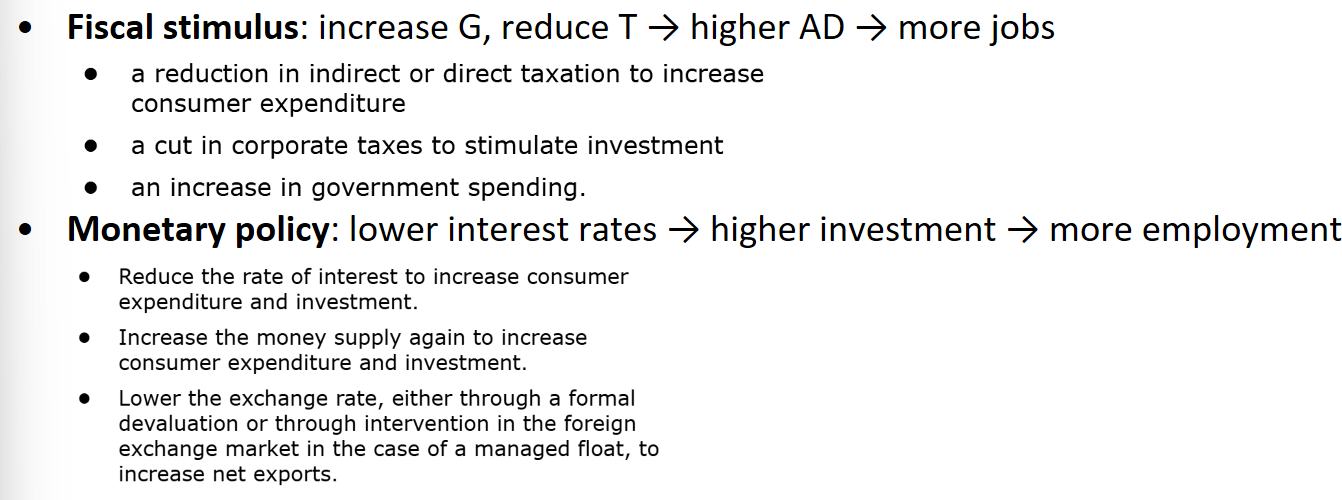
What are demand-side policies to reduce unemployment (2)
What are supply-side policies to reduce unemployment (4)
• Education and training → improve occupational mobility & reduce structural unemployment
• Labour market flexibility → reduce frictional unemployment
• Relocation subsidies → improve geographical mobility
• Increase information on the job market
What factors affect the effectiveness of unemployment policies (5) + why
Time lags (policies take time to work)
Inflationary pressures (AD policies)
Cost to government budgets
Type of unemployment being targeted
Expectations for the future/ confidence
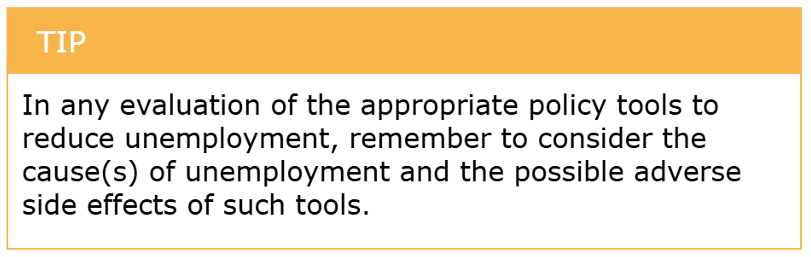
Tip: When evaluating policy tools to reduce unemployment, what should you remember to consider
What diagrams should you be able to draw for unemployment (2)
Labour market diagram (wages vs employment), showing equilibrium, minimum wage, and excess supply
Unemployment types diagram (frictional, structural, cyclical).