Lecture 1: Roberts
 Call Kai
 Learn
Learn Practice Test
 Spaced Repetition
 Match
Match Flashcards
 Knowt Play
1/8

There's no tags or description
Looks like no tags are added yet.
Name | Mastery | Learn | Test | Matching | Spaced | Call with Kai |
|---|
No analytics yet
Send a link to your students to track their progress
9 Terms
Define the essential functions of cholesterol
High cholesterol correlates to increased risk of heart disease
Functions:
Crucial as membrane component
Precursor for steroid hormones, vitamin D
Precursor for bile acids
Sources:
Biosynthesis
Diet
Outline key points of cholesterol biosynthesis
Acetyl-Coa precursor
Condensation of 3 acetate units to form mevalonate (C6)
Conversions of mevalonate to activated isoprene units
Polymerization of six 5C isoprene units to form the 30C linear squalane
Cyclization of squalene to form the 4 rings of the steroid nucleus, with further changes (oxidation, removal or migration of methyl groups) to produce cholesterol
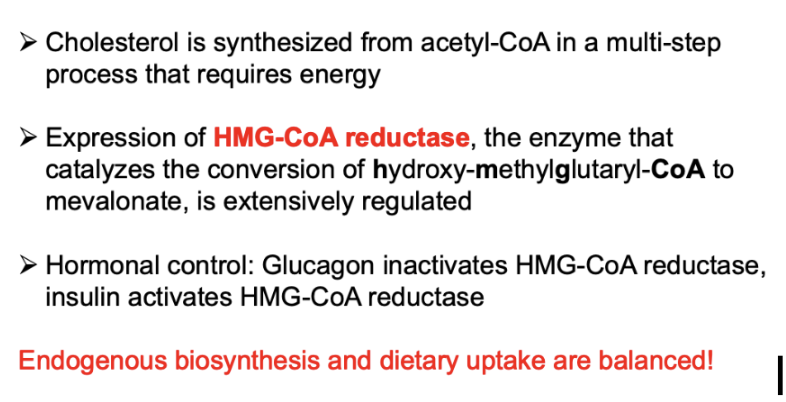
Rate-limiting and regulates step in pathway: HMG-CoA reductase
Converts B-hydroxy-B-methylglutaryl-CoA to mevalonate
Cholesterol biosynthesis key points
Discuss the key role of HMG-CoA reductase
HMG-CoA reductase is the enzyme responsible for the rate-limiting and regulated step in cholesterol biosynthesis
Function: it catalyzes the coercion of hydroxy-B-methylglutaryl-CoA to mevalonate using NADPH
Regulation:this enzyme is strictly controlled via transcription, translation, degradation, and hormonal signals
Hormonal control:
Glucagon: inactivates enzyme
Insulin: activates enzyme
Feedback inhibition: high levels of sterols (products) inhibits the transcription and transplantation of the enzyme and stimulate its degradation
Clinical relevance: statins are competitive inhibitors of HMG-CoA reductase, mimicking the substrate to block cholesterol synthesis
Recall the general composition of lipoproteins
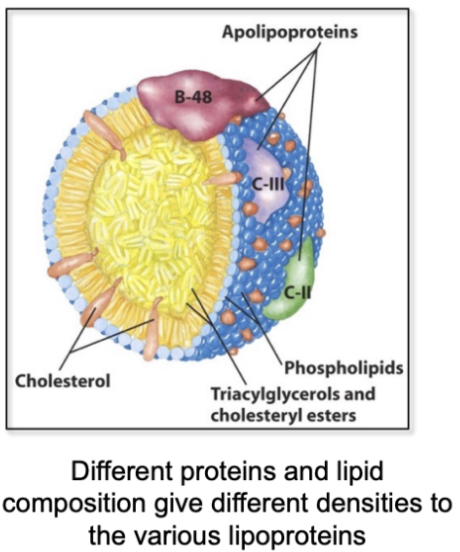
Core: triacylglycerols, cholesteryl esters
Single layer membrane: phospholipids, cholesterol
Proteins: different proteins combine with lipids; apolipoproteins
Define chylomicrons, VLDL, LDL, and HDL and explain their role in lipid transport in detail
Chylomicrons: synthesizes in enterocytes; delivers fatty acids (triacylglycerol) to adipocytes and muscle cells
VLDL: (very-low-density lipoprotein) transport of endogenous triacylglycerol produced in liver
LDL: (low-density lipoprotein) transfer of endogenous cholesterol to extrahepatic tissue
HDL: (high density lipoprotein) reverse cholesterol transport, taking excess cholesterol back to liver for disposal, preventing plaque build up and protecting against heart disease
Define the key functions of Apo B100, Apo CII, and Apo AI
Apo B100: “address tag,” binds to receptors to facilitate endocytosis of LDL and chylomicrons
Apo CII (apolipoprotein): protein on chylomicrons activates lipoprotein lipase in capillaries (chylomicrons, VLDL)
Apo AI: HDL formation
Describe the role of lipoprotein lipase for chylomicrons and VLDL
Lipoprotein lipase is an enzyme located in the capillaries of tissues like muscle and adipose. They extract fatty acids from chylomicrons.
Apo CII: protein on chylomicrons activates lipoprotein lipase
Activated by Apo CII, Lipoprotein lipase hydrolyzes (extracts) fatty acids from the triacylglycerols carried by chylomicrons and VLDL.
This allows for free fatty acids and glycerol to be taken up by cells for energy or storage, causing the lipoprotein particles to shrink and become remnants (or LDL in the case of VLDL)
Briefly outline LDL endocytosis and the role of the LDL receptor.
Explain how LDL uptake correlates with cholesterol levels in the cell and the bloodstream
LDL-receptor is synthesized and sent to cell surface
LDL particles binds to receptors on cell surface
LDL particles is taken by by endocytosis
LDL receptor recycled back to surface
LDL is degraded and components recycles
Cholesterol signals the cells to produce less cholesterol and less LDL
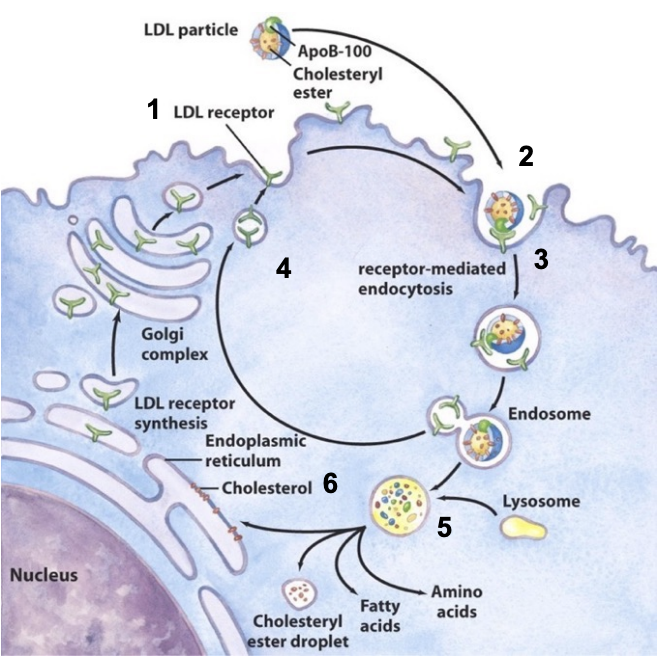
Cholesterol regulates this pathway. When cholesterol is released inside the cell
it signals the cell to produce less endogenous cholesterol
it signals the cell to synthesize fewer LDL receptor
if cell has high cholesterol, it reduces receptor availability, leading to decreased uptake of LDL from the bloodstream
if cell has low cholesterol, it will increase LDL receptor to gain more cholesterol in blood