MSK General Treatment & Assessment Principles
 Call Kai
 Learn
Learn Practice Test
 Spaced Repetition
 Match
Match Flashcards
 Knowt Play
1/46

There's no tags or description
Looks like no tags are added yet.
Name | Mastery | Learn | Test | Matching | Spaced | Call with Kai |
|---|
No analytics yet
Send a link to your students to track their progress
47 Terms
- engage
- empathize
- educate
- enlist
- end
what are the 5 Es
- Need to consider red flags in every patient
- Skilled history and physical examination important
- Know the signs and symptoms of serious pathologies for each region
What are the first things we do/look for when Assessing for Serious Pathology
- What could cause that?
- What structures underlie this region?
- What structures can refer to this region?
when a patient presents with pain on the outside of the hip, while engaging in differential diagnosis, what types of questions should be asked
Calm it down
what is the goal of the first stage of treatment in MSK conditions
Treatment: Stage 1 "Calm it Down"
- Patient presents with acute or irritable condition
- Tissues may need to time heal or maybe not ready for full loading
- Nervous system in protective mode
Reduce symptoms
allow for healing (protection unloading)
mitigate consequences of disuse
decrease swelling/inflammation
begin early loading
what is the goal of treatment: Stage 1 "Calm it Down"
- Relative rest and optimal loading
- Education
- Exercise
- Manual therapy
- Modalities
- Medicine
through what methods is symptom reduction during Treatment: Stage 1 "Calm it Down" achieved
P - Protection
E - Elevation
A - Avoid anti-inflammatories
C - Compression
E - Education
L - Load
O - Optimism
V - Vascularization
E - Exercise
what does PEACE & LOVE stand for
Gradual return to function
what is the goal of treatment stage 2
treatment stage 2: “Build back up.” entail
- Progressive loading of the whole body and involved region.
- Based on patient's functional needs and goals.
- Consider adaptive ability of biological tissues "bioplasticity."
1. pain control
2. mobility
3. motor control
4. proprioception
5. endurance
6. strength & power
7. functional activity
8. full recovery
what are the steps to recovery from and acute injury
Envelope of Function Theory
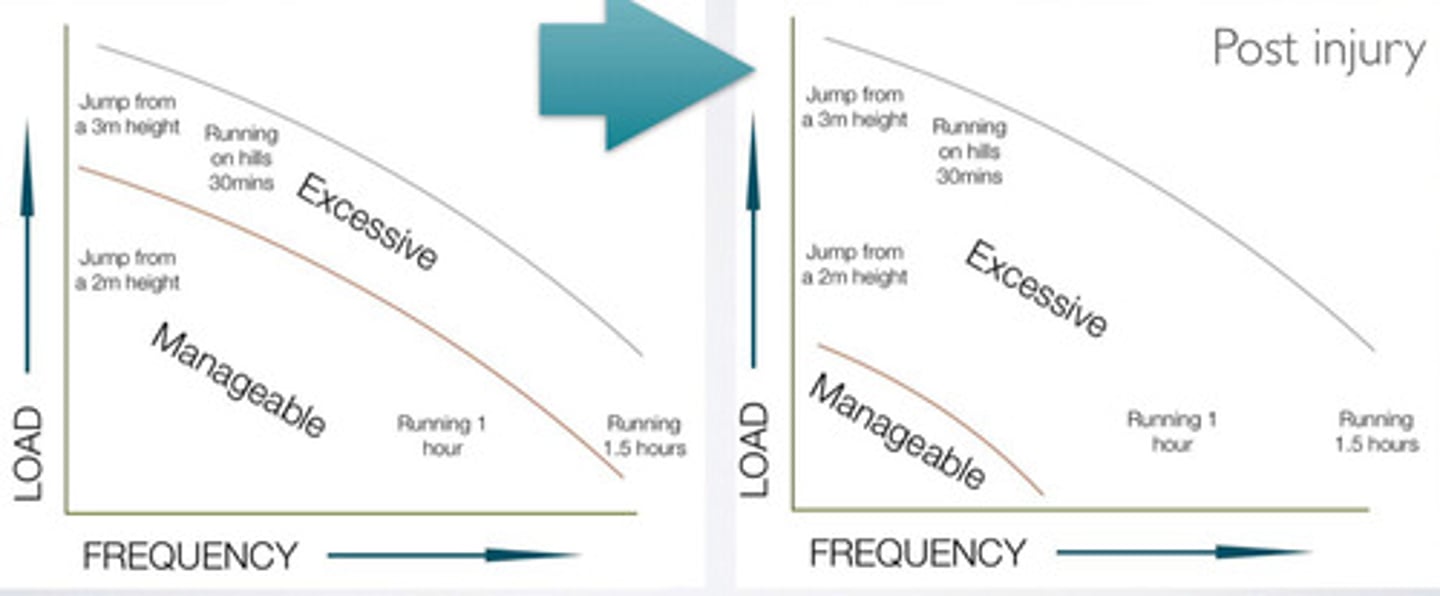
adaptive pain
protection is adequate but not too much. Allows the person to heal/recover.
maladaptive pain
overprotective and leads to intolerance or avoidance of loading.
Poorly vascularized, slow metabolic turnover
why are tendons and ligaments difficult to heal and adapt
Mechanotransduction
Process by which body converts mechanical loading into cellular responses
- Mechanocoupling = physical load causing perturbation of cells
- Cell-cell communication = cell signaling within and among cells
- Effector response = protein synthesis
what are the stages of Mechanotransduction
Mechanocoupling
physical load causing perturbation of cells
Cell-cell communication
cell signaling within and among cells
Effector response
protein synthesis
Mechanotherapy
harnessing this physiologic process for desired therapeutic physiologic effects
connective tissue
protein synthesis
tissue
Loading and mechanontransduction
“In the absence of activity, the mechanotransduction signal is weak, so _______ is lost (eg, osteoporosis). When there are loads above the tissue’s set point, there is a stimulus through mechanotransduction so that the body adapts by increasing ________ and adding ______ where possible (larger, stronger bone).”
- are there any red flags
- is there a specific pathology
- is it a non-specific diagnosis
what three questions should be asked when performing diagnostic triage during an evaluation
1. acute
2. sub-acute
3. chronic/persistent
4. recurrent
what are the 4 stages of disorder
- Trauma with tissue injury?
- Consider stages of tissue healing
- Screen for risk of persistent problem.
key points about acute and sub-acute stages of disorder
3-6
red flags or specific diagnosis
chronic/persistent stage of disorder
- > ___ months
- Screen for _____ or ______
- Consider mitigating factors leading to persistence.
recurrent stage of disorder
- Very common with MSK conditions
- May have mild persistent pain or periods with no pain with recurrent exacerbations.
- Consider mitigating factors leading to recurrence.
persistent pain
- individuals pain intensity stays within the mean +/- 1
- pain reported > 4 days per week
fluctuating pain
variation in pain intensity exceeds 2 points without periods of no pain lasting > 1 month
episodic pain
experiencing more than one period of pain separated by periods with no pain lasting > 1 month
single episode pain
one period of pain preceded and followed by periods with no pain lasting > 1 month
nociceptive pain
- pain that arises from damage to or inflammation of tissue other than that of the PNS and CNS;
- usually throbbing, aching, localized;
- typically responds to opioids and nonopioid medications
- mechanically oriented
peripheral neuropathic pain
Pain caused by a lesion or disease of the peripheral somatosensory nervous system
central sensitization pain
diffuse widespread pain due to Alteration of the CNS processing of sensation, leading to amplifications of pain signals
Nociplastic Pain
“pain that arises from altered nociception despite no clear evidence of actual or threatened tissue damage causing the activation of peripheral nociceptors or evidence for disease or lesion of the somatosensory system causing the pain”.
mechanical pain
- Clear mechanical behavior
- Clear anatomical origin
- Movement sensitivity
- Linked to posture, loading, movement control, activity, sleep problems, stress.
nonmechanical pain
- No clear relationship with mechanical stimulus.
- Response disproportionate with stimulus.
- No clear anatomical origin
- Increased anxiety, depression, catastrophizing, stress, sleep problems, co-morbidities.
Örebro Musculoskeletal Pain Screening Questionnaire
- 10 item screening questionnaire predictive of work absenteeism after MSK injury.
- Scored 0-100
>50 (high risk of disability)
cut off score for Örebro Musculoskeletal Pain Screening Questionnaire
blue flags
Perceptions of work: Job dissatisfaction, stress, perception of lack of support, perception that work is un-safe or harmful.
black flags
Workplace factors: heavy or repetitive work, negative experience with workplace injury management, lack of acceptance of legitimacy of injury by employer.
- "Do you enjoy your work?"
- "When do you think you will go back to work?"
- "Is it safe for you to do your job?"
what types of questions should be asked about blue flags: perception of work
- "Tell me about your work."
- "How is your workplace responding to your injury?"
- " Do you have a plan for return to work?"
what types of questions should be asked about black flags: workplace factors
- General health and co-morbidities
- Genetic/familial factors
what are whole person factors
Limited active and passive range
Movement impairments are generally due to:
No impairment in range in direction of pain, aberrant control of movement.
Control impairments are generally due to:
- Limping
- using support
- breath holding
- grimacing
- groaning.
what are examples of pain behaviors