Unit 5: Evolution (slideshow notes)
 Call Kai
 Learn
Learn Practice Test
 Spaced Repetition
 Match
Match Flashcards
 Knowt Play
1/98

There's no tags or description
Looks like no tags are added yet.
Name | Mastery | Learn | Test | Matching | Spaced | Call with Kai | Chat |
|---|
No analytics yet
Send a link to your students to track their progress
99 Terms
What is evolution?
A change in the genetic make-up of a population over time
Supported by multiple lines of evidence
THE CHANGE IN THE ALLELE FREQUENCY OF A POPULATION OVER TIME
Early Ideas of earth
Earth is young
Earth is unchanging
What year and Who proposed the theory of Gradualism
James Hutton (1788)
What is gradualism
earth was formed entirely by slow-moving processes, such as erosion and sedimentation, and that these slow forces continue to shape the landscape
Who and when was the theory of catastrophism invented
George Cuvier (1796)
What is the theory of catastrophism
major changes to earths crust were due to catastrophic vs gradual changes
species can become extinct
species can change over time
What did palaeontology find
Found that fossils were dissimilar to modern life
Who wrote the essay on the principle of population
Thomas Malthus (1798)
What did Thomas Malthus describe
described competition as a struggle for survival
Who proposed the theory of Uniformaitarianism
Charles Lyell (1830)
What does Uniformitarianism say
Changes to earth is uniform
land masses change over immeasurable time
earth is ancient
What did Jean Baptiste Lamarck (1809) do
He looked at fossil records and role of environment
What did Jean Baptiste Lamarck (1809) propose
Idea 1: Use and disuse
use: gets enhanced over time
disuse: loses over time
Idea 2: Inheritance of aquired characteristics
these traits get passed on
What is Charles darwin famous for
His theory in evolution: Natural Selection (1837)
Whats an important location that Darwin and Fitzroy went to
Galapagos islands
Islands’ important factors:
isolation
new/different/unique populations found no where else
What did darwin notice about the animal species that lived on galapagos islands
they resembled species living on the south american mainland
What did Darwin hypothesize based on what he saw on the galapagos islands
Hypothesized that the islands had been colonized by plants and animals from the mainland that had then diversified on the different islands
Darwin’s Finches, what was special
He was amazed to find out that ALL 14 species of birds that he found were finches
but there was only ONE specie of finch on the mainland
Essense of darwin’s ideas (5)
Variation exists within population
Competition for limited resources results in differential survival
individuals with. more favorable phenotypes are more likely to Surive and Reproduce
Evolutionary fitness is a measure of reproductive success
Changes in environment causes changes in selection
Darwin finches explained..(3)
Variation in beak sizes and shapes exist within mainland population of finches
Changes in food availability lead to changes in competition among individuals
individuals that could forage for food more successfully (ideal beak phenotype) were more likely to survive and reproduce
the other individuals either died or moved to a different environment (an island)
Over many generations the population diversified
whats speciation
when populations diversify over many generations
What did darwin do when he returned to england in 1836
he wrote “secret” papers describing his collections and observations
he completed a draft of his theory of specie formation in 1844 but was reluctant to publish it
Who is alfred russel wallace
a young naturalist working in the east indies
had written a short paper with a new idea
he asked darwin to evaluate his ideas and pass it along for publication
What was darwins book titled
The origin of species by means of natural selection
What is the process of natural selection according to Darwin? (4)
There is a natural variation in populations
Competition for limited resources results in differential survival
Individuals with more favorable adaptations are likely to survive
more likely to produce more favorable offspring
more likely to pass traits on to the next generation
Selection is based on the environmental conditions
Individuals are selected and populations evolve!
(with darwin theories, DONT MENTION DNA OR GENES)
Natural selection Mnemonic
ICE AGE
What does “I” stand for in the natural selection Mnemonic
Inherited variation exists within the population
What does “C” stand for in the natural selection Mnemonic
Competition results from an overproduction of offspring
What does the E stand for in the natural selection Mnemonic
Enivoronmental pressures lead to differential reproduction
What does the “A” stand for in the natural selection Mnemonic
Adaptations which benefit survival are selected
What does the “G” stand for in the natural selection Mnemonic
Genotype frequency changes across generations
What does the “E” stand for in the natural selection Mnemonic
Evolution occurs within the population
Where does variation come from?
Mutation + Sexual reproduction
Where does variation come from? (mutations)
random changes to DNA
errors in mitosis and meiosis
environmental damage
Where does variation come from? (sexual reproduction)
Mixing of alleles
recombination of alleles
new arrangements in every offspring
new combinations = new phenotypes
Spreads variation
offspring inherit traits from parent
Why is variation important? (in terms of Fitness?)
Fitness is the survival + reproduction success of individuals
individuals with certain phenotype variations leave more or less surviving offspring
depends on abiotic and biotic factors that can be more or less stable
affects the rate and direction of evolution
What is artificial selection
selective breeding
humans select traits in organisms that are desirable
organisms with common traits are crossed
leads to a change in the allele frequencies in a population over time
operates on the natural variation that exists in the population
What do evolutionary biologists refer to an “adaptation” as?
a genetically controlled trait that evolved as a result of natural selection
increases the fitness of an organism
short term for acclimitization
do not involve genetic change
Structural adaption
anything that has to do with the body structure
characteristics of body form including skeleton, size, shape, number of limps, body covering, and so on
Eg. spines on cactus protect against herbivores
Physiological adaptations
Deal with the individuals physiology
internal/cellular responses to stimuli
chemicals they may produce
Eg. spiders produce silk for web
spiders
snakes
plants
insects
behavioural adaptations
Combinations of structural and physiological adaptations that make the behavioural response to stimuli possible
eg. hunting behaviour results from colouration, strength and speed, or stealth to catch food
hunting
avoiding
migration
types of natural selection
stablizing selection
directional selection
disruptive selection
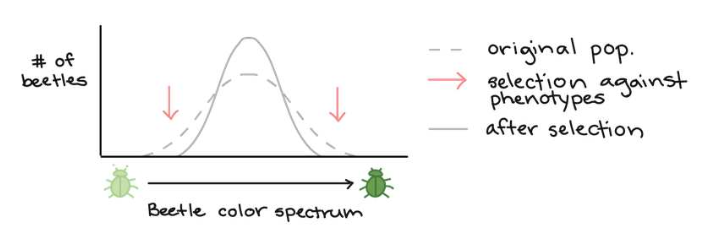
stablizing selection
favours individuals with an “average” value for a trait
selects against those with extreme values
tends to keep allele frequencies relatively constant, thereby limiting evolution
Example: human birth weight
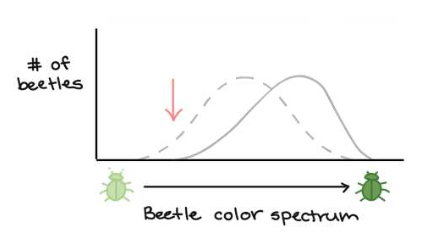
Directional selection
favours individuals with a trait at one extreme of distribution
selects against the average and the other extreme
examples:
the progressive change in coloration of peppered moths
antibiotic-resistant bacteria
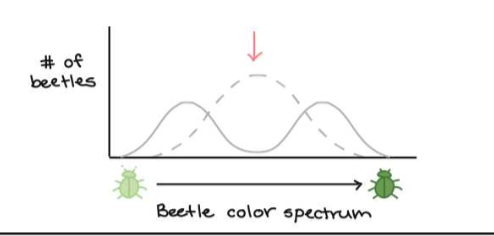
Disruptive selection
Favours individuals at both ends of the distribution
selects against the average
It is also known as diversifying selection
leads to the formation of distinct subpopulations of organisms
in time, the allele frequencies in the subpopulations may change to the extent that the two groups may no longer be able to interbreed —> speciation
Example: darwins finches (beak sizes)
What is Microevolution
describes changes to the alleles frequencies within a population of a single species over time
Example of microevolution
Industrial melanism
Peppered moth has variation in the body colour
found in all parts of england
prior to industrial evolution
mostly light, peppered variety
following the Industrial Revolution
mostly the dark variety
selection pressure —> Predation
What is Macroevolution
Refers to large-scale and long-term evolutionary changes leading to the formation of new species
What is selective pressure
predation / predator
an evolutionary force that causes a specific phenotype to be more favorable in certain environmental conditions.
Example of macroevolution
the extinction of the dinosaurs
darwins finches
What is population Genetics?
The study of genetic variation within populations
measures changes in the allele frequencies in a gene pool
What is a population
A population is a group of individuals that are part of the same species in the same area at the same time
What is a gene pool
the collection of alleles in a population
what is allele frequency
how common an allele is in the population
how many A vs a in a whole population
the 5 agents of evolutionary change
mutation and variation
gene flow
non-random mating
genetic drift
selection
describe the impact of mutation and variations
mutation create variation
new muations are constantly apearing
mutation changes DNA sequence
How do mutations change DNA sequence
changes amino acid sequence
changes protein
changes structure
changes function
changes in protein may change phenotype and therefore change fitness
Describe gene flow
movement of individuals and alleles in and out of population
seed and pollen distribution by wind and insects
migration of animals
sub-populations may havae different allele frequencies
causes genetic mixing across regions
reduce differences between populations
Describe Non-Random mating
Sexual selection
the probability that two individuals in a population will mate is not the same for all possible pairs of individuals
Mating is not random
Describe genetic drift (1. Founder effect)
effect of chance events
Founder effect
when a new population is started by only a few individuals
some rare alleles may be at a high frequency; others may be missing
skews the gene pool of new population
Describe genetic drift (2. Bottleneck)
When large populations is drastically reduced by a disaster
famine, natural disaster, loss of habitat..
alleles lost from gene pool, not due to fitness
narros the gene pool
population recovers and expands again
example of an animal that experienced founder effect
darwins finches
example of an animal that suffered bottleneck and describe its impact
Cheetahs
suffered a major bottleneck around 10,000 years ago
all surviving cheetahs share their ancestry back to around a dozen or so indiviudals that survived
smaller gene pool, very similar genetically less than 1% diversity between cheetahs
cheetahs now face another bottleneck from loss of habitat and poaching
Natural selection
differential survival and reproduction due to changing environmental conditions
environment selects who is most fit and will reproduce
combinations of alleles that provide “fitness” increase in the population
adaptive evolutionary change
5 Agents of evolutionary change
mutation
gene flow
non-random mating
genetic drift
selection
what is Hardy-Weinberg equilibrium
a mathematical basis for population genetics
based on a hypothetical, non-evolving population
acts as a model - null hypothesis
useful for measuring forces acting on populations
Natural populations are rarely in the H-W equilibrium
what conditions would cause allele frequencies to not change?
for a hypothetical, non-evolving population.. remove all agents of evolutionary change
very large population size (no genetic drift)
no migration (no gene flow in or out)
no mutation (no genetic change)
random mating (no sexual selection)
no natural selection (everyone is equally fit)
Hardy-Weinberg equilibrium equation
p + q = 1
How do new species emerge
populations become isolated
reproductive isolation
sympatric speciation
geographic isolation
allopatric speciation
isolated populations evolve independently
what is allopatric speciation
Geographic isolation
species occur in different areas
physical barriers like:
mountain range
canyon
river
division of a lake
What defines a specie
populations whose members can interbreed and produce viable fertile offspring
must be reproductively compatible
Sympatric speciation
speciation occurs within the same geographic area
most common cause of sympatric speciation
a result of a meiotic failure during gamete formation
describe the failure of cytokinesis which causes meiotic failure during gamete formation
chromosomal number will double in the gamete (diploid instead of haploid)
offspring have additation sets of chromosome
polyploidy
offspring may be viable and fertile
but cannot interbreed with the original parent population
speciation occurs
pre-zygotic meaning
beofre the zygote
what is meant by pre-reproduction barriers
obstacles to mating or to fertilzation if mating occurs
maintains reproductive isolation and prevent gene flow
what are the 6 pre-reproductive barriers
geographic isolation
ecological isolation
temporal isolation
behavioral isolation
mechnical isolation
gametic isolation
Ecological isolation
species occur in same region, but occupy different habitats so rarely interbreed
Ecological isolation examples
eg. lion and tigers could hybridize but they live in different habitats
lions in grasslands
tigers in rainforests
Temporal isolation
Species that breed during different times so gametes dont mix
day, season, year
example: the american toad mates in the early part of summer, while the fowlers toad mates later in the season
Temporal isolation example
example: the american toad mates in the early part of summer, while the fowlers toad mates later in the season
Behavioral isolation
unique behavioral patterns and rituals isolate species
identify members of species
attract mates of same species
courtship rituals, mating calls
Should have same appearance and behaviours to attract
behavioral isolation example
ex: blue footed boobies mate only after a courtship display unique to their species
mechanical isolation
morphological (form/structure) differences can prevent successful mating
for many insects, male and female sex organs of closely related species do not fit together, preventing sperm transfer
what are reasons why sperm of one specie may not be able to fertilize eggs of another
Biochemical barrier
chemical incompatibility
Biochemical barrier
sperm cannot penetrate egg
receptor recognition: lock and key between egg and sperm
chemical incompatibility
sperm cannot survive in female reproductive tract
What is a Post-reproduction barrier
prevention of hybrid offspring from developing into a viable adult
what are the 3 post reproduction barriers
reduced hybrid viability
reduced hybrid fertility
hybrid breakdown
explain reduced hybrid viability
genes of different parent species may interact and impair the hybrids development
might not reach reproductive age
die early
explain reduced hybrid fertility
even if hybrids are vigorous the maybe sterile
chromsomes of parents may differ in number or structure and meiosis in hybrids may fail to proudce normal gametes
explain hybrid breakdown
hybrids may be fertile and viable in first generation, but when they mate offspring are feeble or sterile
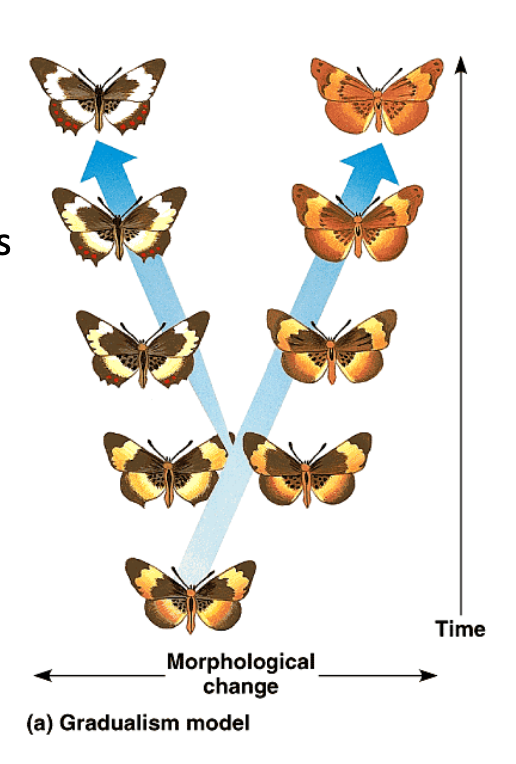
explain Gradualism in terms of rate of speciation
gradual divergence over long spans of time
assume that big changes occur as the accumualation of many small ones
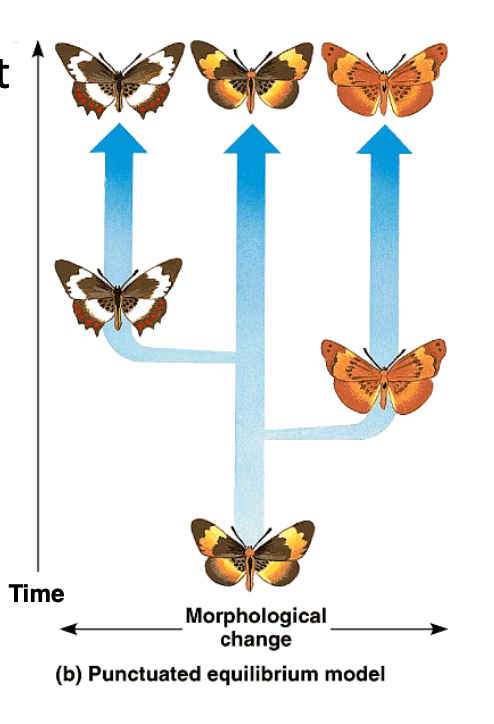
Explain punctuated equilibrium
rate of speciation is not constant
rapid bursts of change
long periods of little or no change
species undergo rapid change when the 1st bud from parent pipulation
is evolution goal oriented?
NO, an evolutionary trend does NOT mean tha evolution is GOAL-ORIENTED
evolution is not the survival of the fittest. Rather it is the survival of the just good enough
surviving species do not represent the peak of perfect. there is compromise and random chance aswell
How do we know that organisms have changed over time? what do we look at (4)
Fossils
Anatomical
biogeographical
molecular
Describe fossil evidence
Provide evidence of long-term evolutionary changes documenting the past existence of species that are now extinct
Layers of sedimentary rock contain fossils
new layers cover older ones, creating records over time
fossils within layers show that a successsion of organisms have populated earth throughout a long period of time
Transition fossils