Intro to Hematology
 Call Kai
 Learn
Learn Practice Test
 Spaced Repetition
 Match
Match Flashcards
 Knowt Play
1/107

There's no tags or description
Looks like no tags are added yet.
Name | Mastery | Learn | Test | Matching | Spaced | Call with Kai |
|---|
No analytics yet
Send a link to your students to track their progress
108 Terms
hematology
study of blood and blood-forming organs
bone marrow
thymus
spleen
lymph nodes
liver
blood forming organs
bone marrow
makes RBCs, platelets, and 60-70% WBCs
thymus, spleen, lymph nodes
these three make lymphocytes
liver
makes clotting factors and proteins
6 L (7-8% body weight)
total volume of blood in an average adult
45% cells
55% plasma
circulating blood is divided into…
RBCs
WBCs
platelets
what the 45% of cells are made up of
erythrocyte development
maturation process in bone marrow —> peripheral blood
maturation process in bone marrow
normalblast
proniormoblast
polychromatic erythrocyte
orthochromatic erythrocyte
reticulocyte
erythrocytes
contained in peripheral blood
reticulocytes
young erythrocytes that have matured enough to extrude their nucleus but not their cytoplasmic RNA
lack full amount of Hb
appears as polychromatic RBCs (bluish tint) on Wright’s stain
production of RBCs
the number of circulating reticulocytes is a measure of the _______________
if a bone marrow transplant is successful
the number of circulating reticulocytes is used to determine ….
reticulocytes
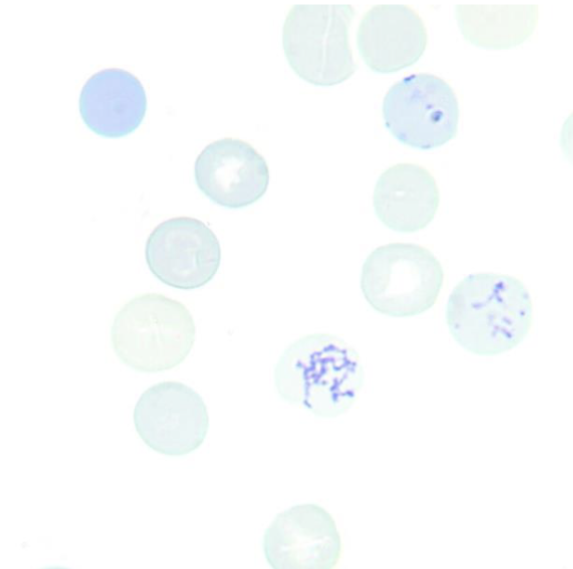
bone marrow
where hemoglobin synthesis occurs
iron
heme portion of hemoglobin contains…
protein
globin portion of hemoglobin contains…..
heme
globin
2 portions that form the activated form of hemoglobin that is ready to carry oxygen
heme
4 tetrapyrrole rings ending in protoporphyrin with a central iron
porphyrias
disorder of heme synthesis
globin
protein part that contains 4 chains of amino acids as a polypeptide
hemoglobin
composed of 4 protein globin chains, each surrounding a central heme group
RBC formation + destructive process
3 ways:
reticulo endothelial system “breakdown system” —> “waste products” in the form of bile pigments excreted in the urine and feces
reticulo endothelial system “breakdown system” —> protein storage pool —> back to bone marrow for formation of new red cells
reticulo endothelial system “breakdown system” —> iron storage pool —> back to bone marrow for formation of new red cells
erythrocytes - extravascular metabolism
iron is recycled:
iron absorption happens in the duodenum
iron bound as ferritin
iron circulates as transferrin
duodenum
Fe absorption happens in the _______ in erythrocyte extravascular metabolism
ferritin
Fe is bound as _______ in erythrocyte extravascular metabolism
Fe circulates as _____ in erythrocyte extravascular metabolism
erythrocytes - intravascular metabolism
Fe distribution:
as hemoglobin
ferritin and hemosiderin
transferrin
Fe metabolism:
taken up by RBC precursors
combined with globin
Fe storage:
macrophages
hemoglobin
ferritin and hemosiderin
transferrin
Fe distribution in intravascular metabolism
taken up by RBC precursors
combined with globin
Fe metabolism in intravascular metabolism
macrophages
Fe storage in intravascular metabolism
hemoglobin function
carries oxygen to tissues
iron
essential for hemoglobin being able to carry oxygen to tissues
if lacking, anemia develops due to Hb not being formed in sufficient quantities
oxyhemoglobin
reduced Hb (not carrying oxygen) when exposed to oxygen at increased pressure, oxygen is taken up at the iron atom until each molecule of Hb has bound 4 oxygen molecules
Fe2+
ferrous state
Hb bound (reduced oxidation state)
Fe3+
ferric state
no Hb bound
(oxidized)
(methemoglobin)
what happens in your lungs
left shift in oxygen dissociation curve represents —> ?
what happens in your tissues
right shift in oxygen dissociation curve represents —> ?
alpha
beta
gamma
delta
4 types of amino acid chains in hemoglobin
alpha chains
has 141 amino acids
beta chains
has 146 amino acids
hemoglobin A
alpha and beta chains compromise about 95% of adult hemoglobin and are called ?
oxyhemoglobin
when hemoglobin carries oxygen (bright red)
temporary bond with oxygen
when iron is in the ferrous state (Fe2+) (reduced), it forms a ___________ to transport it to tissues
methemoglobin
when iron is in the ferric state (Fe3+) (oxidized), it does not bind oxygen and is called ?
Hb A
Hb A2
Hb F
normal variants of hemoglobin
Hb A
2 alpha + 2 beta chains
Hb A2
2 alpha + 2 delta chains
Hb F
2 alpha + 2 gamma chains
Hb C
Hb S
(both have beta chains)
abnormal variants
Hb C
lysine for glutamic acid 6th position)
Hb S
valine for glutamic acid 6th position
Hemoglobin S (sickle cell)
beta chain containing Val amino acid
normal hemoglobin
beta chain containing Glu amino acid
carboxyhemoglobin
Hb + CO
found in smokers and people exposed to CO
methemoglobin
formed when Fe2+ —> Fe3+
unable to bind with oxygen
normally present in trace amounts (increased amounts occur form ingestion of certain drugs and chemicals)
sulfhemoglobin
Hb + sulfur
once formed, compound is extremely stable and lasts the life of the RBC (120 days)—> results from the ingestion of oxidizing drugs
cyanmethemoglobin method
most accurate method used in hematology instrumentation
mixes cyanide solution (Drabkin’s reagent) with blood sample —> forms very stable, colored compound (cyanmethemoglobin)
oxidized blood is read in spectrophotometer
cyanmethemoglobin
cyanide solution (Drabkin’s reagent) + blood sample
very stable, colored compound
cyanmethemoglobin
Hb + cyanide
cyanmethemoglobin
RBCs are lysed —> ferrous ion (Fe2+) of the released Hb is oxidized to the ferric state (Fe3+) —> forms methemoglobin
methemoglobin reacts with K+ cyanide —> forms ? (read by spectrophotometer at 540 nm)
hemoglobin in sample
concentration of cyanmethemoglobin = concentration of ?
spun hematocrit (packed cell volume)
measurement of the percentage of RBCs in a sample of whole blood
blood sample in EDTA/purple top tube
specimen for hematocrit
capillary tubes
centrifuge
reading device
equipment for manual microhematocrit
3 x RBC value = Hb value
3 x Hb value = Hct value
QC check in healthy patients is the rule of 3….
40-54%
normal hematocrit in adult male
37-47%
normal hematocrit in adult female
RBC indices
RBC measurements that aid in the classification of anemia
RBC indices
calculated using the RBC count, Hb concentration, and Hct measurement
Hct x 10 / RBC
mean corpuscular (cell) volume equation (in fL)
80 - 96 fL
normal MCV value
microcytic (<80 fL)
macrocytic (>96 fL)
terms used to describe abnormal MCV
Hb x 10 / RBC
mean corpuscular (cell) hemoglobin equation (in pg)
27 - 33 pg
normal MCH value
hypochromic (<27 pg)
term used to describe abnormal MCH
red cell distribution width
measurement of the degree of anisocytosis present, or the degree of variability in RBC size, in a blood specimen
SD of MCV / mean MCV x 100
red cell distribution width (RDW) equation (in %)
11-15%
normal value of RDW
anemia
condition in which there is a decrease in the oxygen-carrying capacity of blood and the amount of oxygen that is delivered to the tissues
not specific disease
not always due to a blood disorder
anemia
alterations in RBC morphology are associated with many diseases, including ?
type of anemia present
cause
? and ? must be determined for effective treatment for anemia
symptoms/complaints
all patients with anemia have similar ______/________ regardless of the cause
Hb concentration
severity of anemia depends on ?
fatigue/shortness of breath
faintness
dizziness
heart palpitations
headache
common symptoms of anemia
patient history
physical
CBC
blood smears
used for diagnosis of anemia
RBC appearance (morphology)
physiological cause (etiologic or pathogenic classification)
two factors of anemia classification
normochromic - normocytic
macrocytic
hypochromic - microcytic
three types of anemia classification
blood loss
impaired production
hemolytic anemia
3 etiologic classification of anemia
blood loss anemia
types:
acute
chronic
examples:
trauma
colon cancer
impaired production anemia
types:
aplastic anemia
Fe deficiency anemia
sideroblastic anemia
anemia of chronic disease
megaloblastic anemia
examples:
radiation exposure
excessive menstrual bleeding faculty Fe utilization
cancer
pernicious anemia
hemolytic anemia
types:
inherited defects
acquired disorders
hemolytic-hemoglobin disorders
examples:
hereditary spherocytosis
hemolytic disease of the newborn
sickle cell, thalassemia
nromochromic-normocytic anemias
number of RBCs produced in the BM are normal, but the number of RBCs circulating is decreased
normal-appearing RBCs on the blood smear and normal RBC indices
overhydration
hypoplastic BM
CA neoplasm
malignancy
hemolytic diseases (chronic kidney or liver disease)
causes of normochromic-normocytic anemias
macrocytic anemias
represented by the megaloblastic anemias that result from a Vitamin B12 or folic acid deficiency
nutritional or form a malabsorption problem (pernicious anemia)
malabsorption leads to an inability to absorb Vitamin B12 —> leads to a nuclear maturation defect and megaloblastic anemia
megaloblastic changes in WBC show open chromatin patterns and larger hyper-segmented neutrophils
RBCs are enlarged with MCV 120-140 fL
malabsorption
leads to an inability to absorb vitamin B12 in macrocytic anemias —> nuclear maturation defect and megaloblastic anemia
megaloblastic changes in WBC (macrocytic anemia)
show open chromatin patterns and larger hyper-segmented neutrophils
macrocytic anemias
can be severe
RBC count is decreased more than the Hb, due the RBCs that are large and almost filled with Hb
megaloblastic anemias —> commonly seen in alcoholics
other malabsorption disorders —> celiac
changes in cells are not limited ot the RBCs → large hyper-segmented neutrophils (lymphocytes are not affected)
hypochromic - microcytic anemias
most common type
Fe deficiency —> results from decreased Fe intake, increased Fe loss, errors in metabolism (sideroblastic anemia), and increased Fe requirements in infancy, pregnancy, and lactation
cause must be determined before treatment