Chapter 6: Long Term Memory Structure Part I
 Call Kai
 Learn
Learn Practice Test
 Spaced Repetition
 Match
Match Flashcards
 Knowt Play
1/21

There's no tags or description
Looks like no tags are added yet.
Name | Mastery | Learn | Test | Matching | Spaced | Call with Kai |
|---|
No analytics yet
Send a link to your students to track their progress
22 Terms
Long Term Memory
archive of information about past events and knowledge
- works closely with working memory
Serial Position Curve
curve that plots the percentage of recall for words in a list
- primacy effect and recency effect
Primacy Effect
more likely to remember words at the beginning of a list
- more time to rehearse and enter LTM; retrieval from LTM
- beginning of a serial position curve
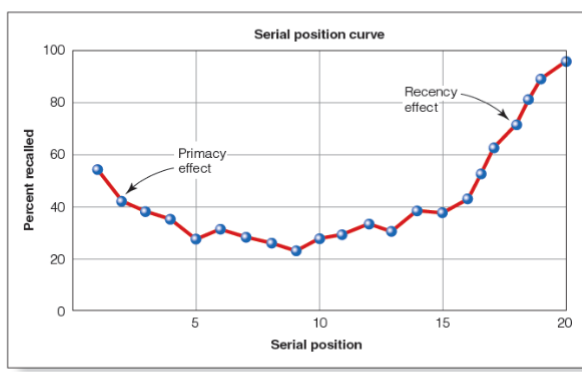
Fischler, Rundus, Atkinson (1970)
early list items are remembered better bc they receive more rehearsal and enter LTM
- subjects rehearsed only the word currently on the screen
- primacy effect
Recency Effect
better memory for stimuli presented at end of a list
- stimuli still in STM; retrieval from STM
- serial position curve
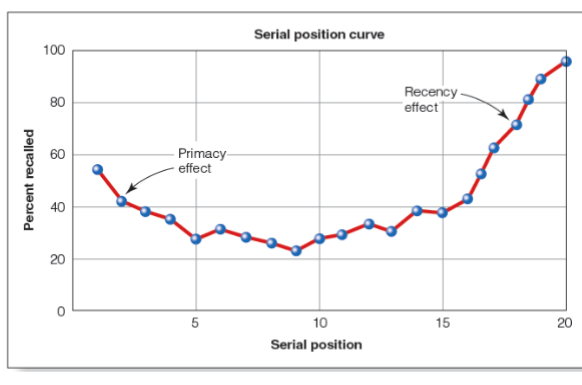
Glanzer and Cunitz (1966)
recency effect is due to storage of recently presented items in STM
- subjects recalled words afte they had counted backwards for 30 seconds
Coding
the form in which stimuli are represented in the mind
- the way in which it is coded can be LTM or STM
- visualm auditory, semantic,
Physiological Approach to Coding
determing how stimulus is represented by firing of neurons
Mental/Cognitive Approach to Coding
how stimulus or an experience is represented in the mind
- visual, auditory, semantic
STM Visual Coding
mental rotation tasks
LTM Visual Coding
visualize a person or place from the past
STM Auditory Coding
misidentifying letters or words that sound similar
- phonological similarity effect
- ex confusing letters like F and S
LTM Auditory Coding
when you “play” a song in your head
STM Semantic Coding
temporarily holds information based on meaning
- Wickens exerpiment; earlier fruit words interfered with memory for later fruits
- shows proactive interference
Proactive Interference
decrease in memory that occurs when previously learned information interferes with learning new information
- ex. list of fruits change; previosuly learned fruits affected recall
Release From Proactive Interference
memory performance improves because new information is distinct from previously learned material
- reduces proactive interference
LTM Semantic Coding
recognition memory
- performed by Sachs (1967)
Recognition Memory
identification of a previosuly encounted stimulus
Hippocampus
forms long term memories
Patient HM
hippocampus was removed
- intact STM but was not able to form new LTM
Patient KF
damage to parital lobe
- intact LTM but deficient STM
Patient KF and HM Are an Example Of…
double dissociation