Test 4 - Module 14 - Overview of Population Genetics
 Call Kai
 Learn
Learn Practice Test
 Spaced Repetition
 Match
Match Flashcards
 Knowt Play
1/45

There's no tags or description
Looks like no tags are added yet.
Name | Mastery | Learn | Test | Matching | Spaced | Call with Kai |
|---|
No analytics yet
Send a link to your students to track their progress
46 Terms
What does population genetics study?
This area of genetics studies genetic variation in a population and how variation changes over time.
Different populations have different ________ compositions
genetic
What is the gene pool?
all of the alleles of every gene in a population.
Allele and Genotype Frequency
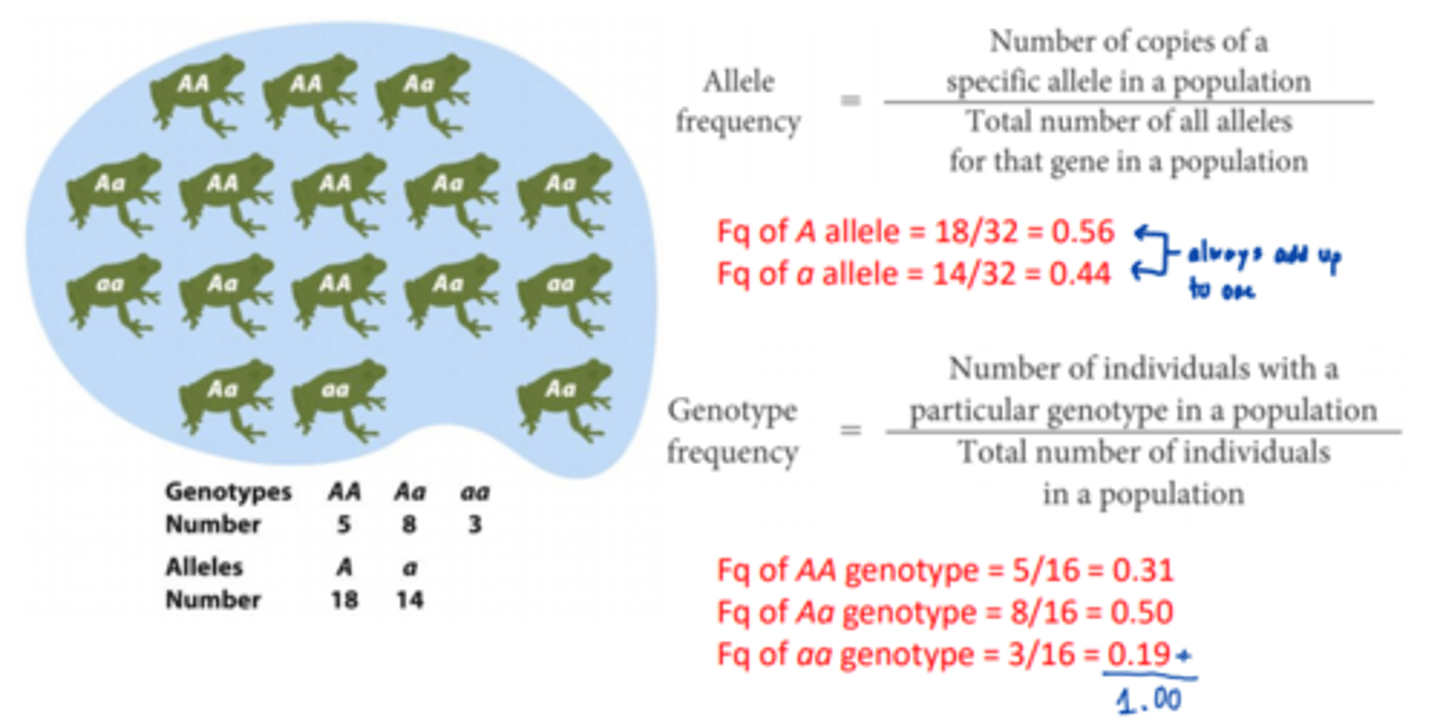
Allele frequency formula?
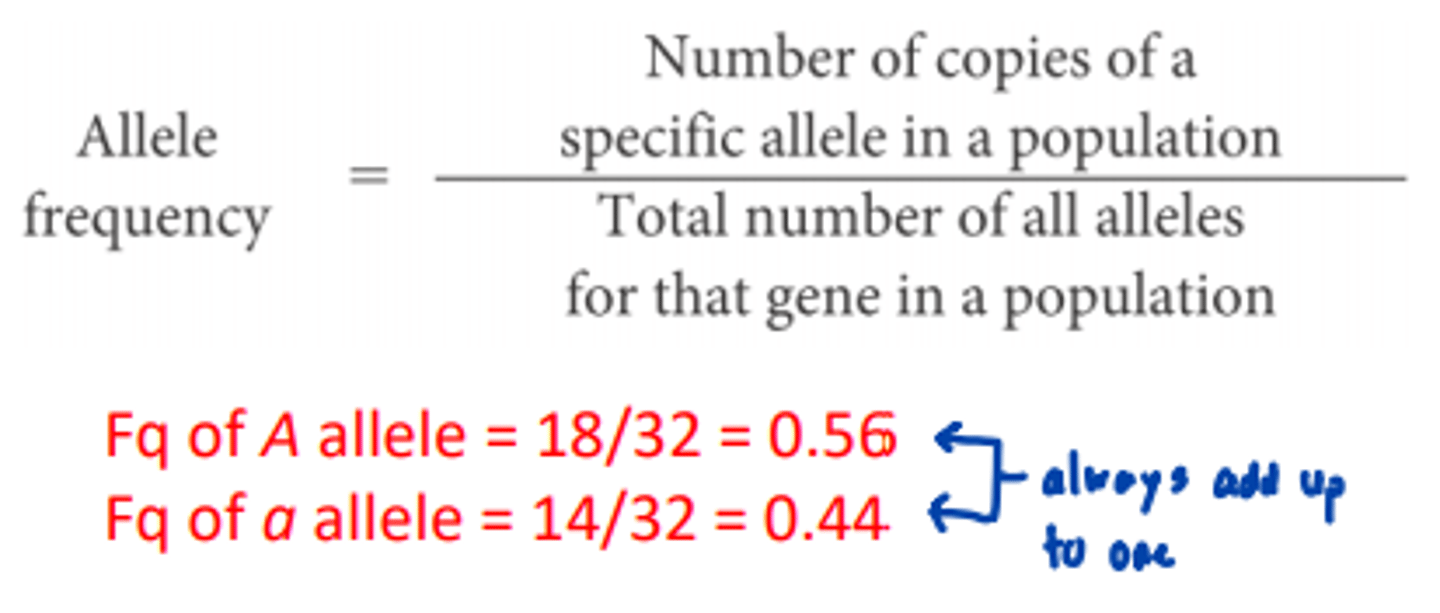
Genotype frequency formula?
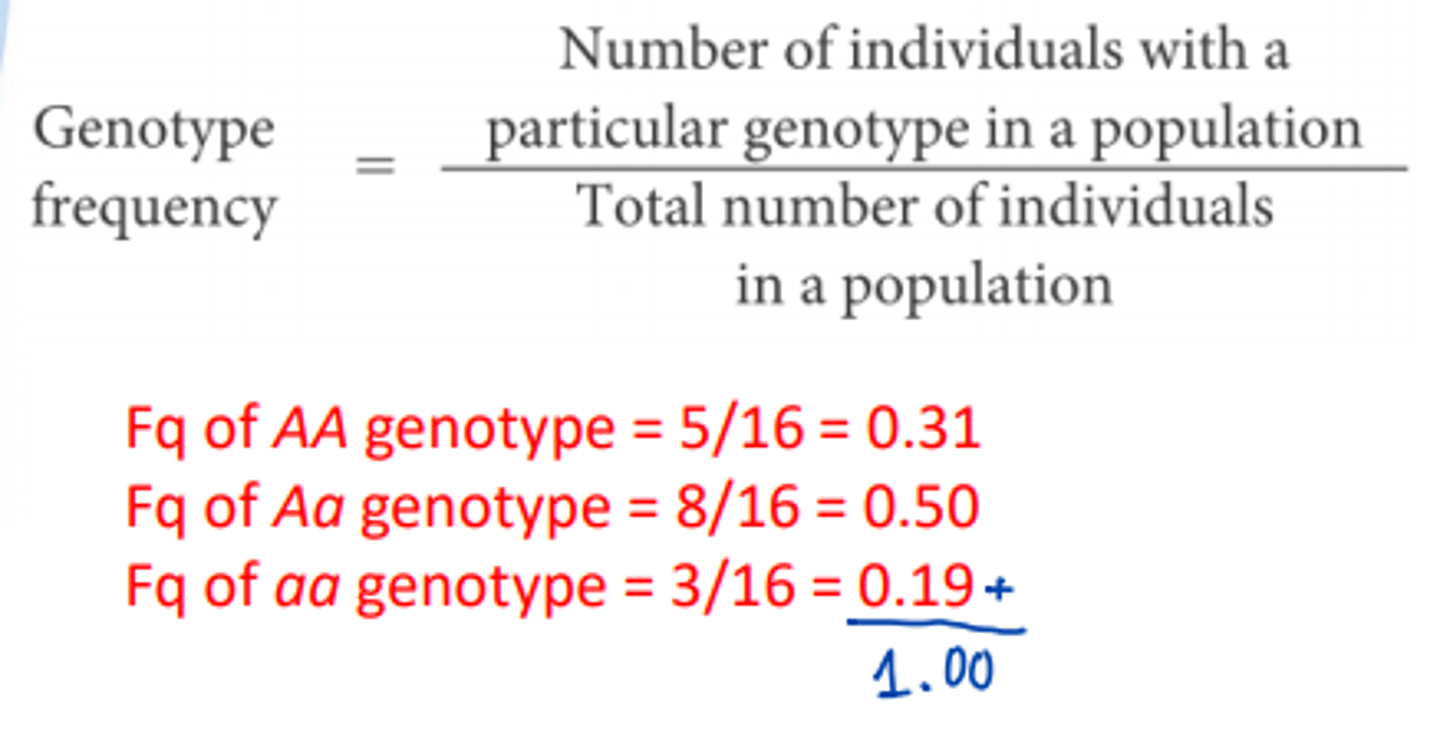
What does the Hardy Weinburg Equilibrium relate?
The Hardy Weinburg Equilibrium relates Allele and Genotype frequencies in a Population
Hardy Weinburg Equilibrium and what the variables mean?
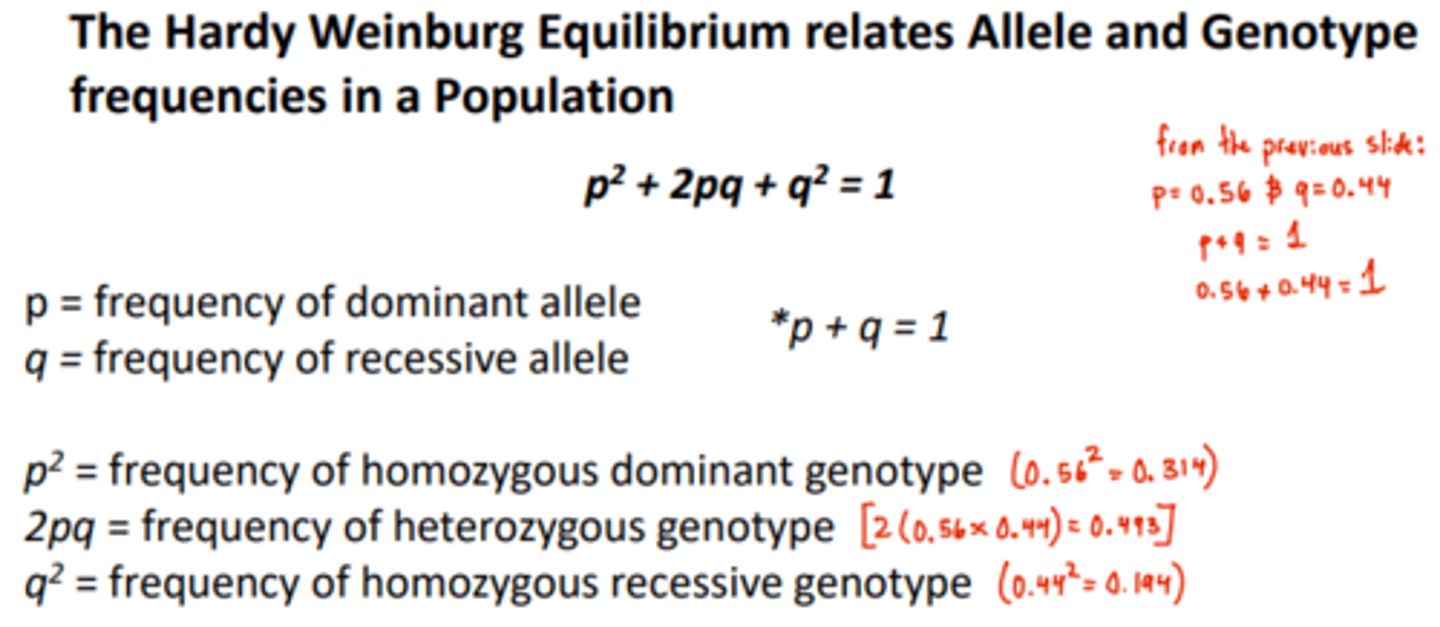
The Hardy Weinburg Equilibrium relates Allele and Genotype frequencies in a Population
1) What is the formula?
2) p + q = ?
3) p = ?
4) q = ?
5) p^2 = ?
6) 2pq = ?
7) q^2 = ?
8) The frequency of gametes carrying a particular allele is equal to...?
9) Multiplying the allele frequencies gives...?
1) p^2 + 2pq + q^2 = 1
2) 1
3) frequency of dominant allele
4) frequency of recessive allele
5) frequency of homozygous dominant genotype
6) frequency of heterozygous genotype
7) frequency of homozygous recessive genotype
8) the allele frequency for a population in Hardy-Weinberg equilibrium.
9) the proportion of each allele combination in the population.
Example of using the Hardy Weinburg Equation to calculate allele frequency and genotype frequency
In Africa, albinism results from a recessive allele at the OCA2 locus. Albino individuals are present a frequency of 1 in 1100 in a particular African group. What are the frequencies of the normal and affected alleles? Per every 100, 000 individuals, how many individuals are heterozygous?
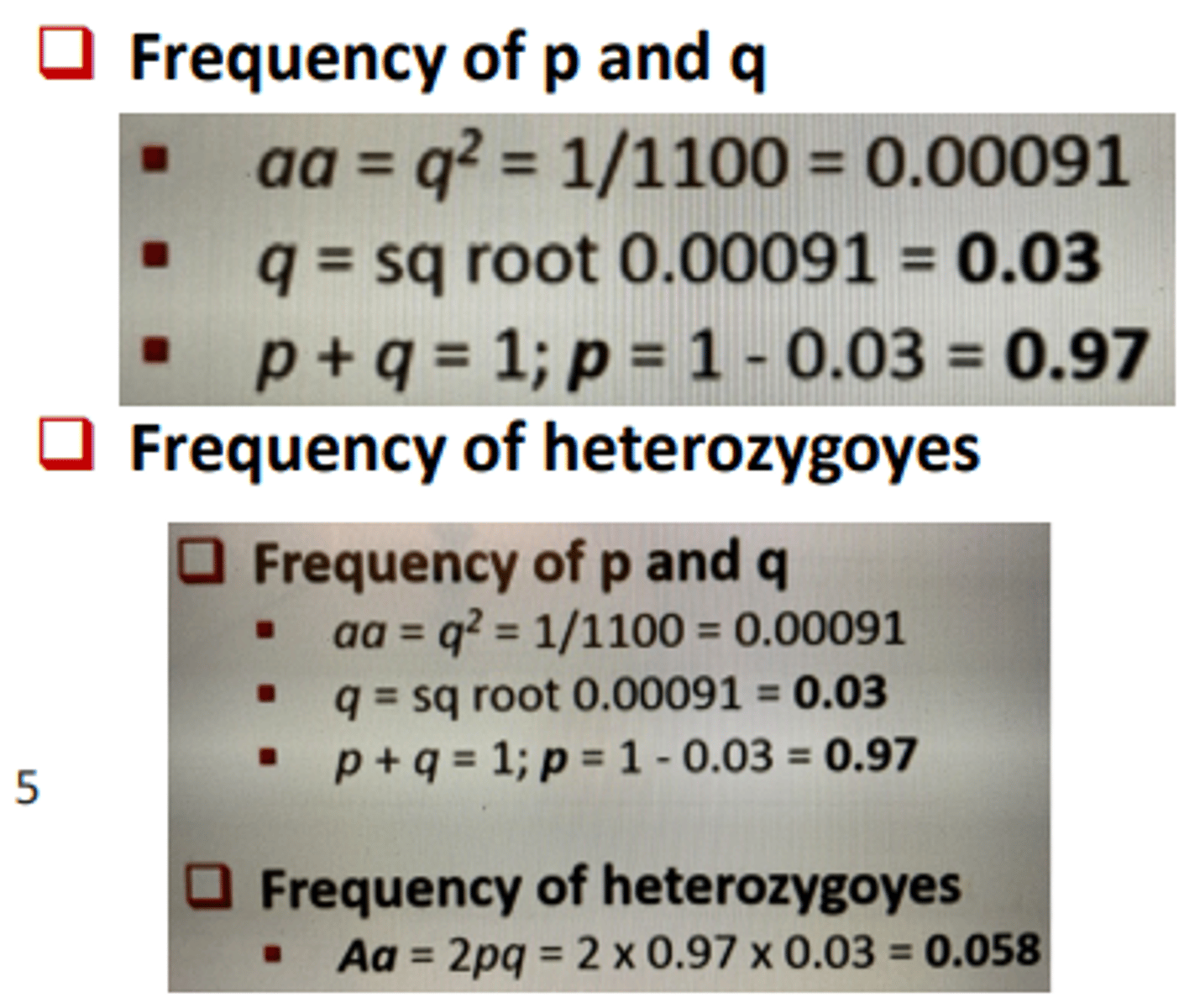
The Hardy Weinburg logic also applies to X-linked genes
1) ______ are hemizygous
2) For X-linked genes, in males, genotype frequencies are equal to...?
3) The b allele is associated with pattern baldness (B = normal; b = pattern baldness). The proportion of European males with pattern baldness is 0.71. What frequency of European women are homozygous recessive?
1) Males
2) allele frequencies
3)

Conditions for Hardy Weinburg Equilibrium
Allele and genotype frequencies will remain constant from generation to generation if the following conditions are met:
▪ Random mating (mating occurs without regard to genotype/phenotype)
▪ No natural selection (all genotypes have the same reproductive success)
▪ No migration between populations
▪ No genetic drift (population size is large enough that allele frequencies don't change due to random chance)
▪ No new mutations or other sources of new genetic variation
Factors that govern microevolution?
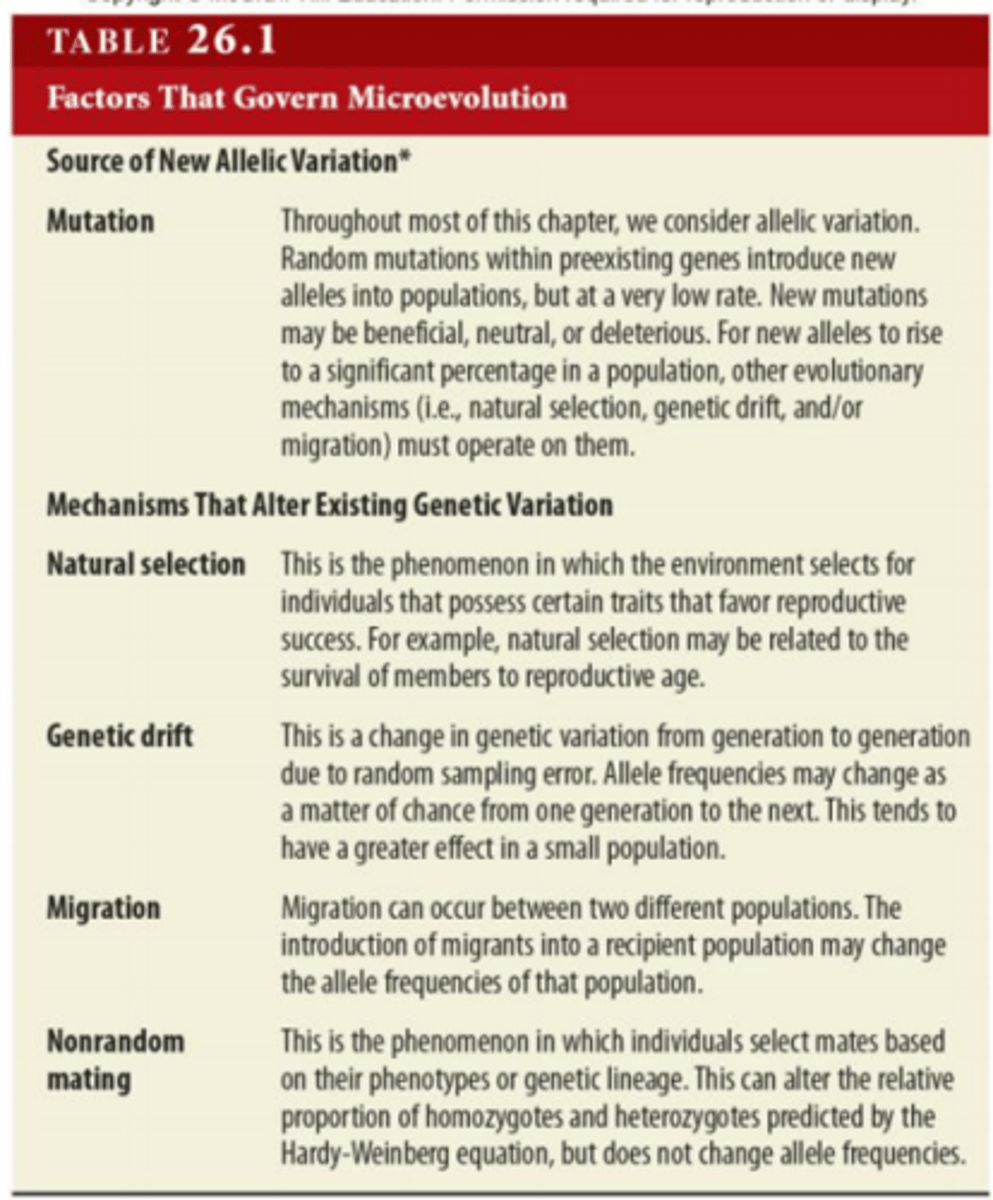
What is microevolution?
changes in the gene pool from generation to generation.
Natural Selection
1) What happens during natural selection?
(a) Natural selection favors traits that...?
2) Fitness is a measure of...?
(a) What is fitness a likelihood of?
1) individuals with beneficial alleles will be more likely to survive, reproduce and pass on their alleles (i.e., they are naturally selected for).
(a) traits that enhance survival and traits that enhance reproductive success.
2) reproductive success
(a) It is the likelihood that one genotype will contribute to the gene pool relative to other genotypes.
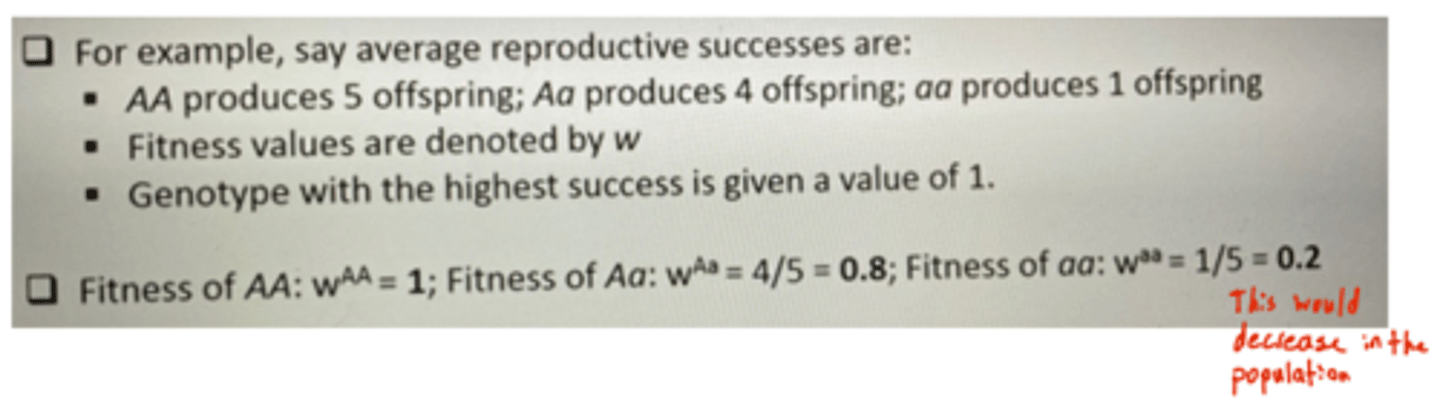
Fitness example?
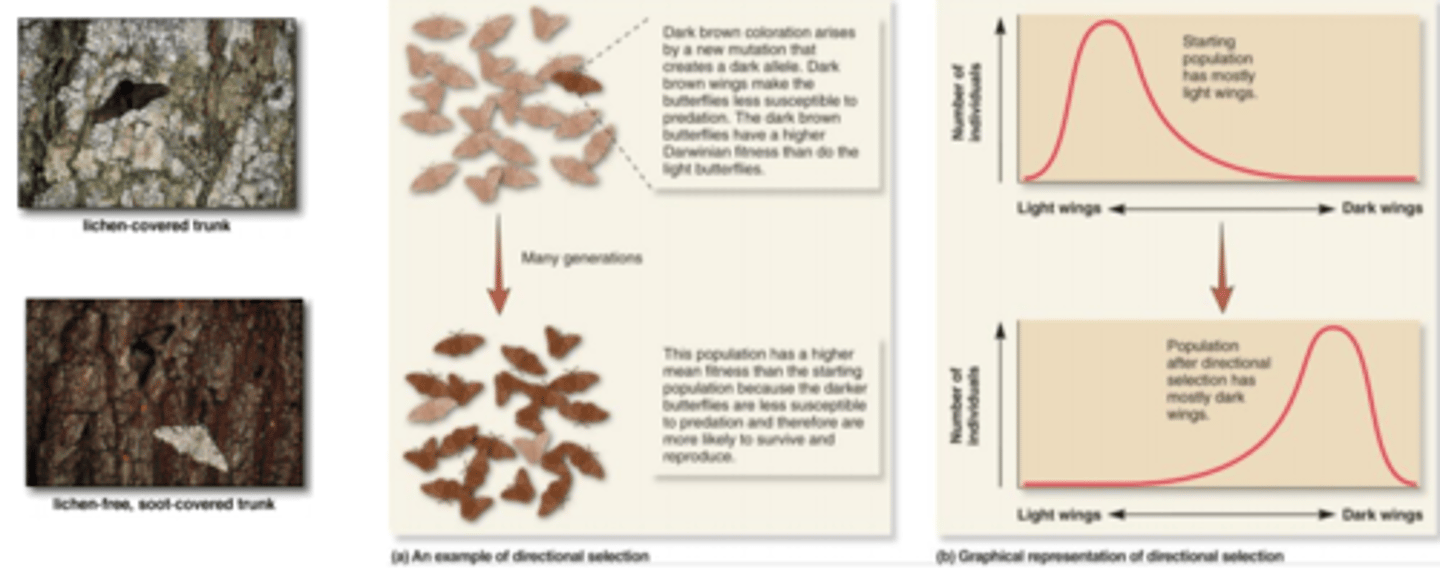
Natural Selection: Directional Selection
1) How does it work?
2) It may occur due to...?
3) Example?
4) For example, the selection for ______ in early Europeans
1) Favors individuals at one extreme
2) a change in environment, introduction of a new allele, or both.
3) Directional selection of dark colored moths during industrial revolution
4) lactose tolerance
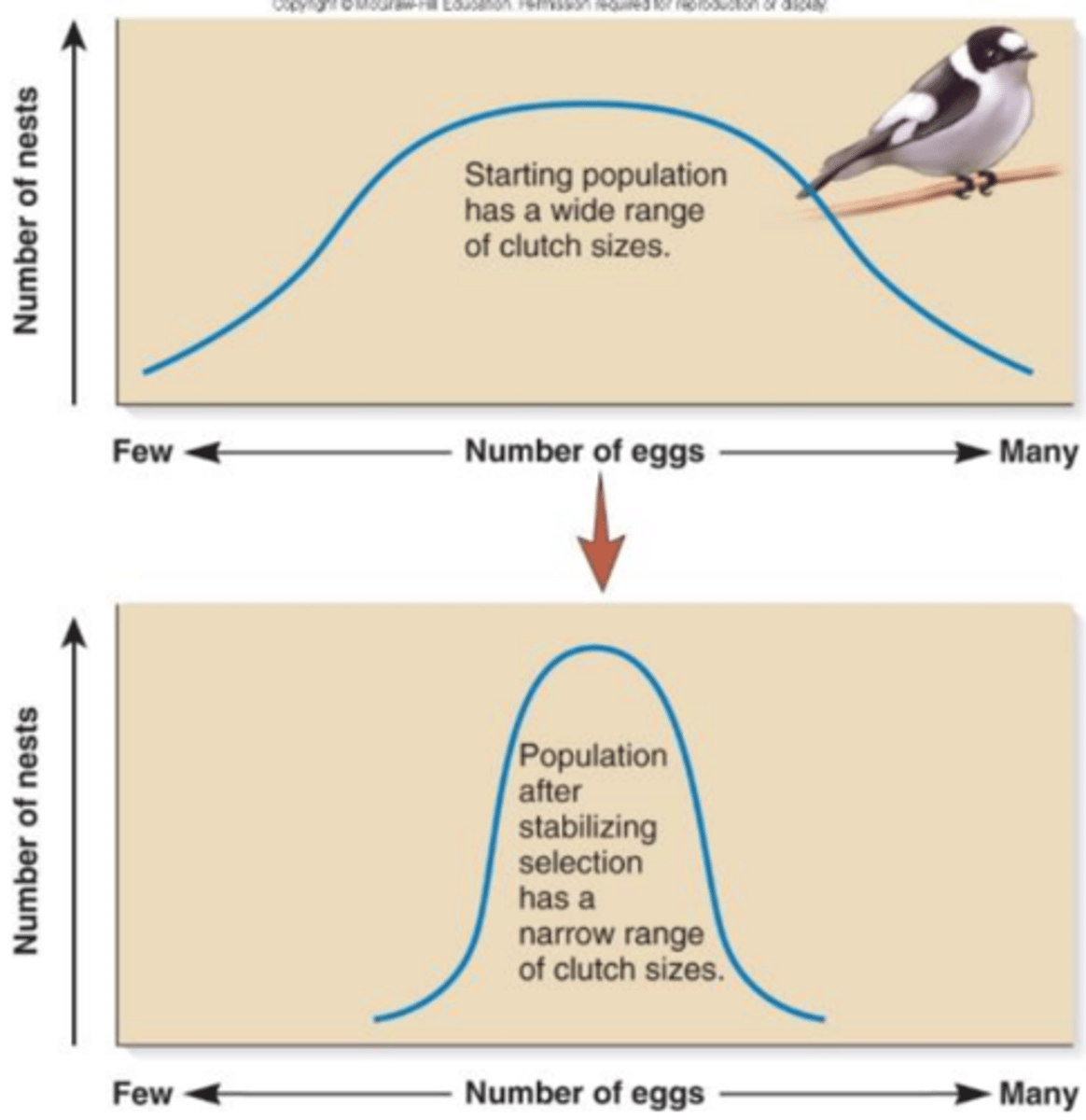
Natural Selection: Stabilizing Selection
1) How does it work?
2) What has the highest fitness?
3) Examples in humans?
1) Extreme phenotypes are selected against.
2) Mean phenotype has the highest fitness
3) ▪ Infant birth weight
▪ Brain size after a period of directional selection
Natural Selection: Disruptive Selection
1) How does it work?
1) Favors selection of two or more different phenotypes in populations that occupy a diverse environment.
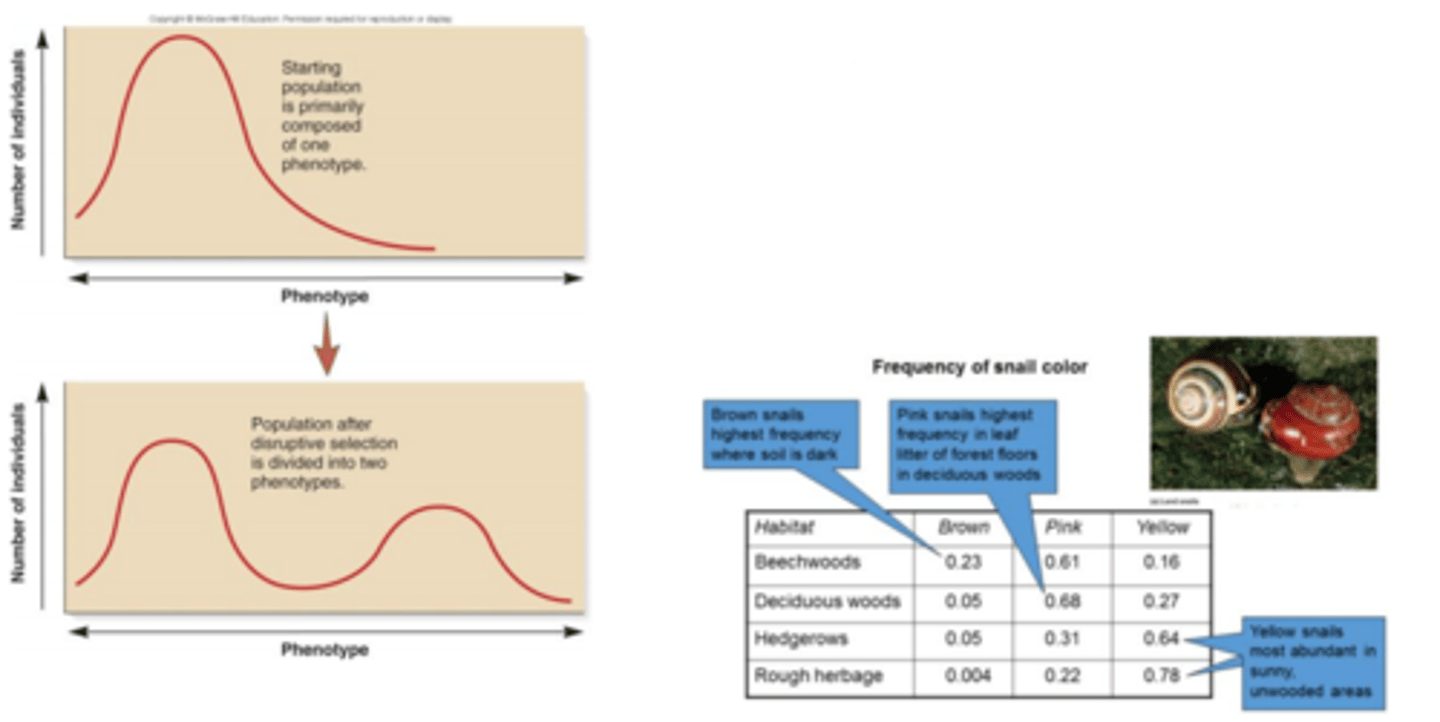
Natural Selection: Disruptive Selection
1) Favors...?
2) In what kind of populations does it occur?
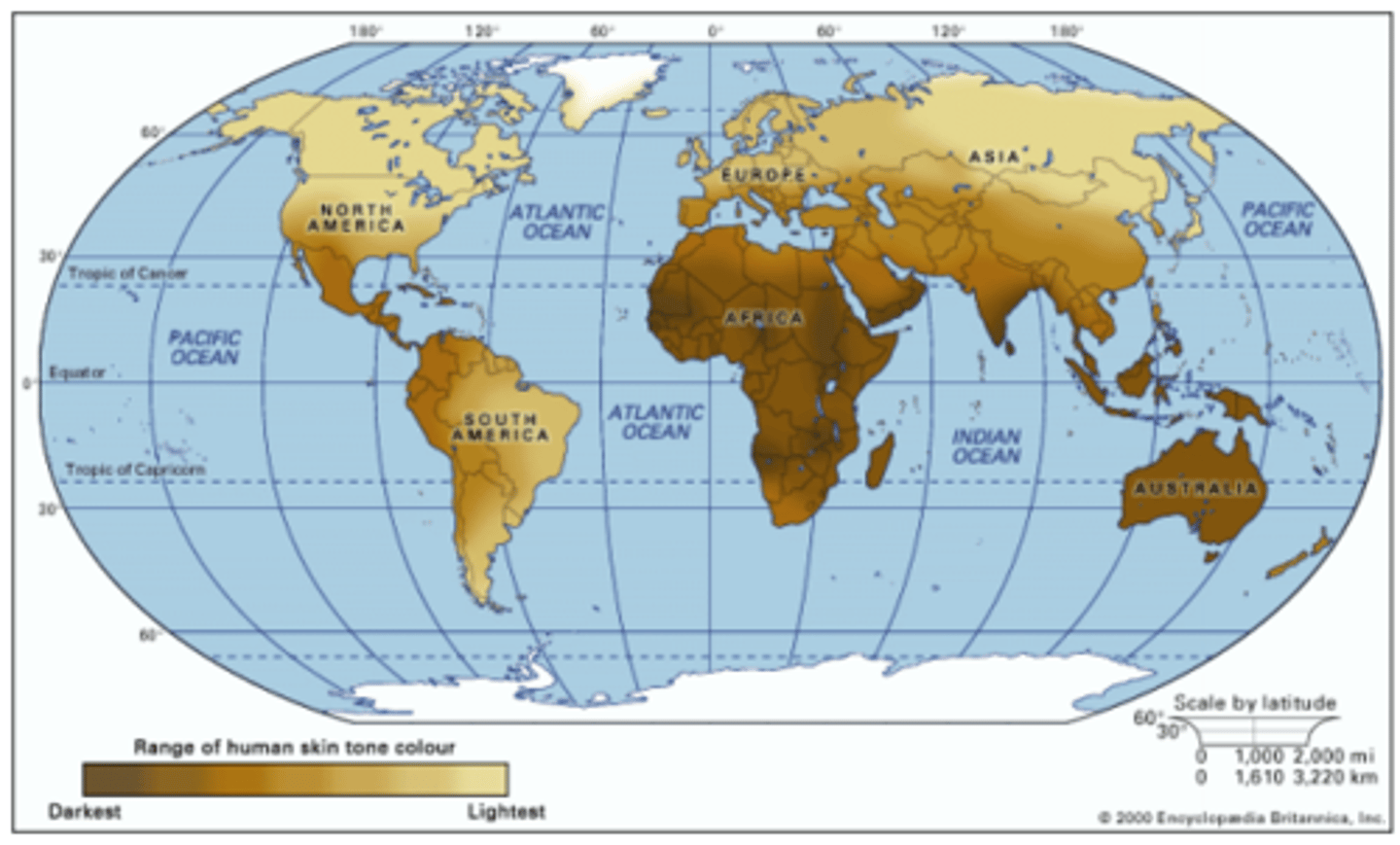
3) Human example?
1) Favors two different phenotypes in a heterozygous environment
2) Occurs in populations that occupy a diverse environment.
3) selection for dark skin pigmentation in areas with plentiful sunlight and light skin pigmentation in areas with less sunlight.
Two types of balancing selection?
Heterozygote advantage and Negative frequency-dependent selection
Natural Selection: Balancing Selection
1) Favors...?
2) What is heterozygote advantage?
(a) Example?
3) What is Negative Frequency-Dependent Selection
(a) Example?
1) Favors maintenance of both alleles in a population.
2) Heterozygotes have a survival advantage over either of the homozygotes
(a) E.g. in areas where malaria is endemic, both the HbA and HbS alleles are maintained in the population in the heterozygous form
▪ HbSHbS = sickle cell anemia
▪ HbAHbS = increased resistance to malaria over homozygotes
▪ HbAHbA = normal
3) Fitness decreases as phenotype becomes more common
(a) Negative frequency dependent selection of Flu viruses and the flowers
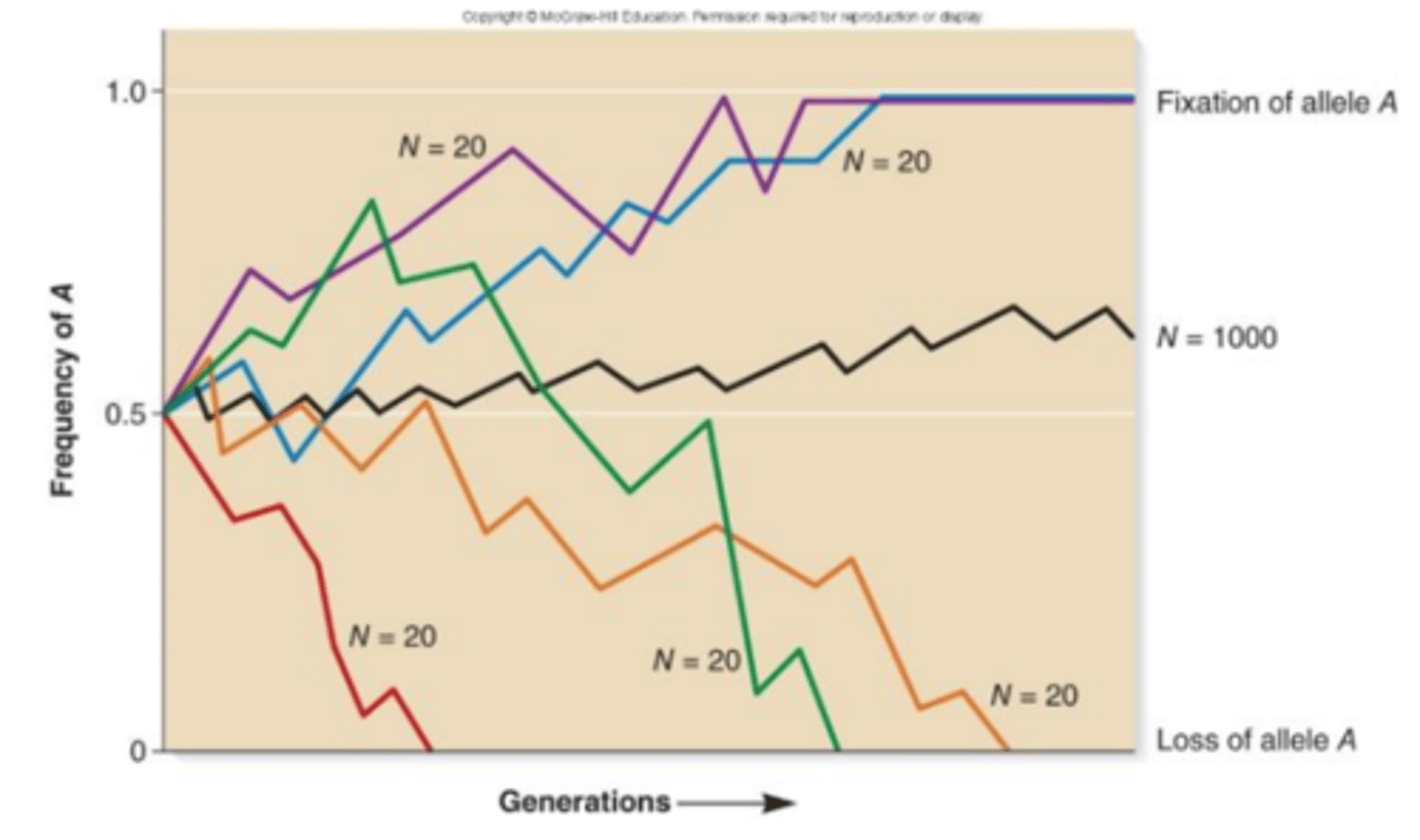
Genetic Drift
1) What is it?
2) What can it lead to?
3) The rate of genetic drift depends on...?
4) Allele frequencies are more susceptible to genetic drift in...?
1) Changes in allele frequency due to random chance.
2) Can lead to loss of an allele from a population or fixation of an allele at 100% in a population.
3) the population size and initial allele frequencies.
4) small populations.
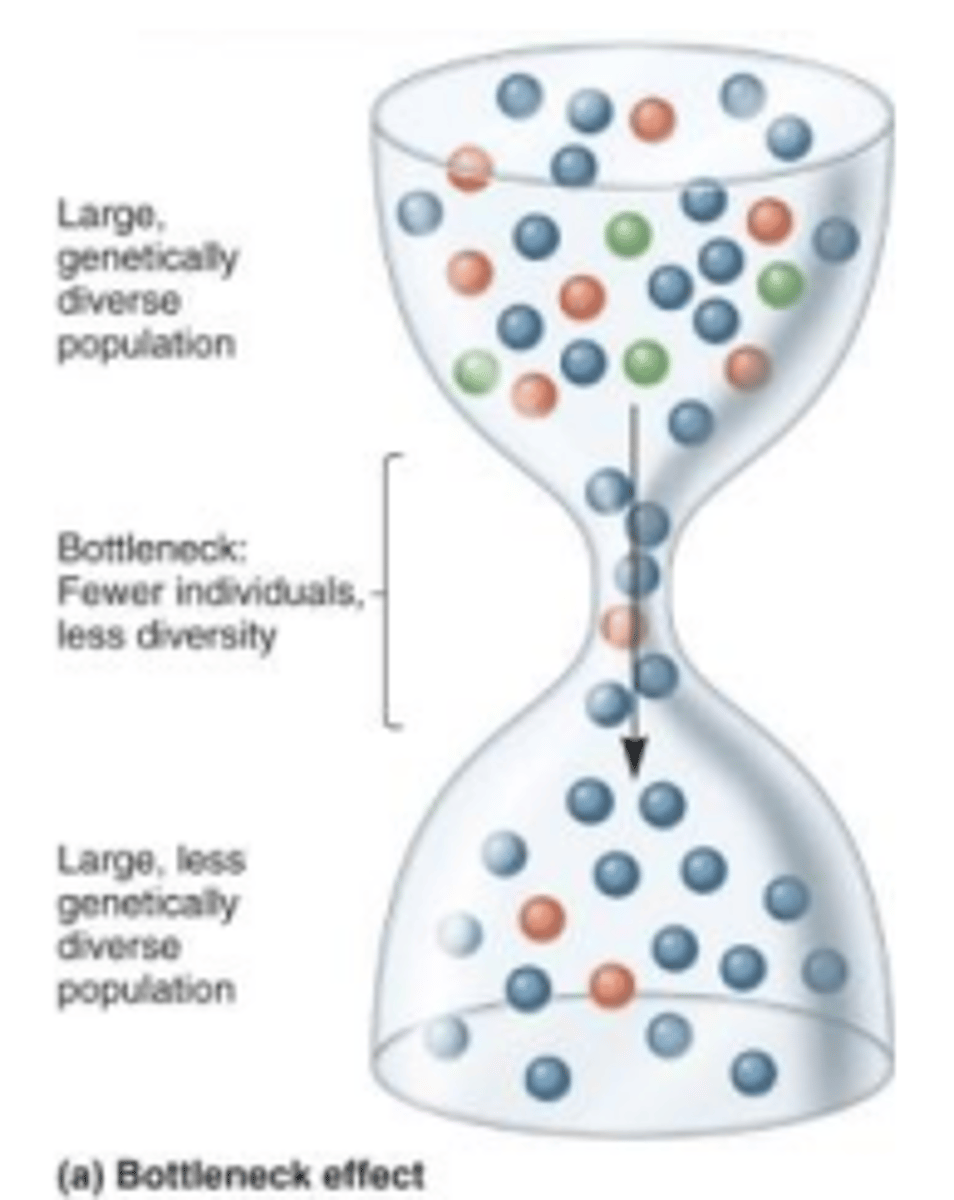
Genetic Drift - Bottleneck effect
1) What starts it?
2) Individuals are lost from the population without...?
3) The population rebounds, but...?
4) Bottlenecks occurred during...?
1) A population decreases dramatically in size due to a natural event.
2) regard to genotype.
3) genetic composition is altered.
4) human evolution
Genetic Drift - Founder Effect
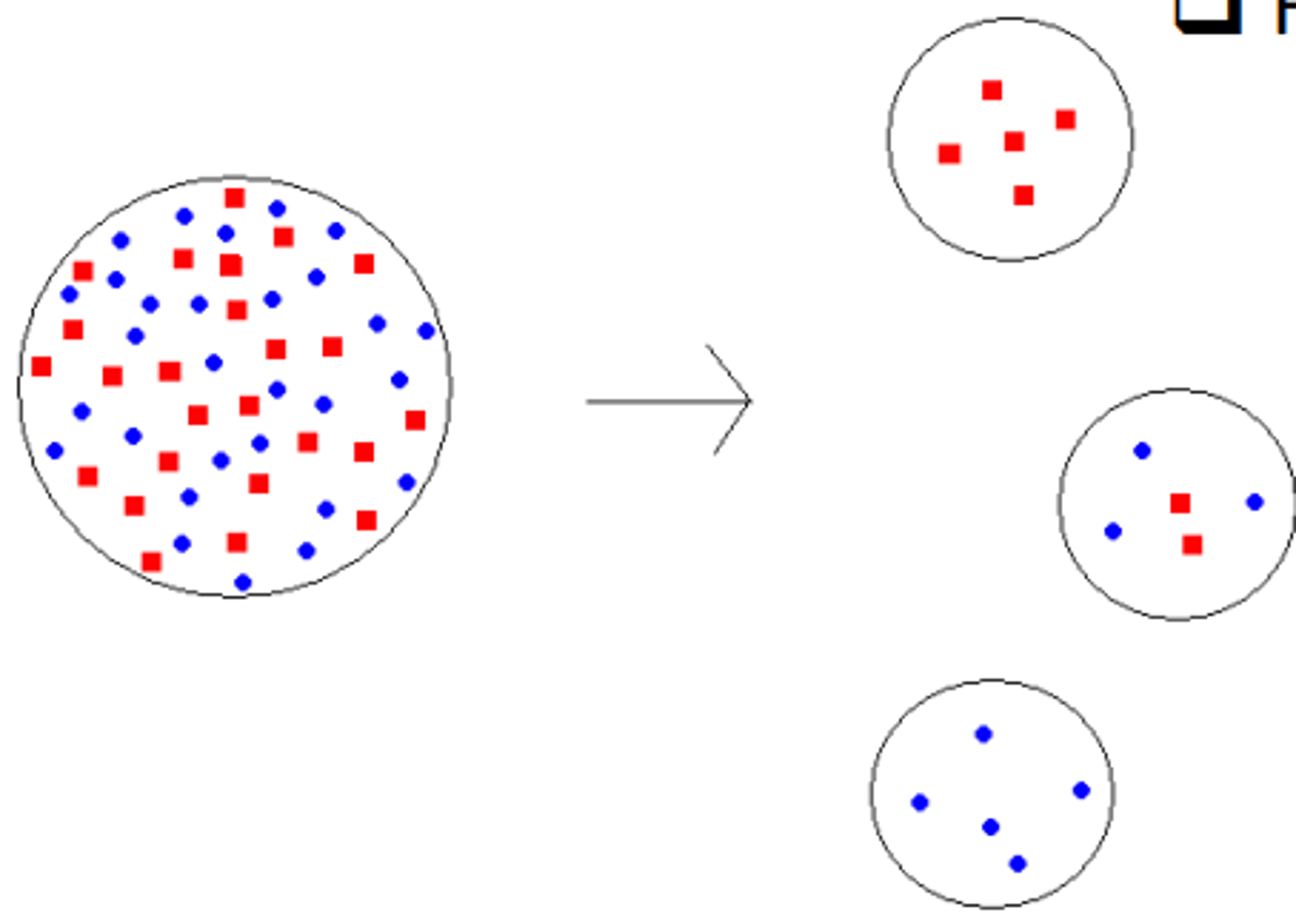
1) What starts it?
2) Allele frequencies of the founder population are not...?
3) Two examples?
1) A small group of individuals separate from a larger population.
2) representative of the original population.
3) ▪ E.g. Pennsylvania Amish population
▪ E.g. Barranquitas village of Venezuela
Migration
1) How does migration cause gene flow?
2) How does it affect the population of the receiving and donating populations?
1) Gene flow occurs when individuals migrate between populations with different allele frequencies.
2) Increases the genetic variation within the receiving population and reduces genetic variation between populations.
What is random mating?
individuals chose mates irrespective of genotype and phenotype.
What is assortative mating?
mating is not random
What is positive assortative mating and what effect does it have on populations?

What is negative assortative mating and what effect does it have on populations?

Non-random mating
1) Effect depends on...?
2) Effects of assortative mating cannot be easily measured as...?
1) the number of genes involved in producing the phenotype and the degree of assortative mating
2) there are many variables
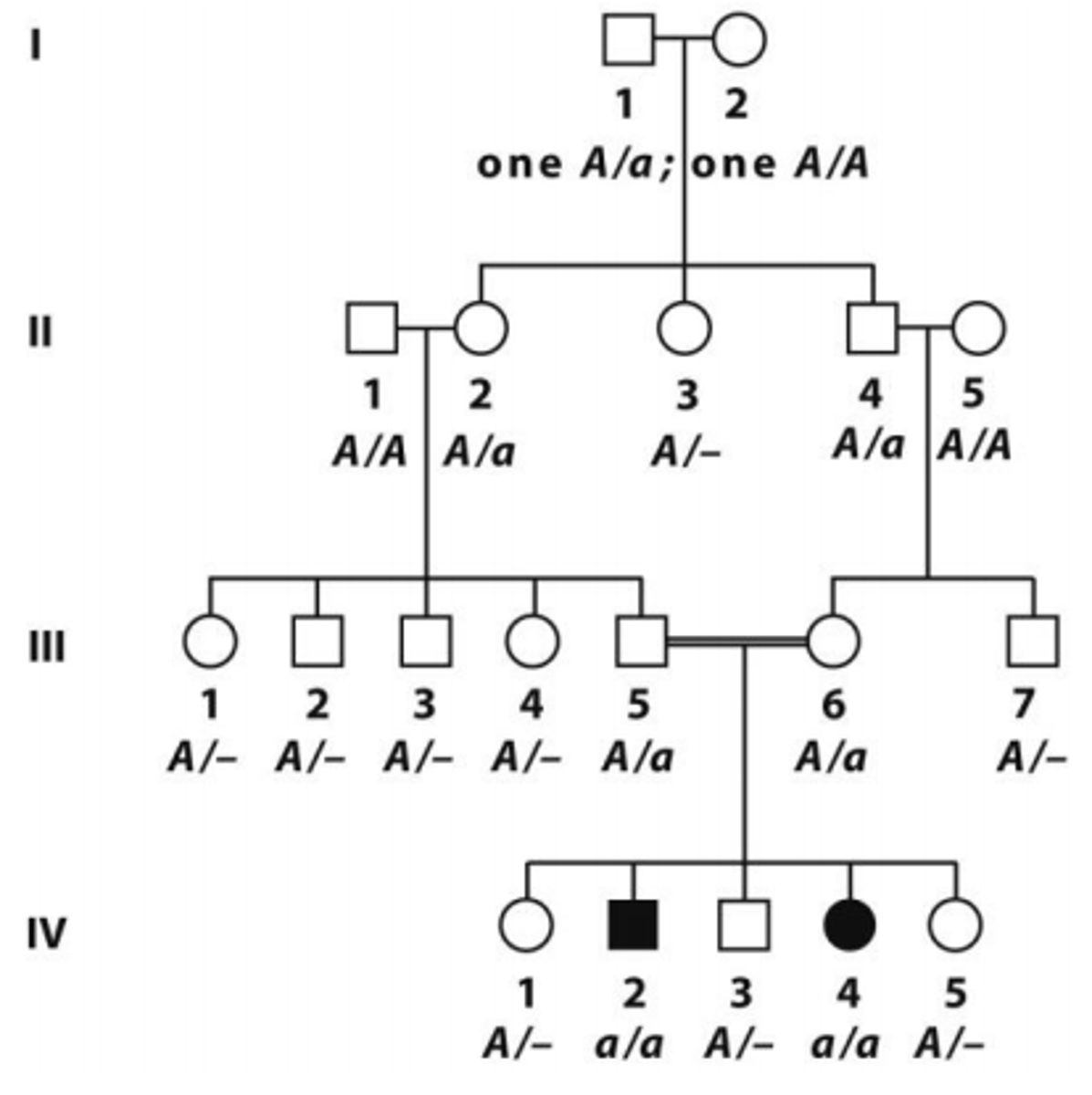
What is inbreeding and what effect does it have on populations?

Pedigree to demonstrate inbreeding
What is the gene pool?
All of the alleles for every gene in a population.
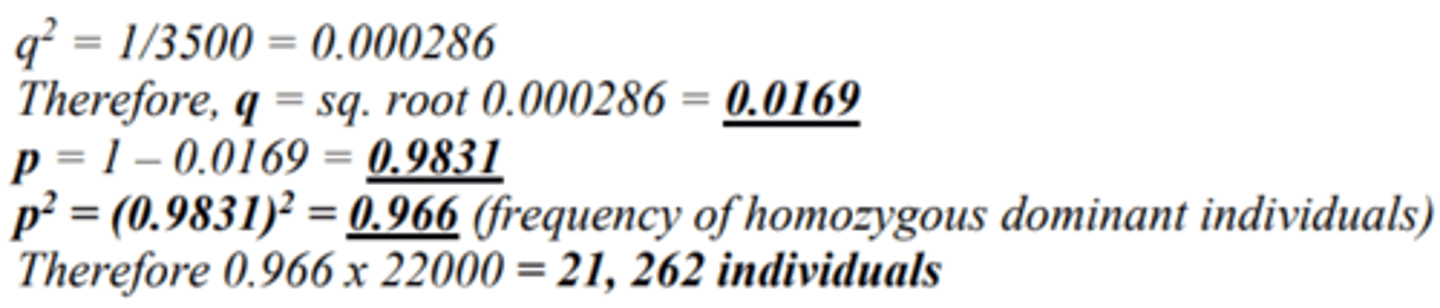
Cystic fibrosis shows autosomal recessive inheritance. The frequency of cystic fibrosis in the US is about 1 in 3500. What are the frequencies of the normal and affected alleles? What is the frequency of homozygous dominant individuals? MSU has approximately 22, 000 students- how many students are expected to be homozygous dominant?
Red-green color blindness shows X-linked recessive inheritance. In a sample population of 210 000 males, 13 860 males were red-green color blind. What is the frequency of the affected allele in this population? If we also sampled 210 000 females in this population, how many females are expected to be red-green color blind?
For X-linked alleles, the allele frequency is equal to the genotype frequency in males.

What is microevolution?
Changes in allele frequencies that occur in a population from one generation to the next.
What type of traits does natural selection select for and why?
Natural selection selects for traits that enhance survival and traits that enhance reproductive success (e.g. increase fertility or make an individual more appealing to the opposite sex) because such traits ensure that genes are passed to the next generation.
What is fitness?
Fitness is the relative likelihood that a particular genotype will contribute genes to the next generation.
Lactose tolerance is inherited as a dominant trait (A = lactose tolerance; a = lactose intolerance). In early European populations, most individuals were aa, and only rare individuals were AA or Aa. Following domestication of cattle, individuals with the dominant mutation had a survival advantage. Over many generations, how would the A and a allele frequencies be expected to change, and how would the genotype frequencies be expected to change? What type of natural selection would act on the trait, and which graph below best illustrates that type of selection (right, middle or left graph)?
Over many generations we would expect the frequency of the A allele to increase in the population and the frequency of the a allele to decrease in the population because individuals with the A allele are more likely to survive and pass on their alleles to the next generation. Therefore, we would expect the frequency of AA and Aa individuals to increase in the population, and the frequency of aa individuals to decrease in the population. Directional selection is acting on the trait. Directional selection is illustrated by the graph in the middle).
How does balancing selection due to the heterozygote advantage work to maintain two different alleles in a population?
Individuals with the heterozygous genotype have the highest fitness, so the heterozygotes are most likely to survive and pass on their alleles to the next generation. Heterozygotes pass on both alleles to the next generation ensuring both alleles are maintained, even if the recessive allele is deleterious in the homozygous form. It results in the recessive allele being present in the population at a higher frequency than would otherwise be expected.
What effect does stabilizing selection have on the phenotype of a population? Which graph below best illustrates stabilizing selection (left, middle or right graph)?
In stabilizing selection, the mean phenotype has the greatest fitness, so the mean phenotype is naturally selected for and the extreme phenotypes are selected against. Over many generations of stabilizing selection, there will be a greater proportion of individuals with the mean phenotype and fewer individuals with extreme phenotypes (i.e., less variation about the mean). The graph on the left best illustrates stabilizing selection.
What effect does diversifying selection have on the phenotype of a population? Which graph below best illustrates diversifying selection (the left, middle or right graph)?
Diversifying selection selects for different phenotypes in different environments. For example, in early human populations we had the natural selection for dark skin pigmentation in areas with intense sunlight, and the selection for light skin pigmentation at higher altitudes where there was less sunlight. The graph on the right best illustrates diversifying selection
What is genetic drift? Is genetic drift more likely to alter allele frequencies in smaller populations or larger populations? How do the bottleneck effect and the founder effect act to promote genetic drift?
Genetic drift refers to changes in allele frequency due to random chance. Genetic drift is more likely to affect small populations (e.g., in a small population, there is a greater probability that all individuals will randomly pass on one allele more often than another).
In the bottleneck effect, a natural event randomly eliminates individuals without any regard to genotype. After the event, the population may have altered allele frequencies, and it is reduced in size (and therefore, even more prone to genetic drift).
In the founder effect, a small founder population of individuals migrate to a new location. The founder population may have a gene pool that is not representative of the larger, original population, and it has a small population size (making it even more prone to genetic drift).
How does migration promote microevolution?
Migration results in gene flow, which is the transfer of alleles from one population into another. The introduction of new alleles may alter allele frequencies in the receiving population
Suppose that a population composed of 100 individuals existed on an island. Two different alleles of the "A" gene were present in this population (a1 and a2 ) at equal frequency. The following events occurred to the population. Determine what evolutionary force (migration, genetic drift, natural selection or non-random mating) is represented by each event and the effect of each event on allele frequencies in the population.
(i) A devastating fire caused the death of 10 individuals
(ii) A disease swept through the island and killed 13 individuals. The a1 confers resistance to the disease.
(iii) A disease swept through the island killing 13 individuals. Neither a1 nor a2 confers resistance to the disease.
(iv) A ship containing 10 individuals from a different island with a 1 , a2 , and a3 alleles landed at the island.
(v) Two couples (whose genotype is a1 a 1 ) moved to another island to start a new population.
(vi) A couple had several children. Some of their babies had a novel a4 allele.
(i) Genetic drift (bottleneck effect), which may alter the allele frequencies due to random chance.
(ii) Directional selection, which would increase the frequency of the a1 allele and decrease the frequency of the a2 allele.
(iii) Genetic drift (bottleneck effect), which may alter allele frequencies due to random chance
(iv) Migration, which brings alleles into the population. This may alter allele frequencies in the original population, and it also introduces the new allele a3 into the population, thereby increasing genetic diversity.
(v) Genetic drift (founder effect), which would lead to fixation of the a1 allele in the new population and loss of the a2 allele.
(vi) Mutation alone does not alter allele frequencies. When mutations first arise, they are present at a very low frequency and are at high risk of loss through genetic drift. The introduction of the novel allele due to mutation could alter allele frequencies if genetic drift or natural selection act on the allele in a positive way (e.g., by chance all children with the mutation pass on the a4 allele to their children, or the a4 allele offers a survival advantage)