Cosmic Origins 2
 Call Kai
 Learn
Learn Practice Test
 Spaced Repetition
 Match
Match Flashcards
 Knowt Play
1/106

There's no tags or description
Looks like no tags are added yet.
Name | Mastery | Learn | Test | Matching | Spaced | Call with Kai |
|---|
No analytics yet
Send a link to your students to track their progress
107 Terms
Star’s color
Proportional to the surface temperature
What color is the sun?
Green (appears as white)
Blackbody
Idealized body that absorbs all radiation that falls on it and perfectly emits radiation
Wein’s Law
Alpha times the peak wavelength is equal to the constant b, over the temperature
Small wavelengths
The smaller the wavelength the hotter a star
Spectral Sequence
O→M were subdivided from 0-9 (hot to cool)
What spectral class is the sun?
G2
Most common star
76% of stars are red dwarf stars (LTY on the spectrums)
Least common star
O stars are the least common because they burn through their fuel really fast (only last a few million years)
Brown Dwarfs
They can’t sustain fusion and are usually 13-18 MJ
What is lowest mass a star could be a brown dwarf
The lowest would is 80 MJ or 0.08 Ms
Stefan-Boltzmann Law
How we determine a star’s luminosity:
1.) Temperature (dominates)
2.) Radius
Hertsprung-Russle Diagram (H-R)
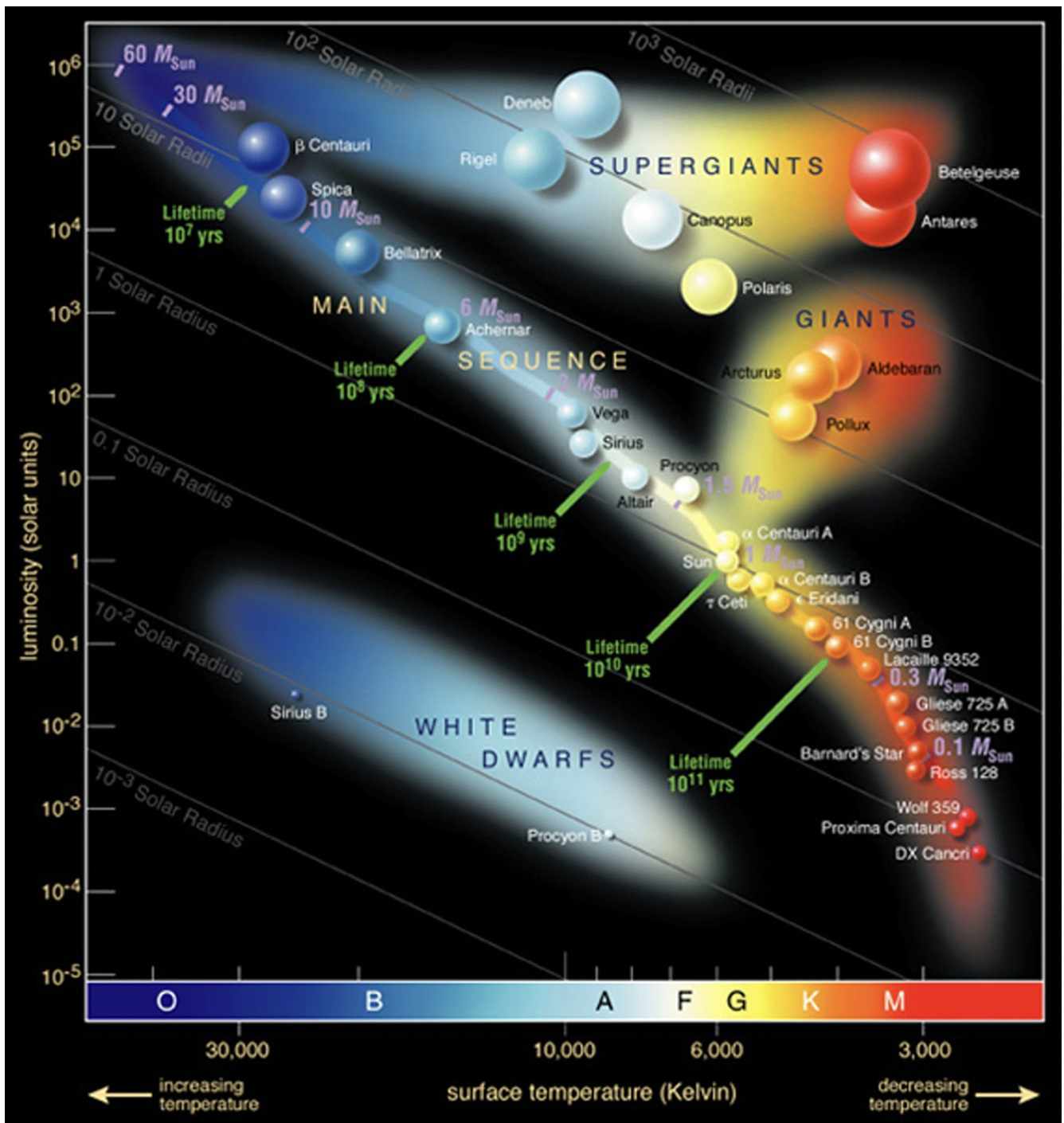
Main Sequence
A star that that is burning hydrogen in the core
Life of a star
Born→main sequence→death (runs out of hydrogen)
Mass
Tells you luminosity, lifespan, and temperature
Luminosity class
I.) Supergiant
II.) Bright giant
III.) Giant
IV.) Sub-giant
V.) Main sequence star (sun is a G2V)
Variable stars
Apparent magnitude of the star changes over time
Light Curve
Is a plot of the apparent magnitude over time
Extrensic Variable Stars
Exoplanet (exoplanet passes in front of the stars)
Eclipsing binary stars
Rotating variable stars (there are star spots)
Eruptive variable stars (large ejections of matter into space)
Intrensic Variable Stars
Star physically changes (pulsating variable star)
Instability Strip
Where most variable stars are
Henrietta Swan Leavitt
Investigated Variable Stars (cepheids)
Period
Time it takes a star to go from maxima to maxima (brightest back to brightest)
Period luminosity relationship
The brighter the star, the longer its period
Leavitts Law
Can use brightness of a cephid to measure the distance of stars
Limit of Leavitts Law
30million parsecs
Cepheids
Are important because they are bright and can be used to find the distance to other galaxies
Type 1 Cepheid
Are more luminous, massive, and have higher metallicity (is younger)
Type 2 Cepheid
Is the opposite of a type 1
Star’s mass at birth
Less than 2 Ms= low
2-8Ms= intermediate
8Ms+= high
Death process
1.) Inert helium core causes fusion to stop
2.) Initiates main sequence turn off (vertical)
3.) Outer layer eventually cools (moves right horizontally to the sub-giant branch)
4.) Hydrogen shell around the helim core causes burning and pushes outward (moves to red giant branch
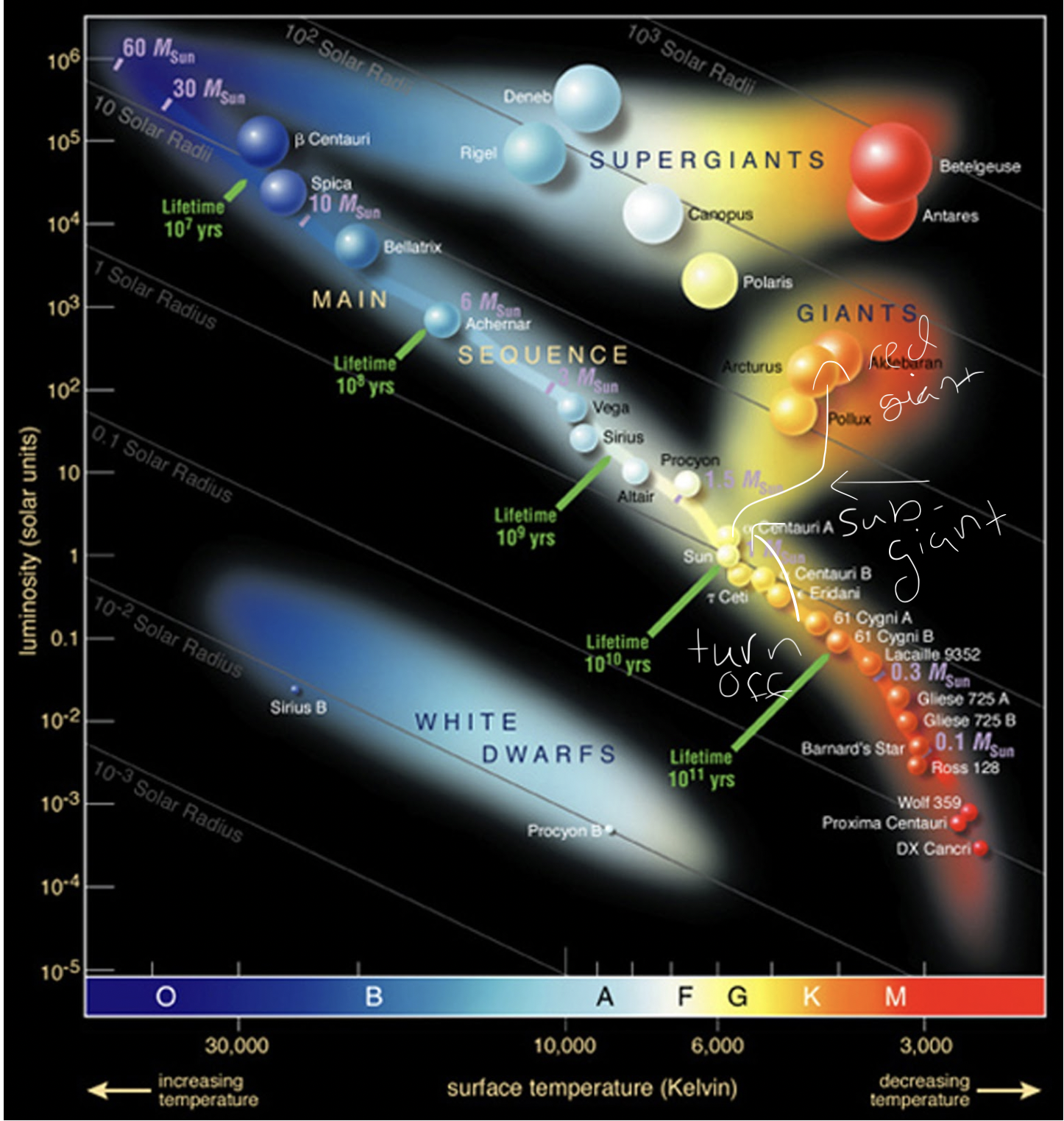
Inert helium core
When hydrogen is exhausted
Main sequence turn off
Leaves the main sequence
Hydrogen shell
Surrounds the helium core and by proximity it ignites, causing an increase in luminosity and pushes outward to the red giant branch
What will happen to the sun when it is about to die?
It will eventually become 100x bigger and 1kxs more luminous (will only get up to luminosity class 3)
Dredge-up
During hydrogen shell burning CNO is brought to the surface and convection layer expands down to the hydrogen shell burning
Temperature to fuse helium
100 million kelvin
Tripple Alpha Process
3 Helium → 1 Carbon
Helium Flash
Runaway helium fusion event at the tip of the Red Giant Branch
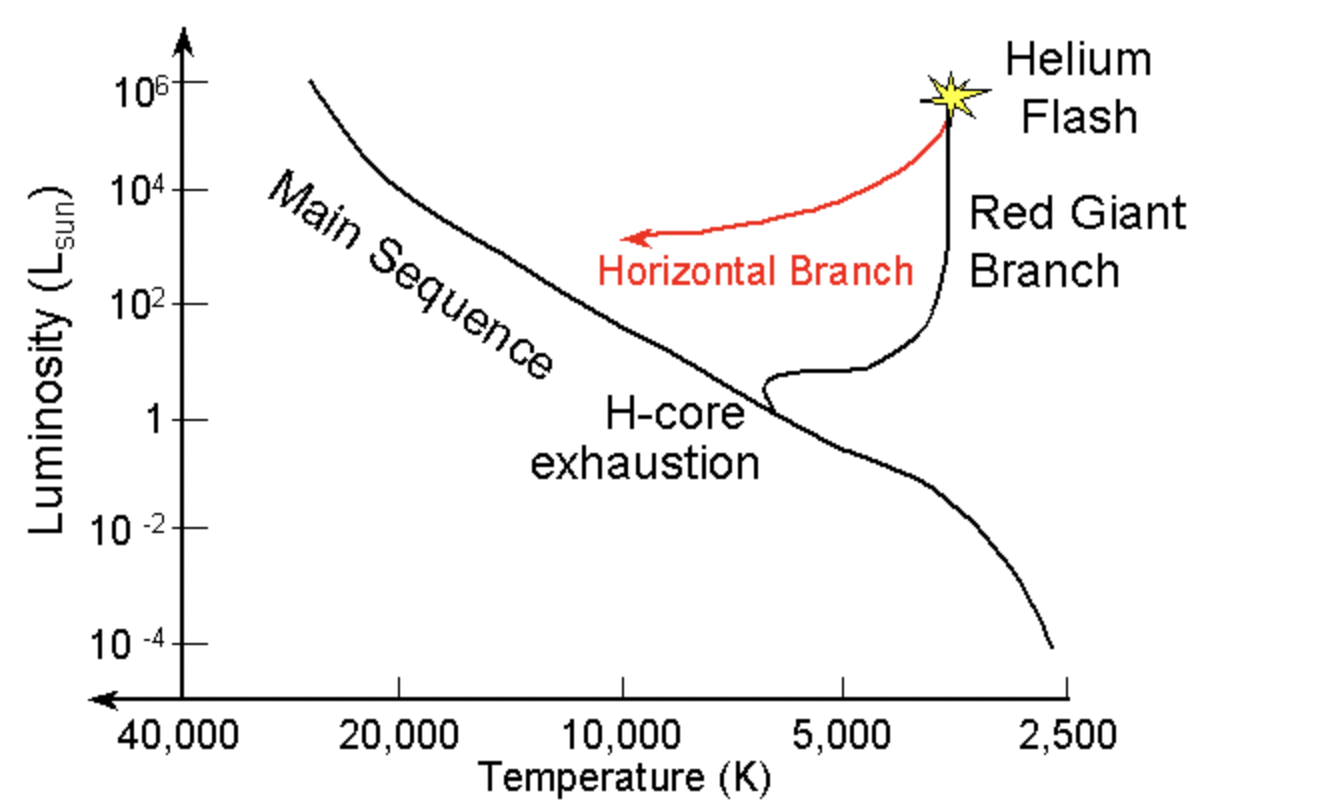
Horizontal Branch
The distance it goes on this branch depends on how much mass is lost from burning (little mass lost= big dip) and has helium core burning (only one)
What happens at the end of the horizontal branch
Helium is exhausted and the core becomes carbon and oxygen (we have double shell burning with hydrogen and helium)
Asymptotic Giant Branch
Helium shell burning stops and that is when the thermal pulse start (variable star) and have dredge up too
Envelope ejection
Ends the thermal pulses and the outer layers are left (becomes planetary nebula, leaving the core behind)
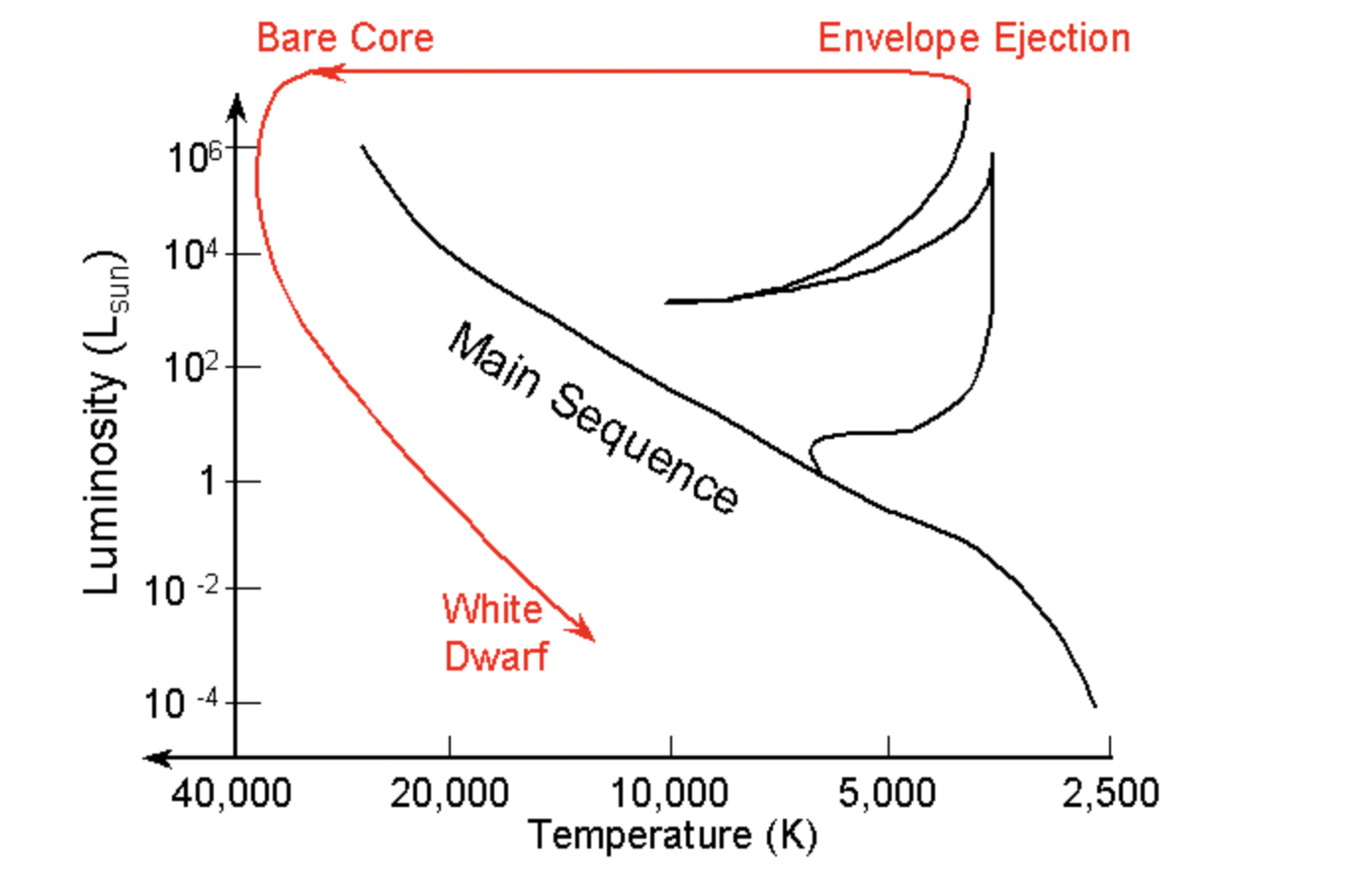
White dwarfs
Are leftover core of a low to intermediate mass star (made of carbon and oxygen)
Mass classifications
Low mass star- 2 Ms or less
Intermediate mass star- 2-8 Ms
High mass star- 8+ Ms
Iron limit
Stars will never fuse iron
Iron
Z= 26 and has the highest binding energy of any element; can’t get fission or fusion
Binding energy
The minimum energy needed to disassemble a nucleus into its consituant nucleons (protons and neutrons)
High mass star’s main sequence turn off
They go to the right because mass increases but luminosity does not and all of them will produce a super giant
Iron Core
Will collapse and then rebound (will push out and explode), creating a supernova (left over gases turn into a nebula)
1572 Tycho Brahe
Discovered the nova stella (new star), which is not the same as a super nova
Nova
Is a minor detination of hydrogen fusion
Ways to measure distance
Stellar paralax (limit is 100 parsecs)
Nova (20 mega parsecs)
Leavitts’s Law (30 mega parsecs)
Chandrasethar Limit (1k mega parsecs)
Super nova
Type 1 has no hydrogen lines and type 2 has hydrogen lines
Type 1a Super nova
A progenetor that can get up to 8Ms gives rise to white dwarf (1.4 Ms)
How does a type 1a come about?
1.) Accretion (gets close enough to a red giant to exceed Chandrasekhar's limit)
2.) Two white dwarfs merge
Type 1b/c supernova
Massive star core collapse (blow out hydrogen envelopes before collapse)
Type 2 super nova
Massive star core collapse
Tollmin/ Openheimer limit
The lower limit of a neutron star is 1.4Ms and the upper limit is 3 Ms
Recurrent nova
When a white dwarf collect hydrogen from a red giant that results in the detonation of hydrogen fusion
What’s leftover after a supernova
Depends on the mass
Neutron star
The most dense object in the universe (beside black hole) that has beams of radiation
1967 Jocelyn Bell
Built a radio telescope and saw “little green men”; she ended up discovering pulsars, which confirms high mass stellar evolution
Pulsar
spinning neutron star where beam of radiation passes over earth
Why do pulsars spin faster
Conservation of Angular Momentum
What do you get out of stars
Low mass- Main sequence→red giant→nebula→white dwarf
Intermediate mass- Main sequence→red giant→nebula→neutron star
High mass (greater than 20 Ms)- Main sequence→red giant→nebula→black hole
Escape Velocity
The minimum speed needed to escape gravity
Katal Schwarzschild
Solved general relativity
Singularity
Point that contains the entire mass of a black hole
Escape speed for a black hole
Is the speed of light
The event horizon
The distance from the singularity that you would need to go the speed of light to escape
Who first predicted black holes
Openheimer
Accretion disk
Swirling hot plasma rotating around a black hole in a disk (the light get bent around the black hole)
Doppler Beaming
Plasma from accretion disk rotates toward you (will look brighter)
Relativistic Jets
From title event you get beams of radiation coming from the disk that are super hot/fast plasma
Types of black holes
Micro Black holes- less than 1Ms
Stellar mass black holes- 3Ms to hundreds Ms
Intermediate mass black holes- hundreds Ms to hundreds of thousands Ms
Supermassive black hole- millions to billions of Ms
Ways to detect black holes
1.) Stars orbit something that is not there (cygnus x-1 is the first confirmed black hole in 1971)
2.) Bright x-rays (our black hole is Sagitarius A*)
3.) Relativistic jets
4.) Gravitational waves (black hole mergers emit gravitational waves we can detect)
5.) We can take a picture (only since 2019)
Shadow of a black hole
Event horizon is smaller
Photons
We can see photons shoot off (they can get closer to the black hole, but it is not the accretion disk)
How do we take pictures
Use radio waves to take a picture and send those drives from sinked telescopes to be put in an algorithem that can fill the gaps
Tidal force event
The difference in strength of gravity between two points
Spagettification
The difference in gravitational force causes molecuels to be ripped appart (if the black hole is bigger than you have more of a chance to survive the encounter)
Doppler effect
Waves are shorter towards us and get longer away from us
Photon Sphere
Photons have no mass so they can get closer to black holes
General relitivity
Discovered by Einstine in 1915
Test for general relitivity
1.) Gravitational red shift
2.) Gravitational time dilation
3.) Gravitational lensing
Gravitational red shift
Light gets redshifted near massive objects (if you fell into a black hole, light would be blueshifted cause it is accelerating toward you)
Gravitational time dilation
Time runs slower near massive objects
Gravitational lensing
Light bends around massive objects (more mass=more bend)
When was general relitivity first proved
In 1919 by Arthur Eddington
Milky Way Galaxy
Spiral galaxy that is 1000 lightyears across (has bulge and disk)
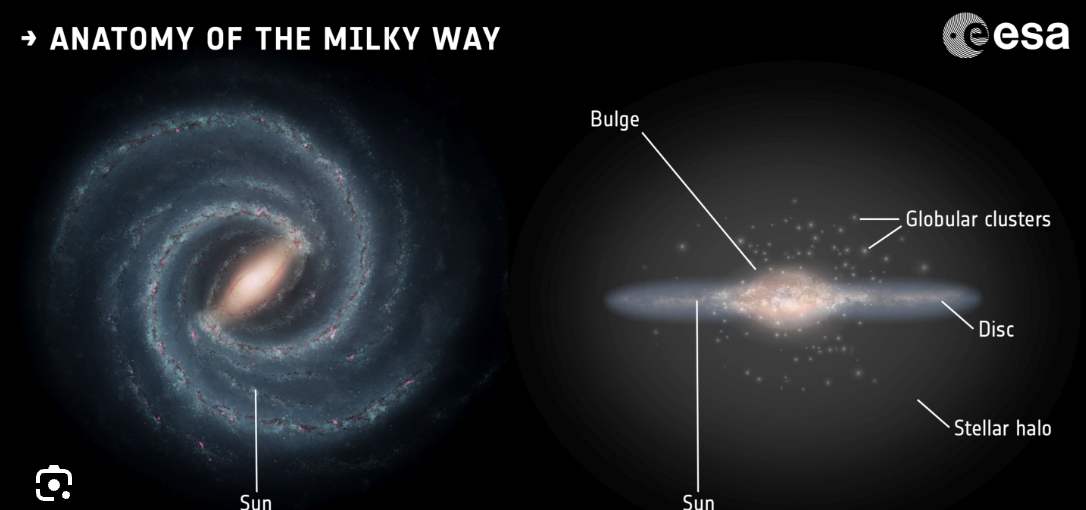
Bulge vs disk
Bulge is dead (no stars are made) and the disk has active star formation
Open clusters
Found the disk (very blue and young)
Globular cluster
Larger and more dense in the stellar halo (older stars that are reder)
Fuzzy nebule
Fuzzy objects in the sky
1785
William Hershel proposed the first model of the Milky Way
The Great Debate
Debate in 1920s at the Smithsonian over how big the universe was and what are the fuzzy nebule between Heber Curtis and Harlow Shaply (no one won)
Herber Curtis
Said fuzzy nebule were “island universes” (galaxies) so the universe huge
Harlow Shapley
Said fuzzy neblue were clouds on the outer part of the Milky Way (universe is only a bit bigger than the Milky Way)