Module 4 FINAL
 Call Kai
 Learn
Learn Practice Test
 Spaced Repetition
 Match
Match Flashcards
 Knowt Play
1/33

There's no tags or description
Looks like no tags are added yet.
Name | Mastery | Learn | Test | Matching | Spaced | Call with Kai |
|---|
No analytics yet
Send a link to your students to track their progress
34 Terms
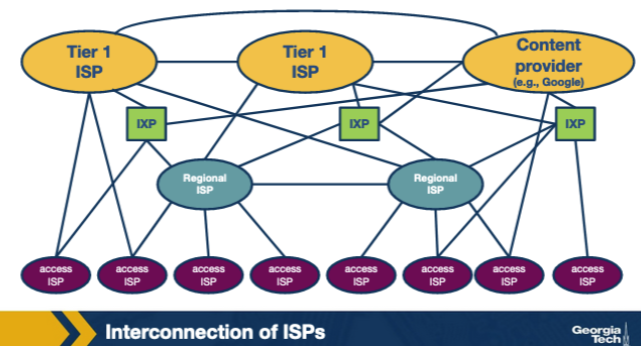
Looking at the AS-hierarchy figure: a small access ISP that wants to deliver traffic to a distant network outside its providers' tables must rely on which other entity in the picture? A. A regional or Tier-1 isp it is a customer of, which forwards the traffic onward. B. An IXP route server alone, with no involvement from any provider. C. Another access ISP at the same tier as itself, using a settlement-free peering session. D. The destination network must connect directly to the access ISP for traffic to be deliverable.
A. A regional or Tier-1 isp it is a customer of, which forwards the traffic onward. Why: Small access ISPs reach far destinations via their transit providers. The small ISP doesn't have its own routes to the whole Internet — its provider's BGP table covers everywhere else, and traffic for unknown prefixes is sent upstream.
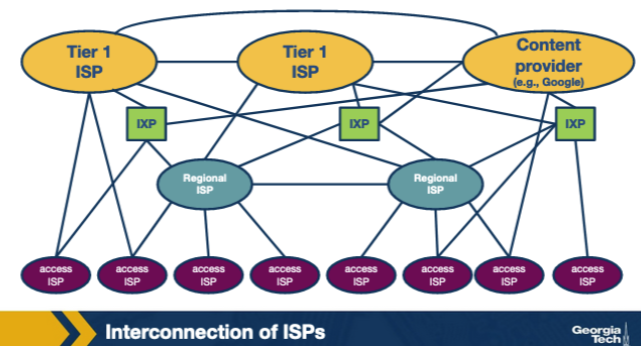
In the same hierarchy figure, suppose two Tier-1 ISPs lose their direct peering link. What is the likely effect on a customer of one Tier-1 trying to reach a customer of the other? A. No effect; Tier-1 ISPs always have multiple direct peerings with every other Tier-1 ISP. B. The two halves of the Internet may become partially unreachable between those Tier-1 customer cones until the peering is restored or rerouted. C. Traffic gets dropped at the IXP because IXPs cannot connect Tier-1 networks — this is the canonical convention documented in the BGP specification for production routers. D. Tier-1 ISPs automatically fall back to using IPv6 in this scenario, restoring connectivity via the v6 plane.
B. The two halves of the Internet may become partially unreachable between those Tier-1 customer cones until the peering is restored or rerouted. Why: Direct peering loss between Tier-1s => partial partition. Tier-1s have no transit provider above them, so if direct peers don't reach each other, their customer cones can become mutually unreachable until peering is restored.
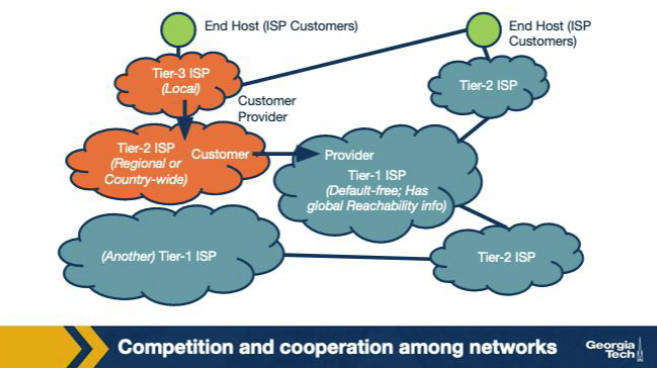
This figure depicts the Internet topology shifting from strictly hierarchical to flatter. What development drove most of this flattening? A. The Internet now has fewer total ASes than it had a decade ago. B. Tier-1 ISPs absorbed all Tier-2 networks via mergers, removing the middle tier. C. Large content providers and CDNs deployed at IXPs let networks bypass higher tiers for popular content. D. BGP was redesigned to forbid customer-provider relationships and require flat peering.
C. Large content providers and CDNs deployed at IXPs let networks bypass higher tiers for popular content. Why: CDNs/content providers colocate at IXPs => bypass higher tiers. Popular content (Netflix, YouTube, Akamai) lives close to eyeballs at IXPs, so traffic no longer needs to climb the hierarchy through Tier-1 transit links.
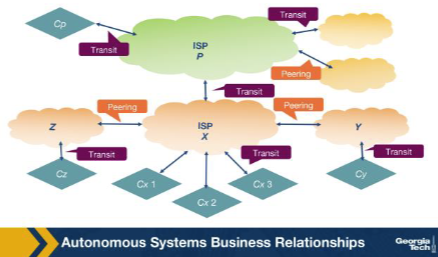
Looking at the AS business-relationship figure: AS X is a customer of AS Y. In this relationship, who pays whom, and what does X receive? A. Y pays X; in return X agrees to forward traffic destined for Y's customers along its links. B. X and Y both pay the IXP that hosts their interconnection fabric for the duration of the relationship. C. Neither pays; the link is settlement-free and serves both parties equally on traffic volume. D. X pays Y; in return X receives reachability to every destination Y can reach.
D. X pays Y; in return X receives reachability to every destination Y can reach. Why: Customer pays provider for reachability to everywhere. The transit contract: customer pays for upstream access; in return provider announces every route it can reach (default route or full table) to the customer.
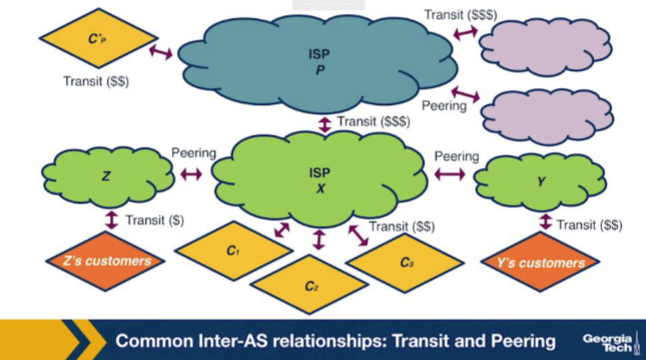
In the figure, two ISPs of similar size establish a settlement-free peering link rather than buying transit. Which is the BEST motivation? A. To avoid paying their upstream providers for traffic going directly between each other's customers. B. To take over the AS-PATH attribute and shorten everyone's routes uniformly across the Internet. C. To merge their two ASes into one for administrative simplicity in a single global table. D. To allow both ASes to begin charging Tier-1 ISPs for transit service over time.
A. To avoid paying their upstream providers for traffic going directly between each other's customers. Why: Peering avoids paying transit on traffic to each other's customers. Two similar-size ISPs save money by exchanging customer-bound traffic directly; previously they each paid upstream providers to carry it.
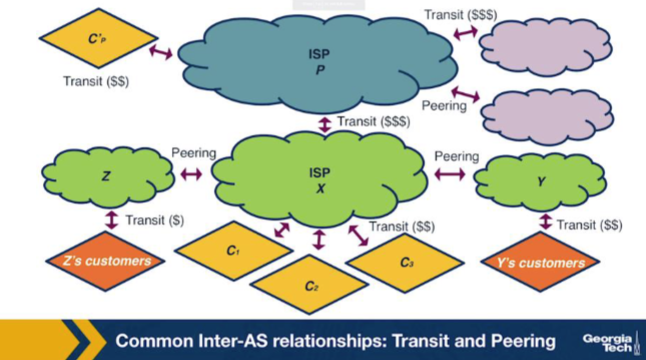
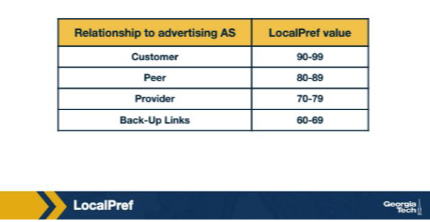
Scenario: AS X learns the SAME prefix from a customer AS, a peer AS, and a provider AS at the same moment. Which path will X most likely install for forwarding, and why? A. The peer-learned route, because peers are usually closer in the topology and have lower AS-PATH lengths than providers. B. The customer-learned route, because forwarding via customer earns X revenue while the other two cost X money or provide no revenue. C. The provider-learned route, because providers always advertise the most stable and well-vetted paths to a destination. D. Whichever has the shortest AS-PATH; relationship type plays no role in this decision, as is widely deployed across modern Tier-1 networks for predictable inter-domain behaviour.
B. The customer-learned route, because forwarding via customer earns X revenue while the other two cost X money or provide no revenue. Why: Customer route is preferred => revenue. Among same-prefix routes, exporting via a customer earns money; via a provider costs money; via a peer is settlement-free — BGP best-path is overridden by relationship preference (via LocalPref).
In a customer-provider relationship, the customer can use the provider's link to reach every destination the provider knows about. True or False?
True. Why: Customer = full transit reachability. The customer-provider contract grants the customer access to everything the provider can reach, which is typically the full Internet or a default route.
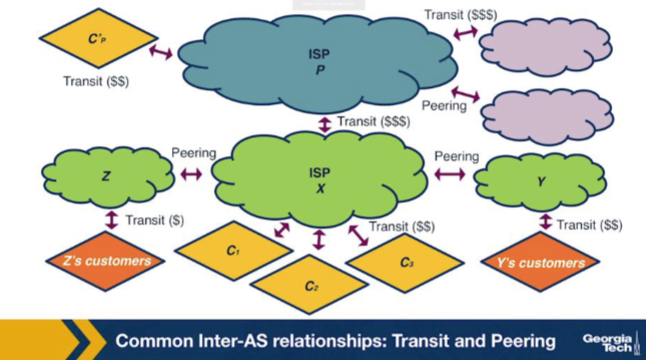
From the import/export policy figure: AS X learns a route to prefix p from one of its CUSTOMERS. To which neighbors will X export p, in the standard Gao–Rexford convention? A. Only to its customers; X does not announce customer routes to peers or providers. B. Only to its providers; customer routes are intended to climb the hierarchy. C. To all neighbors — customers, peers, and providers — to maximize reachability for p across the Internet. D. Only to its peers, never to its customers, since peers reciprocate the announcement.
C. To all neighbors — customers, peers, and providers — to maximize reachability for p across the Internet. Why: Customer routes are exported to EVERYONE. The customer pays for transit, so the provider announces the customer's prefixes everywhere (other customers, peers, providers) to maximize traffic earned for that customer.
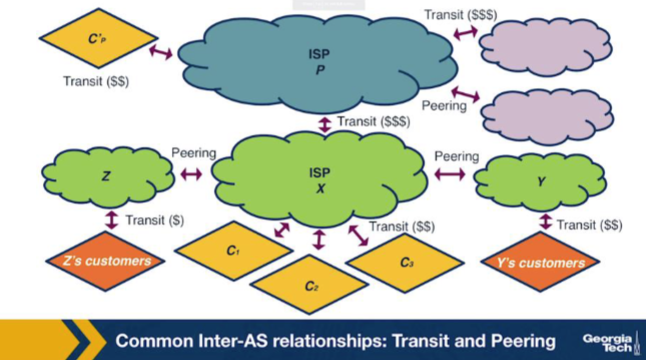
From the same figure: AS X learns a route to prefix p from one of its PROVIDERS. Whom does X announce p to, under standard policy? A. All neighbors of X — providers, peers, and customers alike — to maximize reachability. B. Providers and peers only — never customers, since customers are paying for transit. C. Peers only — peering reciprocity demands re-announcement to peers but not customers. D. Customers only.
D. Customers only. Why: Provider routes are exported only to customers. Re-announcing a provider's route to peers or other providers would cost money to carry that traffic without any incoming revenue — so Gao-Rexford restricts to customer-only.
Why does an AS typically WITHHOLD a route learned from a provider when re-announcing to its peers and other providers? A. Because the AS would carry traffic for other networks while paying its own provider for that traffic, with no incoming revenue to offset it. B. Because BGP forbids re-advertising any route ever learned over eBGP — operators rely on this property when designing their routing policies for global reachability. C. Because peer and provider routers refuse to accept routes longer than 3 AS hops along the path. D. Because MED attributes from providers cannot be re-exported by routing software.
A. Because the AS would carry traffic for other networks while paying its own provider for that traffic, with no incoming revenue to offset it. Why: Re-announcing provider route would cost money without revenue. The AS would be carrying transit traffic for non-customers — paying its own provider to receive it and earning nothing — a clear losing position.
BGP is a path-vector protocol rather than a link-state protocol like OSPF. Which characteristic best explains why path-vector was preferred at AS scale? A. Path-vector protocols converge faster than link-state in every topology, regardless of size. B. Path-vector lets each AS apply its own policy decisions and hide internal topology from other ASes, while still carrying enough information to avoid loops. C. Path-vector consumes less memory than link-state databases by storing only destination addresses, without any path information. D. Path-vector is the only design that supports IPv6 in the wider Internet today across every router participating in the same routing domain at the same moment.
B. Path-vector lets each AS apply its own policy decisions and hide internal topology from other ASes, while still carrying enough information to avoid loops. Why: Path-vector hides topology + supports policy. BGP carries an AS-PATH (loop detection, prefix length, route preference) without revealing internal links; each AS independently applies its own export/import policies.
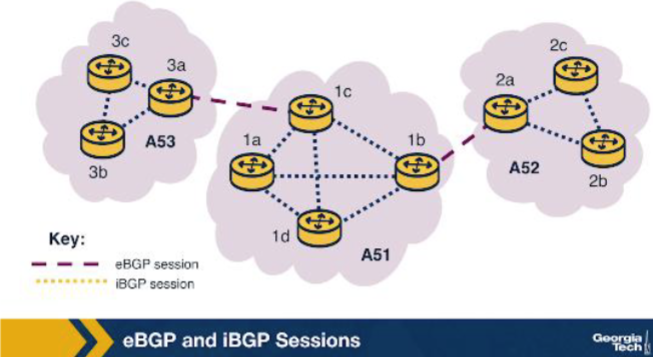
In the BGP-basics figure, the session between border router 3a (in AS3) and border router 1c (in AS1) is best classified as which? A. iBGP, because both endpoints are border routers and BGP between border routers is internal. B. An IGP adjacency such as OSPF; only inside-AS sessions use BGP. C. eBGP, because the two routers belong to different ASes. D. A route-server multilateral session, since they are at different ASes.
C. eBGP, because the two routers belong to different ASes. Why: eBGP = between ASes; iBGP = same AS. Border routers 3a and 1c are in different ASes (3 and 1), so the session between them is external BGP by definition, regardless of router role.
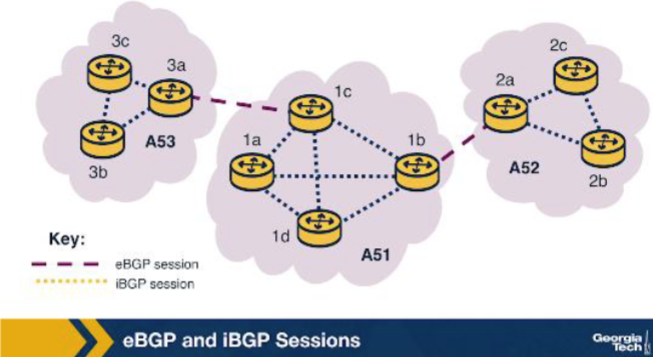
Looking at the figure, an eBGP session between 3a and 1c suddenly goes down. What is the immediate effect on the BGP routes those two routers had been exchanging? A. Nothing; routes persist in the RIB until manually deleted by an operator on each side. B. The IXP automatically takes over the session and continues forwarding announcements on behalf of both sides. C. Only AS1 withdraws routes; AS3 holds onto its learned entries until it receives a new explicit withdraw. D. Both routers withdraw the routes learned from each other and propagate the withdrawal to their iBGP and eBGP neighbors.
D. Both routers withdraw the routes learned from each other and propagate the withdrawal to their iBGP and eBGP neighbors. Why: Both sides withdraw and propagate. When an eBGP session drops, both routers invalidate everything they learned from each other; that triggers iBGP withdrawals internally and eBGP withdrawals to other peers.
A BGP UPDATE message can contain which of the following content categories? A. Both announcements (newly available routes) and withdrawals (no-longer-valid routes) in the same message. B. Only withdrawals; announcements use a different message type, because BGP enforces strict isolation between AS routing tables in the global routing system. C. Only announcements of newly available routes; withdrawals require a separate WITHDRAW message type. D. Neither announcements nor withdrawals; UPDATE messages carry only KEEPALIVE counters between peers.
A. Both announcements (newly available routes) and withdrawals (no-longer-valid routes) in the same message. Why: UPDATE = announcements + withdrawals in one message. A BGP UPDATE encodes both new reachability and routes that should be removed in a single packet — there's no separate WITHDRAW message type.
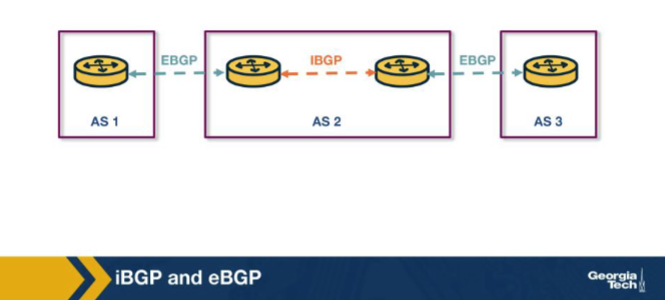
In the iBGP/eBGP figure: border router the left router in AS2 learns a route to prefix p via eBGP from AS1. How does the right internal router in AS2 learn about p? A. It learns p directly over eBGP from AS1's border router. B. It receives p inside AS2 via an iBGP session from the left router. C. It learns p via an IGP such as OSPF that carries external BGP routes alongside internal ones. D. It cannot learn about this prefix at all.
B. It receives p inside AS2 via an iBGP session from the left router. Why: Internal routers learn external prefixes via iBGP. Border router receives p over eBGP from outside; it then redistributes p via iBGP to internal routers so they know how to forward toward that prefix.
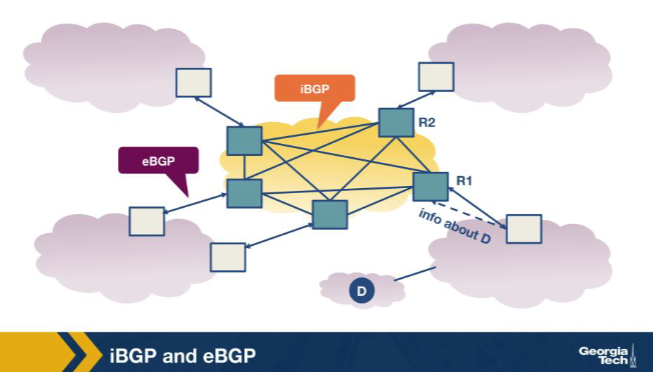
From the iBGP full-mesh figure: an AS currently has 5 BGP-speaking routers connected in a full mesh of iBGP sessions. The operator adds a 6th BGP router. How many NEW iBGP sessions are required? A. 1 new session — just one connection to the nearest existing router suffices. B. No new sessions — iBGP scales automatically because each router gossips to its IGP-discovered neighbors. C. 6 new sessions — one extra for redundancy with each existing router. D. 5 new sessions — one to each of the existing routers, to preserve the full mesh.
D. 5 new sessions — one to each of the existing routers, to preserve the full mesh. Why: n -> n+1 routers => +n new iBGP sessions. Full mesh on n routers has n(n-1)/2 sessions; adding one more requires a session to each of the existing n routers — for n=5, that's 5 new sessions.
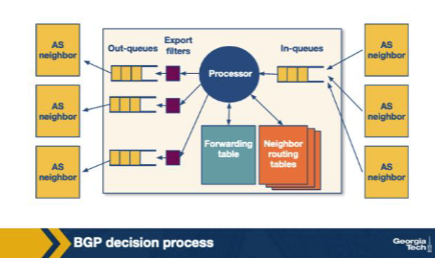
Looking at the BGP decision-pipeline figure, which order describes how an incoming route progresses through a BGP router? A. Export policy → decision process → install in FIB → import policy. B. Import policy → decision process → install in forwarding table → export policy. C. Install in FIB → decision process → import policy → export policy. D. Decision process → import policy → export policy → install in FIB.
B. Import policy → decision process → install in forwarding table → export policy. Why: Import -> decision process -> install in FIB -> export. Incoming routes are first filtered by import policy, then the BGP decision process picks the best path, then it's installed in the forwarding table, and finally export policy decides what to re-advertise.
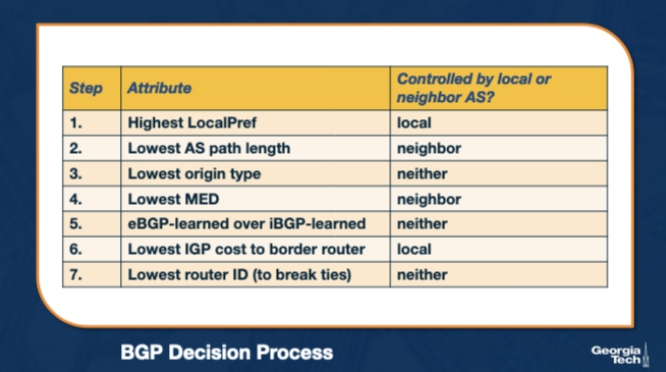
Scenario: AS X learns the same prefix p via three eBGP neighbors. The three routes have LocalPref values 100, 200, 100 respectively. Which route does BGP install, and why? A. Whichever route arrived first in time, since LocalPref is only a tiebreaker for the rare equal-AS-PATH case. B. The route with LocalPref 100 that has the shortest AS-PATH, because LocalPref ties go to AS-PATH. C. The route with LocalPref 200, because BGP's first decision step (after policy) prefers the highest LocalPref value. D. The route with LocalPref 100 from the LEFT-most neighbor, because BGP always prefers the lowest router-ID.
C. The route with LocalPref 200, because BGP's first decision step (after policy) prefers the highest LocalPref value. Why: Highest LocalPref wins (step 1 of decision). LocalPref is the first tie-breaker after import policy: 200 beats 100, and AS-PATH length is only consulted if LocalPref is tied.
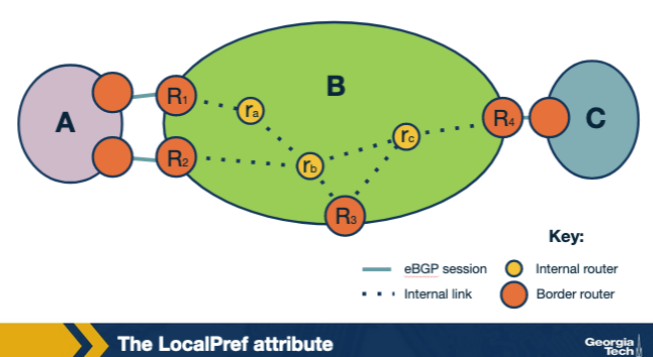
Scenario from the LocalPref figure: AS B learns the same prefix via neighbor A AND via neighbor C. B wants traffic to leave through A. What is the simplest policy knob B configures? A. B advertises a longer AS-PATH out to neighbor C by AS-path prepending its own ASN multiple times. B. B disables its iBGP sessions to internal routers so they all default to using A. C. B lowers the MED it advertises TO A, hoping A will prefer that route in its own decision process. D. B sets a higher LocalPref on the route received from A than on the route received from C.
D. B sets a higher LocalPref on the route received from A than on the route received from C. Why: Higher LocalPref on A's route = prefer A as exit. LocalPref is the standard knob for outbound traffic engineering: set it higher on the route from A and BGP will pick A's route over C's regardless of AS-PATH length.
Scenario from the MED figure: AS B has two parallel links to AS A, through routers R1 and R2. B advertises the same prefix on both links and tags the R1 advertisement with a LOWER MED. Where does A's traffic for that prefix ENTER AS B? A. Through R1, because A's BGP decision process prefers the lower MED among routes equal in earlier steps. B. Through R2, because higher MED is preferred at the receiver side of BGP best-path selection. C. Equally split across R1 and R2, since MED is only a hint and not used for hard routing decisions. D. Through neither; A discards both routes because conflicting MED values are treated as a misconfiguration.
A. Through R1, because A's BGP decision process prefers the lower MED among routes equal in earlier steps. Why: Lower MED at R1 => A enters via R1. MED is compared at the receiver among routes from the SAME AS; lower MED wins, so A's BGP decision process picks R1 as the entry into AS B.
MED is named 'Multi-Exit Discriminator', yet operators use it to influence INBOUND traffic. What does the 'exit' in the name actually refer to? A. The exit interface on a downstream IXP route-server, not on any AS, reflecting how the routing decision flows through a typical commercial-grade BGP daemon at scale. B. The exit point of the receiving AS — i.e., MED helps the neighbor decide which of its own exit links to use when sending traffic toward you. C. The exit code of the BGP daemon when it crashes due to malformed MED values from peers. D. The exit from slow-start mode in the underlying TCP connection that carries the BGP session.
B. The exit point of the receiving AS — i.e., MED helps the neighbor decide which of its own exit links to use when sending traffic toward you. Why: 'Exit' = exit of the RECEIVING AS. MED tells your neighbor which of THEIR exits toward you to prefer — you're influencing inbound traffic by hinting which of your neighbor's egress links should carry it.
BGP includes a tie-breaker preferring 'eBGP-learned over iBGP-learned'. What is the intuition behind preferring eBGP routes when other attributes are equal? A. eBGP routes are signed cryptographically and iBGP routes are not — this is the canonical convention documented in the BGP specification for production routers. B. eBGP routes always have shorter AS-PATH attributes than iBGP routes by construction. C. eBGP routes typically reach the destination through fewer internal hops, sending traffic out of the AS sooner ('hot-potato' routing). D. eBGP routes consume less memory in the RIB than iBGP routes, conserving router resources.
C. eBGP routes typically reach the destination through fewer internal hops, sending traffic out of the AS sooner ('hot-potato' routing). Why: eBGP > iBGP => hot-potato. Among otherwise-equal routes, prefer the one learned via eBGP because that exits the AS sooner, minimizing the carrying cost inside your own network.
In the BGP decision process, LocalPref is evaluated AFTER AS-PATH length. True or False?
False. Why: LocalPref is evaluated FIRST, before AS-PATH. The decision order: LocalPref -> AS-PATH length -> origin -> MED -> eBGP/iBGP -> IGP cost -> router-ID. LocalPref dominates by design so policy beats path length.
BGP convergence after a route withdrawal can take many seconds or longer. What is the primary REASON convergence is slow at this scale? A. BGP UPDATEs are sent over UDP, which often loses messages and triggers retransmission storms. B. BGP uses Spanning Tree Protocol internally, which has long stabilization timers, as is widely deployed across modern Tier-1 networks for predictable inter-domain behaviour. — operators rely on this property when designing their routing policies for global reachability. C. The AS-PATH attribute is cryptographically signed, and verification takes seconds per hop. D. Each affected AS must process the withdrawal, re-run its decision process, possibly explore alternative AS-PATHs, and propagate updates onward — and many ASes do this in series.
D. Each affected AS must process the withdrawal, re-run its decision process, possibly explore alternative AS-PATHs, and propagate updates onward — and many ASes do this in series. Why: Convergence is serial across ASes + alternative path exploration. Each AS must process the withdrawal, potentially try every alternative AS-PATH (path exploration), then propagate onward — so wall-clock time scales with the diameter of the affected portion.
Scenario: a small AS misconfigures its export policy and accidentally re-announces ALL routes from one provider out to another. What is the typical worst-case effect on the wider Internet? A. A route leak in which the misconfigured AS attracts large amounts of transit traffic, overloads its links, and may cause global reachability outages until upstreams filter the leak. B. Nothing visible beyond the misconfiguring AS, since BGP filters prevent route propagation to non-customers automatically by default in modern implementations. C. The misconfigured routes are silently dropped by every other AS because BGP requires cryptographic origin authentication for every announcement. D. The misconfigured AS automatically loses its IP allocation from its RIR within minutes of the leak being detected by RPKI infrastructure across every router participating in the same routing domain at the same moment.
A. A route leak in which the misconfigured AS attracts large amounts of transit traffic, overloads its links, and may cause global reachability outages until upstreams filter the leak. Why: Route leak: AS becomes unintended transit => attracts traffic. When provider-learned routes are re-exported to other providers/peers, traffic floods toward the leaking AS, overloading its links until upstreams filter the bogus announcements.
BGP has built-in cryptographic authentication that prevents any AS from forging the origin of a prefix. True or False?
False. Why: BGP has no built-in origin authentication. Any AS can announce any prefix; preventing forgery requires layering RPKI/BGPsec on top — neither is universally deployed.
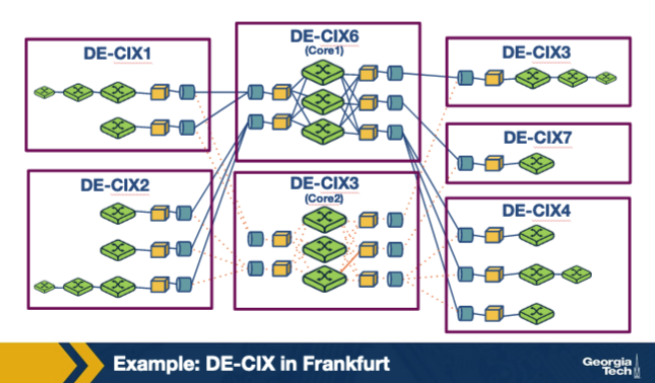
From the IXP figure: an IXP is best described as which of the following? A. A protocol layered on top of BGP that replaces BGP for inter-AS routing. B. A physical (often switched-Ethernet) infrastructure where many networks interconnect to exchange traffic locally rather than via transit. C. A Tier-1 ISP that resells transit to all other tiers, because BGP enforces strict isolation between AS routing tables in the global routing system. D. An authoritative registry that allocates ASNs and IP prefixes to networks.
B. A physical (often switched-Ethernet) infrastructure where many networks interconnect to exchange traffic locally rather than via transit. Why: IXP = shared Layer-2 fabric for many ASes. Physically it's a switch (or set of switches) at one location where many networks plug in and run BGP sessions across that fabric to exchange traffic without using a transit provider.
Scenario: a small ISP joins an IXP that has 100 other members. Without a route server, the ISP must set up how many BGP sessions to peer with all the others? A. 1 session in total, into the shared IXP fabric, which broadcasts routes to everyone. B. Exactly 10 sessions, because IXPs cap bilateral peerings at 10 per member for fairness. C. Up to 100 separate bilateral BGP sessions — one with each member it wants to peer with. D. Zero sessions — the IXP relays all routes automatically without BGP.
C. Up to 100 separate bilateral BGP sessions — one with each member it wants to peer with. Why: 100 peers without route server => up to 100 bilateral sessions. Each pair-wise peering needs its own BGP session; full bilateral peering at a 100-member IXP means up to 100 sessions per member.
Why does IXP-based peering tend to FLATTEN the Internet hierarchy? A. IXPs are forbidden from connecting to Tier-1 networks, so all peering must happen below the top of the hierarchy and the hierarchy collapses. B. IXPs internally use a different routing protocol than BGP, which is incompatible with hierarchical AS relationships. C. IXPs use UDP rather than TCP, which avoids the layering required by Tier-1 ISPs, which the IETF documents as the standard behaviour across all compliant BGP implementations today. — multiple RFCs and BCPs prescribe this behaviour for production inter-domain routing systems. D. Many networks exchange large volumes of traffic directly through the IXP without paying a higher-tier provider to carry that traffic, eroding the strict customer/provider hierarchy.
D. Many networks exchange large volumes of traffic directly through the IXP without paying a higher-tier provider to carry that traffic, eroding the strict customer/provider hierarchy. Why: Direct exchange at IXPs => no upstream needed for that traffic. Networks bypass climbing to Tier-1s for the volumes they exchange at the IXP, eroding the strict customer/provider hierarchy.
Two ISPs of similar size that peer at an IXP typically do so to AVOID paying a common upstream provider for the traffic between them. True or False?
True. Why: Peering at IXP avoids paying upstream for that traffic. Same logic as private peering, just done at shared infrastructure — both ASes save the per-bit transit cost they would otherwise pay providers.
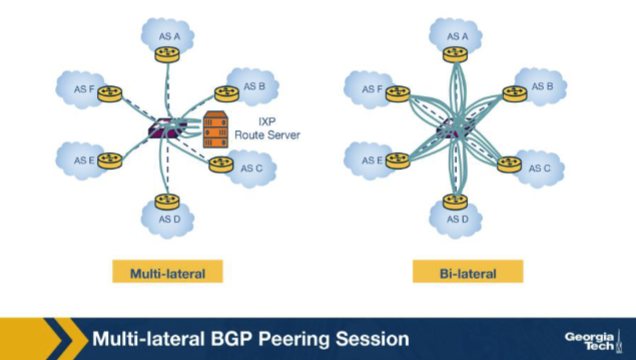
A participant AS uses the route server for MULTILATERAL peering at an IXP. How many BGP sessions does that AS open? A. One BGP session — to the route server itself — which exchanges routes with many other participants on its behalf. B. One BGP session per other participant, just as in bilateral peering, except the sessions are tunneled through the route server. C. Zero sessions; the route server installs forwarding rules directly into each member router via OpenFlow. D. One session per IPv4 prefix the AS announces, for granular policy control.
A. One BGP session — to the route server itself — which exchanges routes with many other participants on its behalf. Why: Route server = ONE session multiplexed to many peers. Instead of N bilateral sessions, a member opens a single BGP session to the route server, which relays routes to/from all other participants per per-pair filters.
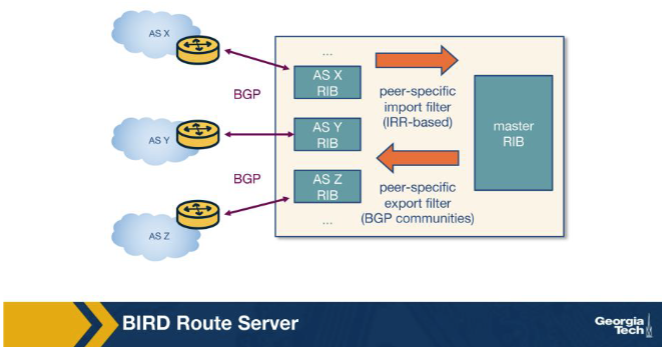
AS X announces prefix p to the route server. Walk through what the route server does next. A. Stores p in its master RIB, applies a single global filter, and re-announces p to every member immediately. B. Stores p in X's per-participant RIB, applies X's import filter, adds it to the master RIB, then for each potential recipient applies X's export filter (does X want Z to see p?) before announcing to Z. C. Drops p because route servers only forward established session traffic, not new advertisements, reflecting how the routing decision flows through a typical commercial-grade BGP daemon at scale. — this is the canonical convention documented in the BGP specification for production routers. D. Installs p as a hardware flow rule in every member's switch via the IXP's SDN controller and bypasses BGP entirely.
B. Stores p in X's per-participant RIB, applies X's import filter, adds it to the master RIB, then for each potential recipient applies X's export filter (does X want Z to see p?) before announcing to Z. Why: RIB-In -> import filter -> master RIB -> per-recipient export filter -> RIB-Out. Each member's announcements are stored separately and per-recipient export filters decide who actually sees what — preserving bilateral policy on top of multilateral session.
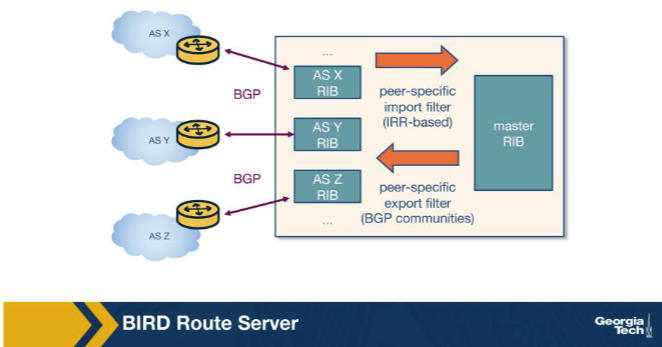
AS X announces prefix p to the route server, but X has configured an export filter blocking AS Z. What does AS Z see? A. Z sees p with the route server as the next hop, since route servers always re-announce regardless of filters. B. Z sees p but with the AS-PATH replaced by 'AS-RouteServer', allowing routing but logging the suppressed origin. C. Z receives nothing for p; the route server respects X's per-recipient export filter and withholds p from Z. D. Z sees p only after manually downloading the IXP's policy table via an out-of-band API.
C. Z receives nothing for p; the route server respects X's per-recipient export filter and withholds p from Z. Why: Export filter respects per-recipient policy => Z gets nothing. Even though the route server has p in its RIB, X's filter blocks announcement to Z; route servers honor each member's policy as if it were direct bilateral peering.
A route server, by design, is 'transparent' in the AS-PATH — i.e., the route server's ASN does NOT appear in any AS-PATH it relays. Why? A. Because route servers run a custom transport protocol that strips the AS-PATH attribute during relay, as is widely deployed across modern Tier-1 networks for predictable inter-domain behaviour. — operators rely on this property when designing their routing policies for global reachability. B. Because route servers operate at Layer 2 and have no Layer-3 visibility into the BGP messages they relay. C. Because IANA has never allocated an ASN to any IXP route server, and BGP requires a real ASN to be inserted. D. Because if the route server's ASN were inserted, every multilateral session would falsely lengthen AS-PATHs by 1, biasing best-path selection against route-server routes — so the route server simply passes through the original AS-path unchanged.
D. Because if the route server's ASN were inserted, every multilateral session would falsely lengthen AS-PATHs by 1, biasing best-path selection against route-server routes — so the route server simply passes through the original AS-path unchanged. Why: Inserting RS ASN would inflate AS-PATH by 1 => bias best-path. Best-path selection prefers shorter AS-PATH; if the RS added itself, multilateral routes would always look longer than bilateral and lose comparisons unfairly.