1.2.3 elasticity of demand
 Call Kai
 Learn
Learn Practice Test
 Spaced Repetition
 Match
Match Flashcards
 Knowt Play
1/18

There's no tags or description
Looks like no tags are added yet.
Name | Mastery | Learn | Test | Matching | Spaced | Call with Kai |
|---|
No analytics yet
Send a link to your students to track their progress
19 Terms
What is elasticity of demand?
Elasticity of demand measures the responsiveness of quantity demanded to changes in price, price of other goods, and real income.
If demand is elastic, quantity demanded responds strongly.
If demand is inelastic, quantity demanded responds weakly.
What is price elasticity of demand (PED)?
PED measures the responsiveness of quantity demanded to a change in the price of a good.
What is the formula for price elasticity of demand?
PED = % change in quantity demanded ÷ % change in price
Interpretation of PED numerical values
PED = 1 → Unitary elastic.
PED > 1 → Relatively elastic.
PED < 1 → Relatively inelastic.
PED = 0 → Perfectly inelastic.
PED = ∞ → Perfectly elastic.
PED values are usually negative so economists look at the absolute value.
What factors influence price elasticity of demand? (NASTI)
N — Necessity: necessities tend to be inelastic.
A — Addictiveness: addictive goods have inelastic demand.
S — Substitutes available: more substitutes make demand more elastic.
T — Time: demand becomes more elastic over time.
I — Income proportion: goods taking a larger share of income tend to be more elastic.
Why is PED important for government when imposing indirect taxes?
PED determines who bears the burden of a tax.
If demand is inelastic, consumers bear most of the tax and price rises significantly with little change in quantity.
If demand is elastic, producers bear more of the tax and quantity falls more.
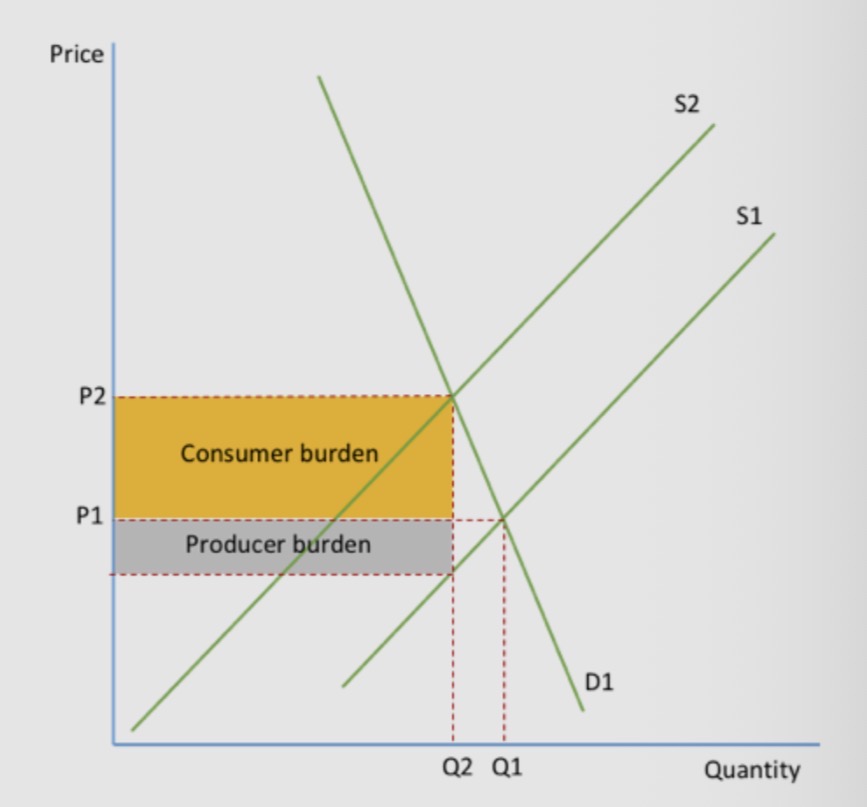
Draw and explain the tax diagram when demand is inelastic
Supply shifts from S1 to S2.
Price increases significantly while quantity falls slightly.
Consumers bear most of the tax burden.
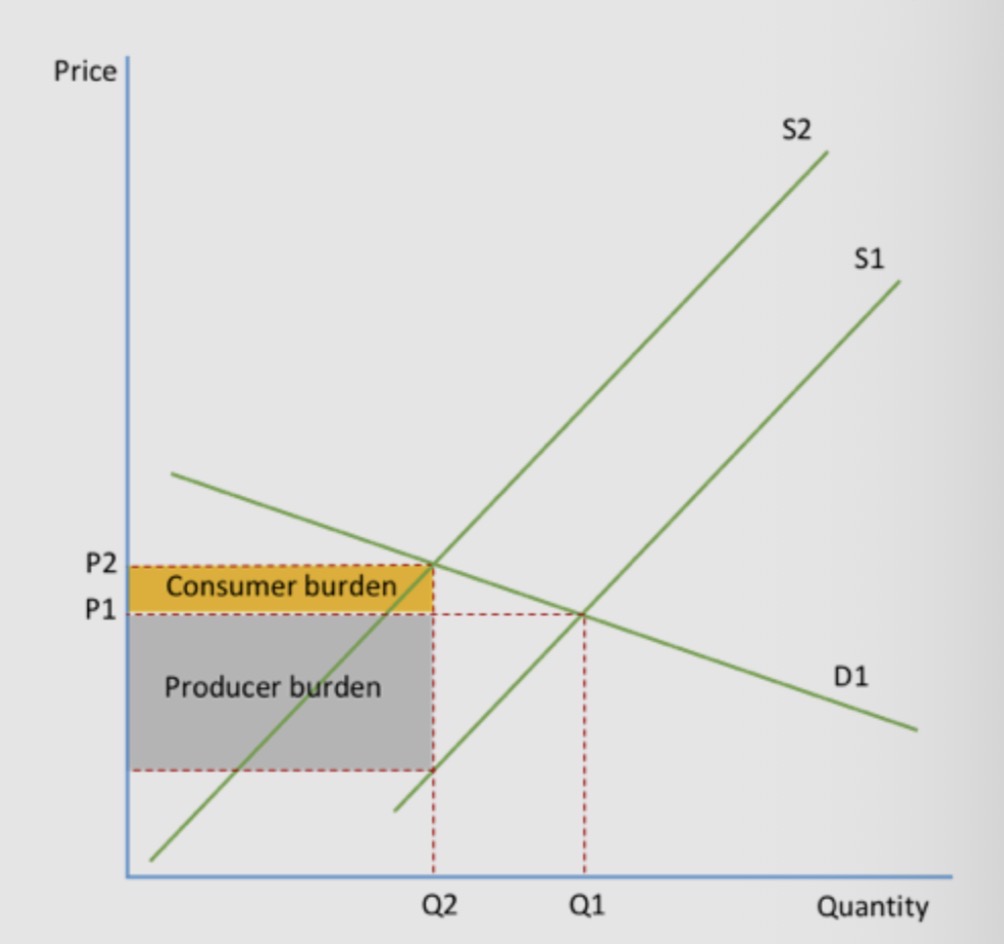
Draw and explain the tax diagram when demand is elastic
Supply shifts from S1 to S2.
Price increases slightly but quantity falls significantly.
Producers bear more of the tax burden.
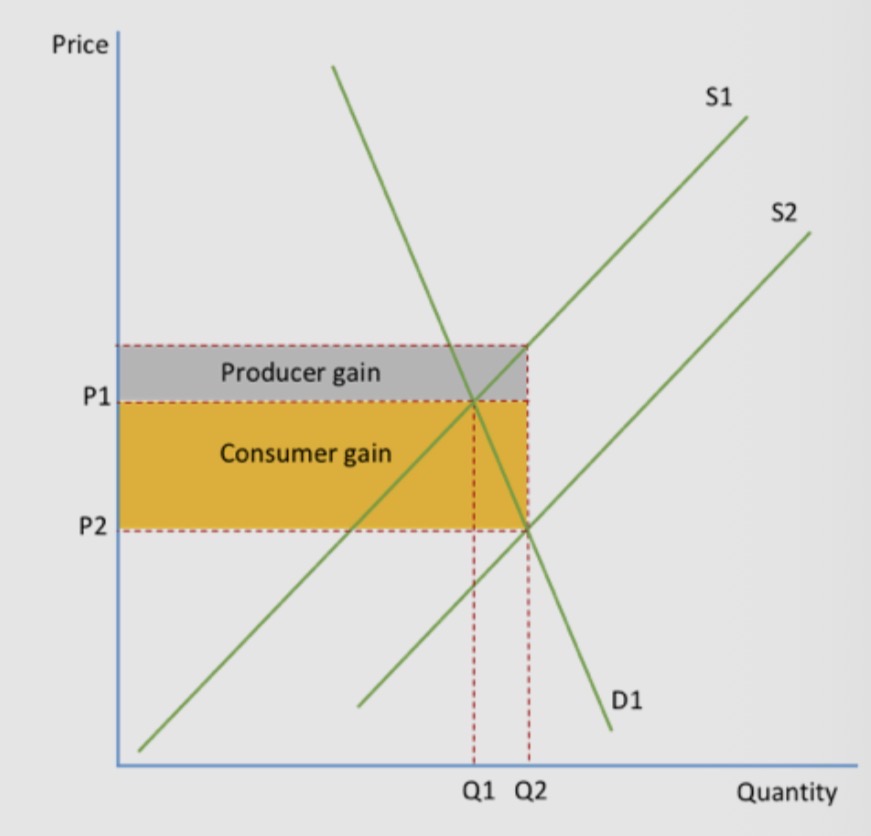
Draw and explain the subsidy diagram when demand is inelastic
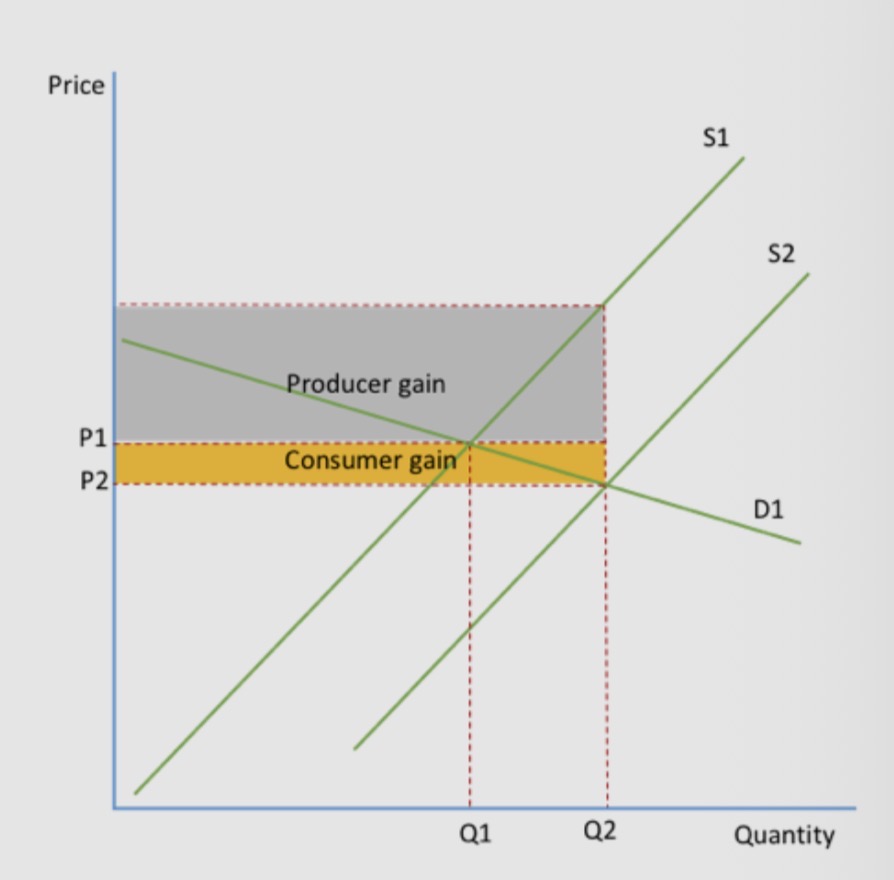
Draw and explain the subsidy diagram when demand is elastic
What is the relationship between PED and total revenue?
Elastic demand (PED>1): price falls → revenue rises, price rises → revenue falls.
Inelastic demand (PED<1): price falls → revenue falls, price rises → revenue rises.
Unitary elastic (PED=1): price change does not change total revenue.
What is income elasticity of demand (YED)?
YED measures the responsiveness of demand to a change in income.
What is the formula for income elasticity of demand?
YED = % change in quantity demanded ÷ % change in income
Interpretation of YED numerical values
YED < 0 → Inferior goods.
0 < YED < 1 → Normal goods.
YED > 1 → Luxury goods. Goods can also be income elastic or income inelastic.
Why is YED important for firms?
Firms use YED to predict how demand will change when consumer incomes change.
For example economic growth increases demand for luxury goods
while recessions may increase demand for inferior goods.
What is cross elasticity of demand (XED)?
XED measures the responsiveness of demand for one product to a change in the price of another product.
What is the formula for cross elasticity of demand?
XED = % change in quantity demanded of good A ÷ % change in price of good B
Interpretation of XED numerical values
XED > 0 → Substitutes.
XED < 0 → Complementary goods.
XED = 0 → Unrelated goods.
The larger the number the stronger the relationship.
Why is XED important for firms?
Firms use XED to understand competition and complementary products and predict how price changes of other goods will affect demand for their product.