Arthrology Limbs
 Call Kai
 Learn
Learn Practice Test
 Spaced Repetition
 Match
Match Flashcards
 Knowt Play
1/75

There's no tags or description
Looks like no tags are added yet.
Name | Mastery | Learn | Test | Matching | Spaced | Call with Kai | Chat |
|---|
No analytics yet
Send a link to your students to track their progress
76 Terms
Arthrology Definition
Study of joints
2 ways that joints are classified according to
Structure and function
3 structural classification of joints
Fibrous
Cartilaginous
Synovial
Fibrous Joints
Composed of fibrous tissue with no joint cavity
Example of Where Fibrous Joints are Found
Joints between skull bones
Cartilaginous Joints
Articulating bones are united by cartilage and no joint cavity present
Synovial Joints
Articular bones are separated by a fluid-filled joint cavity
Example of Synovial Joints
Knees, ankles, wrists, shoulders
3 Functional Classification of Joints
Synarthroses
Amphiarthroses
Diarthroses
Synarthroses
Immovable joints
Amphiarthroses
Slightly movable joints (vertebral bodies and pubic bones)
Example of Amphiarthoses Joints
Vertebral bodies and pubic bones
Diarthroses
Freely movable joints
Example of Diarthroses Joints
Most appendicular joints
Pair Each Joint Structure with Joint Function
Fibrous - Synarthroses
Cartilaginous - Amphiarthroses
Synovial - Diarthroses
Three Types of Fibrous Joints
Sutures
Syndesmoses
Gomphoses
Sutures
Contain dense fibrous connective tissue until adulthood when they ossify (synostoses)
Examples of Sutures
Skull bones (plates)
Syndesmoses
Bones are connected by a filamentous sheet or cord (ligament or interosseous membrane)
Fibers are longer than in sutures but are only slightly more resilient
Movement can range from slight to considerable
Tibiofibular and the radioulnar joint
What connects bones in syndesmoses fibrous joints?
Filamentous sheet or cord (ligament or interosseous membrane)
How do fibers in syndesmoses compare to sutures?
Longer but only slightly more resilient
What is range of movement in syndesmoses fibrous joints?
Slight to considerable movement
What are examples of syndesmoses fibrous joints?
Tibiofibular and the radioulnar joint
Gomphoses
Articulation of tooth with body alveolar surface
Peg in socket
Possess a fibrous connection called the periodontal ligament
What is the articulation of the tooth with the body alveolar surface?
Gomphoses
What fibrous connection is present in gomphoses?
Periodontal ligament
Two Types of Cartilaginous Joints
Synchondroses
Symophyses
Synchondroses
Hyaline cartilage unites bones at a synchondrosis
Cartilage is replaced by bone and becomes synarthrotic
Epiphyseal plate and the costal cartilage of the first rib and the manubrium of the sternum
What type of cartilage is found in synchondroses?
Hyaline cartilage
What does hyaline cartilage do in synchondroses?
Unites bones at a synchondrosis
What happens to cartilage in synchondroses over time?
Cartilage is replaced by bone and becomes synarthrotic
Examples of Synchondroses
Epiphyseal plate
Costal cartilage of the first rib and the manubrium of the sternum
Symphyses
Articular surface of bone covered by hyaline cartilage fused to an intervening pad or plate
Compressible, resilient, and functionally amphiarthrotic
Pubic symphysis and the intervertebral discs
What covers the articular surfaces of bone in symphyses?
Hyaline cartilage
What lies between/fused to the bones in a symphysis?
Intervening pad or plate
What are the mechanical properties of symphyses?
Compressible and resilient
What is the functional classification of symphyses?
Amphiarthrotic (slightly movable)
Examples of Symphyses
Pubic symphysis
Intervertebral discs
All synovial joints are __________. (Function)
Diarthrotic (opposing bones move freely)
Five Distinct Features of the Skeleton (Synovial Joints)
Articular cartilage
Joint cavity
Synovial fluid
Articular capsule
Reinforcing ligaments
What is articular cartilage?
Hyaline type forms a glassy smooth surface over the opposing ends of bones
What is the joint cavity?
Small space between articulating bones in synovial joint filled with synovial fluid
Where does synovial fluid derive from?
Largely derived from blood
What is the consistency of synovial fluid?
Viscous, egg-white consistency
What is the function of synovial fluid?
Leaks out of the cartilage, provides “weeping” lubrication
What are the two parts of the articular capsule?
Fibrous capsule (External)
Synovial membrane (internal)
What is the function of reinforcing ligaments?
Support and strengthen the joint
What are the supportive structures of synovial joints?
Bursae
Bursae Description
Flattened sacs lined with a synovial membrane and contain a thin film of synovial fluid
Bursae Location
Where ligaments, muscles, and tendons overlie and rub against bone
Example of Synovial Joints with Pads of Fibrocartilage Between the Ends of Bones
Menisci of the knee
What is gliding joint motion?
Bones displaced in relation to one another
Examples of Joints with Gliding Motion
Intercarpal
Intervertebral
What is angular joint motion?
Changing the angle between two bones
Flexion vs. Extension (Joint Motion)
Flexion: decreasing joint angle
Extension: increasing joint angle
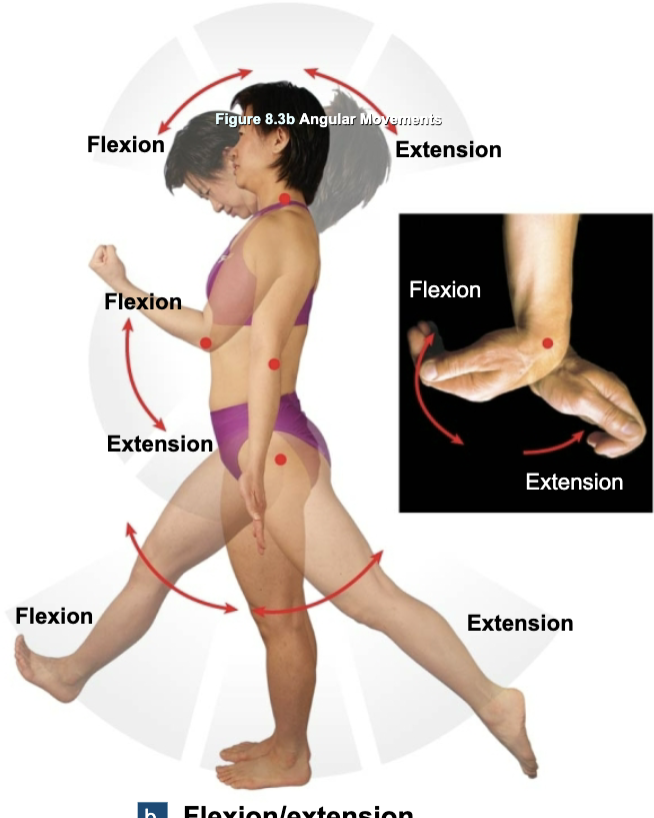
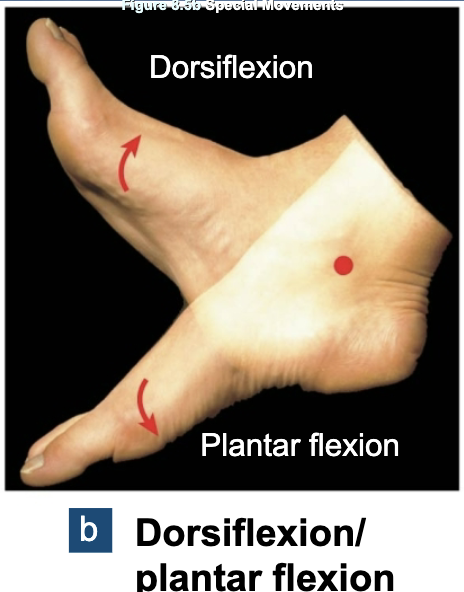
Dorsiflexion vs. Plantar Flexion (Joint Motion)
Dorsiflexion: point toes towards you/up (flexing foot)
Plantar Flexion: point towards away from you/down
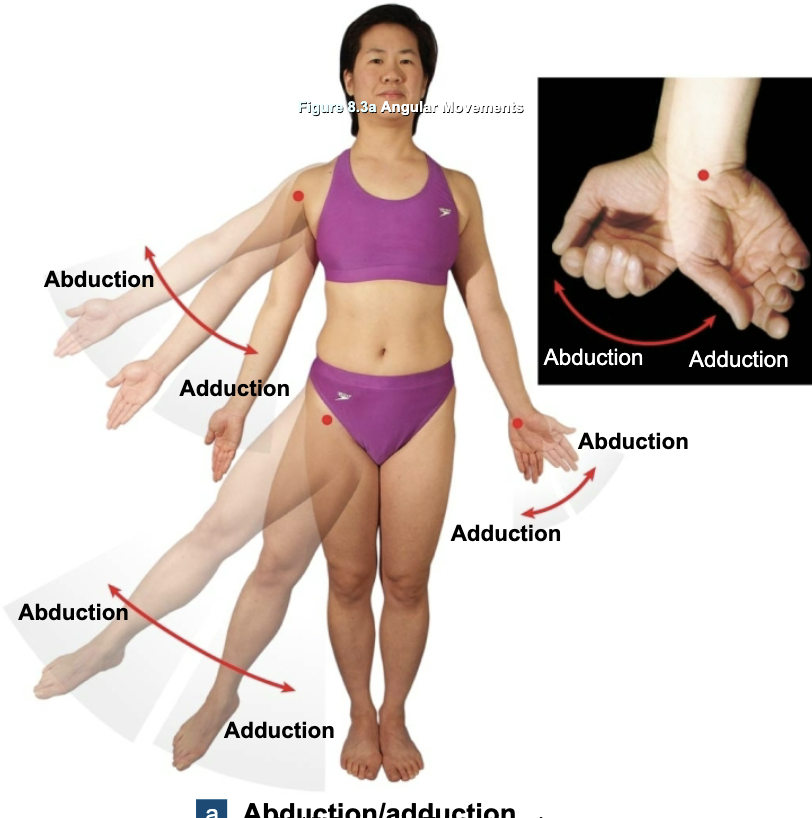
Abduction vs. Adduction (Joint Motion)
Abduction: moving away
Adduction: moving towards
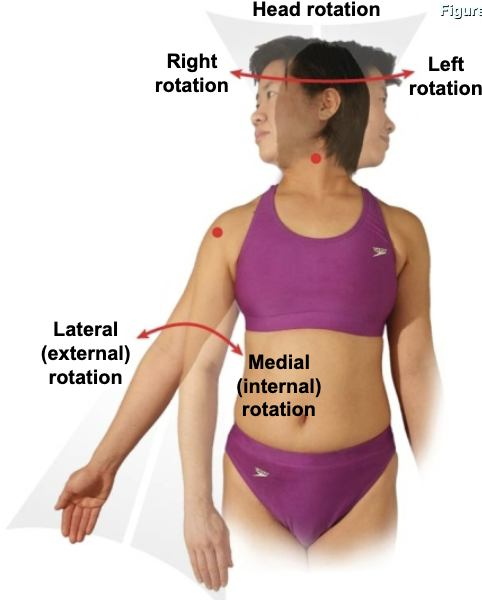
Circumduction vs. Rotation (Joint Motion)
Circumduction: draw around in a circle
Rotation: turning movement of a bone around its own axis (can be medial or lateral)
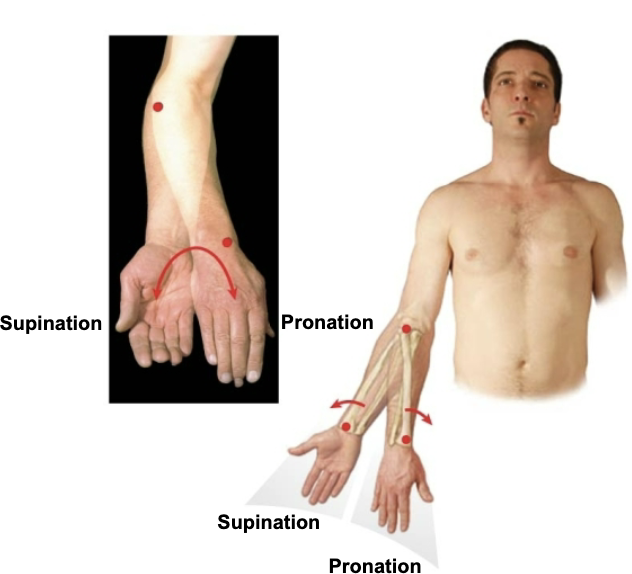
Supination vs. Pronation (Special Movements)
Supination: turning backwards (radius/ulna)
Palms face forward
Pronation: turning forwards (radius ulna)
Palms face backward
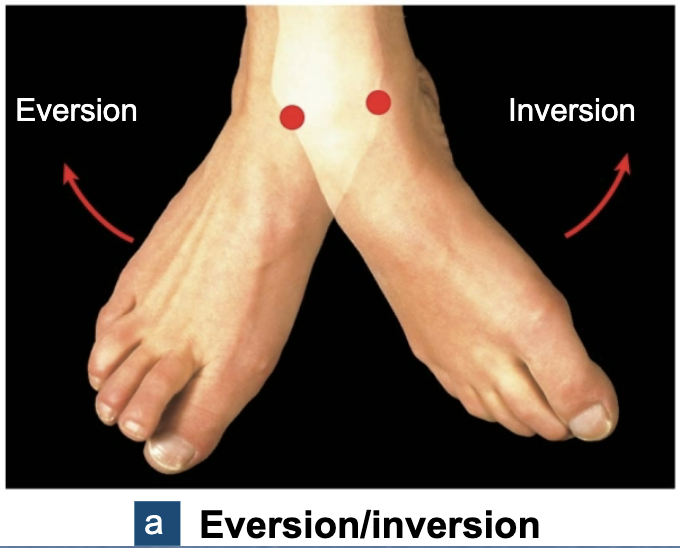
Inversion vs. Eversion (Special Movements)
Inversion: movement of the food medially
Sole facing in
Eversion: movement of the foot laterally
Sole facing out
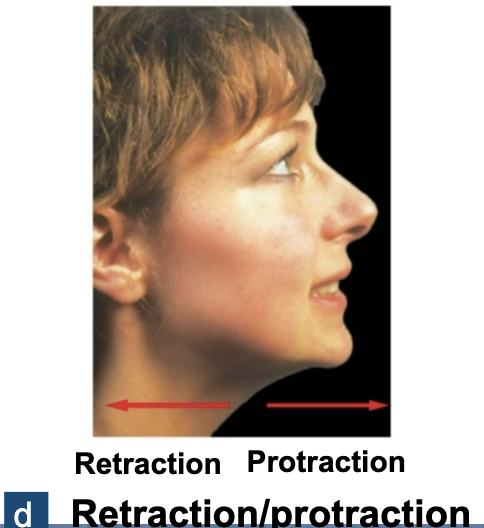
Protraction vs. Retraction (Special Movements)
Protraction: movement of the mandible (jawbone) forward
Retraction: movement of the protracted part back to its starting position
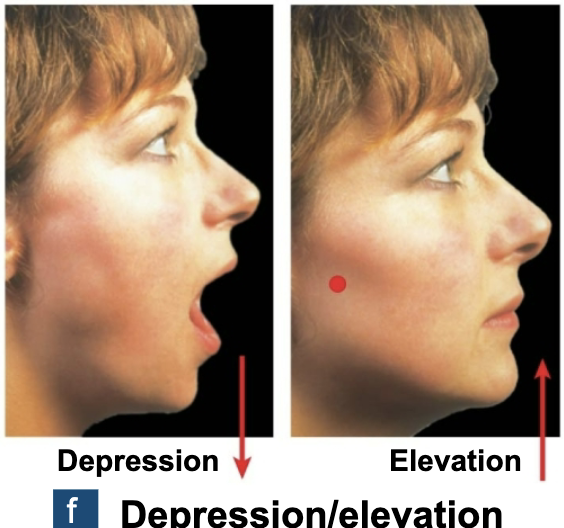
Elevation vs. Depression (Special Movements)
Elevation: lifting a body part superiorly (towards top)
Depression: moving the elevated part inferiorly (towards bottom)
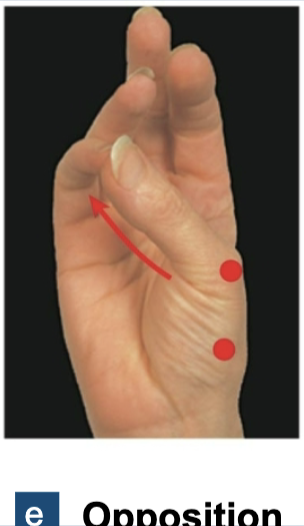
Oppostion (Special Movements)
Touching your thumb to the tips of other fingers
Six Types of Synovial Joints
Plane Joints
Hinge Joints
Pivot Joints
Condyloid Joints
Saddle Joints
Ball and socket
Plane Joints Description
Flat articular surface and only allow for short gliding movements
Example of Plane Joints
Intercarpal Joints
Intertarsal Joints
Hinge Joints Description
Cylindrical projection of one bone fits into a trough-shaped surface on another bone
Example of Hinge Joint
Elbow
Pivot Joint Description
Rounded end of one bone protrudes into a sleeve or ring composed of bone or ligament
Example of Pivot Joints
Radius to ulna
Axis to atlas
Condyloid Joints Description
Oval articular surface of one bone fits into a complementary depression in another
Example of Condyloid Joints
Metacarpophalanges: knuckles
Saddle Joints Description
Each articular surface has a concave and convex area
Example of Saddle Joint
Carpometacarpal joint of the thumb
Ball and Socket Joint
Spherical end of one bone articulates with a cuplike socket of another bone
Example of Ball and Socket Joint
Shoulder or hip joint