Astronomy - Topic 2 - The Lunar disc
 Call Kai
 Learn
Learn Practice Test
 Spaced Repetition
 Match
Match Flashcards
 Knowt Play
1/34

There's no tags or description
Looks like no tags are added yet.
Name | Mastery | Learn | Test | Matching | Spaced | Call with Kai |
|---|
No analytics yet
Send a link to your students to track their progress
35 Terms
What is the shape of the Moon?
An oblate spheroid.
What is an oblate spheroid?
Not a perfect sphere.
Why does the Moon bulge and poles flatten?
Because the Moon spins on its axis.
Why does the Moon always face Earth?
The Moon has a synchronous rotation.
What is a synchronous rotation?
The near side of the Moon always faces Earth, so rotation period equals revolution period.
What is the moon's mean diameter?
3,500 km.
What does the mean diameter help to calculate?
Magnitude calculations, etc.
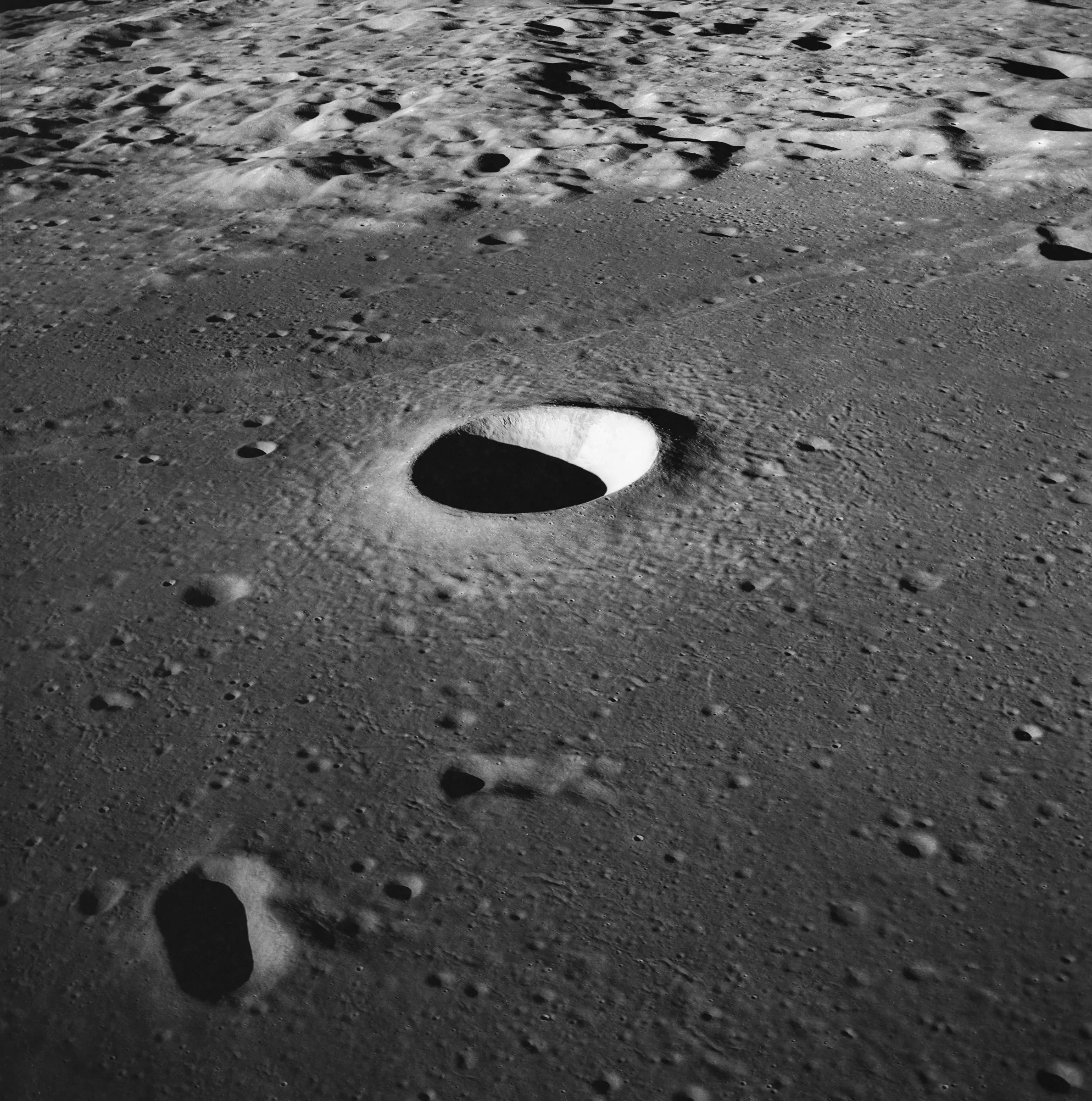
What is the appearance of craters?
.
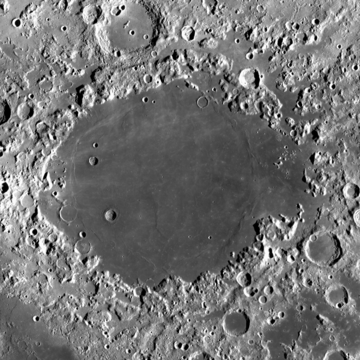
What is the appearance of maria?
.
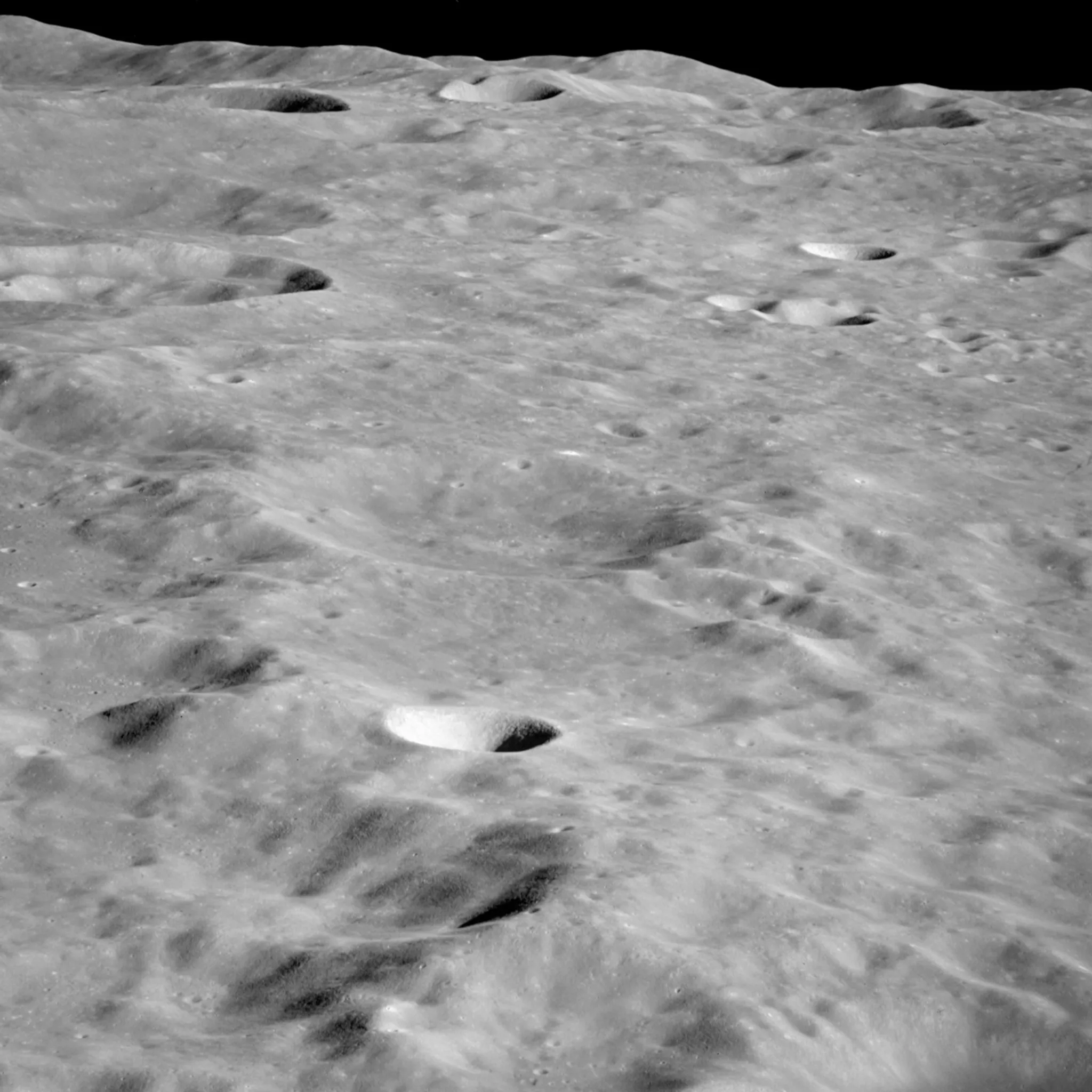
What is the appearance of terrae (highlands)?
.
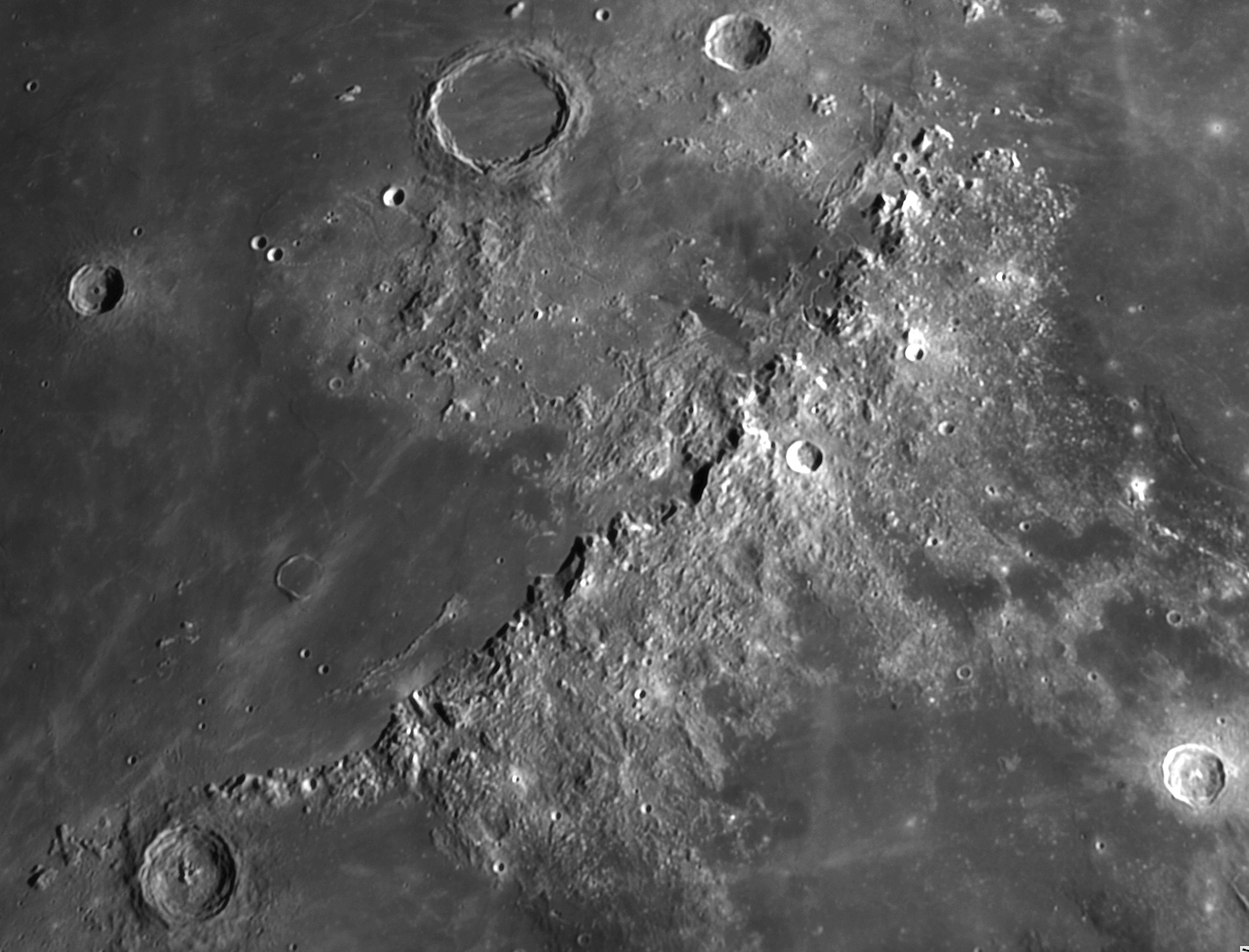
What is the appearance of mountains?
.
What is the appearance of valleys?
.
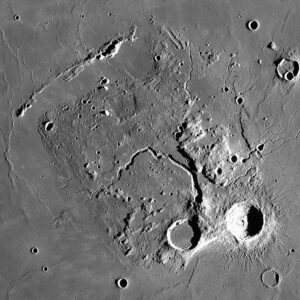
What is the structure and origin of craters?
Formed by asteroid or meteor impacts, producing a crater bowl, raised rim, and sometimes a central peak in large craters.
What is the structure and origin of maria?
Formed when huge impacts create basins, later filled with lava and cooled.
What is the structure and origin of Terrae (highlands)?
The original lunar surface, very old and heavily cratered.
What is the structure and origin of mountains?
Formed mostly from uplifted rims from giant impact basins, not tectonics.
What is the structure and origin of valleys?
Formed by collapsed lava tubes, tectonic faults, and edges of lava seas.
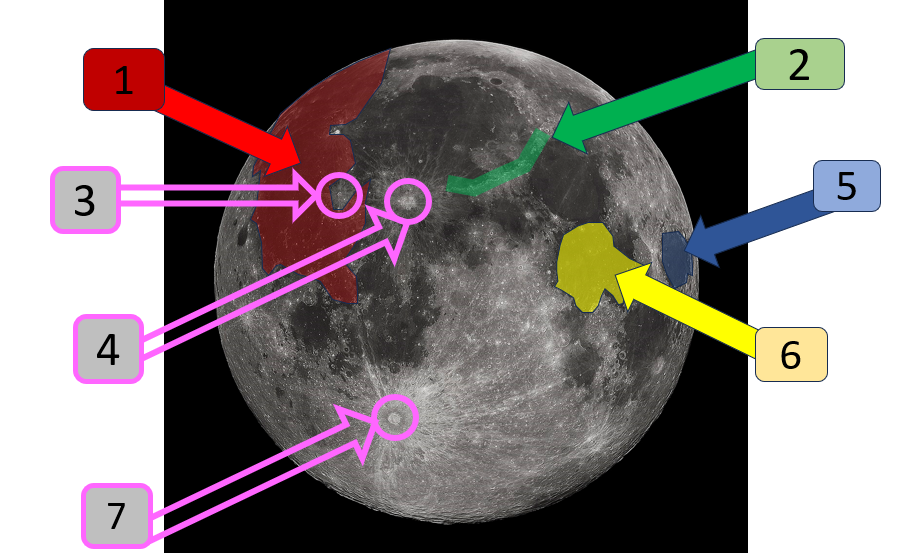
Where is the sea of tranquillity?
6
Where is the sea of crisis?
5
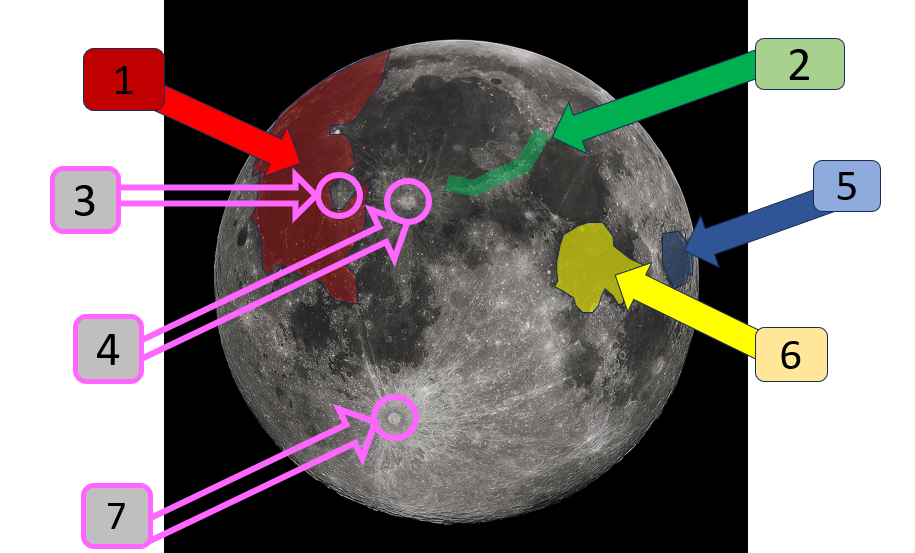
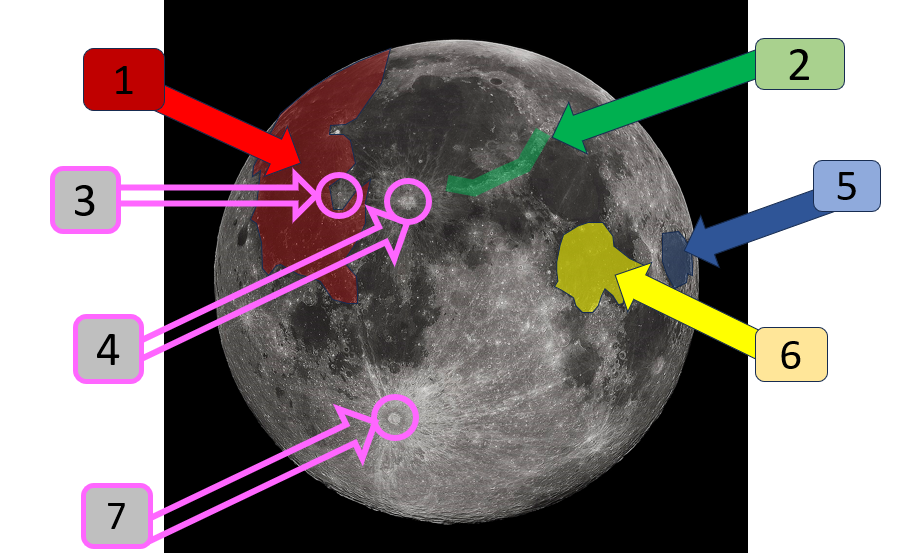
Where is the ocean of storms?
1
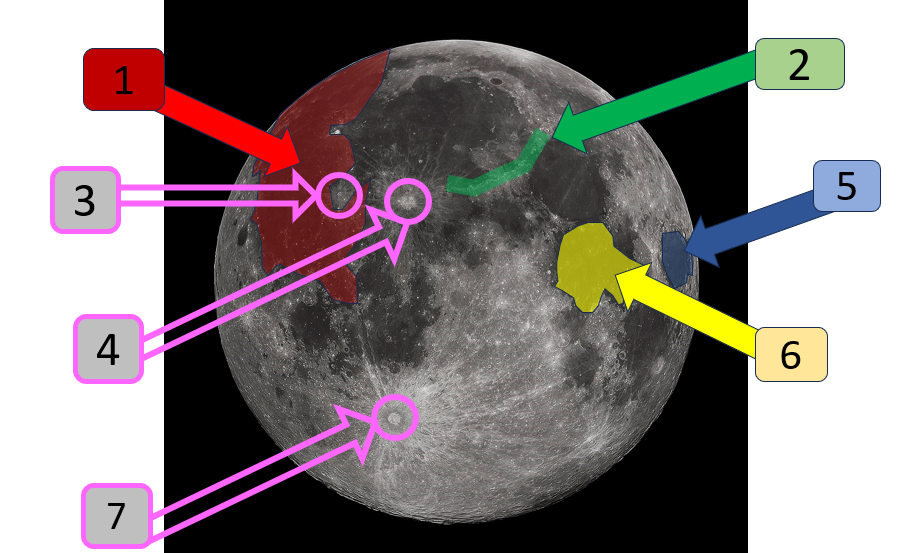
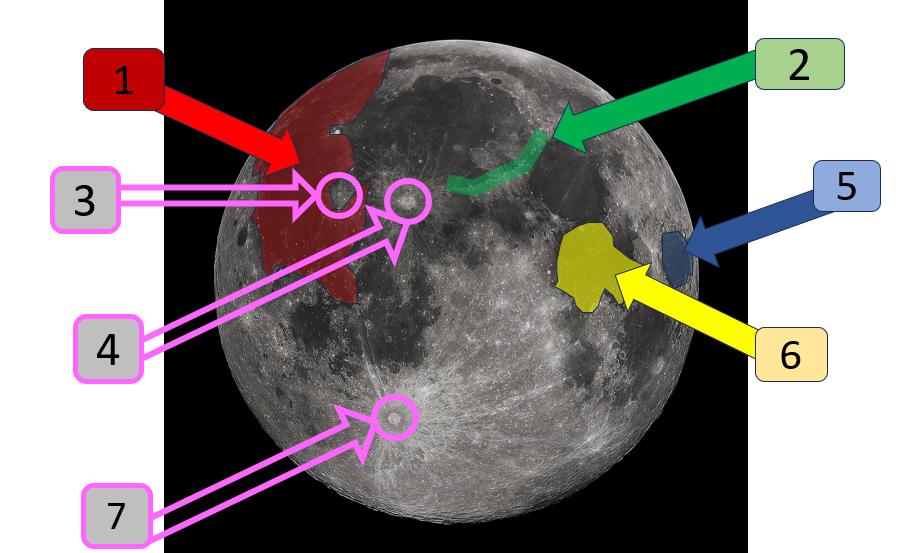
Where is the Tycho crater?
7
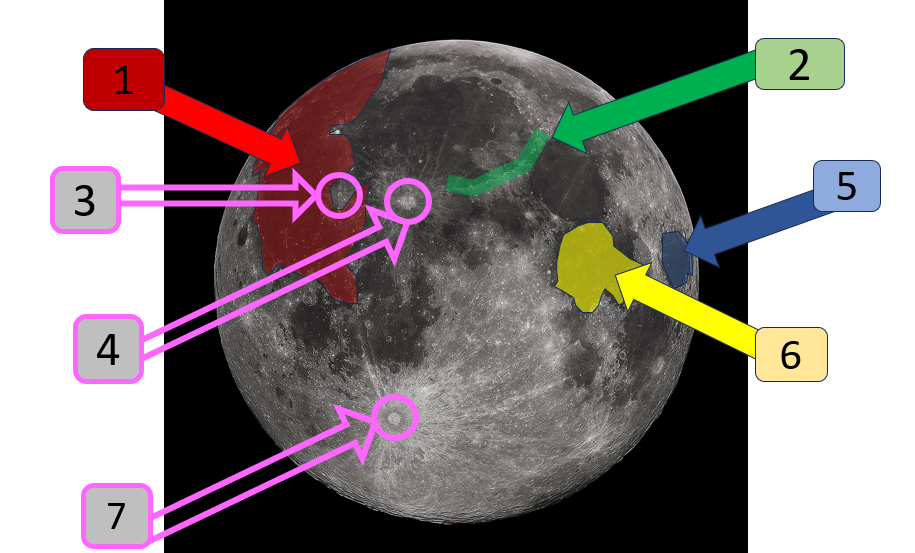
Where is the Copernicus crater?
4
Where is the Kepler crater?
3
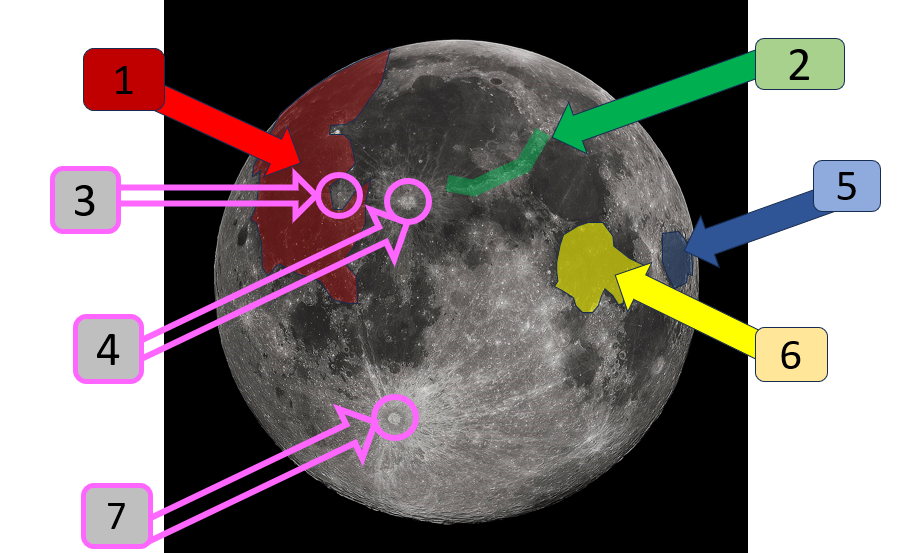
Where is the Apennine mountain range?
2
What is a rotational period?
The time a body (the moon) takes to complete one full axial spin.
What is a revolution period?
The time a body (the moon) takes to complete one full orbital path.
What is the sidereal rotation for the moon?
27 days.
What is the sidereal revolution for the moon?
27 days.
Why are these the same?
Because of synchronous rotation.
What is a synodic month?
29 days (new moon to new moon), caused by Earth's rotation around the sun.
How is synchronous rotation related to rotation and revolution periods?
The moon rotates once on its axis in the same time it revolves once around the Earth, caused by the rotation period being equal to the revolution period (both 27 days).
What is liberation?
The slight 'wobbling' of a body (the moon) that lets us see 59% of the moon.
What is liberation in longitude?
Orbital speed changes, rotation doesn't, causing a side to side wobble.
What is liberation in latitude?
The moon's 6.7 degree tilt causes up and down wobble.
What is diurnal liberation?
Different positions of Earth give an extra view of the moon.