Materials and Nanoparticles
 Call Kai
 Learn
Learn Practice Test
 Spaced Repetition
 Match
Match Flashcards
 Knowt Play
1/119

There's no tags or description
Looks like no tags are added yet.
Name | Mastery | Learn | Test | Matching | Spaced | Call with Kai |
|---|
No analytics yet
Send a link to your students to track their progress
120 Terms
What is materials chemistry?
Explaining why something behaves in a certain way - the relationship between structure and property
Define long range order
When a crystal is highly ordered (crystalline) eg. quartz (SiO2)
Define short range order
When a crystal is not very ordered (amorphous) eg. glass (SiO2)
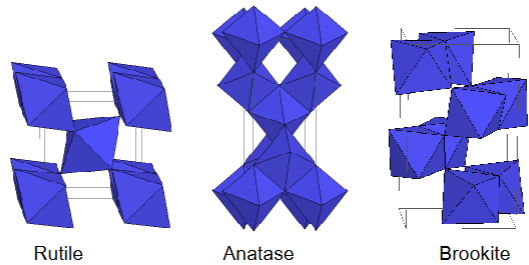
Name the 3 TiO2 polymorphs and explain the difference between them.
Rutile, anatase and brookite.
The difference between them is their structures. They are all TiO2 but layout of octahedra is different.
Therefore they are all stable under slightly different conditions (P,T).
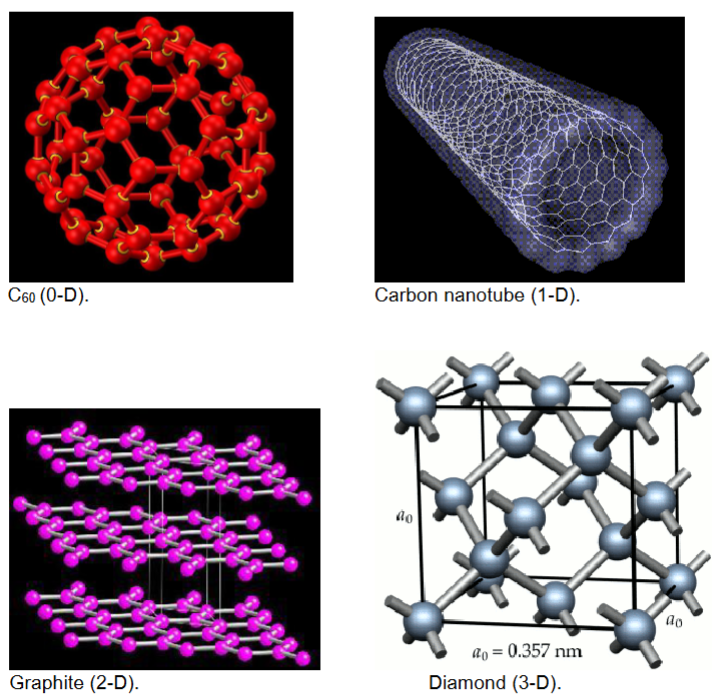
Define dimensionality and describe the dimensionality of these examples:
C60 (Buckminsterfullerene)
Carbon nanotubes
Graphite
Diamond
Dimensionality is an assessment of whether a substance is finite or infinite in each of the 3 dimensions.
C60: 0-D (finite in all dimensions)
Carbon nanotubes: 1-D (infinite in one dimension)
Graphite: 2-D (infinite in 2 dimensions)
Diamond: 3-D (infinite in 3 dimensions)
Broadly describe the arrangement of cations and anions in ionic structures.
Anions are generally much larger so these are closely packed, then the cations fill the interstitial sites (the gaps between). This means that the cations are generally more mobile.
What do the lines indicate in solid structure diagrams such as this:#
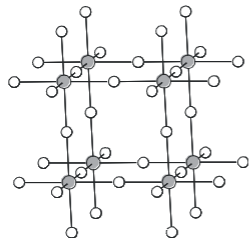
The lines don’t necessarily denote localised bonds.
They often denote coordination (nearest neighbours) in ionic structures.
There may be some covalent structure to these bond but not necessarily.
Using the Gibbs Free Energy Equation, describe why defect form in ionic crystals.
ΔG = ΔH - TΔS
At 0 K, there are no defects and the lattice will be perfectly arranged.
Defect formation is endothermic so at higher temperatures more defects can form.
Above 0 K, the increase in entropy (disorder) caused by defects makes them favourable.
At equilibrium (ΔG = 0), there is a specific number of defects. This is defined by the value of ΔH and the temperature
Explain the trends shown in this graph
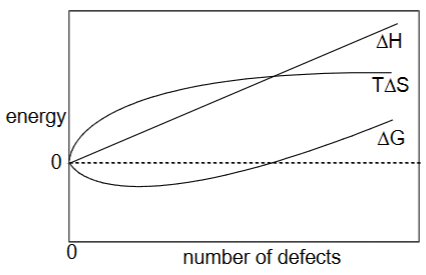
Explain the impact on the graph if T was replaced with T2, which was a higher temperature.
This graph shows the relationship between the enthalpy of formation of a defect and the entropy change due to the defect. At equilibrium, they balance out - gain in entropy balanced by energy requirement of endothermic defect formation.
If T became T2, then the entropy component becomes more significant (ΔG = ΔH - TΔS) and thus more defects are stable at lower temperature as there is a favourable gain of entropy. Therefore, the position of equilibrium moves to a higher number of defects.
Name and describe the 2 types of intrinsic defect in ionic crystals.
Schottky: a pair of vacancies in the lattice. One anion and one cation missing so overall charge is still neutral.
Frenkel: an ion (usually smaller cation) moves into an interstitial site
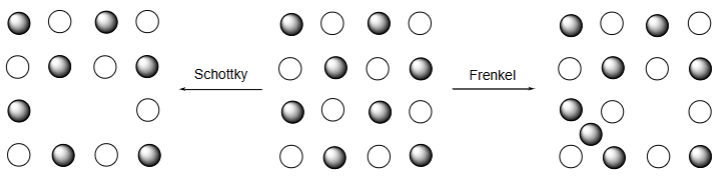
How does a lattice respond to an intrinsic defect, such as those below:
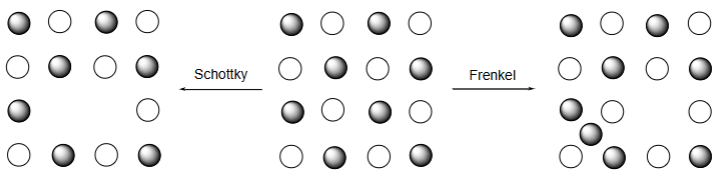
The lattice distorts to minimise the loss of lattice energy.
Give the equation(s) for the number of intrinsic defects in a lattice.
n / N = ?
Shottky:
nS / N = exp(-ΔHS / 2KT)
Where nS is the number of Shottky defects per unit volume and N is the total number of sites (cation and anion) per unit volume. ΔHS is the enthalpy of formation of a Shottky defect.
K is the Boltzmann constant.
(Frenkel is the same but with nF and ΔHF)
What is another name for extrinsic defects?
Describe an example of an extrinsic defect.
Doping
Eg. Adding P to a Si lattice increases the conductivity because the P (grp 15) has an extra electron which can delocalise through the Si (grp 14) lattice.
Draw a diagram to demonstrate how doping with P in a Si lattice increases conductivity of the material.
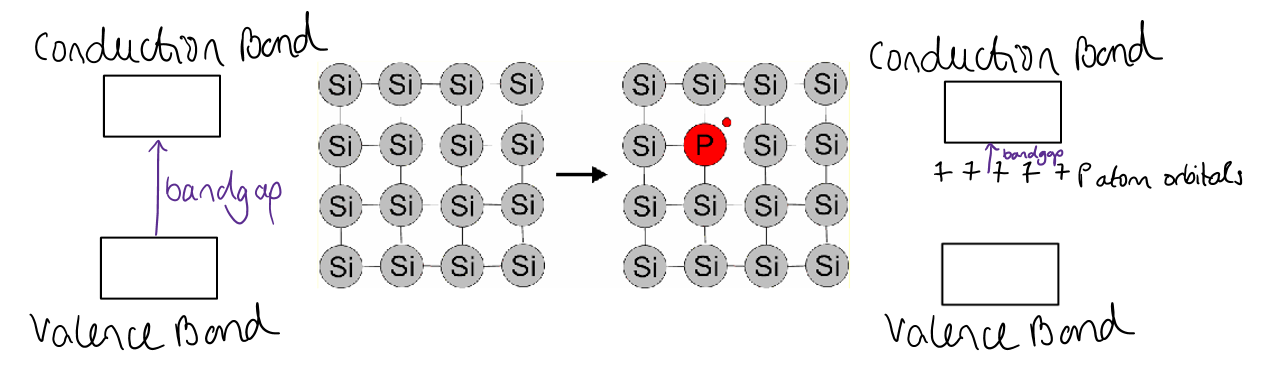
P atom electrons are easily excited into the conduction band.
Explain non-stoichiometric solids.
When do they occur?
Non-stoichiometric solids are when element ratios aren’t integers eg. TiOx: 0.7 < x < 1.25
They occur when there’s defects (intrinsic - Shottky and Frenkel or extrinsic - doping). It is common in transition metals that can occupy multiple oxidation states.
Explain this graph for the non-stoichiometric TiOx (0.7 < x < 1.25)
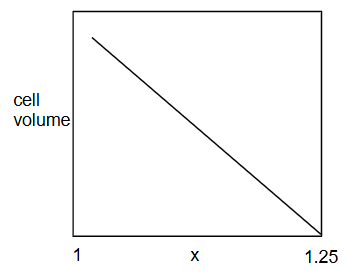
A larger x volume means a larger proportion of O to Ti.
The cell volume gets small in this graph because it isnt the number of O increasing, its a loss of Ti creating vacancies in the lattice.
Explain the meaning of these x values for TiOx
1) x < 1
2) x > 1
3) x = 1
1) There are oxygen vacancies in the structure
2) There are titanium vacancies in the structure
3) There is an equal number of Ti and O vacancies (potentially due to Shottky defects). At 0 K, there are no defects.
If the elemental ratio is TiO1.25, what is the oxidation state of Ti?
Note: oxidation state of Ti in TiO is +2.
+2 × 1.25 = 2.5 (average)
This could mean that the charge is evenly spread over the titaniums and they are all +2.5 each, or that there is an equal amount of Ti(II) and Ti(III).
What is a solid solution?
A crystalline solid with varying composition of elements.
Eg. (Al2-xCrx)O3 where Al and Cr can be of any ratio (0 < x < 2)
What is a substitutional solid solution?
When two elements in a lattice occupy the same sites, but the ratio of each can vary.
Eg. (Al2-xCrx)O3
What is an interstitial solid solution?
When one element can be added in varying quantities, changing the elemental ratio.
Eg. FeCx (0 < x < 0.09) gives steel with different qualities depending on the amount of C added.
Describe the function of graphite (or CoO2) in a lithium ion battery
Lithium ions are stored between the graphite layers during charging (called intercalation). They can then be mobilised again (deintercalation) to carry charge.
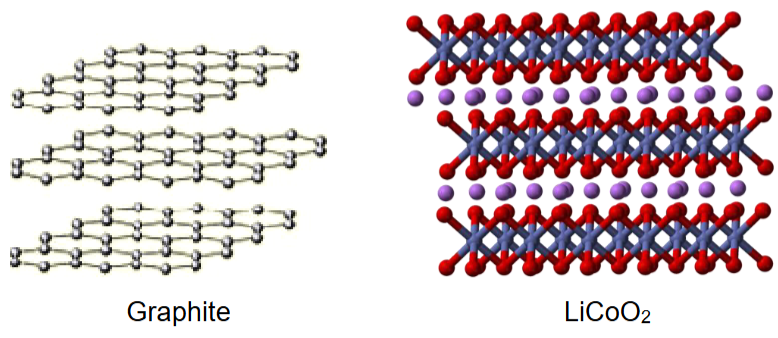
Intercalation: Li+ + e- + graphite (C6) → LiC6
Deintercalation: LiC6 → Li+ + e- + graphite (C6)
Describe the key function of all components in a Li ion battery
All components (electrodes and electrolyte) must be able to facilitate Li+ movement.
What is energy density in terms of batteries and what is the main application?
Energy density: energy per volume (WhL-1)
This is useful for designing smaller batteries.
What is specific energy in terms of batteries and what is the main application?
Specific energy: energy per mass (Whkg-1)
This is useful for designing lighter batteries.
Give the energy output of a battery with an Ecell of 4V (in Whmol-1)
ΔG = -nFEcell
ΔG = -1 × (9.648 × 104) × 4 = -386,000 Jmol-1 = -107.2 Whmol-1
Calculate the theoretical specific energy for a LiC6/CoO2 battery with an energy output of -107.2 Whmol-1
LiC6 = 79 gmol-1
CoO2 = 91 gmol-1
(Theoretical) Specific energy = (-107.2) / (79 + 91) = 0.630 Whg-1 = 630 Whkg-1
What are the limitations to keep in mind when designing a battery?
Intercalation/deintercalation should not cause big structural changes as this causes mechanical stress, fracturing and performance loss
Uncontrolled Li metal growth (dendrites) cause the system to short and electrolytes to ignite. Dendrites grow across the anode/cathode separator hence the shorting.
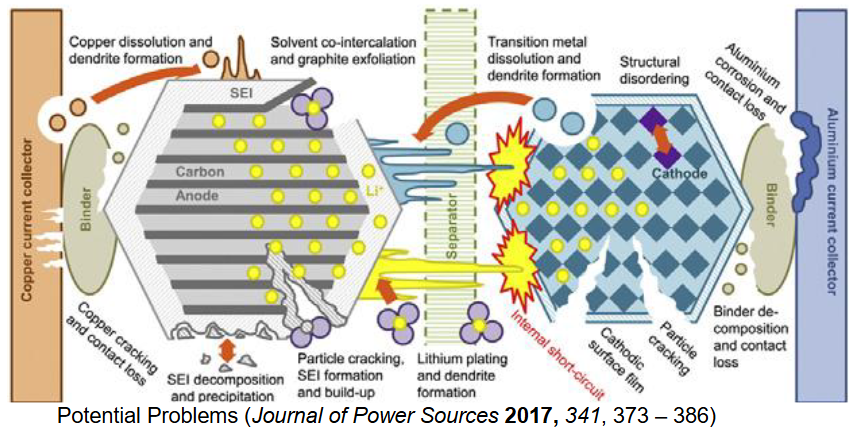
How can degradation and shorting of batteries be prevented?
Solid electrolyte interface (SEI) is a layer around the cathode/anode which prevent it from reacting in contact with the electrolyte, which causes dendrite growth and degradation of the electrodes.
How is it possible to move individual atoms with pm precision?
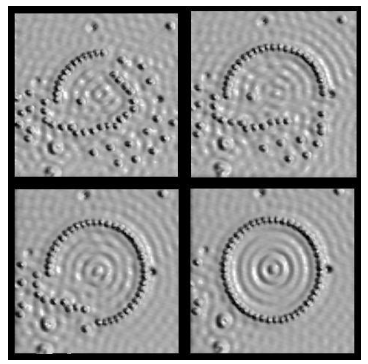
Piezoelectric materials experience a change in electric field under different pressures, or a change in dimensions under different electric fields.
What are the three types of polarisable crystals and what causes their polarisation?
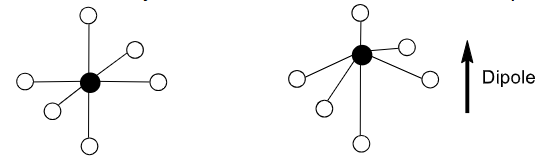
Ferroelectrics: when an electric field causes a change in polarisation (energy is stored as electrical potential)
Piezoelectrics: when a change in pressure causes a change in polarisation (kinetic energy is converted to electrical potential and stored)
Pyroelectrics: when heating (photons) causes a change in polarisation (heat is converted to electrical potential and stored)
Describe a ferroelectric material
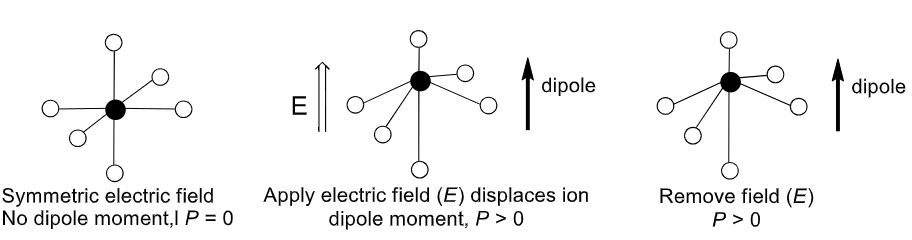
When an applied electric field displaces an ion (cation) to produce a dipole which remains even after the removal of the field.
This stores energy as electrical potential.
This stored energy is measured by its dielectric permitivity in a parallel plate capacitor.
Define dielectric strength
Withstanding high voltages and not becoming electron/ion conducting.
Define dielectric loss
When an alternating electric field causes the loss of electrical energy as heat due to friction of the moving dipole ions.
Define dielectric permittivity
The amount of electrical potential that can be stored by the dipoles in a material, ie. the strength of dipole that can form.
Draw the distortion of BaTiO3 and give the conditions used to cause this movement.
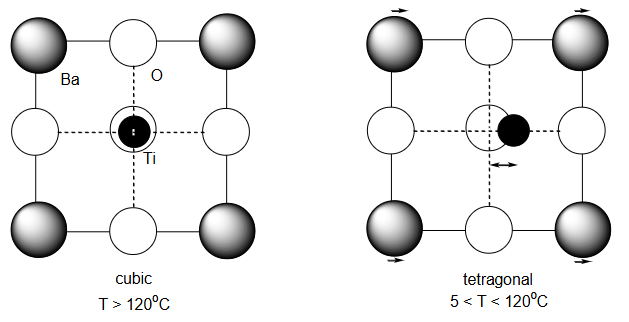
The Ti moves towards one of the O atoms.
BaTiO3 is a ferroelectric material so an electric field causes this polarisation.
Above 120 degrees, the thermal motion (vibration) of the Ti creates enough chemical pressure to retain the ideal perovskite structure (under an electric field).
For a typical ABO3 perovskite structure, what is the mathematical expression for perfect contact?
How is deviation from perfect contact expressed?
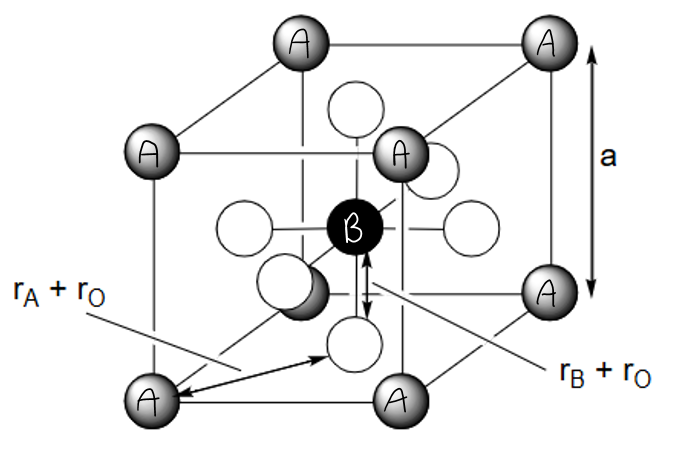
a = 2(rB + rO) = (√2)(rA + rO)
Deviation is expressed by a tolerance factor (t):
t2(rB + rO) = √(2(rA + rO))
No deviation: t = 1
Typical deviation: 0.85 < t < 1.06 (distorted perovskite)
Outside this range forms a non-perovskite structure.
Calculate the tolerance factor for a SrTiO3 perovskite. What does this value mean?
Radii:
Sr2+ = 158 pm
Ti4+ = 74.5 pm
O2- = 126 pm
t2(rB + rO) = (√2)(rA + rO)
A = Sr, B = Ti
t = 1.002
These ions fit almost perfectly together in this structure.
Explain the meaning of these values
SrTiO3: t = 1.002
BaTiO3: t = 1.060
(Sr2+ = 158 pm, Ba2+ = 175 pm)
In a Ba2+ perovskite the Ti is too small to fill the O octahedra so there is some distortion.
Explain what a hysteresis curve shows about a ferroelectric material
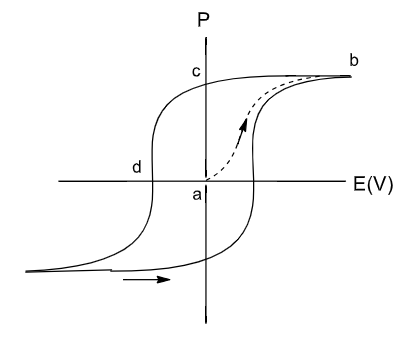
The x-axis is the applied field (E) and the y-axis is the polarisation.
At high field strength, there is maximum polarisation of the material (saturation polarisation).
Removing the field (b → c) leaves a polarisation in the material (remanent polarisation).
To return the polarisation to 0, an opposite direction field of strength d (coercive field) is applied. This is not necessarily as strong as the initial field used to produce the saturation polarisation.
The area within the hysteresis curve is used as a measure of the amount of charge that can be stored by the material.
What are the two characteristics of a piezoelectric?
Under mechanical stress, they polarise (and give electrical charges on opposite crystal faces)
Under an applied field, the crystal expands or contracts
What sort of compounds typically exhibit piezoelectric behaviour?
Materials made up of tetrahedral groups are more likely to distort under stress.
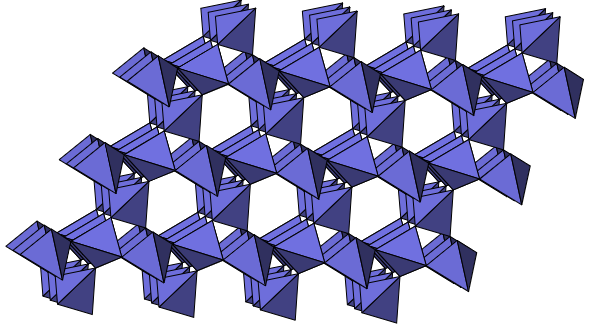
Name some common uses of piezoelectrics
loudspeakers
earphones
inkjet printers
cigarette lighters
timekeeping (quartz in watches vibrates at a set frequency, temperature independently)
What is a pyroelectric?
A material which exhibits a net spontaneous polarisation due to temperature changes.
The amount of polarisation is caused by the amount of thermal expansion/contraction of the lattice.
What makes a pyroelectric different to piezoelectrics and ferroelectrics?
The polarisation cannot be reversed by an electric field because the arrangement is caused by thermodynamics.
What is ZnO an example of?
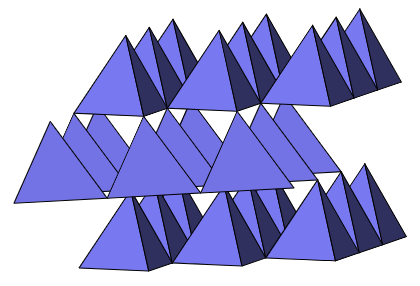
ZnO is a material made up of tetrahedral sites (wurtzite structure). This makes it a pyroelectric material.
Name some common uses of pyroelectrics
night vision and passive IR motion sensors
spectrometers
temperature sensors
What factors explain the strength, direction and magnetic exchange of a magnetic material?
The crystal structure defines the strength and direction of the magnetism, and the mechanism for magnetic exchange depends on the exchange interaction.
Define these terms for a metal ion
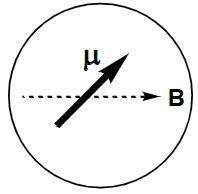
μ is the magnetic dipole of the ion due to its unpaired electrons
B is the magnetic field being experienced by the ion
What is the spin-only formula for an ion’s magnetic dipole?
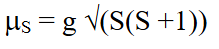
S is the total spin angular momentum (no. of electrons / 2)
g is the g factor (approximation for when L=0) and g ≈ 2
What is the L-inclusive formula for an ion’s magnetic dipole?

S is the total spin angular momentum (no. of electrons / 2)
L is the total orbital angular momentum
Determine S and L for Co2+.
Therefore, calculate μS and μS+L (equations overleaf if needed)

Co2+ is d7.
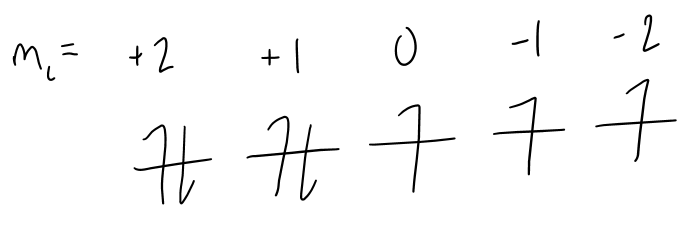
L = (-)1 + (-)2 = 3
S = 5(+1/2) + 2(-1/2) = 3/2
μS = 2 × √3/2(3/2 + 1) = 3.87
μS+L = 5.20
Explain this trend (μeff)
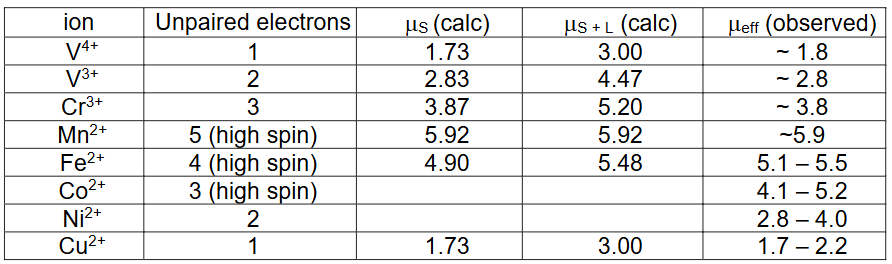
μS is a better approximation for lighter elements because there is less spin-orbit coupling
(S = spin, L = orbital)
Define magnetic susceptibility.
What impacts the magnetic susceptibility?
Magnetic susceptibility (κ) is a measure of how magnetic a material is.
κ varies with temperature and strength of applied magnetic field.
When is paramagnetism observed?
In compounds containing ions with unpaired electrons that do not interact with each other
What does paramagnetism depend on?
Paramagnetism has a very strong temperature dependence.
At high temperatures, the magnetic moments of the ions face in random directions.
At lower temperatures (or very strong applied field), the magnetic moments align to the lowest energy configuration.

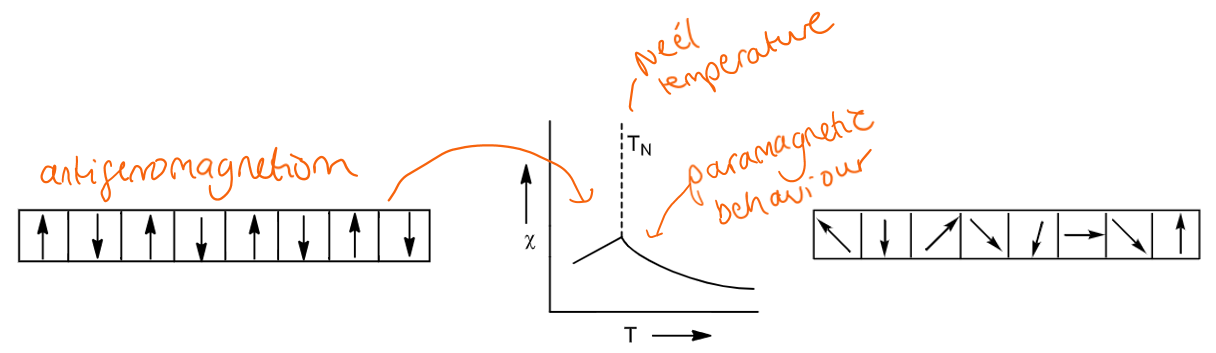
Define antiferromagnetism.
Antiferromagnetism is when ion magnetic moments align themselves antiparallel without the need for applied magnetic field.
However, above a certain temperature (TN - Neel temperature) they act as paramagnets and orientate randomly.
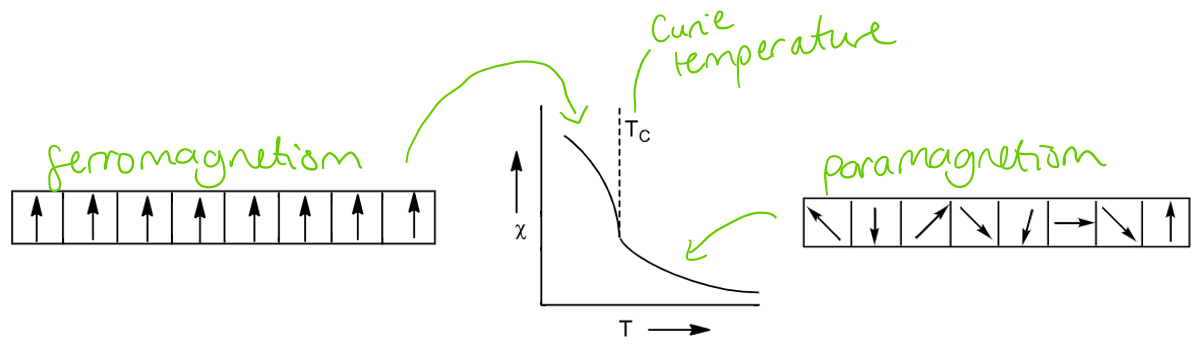
Define ferromagnetism
When magnetic moments of ions align themselves as parallel with no applied field.
At a certain temperature (TC - Curie temperature), they stop acting in this way and orientate randomly (paramagnetically).
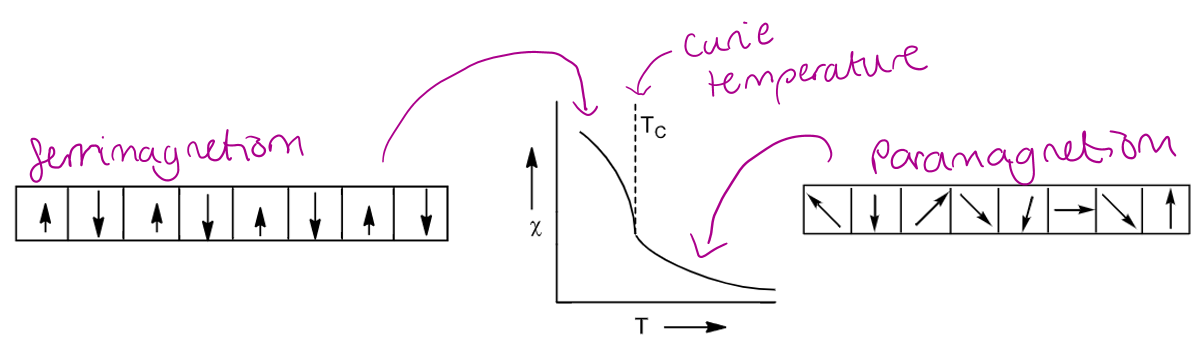
Define ferrimagnetism
When magnetic moments of ions align themselves as mostly parallel without an applied field, with some partial cancellation from opposite moments. Sort of between antiferro- and ferro- magnetic.
At a certain temperature (TC - Curie temperature), they stop acting in this way and orientate randomly (paramagnetically).
What sorts of materials exhibit ferromagnetism?

Magnetic metals like Fe, Co, Ni, Gd, Tb
Define superexchange
When the anions mediate the exchange of magnetism between metal ions.
The anion p-orbitals overlap with the metal d-orbitals in the lattice.
Instead of interacting directly (direct exchange), the magnetic moments "communicate" through the anion orbitals.
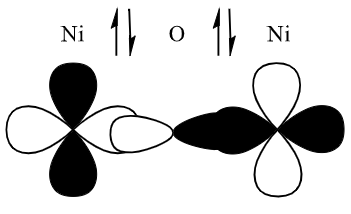
(In this example, the Ni electrons are antiferromagnetic)
Describe how superexchange can lead to antiferromagnetism.
NiO or MnO are examples of this.
Ni2+ = d8
One of the eg electrons aligns with one of the O p electrons.
The other O p electron aligns with the next Ni2+ ’s eg electron to give antiferromagnetism.
What happens to this antiferromagnetic superexchange effect in NiO or MnO-like structures beyond TN?
Above TN, the systems becomes paramagnetic (electrons don’t align) because the thermal energy exceeds the superexchange interaction.
Why are ferrimagnets important to industry?
They have similar properties to ferromagnets but are electrically insulating.
Describe generally what a spinel is.
A spinel is a a crystal structure containing two different metal sites, either different metal ions or ions of the same metal with different oxidation states.
The general structure is AB2X4, such as MgAl2O4.
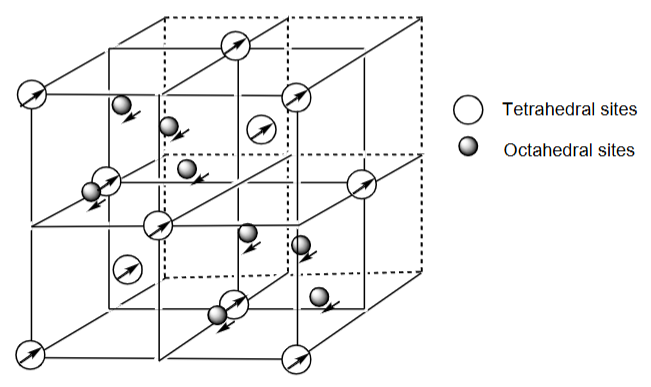
The anion (X) forms a cubic close packed array and then the metals sit in tetrahedral or octahedral sites around this:
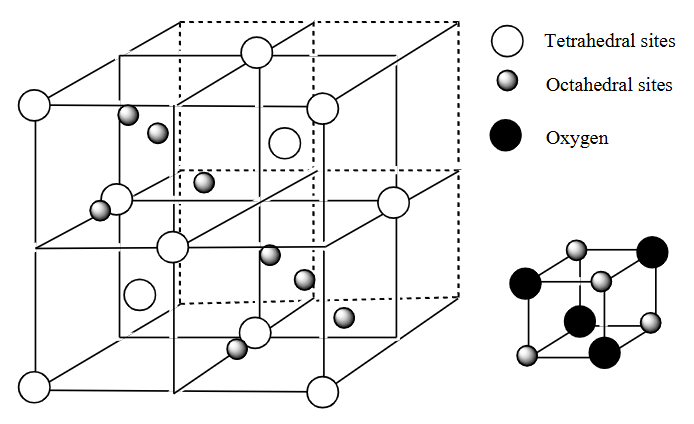
1/8 of the available tetrahedral sites and ½ of the octahedral sites are occupied by ions.
How can you identify a (normal) spinel?
The M2+ ions occupy tetrahedral sites.
This means that they have lower ΔO values than the other metal ions in the system.
How can you identify an inverse spinel?
The M2+ ions occupy octahedral sites.
This means that they have larger ΔO values than the other metal ions in the system.
Determine whether NiGa2O4 is a normal or inverse spinel.
NiGa2O4 gives Ni2+ and Ga3+
Ni2+ → d8 → CFSE = 6(-0.4) + 2(0.6) = -1.2 ΔO
Ga3+ → d10 → CFSE = 0 ΔO
The 2+ metal ion has a higher preference for the octahedral sites so this is an inverse spinel.
There is also some size preference as the Ga3+ is smaller than Ni2+ and therefore better occupies the smaller tetrahedral site.
Inverse.
Determine whether BaFe2O4 is a normal or inverse spinel.
BaFe2O4 gives Ba2+ and Fe3+
Ba2+ → d0 → CFSE = 0 ΔO
Fe3+ → d5 → CFSE = 3(-0.4) + 2(0.6) = 0 ΔO
No preference for either metal to octrahedral sites.
Therefore, 3+ ion occupies the octahedral site due to this allowing more coordination to anions (more electrostatic stabilisation of higher charge).
There is also an element of size preference. The smaller Ba ion prefers the smaller tetrahedral sites.
Describe how we can roughly estimate the magnetic moment of a ferrimagnet.
Using μ = gS (as a rough approximation for μ = g√S(S+1) ). Remember S is number of unpaired electrons (1/2 per electron) and g ≈ 2
Coupling between Oh and Td sites is strong and causes antiferromagnetic mangetic spins:
μion = gS
μtotal = gSoct - gStet
If Fe has a TC of 1043 K, why isnt all iron magnetic at room temperature? How can we make it magnetic?
Within an iron material, there are many domains. Domains are regions of aligned magnetic moments. Different domains acting in different directions cancels out the overall magnetism.
We can make the domains align by applying an external magnetic field (H) to achieve saturation magnetisation.

Explain what a hysterisis curve shows for a magnetic material
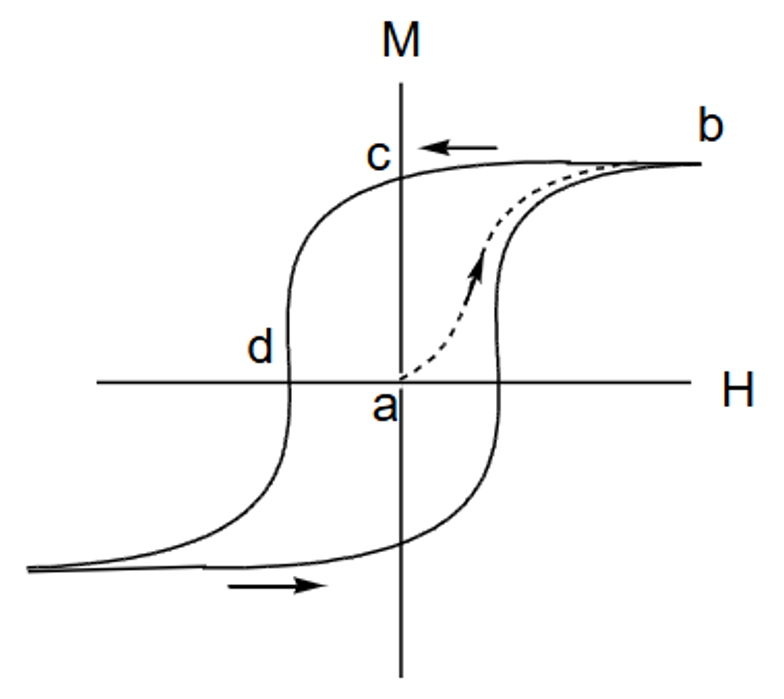
a is a net zero magnetisation due to domains being randomly aligned.
Application of an external magnetic field (H) causes domains to align into saturation magnetisation (M).
Removing the external field leaves the material with high magnetisation (c), this is called remanent magnetisation.
To return the magnetisation to zero, an external field of opposite direction must be applied, this is called the coercive field.
Explain the difference between these two hysterisis curves for two magnetic materials and give the applications of each.
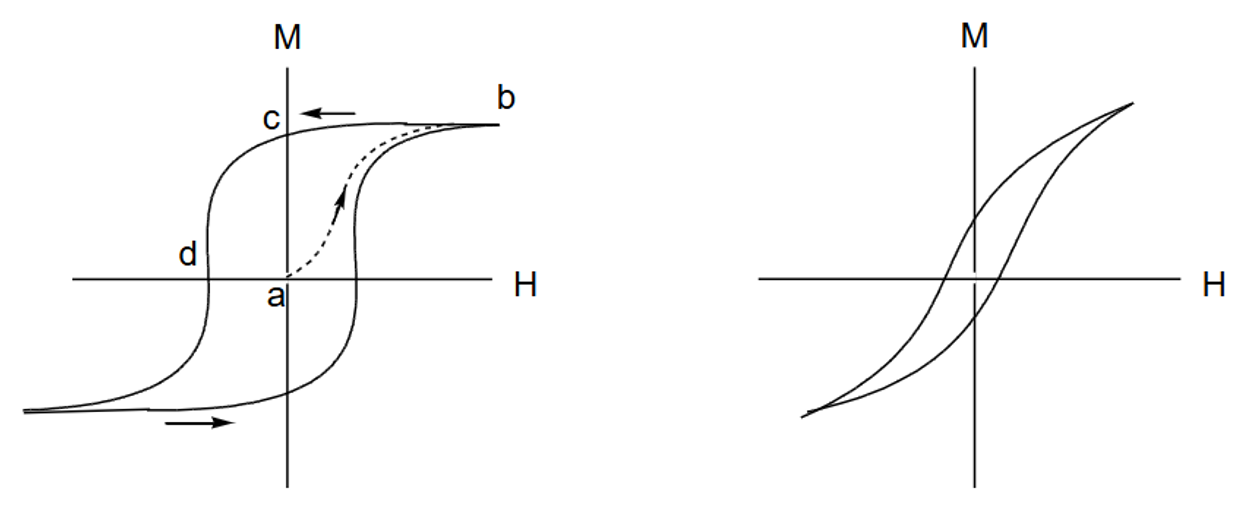
The left is a plot for a hard magnet. It remains magnetic once the external field is removed. These are useful for magnetic memory.
The right is a plot for a soft magnet. These can conduct magnetism (without losses). These are useful in power transformers.
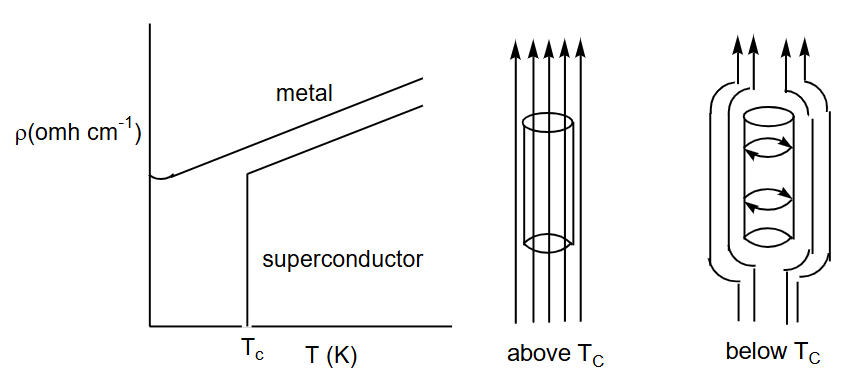
What are the two key properties of a superconductor?
Zero electrical resistance (below TC) (left)
The Meissner effect (below TC) - external magnetic fields are expelled from within the material (right)
What is the benefit of superconductors not having electrical resistance below TC?
A very large current can be run through them, allowing for large magnetic fields to be generated. This is used in NMR and MRI machines.
What is the limitation of using superconductors below TC for their non-resistive electrical conduction?
TC is generally around 25 K, and to use them at room temperature this needs to be around 300 K.
Describe the steps in this process and the overall reasoning for doing this synthesis.
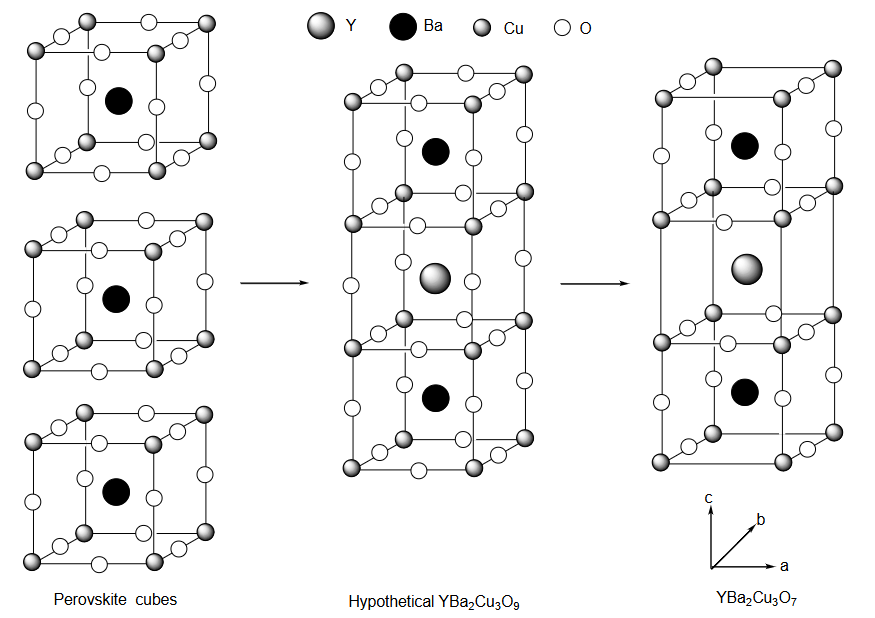
The first step fused the cubes together.
The second step is the removal of oxygen. This gives two distinct Cu environments.
The product is a cuprate which can be superconducting with a fairly high TC (93 K).
Given that the bottom left Cu is the origin (0,0,0), give the positions of two distinct Cu environments.
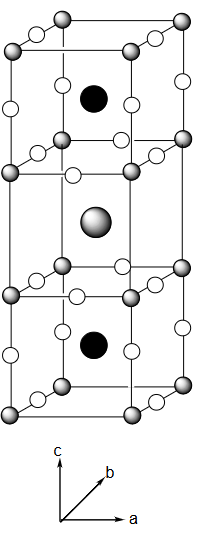
Cu at (1,1,0) is vertically square planar with 4 surrounding oxygens.
Cu at (1,1,1) is horizontally square planar with 4 surrounding oxygens.
Given that the bottom left Cu is the origin (0,0,0), give the positions of the oxygens removed in this step of cuprate formation.
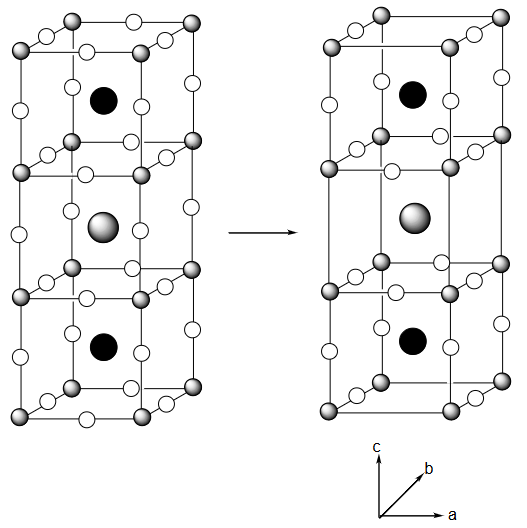
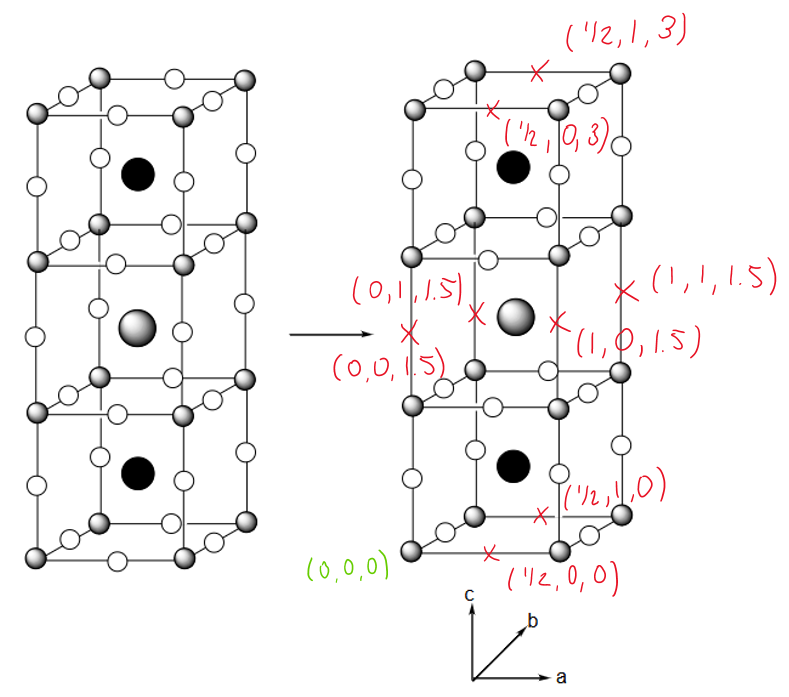
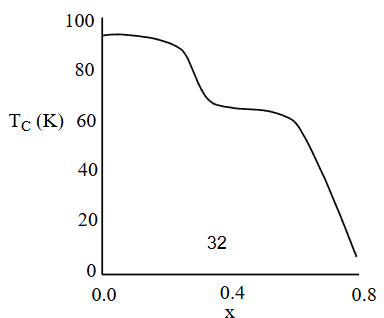
How does TC vary in YBa2Cu3O7-x?
TC varies with oxygen content.
For O6-6.5, the copper is in Cu2+ / Cu+ states so its antiferromagnetic and not superconducting because TC is very low (< 20 K).
For O6.5-7, the copper is in Cu3+ / Cu2+ states and with higher oxygen content TC approaches 100 K so it can be superconducting.
Describe how the features of this structure
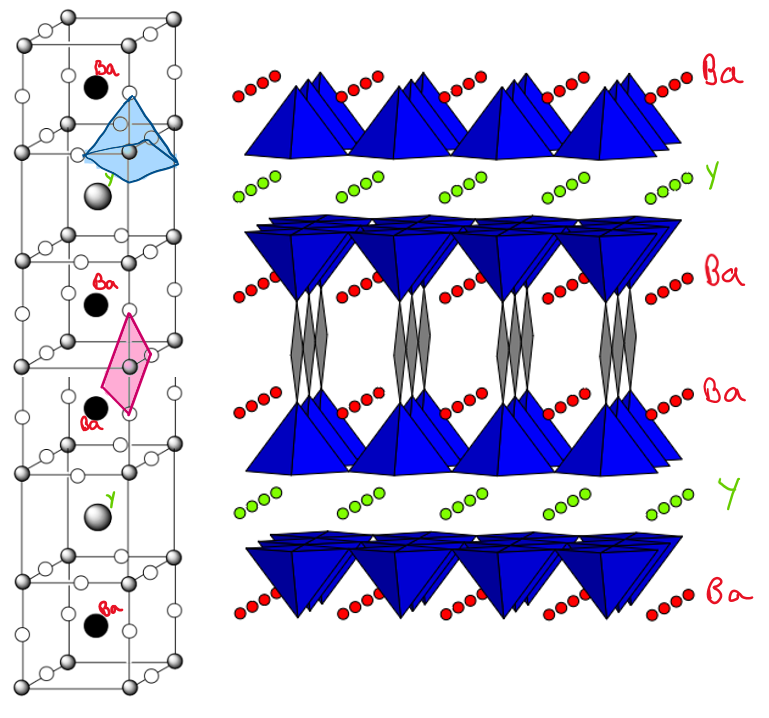
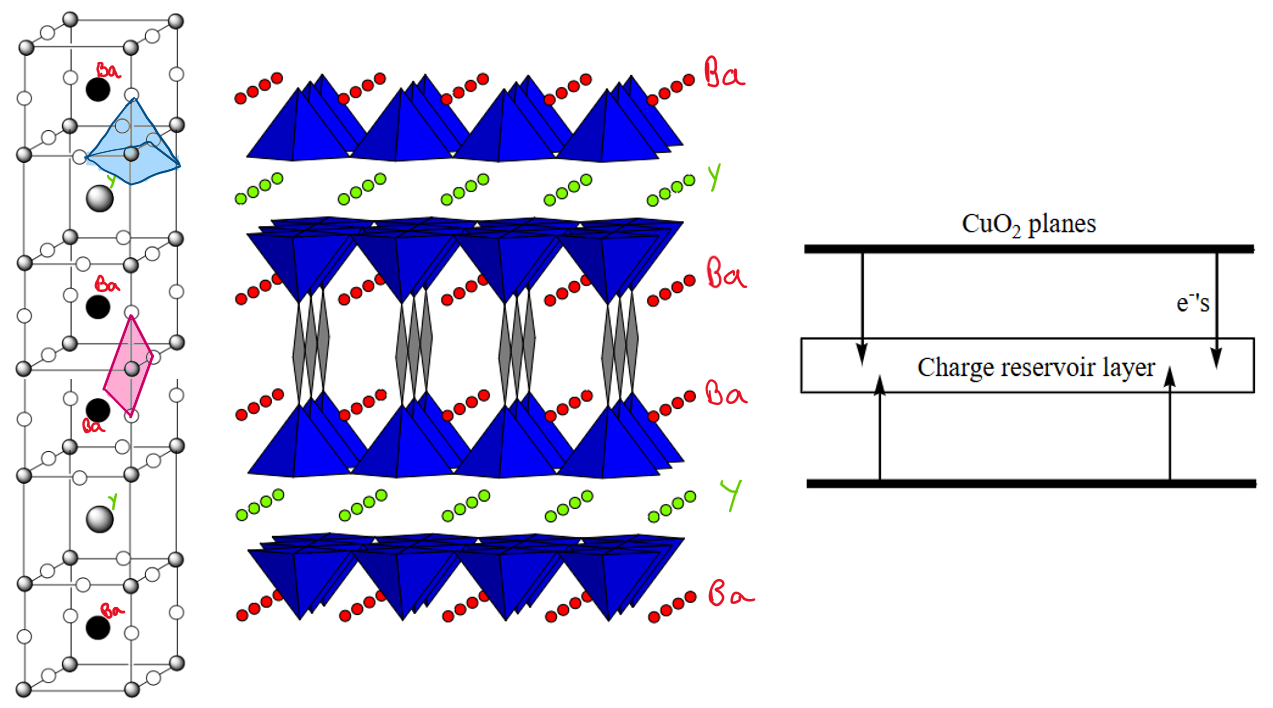
When there is high oxygen content (YBa2Cu3O6.5-7 ) the copper is in Cu3+ / Cu2+.
The vertical square planar Cu layer is a charge reservior layer so this structure can be superconducting.
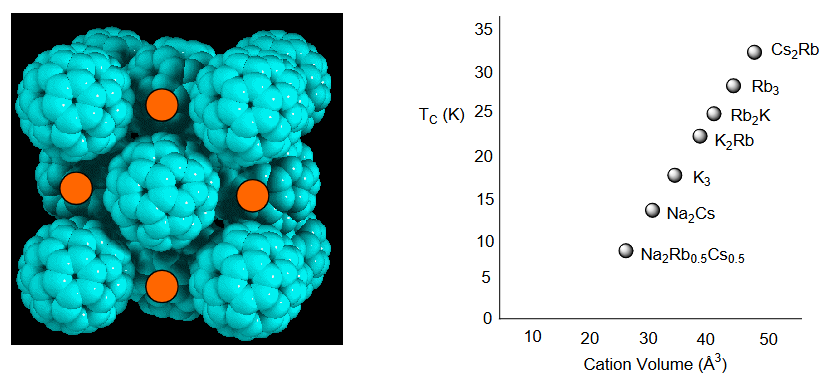
How can fullerenes be made to be electrically conducting?
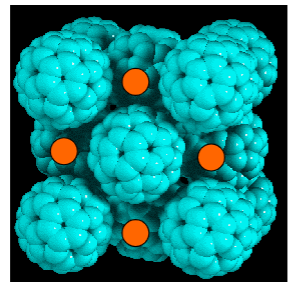
Electropositive metals can be put into the fullerene lattice.
These donate an electron to the fullerene to give a fulleride (C60n-).
The fulleride orbitals can overlap to allow electron transfer.
TC increases with the size of the electropositive metal ion.
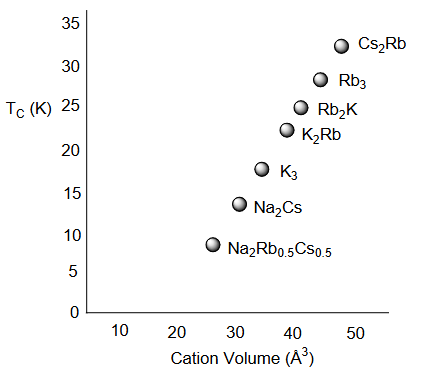
How does the superconductivity of fullerides vary with metal ion size?
TC increases with increasing metal ion size.
TC is the temperature where superconductivity stops.
Therefore, fullerides are superconducting at higher temperatures with larger metal ions.
Use the Bardeen, Cooper, Schrieffer (BCS) theory to explain superconductivity.
Vibrational waves of ions/atoms in a solid lattice are called phonons.
Electron-phonon coupling causes two electrons to be attracted to each other, which is called a Cooper pair.
The electrons in a Cooper pair dont have to be near each other to couple.
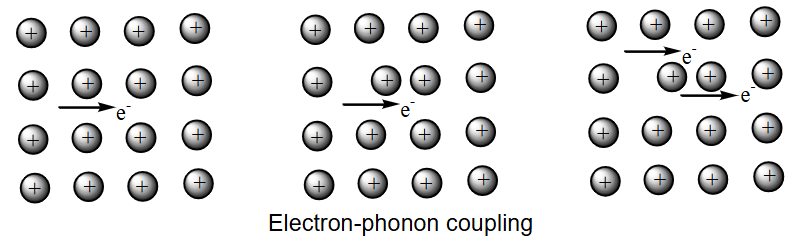
Electrical resistance comes from phonons scattering electrons, but Cooper pairs are not scattered by phonons, hence are superconducting (no resistance).
What two factors can impact electrical conductivity?
1) Temperature - higher temperature means more vibrations of ions/atoms in the lattice (phonons) which scatters electrons, reducing conductivity
2) Mass of lattice ion/atom - lighter ions vibrate at higher frequencies which enhances the pairing between the Cooper pair electrons.
How many silver atoms are in 2 nm diameter nanoparticle?
Ag radius = 172 pm
Assume a 74% packing efficiency.
Volume of nanoparticle = 4πr3/3 = 4.18 nm3
Volume of silver atom = 4πr3/3 = 0.0213 nm3
(4.18) / (0.0213) * 0.74 = 145 atoms
How many silver atoms in a 2 nm nanoparticle are surface atoms?
Ag radius = 172 pm
Assume 90% packing
Silver atom cross section = πr2 = 0.093 nm2
Nanoparticle surface area = 4πr2 = 12.56 nm2
(12.56) / (0.093) * 0.90 = 120 atoms
Why does the chemistry of a bulk substance and its nanoparticles vary?
Because nanoparticles have more exposed surface and have corners/edges with high activity.
There may also be surface defects which can impact activity.
Define homogeneity in reference to nanoparticles.
Homogeneity is whether there is variation between the different nanoparticles in a sample.
What information does X-ray diffraction give you?
X-ray diffraction maps the electron density so shows the relative atomic positions.
What information does neutron diffraction give you?
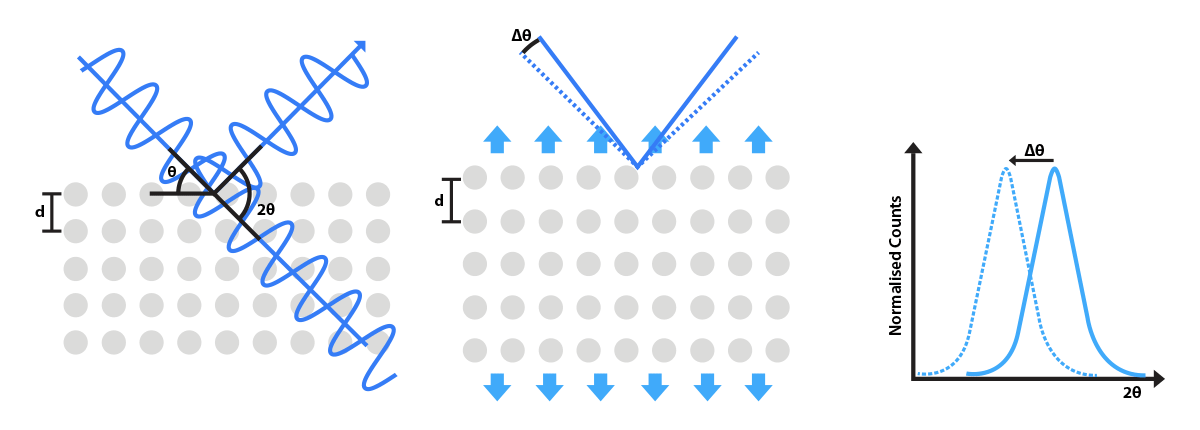
Certain nuclei (like deuterium) are sensitive to this and give a response.
Neutrons also interact with magnetic ions.
Similar to x-ray diffraction which maps electron density, this technique maps the magnetic structure, thus is good for mapping domain boundaries and orientations.
What information does electron diffraction give you?
It can map the electron density to give the average structure of an individual nanoparticle.
Give the Scherrer Equation for particle size.
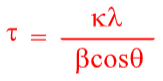
τ = particle size
κ = shape factor
λ = x-ray wavelength
β = full width half maximum height (fwhm) in radians
θ = Bragg angle
What is the conversion for degrees to radians (or reverse)?
360o = 2π radians
What are the two limitations of the Scherrer equation for particle size?
It is only applicable to particles < 100 nm
Band broadening may be caused by other factors so the Scherrer equation often gives an underestimation
What happens to nanoparticles at higher temperatures?
The nanoparticles sinter (grow) at higher temperatures to reduce the overall surface energy.
Give the Abbe diffraction limit equation and what this equation tells us.
The Abbe diffraction limit is the smallest resolvable distance measurable by a technique.
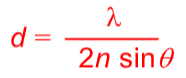
d = minimum resolvable distance
λ = wavelength
n = refractive index
θ = half angle light is converging too
What is the key relationship described by the Abbe diffraction limit?
That using shorter wavelengths (λ) allows you to resolve smaller distances (d).
Give the equation for wavelength in terms of momentum.
λ = h/p
Give the equation for wavelength in terms of velocity
λ = h / mv
m = mass
v = velocity
mv = p (momentum)