(6) bp maintenance and regulation
 Call Kai
 Learn
Learn Practice Test
 Spaced Repetition
 Match
Match Flashcards
 Knowt Play
1/30

There's no tags or description
Looks like no tags are added yet.
Name | Mastery | Learn | Test | Matching | Spaced | Call with Kai |
|---|
No analytics yet
Send a link to your students to track their progress
31 Terms
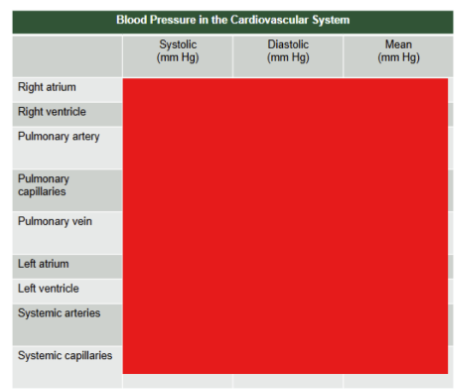
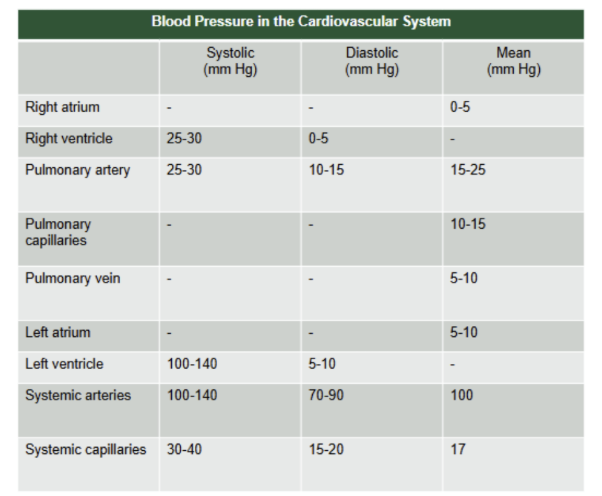
Fill out the chart
Blood pressure is regulated by both — and —- mechanisms operating at the level of — and —
local and systemic; arterioles and pre-capillary sphincters
What is the most important structure for controlling blood flow to capillary beds
pre-capillary sphincters
Mean arterial pressure (Pa or MAP)
function of CO and resistance in arterioles (peripheral resistance). The volume of blood in arteries is determined by CO and the amount flowing out of arteries (which is layered by changing peripheral resistance). As arterial volume increases, pressure increases. Average arterial pressure during a single cardiac cycle
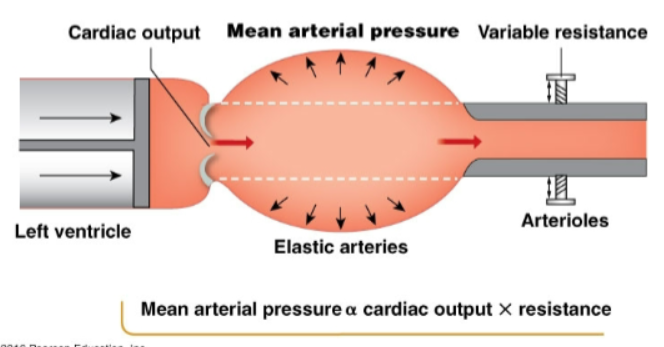
MAP equations
MAP= (CO x TPR) +CVP but can be simplified to MAP=COxTPR as CVP is near 0 mm Hg. MAP= DP+ PP/3 (note:PP=SP-DP) [CVP=central venous pressure; DP=diastolic pressure; PP=pulse pressure]
![<p>MAP= (CO x TPR) +CVP but can be simplified to MAP=COxTPR as CVP is near 0 mm Hg<strong>. MAP= DP+ PP/3 </strong>(note<span style="background-color: transparent;"><strong>:PP=SP-DP) </strong>[CVP=central venous pressure; DP=diastolic pressure; PP=pulse pressure]</span></p>](https://assets.knowt.com/user-attachments/3b12ddd4-63aa-4d66-b76d-61bb3dbfeaae.png)
How to calculate MAP given diastolic and systolic pressure
MAP= DP+ PP/3 (note
MAP must remain at least – mm Hg so that blood can effectively reach all tissues. Normal range is — mm Hg
60 ; 70-110
What happens at low MAP
end-organ manifestations such as ischemia and infarction or loss of consciousness and neuronal death if dropped significantly (blood unable to perfuse to cerebral tissues)
Show the different influences on mean arterial blood pressure (MAP)
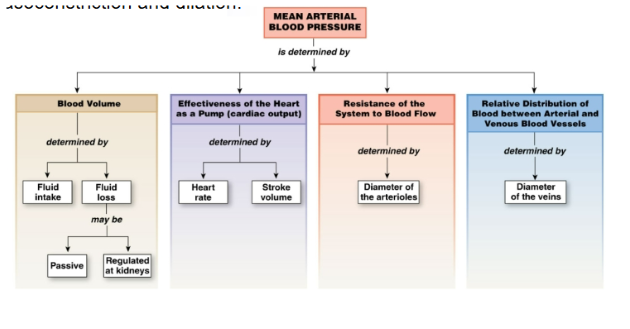
MAP is determined through CO and systemic vascular resistance. Therefore, what factors may influence MAP?
CO is regulated on the level of intravascular volume, preload, afterload, myocardial contractility, heart rate and conduction velocity. Systemic vascular resistance is regulated via vasoconstriction and vasodilation.
Fast response vs slow response to heightened bp in the body
fast response is compensation by cardiovascular system via vasodilation which decreases VR, decreasing preload and lowering CO to lower bp; slow response is compensation by kidneys in which excretion of fluid in urine lowers blood volume.
Autonomic nervous system regulates MAP via — located in the — and —
baroreceptors located in the carotid sinus and aortic arch
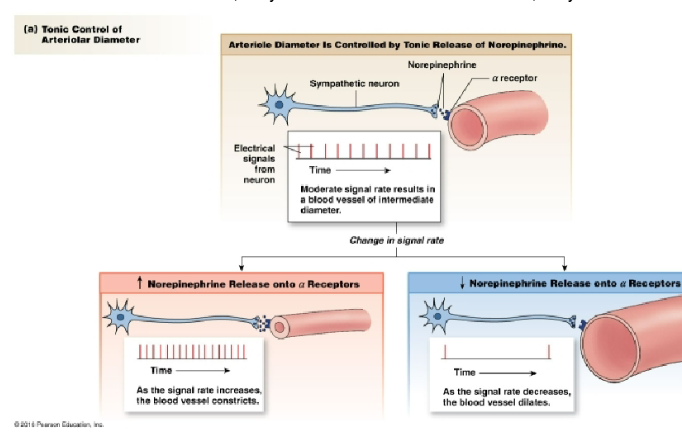
How do arterioles receive input from the sympathetic ANS?
norepinephrine binds to alpha receptors on vascular smooth muscle causing construction that underlies vascular tone. If NE release decreases, they dilate and if it increases further, they constrict
t/f epinephrine release triggers vasoconstriction (explain why or why not it is t/f)
false, it trigger vasodilation as it activates beta2 receptors in heart, liver, and skeletal muscle
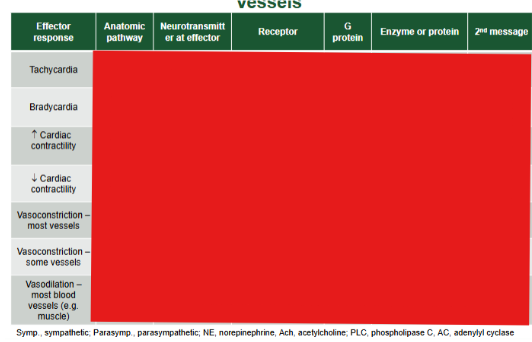
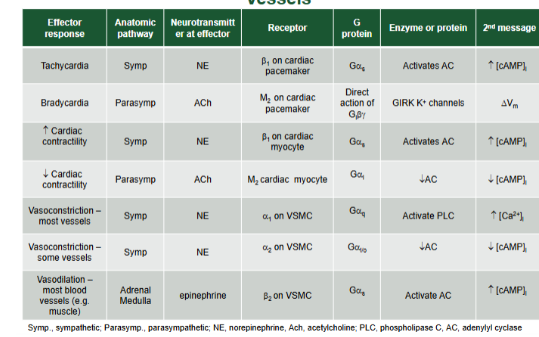
Fill out the chart
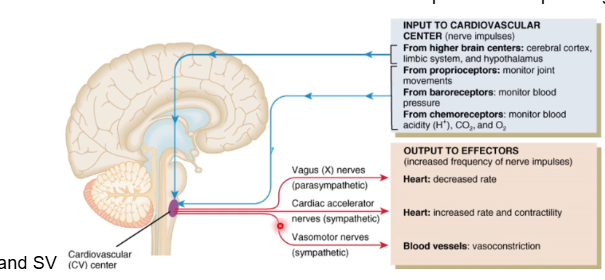
Cardiovascular control center
neural control of blood pressure. Helps to regulate HR and SV
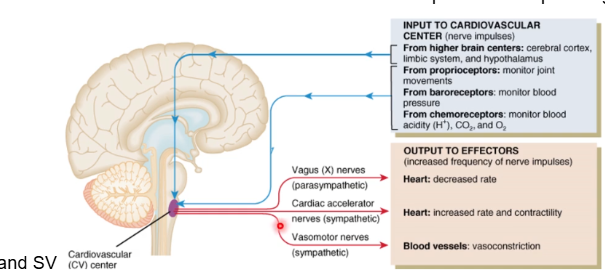
Vasomotor nerves
specific neurons that regulate blood vessel diameter (sympathetic control of vasoconstriction)
Hormonal control of bp
hormones (particularly those that regulate salt and water excretion by kidneys) influence bp by acting directly on arterioles and altering autonomic reflex control
Vasopressin
hormone that triggers vasoconstriction (increasing bp) in response to hemorrhage. Released from vascular endothelium.
Angotensin II
hormone that increases bp via vasoconstriction. Released by kidneys into plasma.
Atrial natriuretic peptide (ANP)
hormone that reduces bp via vasodilation. Released by atrial myocardium in response to high bp.
Vasoactive intestinal polypeptide (VIP)
hormone that triggers vasodilation in order to increase digestive secretions. The source is enteric nerves (gut).
Baroreceptor reflex
primary means of controlling bp . mechanoreceptors located in carotid sinus and in the aortic arch
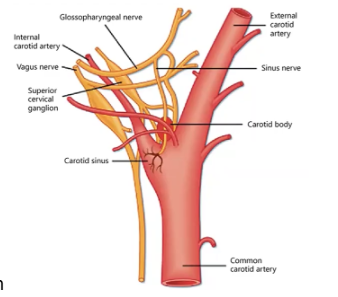
What are baroreceptors sensitive to?
mechanical stretch caused by changes in arterial pressure. Stretch depolarizes the membrane potential at the receptor and increases action potential firing in afferent nerves that travel to the brain stem. Decreases in pressure have the opposite effect. They are particularly sensitive to the rate of change of pressure.
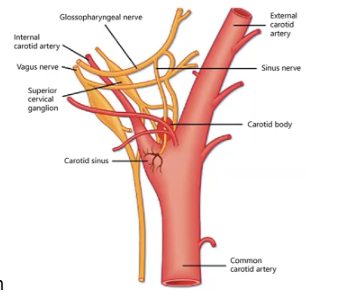
Similarities and differences in the pathway of baroreceptors in the carotid sinus vs aortic arch
Afferent information from the receptors in the carotid sinus is carried in the carotid sinus nerve, while information from the aortic arch is carried in the vagus nerve. These signals are integrated in the medulla.
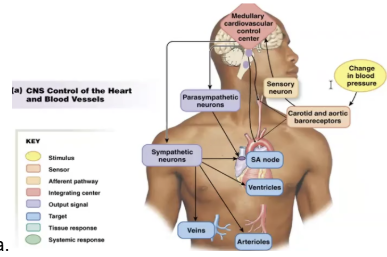
t/f baroreceptors in the carotid sinus are very sensitive to changes in pressure
true; this ensures that blood is delivered to the brain at the exact right bp
Baroreceptors in the — are more sensitive to large changes in bp and have a larger role in control of HR
aortic arch
What are some ways baroreceptors regulate blood pressure when they detect changes in bp?
triggering enhanced or decreased sympathetic firing of NE to change blood vessel diameter,
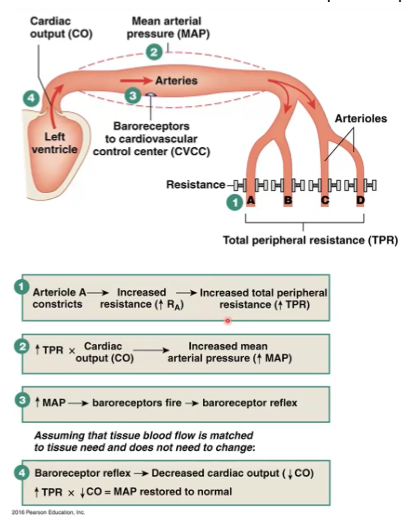
Show the process of what happens to different variables relating to the CV system when arteriole A constricts and how baroreceptors respond to this change
How do baroreceptors respond to an increase in blood pressure? Show the pathway of the baroreceptor signal, how it affects sympathetic and parasympathetic output and what those outputs affect
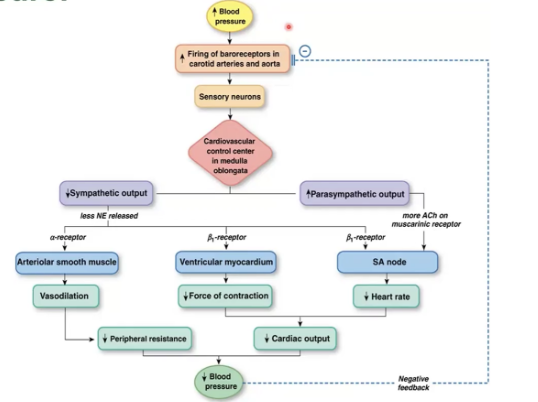
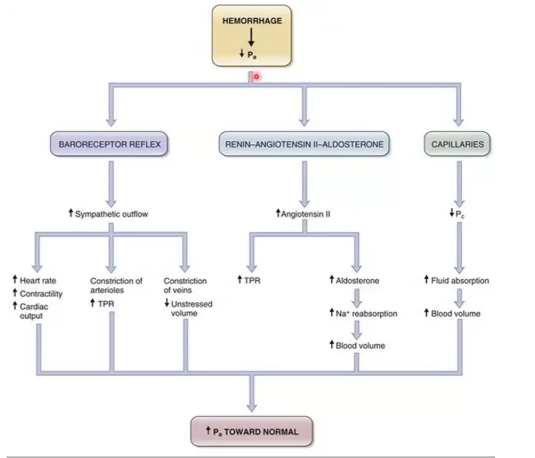
How do baroreceptors respond to a decrease in blood pressure? Show the pathway of the baroreceptor signal, how it affects sympathetic and parasympathetic output and what those outputs affect
there is increased sympathetic outflow and decreased parasympathetic outflow. Venous constriction increases VR.