MCAT Study - General and Organic Chemistry
 Call Kai
 Learn
Learn Practice Test
 Spaced Repetition
 Match
Match Flashcards
 Knowt Play
1/33

There's no tags or description
Looks like no tags are added yet.
Name | Mastery | Learn | Test | Matching | Spaced | Call with Kai |
|---|
No analytics yet
Send a link to your students to track their progress
34 Terms

What do the X, A, and Z represent on this figure?
X is the element (Na, H, etc)
A is the mass number (protons + neutrons)
Z is the atomic number (# of protons)
What is the Rutherford Model and the year it was described?
concept that the electrons surround a compact nucleus in an atom
1911
What is the Bohr Model and the year it was described?
concept that described orbits in more detail (farther orbits require more energy, photons emitted vs absorbed)
AHED (Absorb light, Higher potential, Excited, Distant from nucleus)
1913
A photon is ______ when n decreases (when electron moves closer to nucleus) and a photon is _____ when n increases.
A photon is emitted when n decreases (when electron moves closer to nucleus) and a photon is absorbed when n increases.
What does the AHED mnemonic describe?
Absorb light or energy
moves to a Higher potential
enters an Excited state
travels a path Distant from the nucleus
this describes what happens when an electron jumps from a lower energy level to a higher one
What is the Heisenberg Uncertainty?
the fundamental rule that you cannot know both the exact position and exact momentum of a subatomic particle at the same time
What is Hund’s Rule?
electrons can only double up in orbitals if all orbitals already have 1 electron each
What is Pauli Exclusion Principle?
paired electrons must have a +½ and a -½
What is Avogadro’s Number?
6.022 × 10²³
equals 1 mol
often represented by Nₐ
What is Planck’s constant?
6.626 × 10⁻³⁴ J•s
often represented by h
What is the speed of light?
3.0 × 10⁸ m/s
often represented by c
What is the equation for light energy that uses wavelength?
E = (h • c) / λ
E = light energy
h = Planck’s constant
c = speed of light
λ = wavelength
What is the equation for light energy that uses frequency?
E = h • f
E = light energy
h = Planck’s constant
f = frequency
Planck’s constant (h) multiplied by the speed of light (c) is what?
around 2.0 × 10⁻²⁵ J•m
What does quantum number n represent?
electron energy levels or the shell number
What does quantum number l represent?
the 3D shape of the orbital (s, p, d, f)
What are the possible values for quantum number n?
1, 2, 3, …
What are the possible values for quantum number l?
0, 1, 2, … (aka n-1)
How does the # value of l correlate to the orbital shape?
0 = s orbital
1 = p orbital
2 = d orbital
3 = f orbital
4 = g orbital
What does quantum number ml represent?
magnetic
orbital subtype
What values can quantum number ml be?
+ or - l values (…, -2, -1, 0, 1, 2, …)
What does quantum number ms represent?
electron spin (direction)
What values can quantum number ms be?
+½ or -½
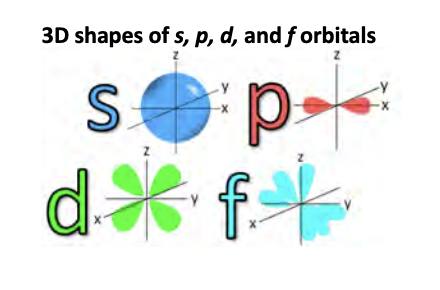
Describe the shapes of the orbitals.
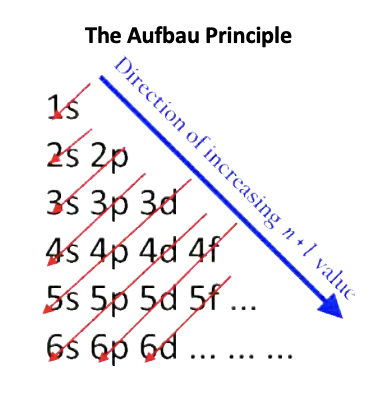
What is the Aufbau Principle?
Electrons fill orbitals in order of increasing energy, generally following this sequence:
1s, 2s, 2p, 3s, 3p, 4s, 3d, 4p, 5s, 4d, 5p, 6s, 4f, 5d, 6p, 7s...
What does the term diamagnetic mean and when does it apply?
paired electrons are repelled by an external magnetic field
occurs when all electrons are paired
used to describe an atom
What does the term paramagnetic mean and when does it apply?
electrons are pulled into an external magnetic field
occurs when there is one or more unpaired electrons
used to describe an atom
What is the Zeff and what is its periodic trend?
effective nuclear charge is the net positive charge experienced by an electron in a multi-electron atom
inner electrons block outer electrons from the full pull of the nucleus
Zeff = Z (atomic number) - S (shielding constant typically 2)
increases to the right