Indirect taxes & Subsidies (9)
 Call Kai
 Learn
Learn Practice Test
 Spaced Repetition
 Match
Match Flashcards
 Knowt Play
1/11

There's no tags or description
Looks like no tags are added yet.
Name | Mastery | Learn | Test | Matching | Spaced | Call with Kai | Chat |
|---|
No analytics yet
Send a link to your students to track their progress
12 Terms
What is an indirect tax?
An indirect tax is paid on the consumption of goods/services
It is only paid if consumers make a purchase
It is usually levied by the government on demerit goods(goods which have harmful impacts on consumers/society) to reduce the quantity demanded (QD) and/or to raise government revenue
Government revenue is used to fund government provision of goods/services e.g education
What can indirect taxes occur as ?
Indirect taxes can occur as a specific or ad valorem tax
They are levied by the government on producers. This is why the supply curve shifts
What do consumers and producers each pay a share of ?
Producers and consumers each pay a share (incidence- the share/burden of the total tax to be paid) of the tax
What is a specific tax ?
A specific tax is a fixed tax per unit of output (specific amount) e.g. $3.25/packet of cigarettes
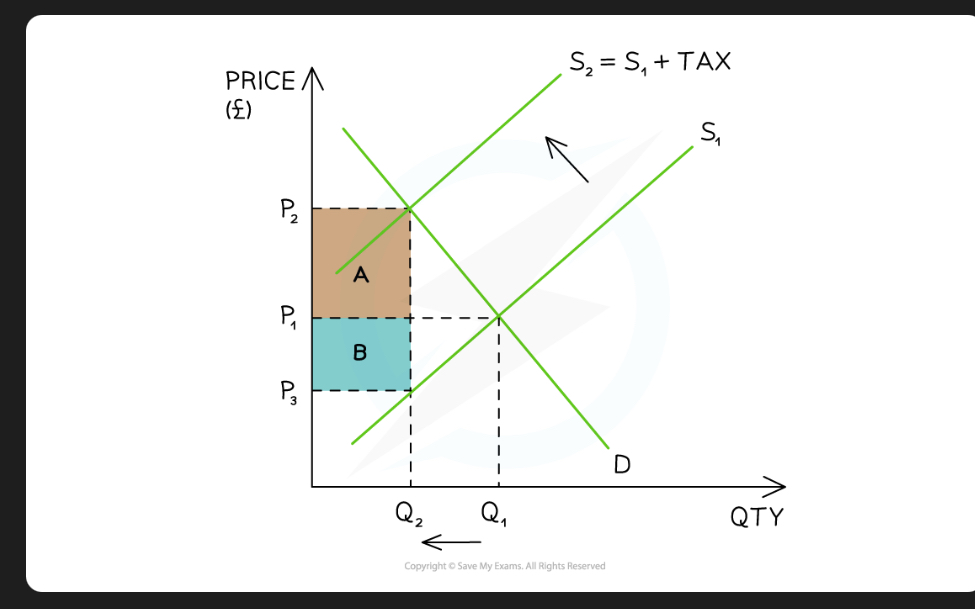
The impact of an indirect tax is split between the consumer (A) and the producer (B) - Diagram Analysis
Initial equilibrium is at P1Q1
The government places a specific tax on a demerit good
The supply curve shifts left from S1→S2 by the amount of the tax
The price the consumer pays has increased from P1 before the tax, to P2 after the tax
The price the producer receives has decreased from P1 before the tax to P3 after the tax
The government receives tax revenue = (P2-P3) x Q2
Producers and consumers each pay a share (incidence) of the tax
The consumer incidence (share) of the tax is equal to area A: (P2-P1) x Q2
The producer incidence (share) of the tax is equal to area B: (P1-P3) x Q2
New equilibrium is at P2Q2
Final price is higher (P2) and QD is lower (Q2)
If the decrease in QD is significant enough, it may force producers to lay off some workers
What is an ad valorem tax ?
A tax that is a percentage of the purchase price e.g. Value added tax (VAT) in Columbia in 2022 was 19%
The more goods/services consumed, the larger the tax bill
This causes the second supply curve to diverge from the original supply curve
VAT raises significant government revenue
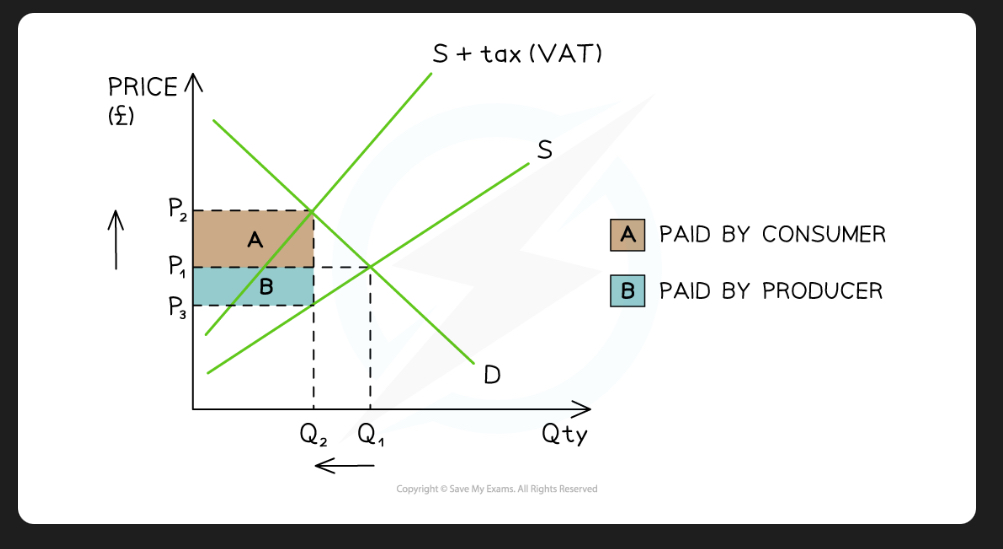
A diagram showing an ad valorem tax (VAT) and the tax incidence for producers and consumers - Diagram Analysis
Initial equilibrium is at P1Q1
The government places an ad valorem tax to raise government revenue
Supply shifts left due to the tax from S → S + tax
The two supply curves diverge as a percentage tax means more tax is paid at higher prices
The price the consumer pays has increased from P1 before the tax, to P2 after the tax
The price the producer receives has decreased from P1 before the tax to P3 after the tax
The government receives tax revenue = (P2-P3) x Q2
Producers and consumers each pay a share (incidence) of the tax
The consumer incidence (share) of the tax is equal to area A: (P2-P1) x Q2
The producer incidence (share) of the tax is equal to area B: (P1-P3) x Q2
New equilibrium is at P2Q2
Final price of goods/service is higher (P2) and QD is lower (Q2)
If the decrease in QD is significant enough, it may force producers to lay off some workers
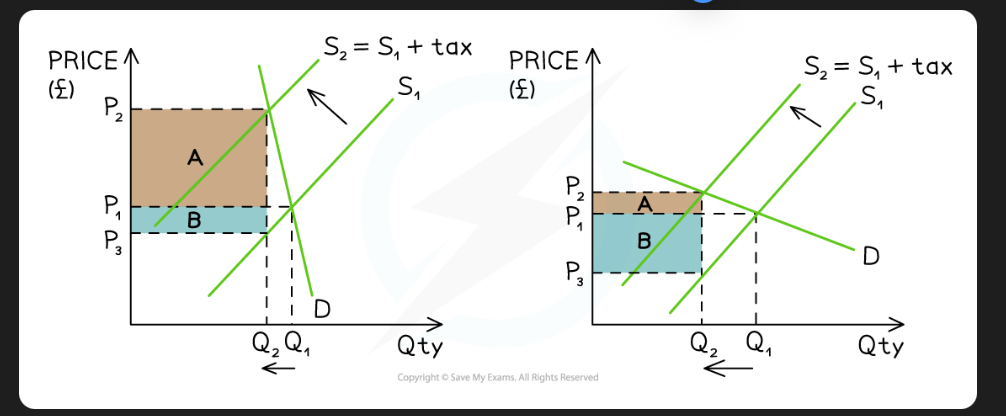
A side by side comparison of the impact of PED on tax incidence
Aiming to maximise their profits, producers pass on as much of the indirect tax as they can to consumers and pay the balance themselves
The amount passed on to consumers depends on the price elasticity of demand (PED) of the product.
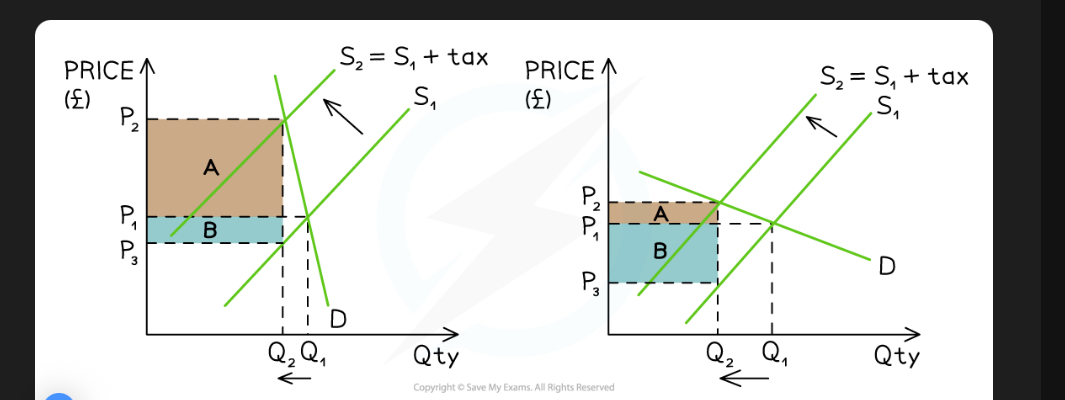
A diagram that demonstrates the tax incidence for a product whose PED is inelastic (left) and elastic (right). A is the consumer incidence and B is the producer incidence - Diagram Analysis
In both diagrams, the specific tax shifts the supply curve from S1→S2
There is a higher market price at P2 and lower QD at Q2
Tax revenue for the government is the sum of A+B
Consumer incidence is represented by A and producer incidence by B
Total revenue for the seller is calculated using P3 X Q2
The difference in PED results in a different steepness to the demand curve
For a price inelastic product (e.g. cigarettes), producers pass on a much higher proportion of the tax to consumers (A) and pay the rest themselves (B)
The QD decreases (Q1→Q2) but by a much smaller proportion than the increase in price (P1→P2)
For a price elastic product (e.g. pizza), producers pass on a much smaller proportion of the tax to consumers (A) and pay the rest themselves (B)
The QD decreases (Q1→Q2) but by a much larger proportion than the increase in price (P1→P2)
What is a producer subsidy ?
A producer subsidy is a per unit amount of money given to a firm by the government
To increase production
To increase provision of a merit good (products that are beneficial for society but the free market does not provide enough of them)
How is the incidence (share) of the subsidy determined ?
The incidence (share) of the subsidy is determined by the PED of the product
If governments subsidise goods/services with high PED, the increase in QD will be more than proportional to the decrease in price
Producers keep some of the subsidy and pass the rest on to the consumers
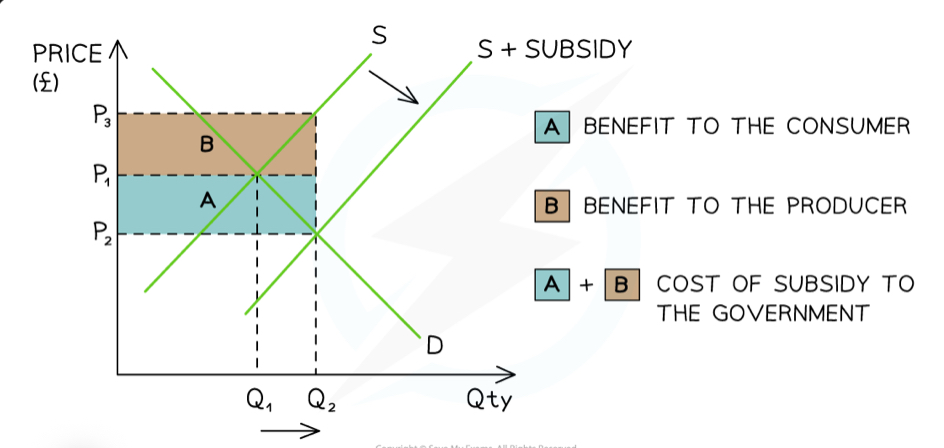
A diagram which demonstrates the cost of a subsidy to the government (A+B) and the incidence received by the consumer (A) and producer (B) - Diagram analysis
The original equilibrium is at P1Q1
The subsidy shifts the supply curve from S → S + subsidy:
This increases the QD in the market from Q1→Q2
The new market equilibrium is P2Q2
This is a lower price and higher QD in the market
Producers receive P2 from the consumer PLUS the subsidy per unit from the government
Producer revenue is therefore P3 x Q2
Producer incidence of the subsidy is marked B in the diagram
The subsidy decreases the price that consumers pay from P1 → P2
Consumer incidence of the subsidy is marked A in the diagram
The total cost to the government of the subsidy is (P3 - P2) x Q2represented by area A+B