GW BGZ 2025 Case 7 - Start… to run!
 Call Kai
 Learn
Learn Practice Test
 Spaced Repetition
 Match
Match Flashcards
 Knowt Play
1/45

There's no tags or description
Looks like no tags are added yet.
Name | Mastery | Learn | Test | Matching | Spaced | Call with Kai |
|---|
No analytics yet
Send a link to your students to track their progress
46 Terms
What is the main cardiac adaptation to endurance training?
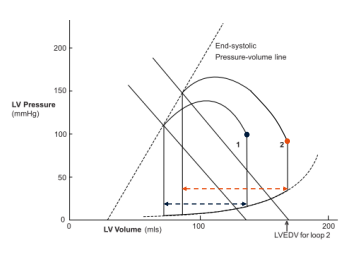
The heart undergoes eccentric hypertrophy, meaning the left ventricle enlarges and becomes more compliant. This increases end-diastolic volume (EDV), allowing the heart to fill with more blood and eject a larger stroke volume per beat.
What structural changes occur in the heart?
Increased left ventricular chamber size
Slight increase in wall thickness (physiological hypertrophy)
Increased total heart mass
Improved myocardial contractility
These changes improve the heart’s ability to pump large volumes of blood efficiently during exercise.
What is the Frank–Starling mechanism and how does it improve with training?
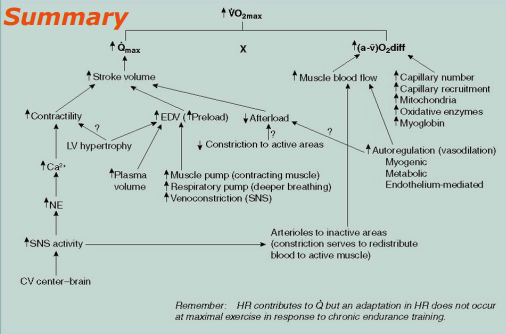
The Frank–Starling mechanism states that greater ventricular filling leads to stronger contraction. Endurance training increases blood volume and venous return, which increases preload and strengthens this mechanism, resulting in higher stroke volume.
What happens to stroke volume in endurance training?
Stroke volume increases significantly (often 20–50% or more) due to:
Greater ventricular filling (higher EDV)
Stronger contraction
Increased blood volume
Improved cardiac compliance
What happens to resting heart rate and why?
Resting heart rate decreases (often 30–50 bpm in athletes) due to:
Increased stroke volume (less beats needed)
Increased parasympathetic (vagal) tone
Reduced sympathetic activity
This is called training-induced bradycardia.
What happens to maximal cardiac output?
Maximal cardiac output increases significantly because stroke volume increases, while maximal heart rate remains mostly unchanged.
Typical values:
Untrained: ~20–25 L/min
Elite athletes: ~35–45 L/min
What is the volume-loading effect?
Endurance training increases plasma volume → increases venous return → increases ventricular filling → increases stroke volume. This long-term volume expansion is called the volume-loading effect.
What happens to blood volume and hematocrit?
Plasma volume increases first (rapid adaptation)
Red blood cell mass increases more slowly
Hematocrit may temporarily decrease (“sports anemia”) due to dilution
Total oxygen transport capacity increases overall
Why is the athlete’s heart considered healthy adaptation?
Because it improves cardiac efficiency, oxygen delivery, and exercise performance without pathological consequences (unlike disease-related hypertrophy).
Do the lungs significantly change with endurance training?
Not structurally. Lung size and baseline function are largely genetically determined. However, efficiency during exercise improves.
What happens to respiratory muscles?
Stronger diaphragm and intercostals
Delayed respiratory muscle fatigue
Reduced oxygen cost of breathing
This allows more energy to be used for working muscles.
How does ventilation change with training?
Maximal ventilation increases due to:
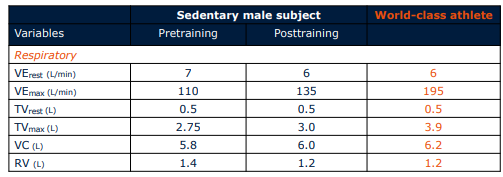
Increased tidal volume
Improved breathing efficiency
Stronger respiratory muscles
Elite athletes can exceed 150–200 L/min ventilation.
What is ventilation-perfusion (V/Q) matching?
It is the alignment of airflow and blood flow in the lungs. Endurance training improves V/Q matching, increasing oxygen uptake efficiency during exercise.
Why can oxygen saturation drop in elite athletes?
Because cardiac output becomes extremely high, blood passes through the lungs too quickly for full oxygen diffusion → mild arterial desaturation (exercise-induced hypoxemia).
What is the ventilatory equivalent and how does it change?
It is the amount of ventilation required per unit of oxygen consumed. It decreases with training, meaning breathing becomes more efficient.
What happens to muscle fiber types with endurance training?
Type IIx fibers shift toward Type IIa (more oxidative)
Increased fatigue resistance
Improved aerobic energy production capacity
What happens to Type I fibers?
Type I fibers increase in:
Size (moderate hypertrophy)
Oxidative enzymes
Endurance capacity
What happens to capillary density?
It increases significantly:
More capillaries per fiber
Shorter diffusion distance
Improved oxygen delivery and waste removal
What is the role of myoglobin and how does it change?
Myoglobin stores oxygen inside muscle cells and transports it to mitochondria. Endurance training increases it by ~60–80%, improving intracellular oxygen availability.
What happens to mitochondria?
Increased number (biogenesis)
Increased size
Improved efficiency
This increases aerobic ATP production capacity.
What is SDH and why is it important?
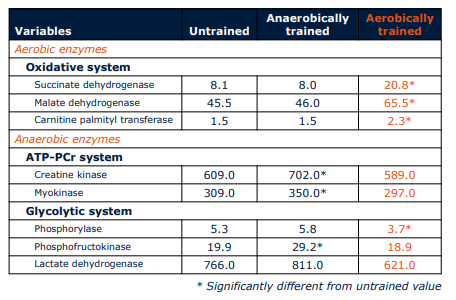
Succinate dehydrogenase is both a Krebs cycle enzyme and Complex II of the electron transport chain. It is a key marker of oxidative capacity.
What happens to SDH with training?
Increased SDH activity
Faster electron transport
Improved aerobic metabolism
Greater fat oxidation capacity
What is the overall muscle adaptation summary?
Muscle becomes:
More oxidative
More fatigue resistant
Better at using fat and oxygen
More efficient at ATP production
What is the main metabolic shift in endurance training?
The body shifts toward greater aerobic metabolism and fat utilization, sparing glycogen.
What happens to fat metabolism?
Increased fat oxidation enzymes
Increased intramuscular fat use
Increased ability to use fatty acids at submaximal intensities
Result: glycogen is spared and fatigue is delayed.
What happens to glycogen storage?
Muscle and liver glycogen stores increase significantly, providing more energy reserve for prolonged exercise.
What is glycogen sparing?
At the same workload, trained athletes use more fat and less glycogen, delaying exhaustion.
What happens to lactate production and clearance?
Lower lactate production at same workload
Higher lactate clearance
Improved lactate recycling
Result: higher lactate threshold.
What happens to insulin sensitivity?
It increases, improving glucose uptake into muscles and metabolic efficiency.
What is the overall metabolic benefit?
The athlete can sustain higher intensities aerobically with delayed fatigue.
Why is cardiac output the main limitation?
Because oxygen delivery depends heavily on heart pumping capacity, especially stroke volume.
What is exercise economy?
The oxygen cost of movement. More economical athletes use less oxygen at the same speed.
What is the role of lactate threshold?
It determines the intensity an athlete can sustain. Two athletes with equal VO₂max can perform differently depending on lactate threshold.
What are environmental limitations?
Heat (increases cardiovascular strain)
Altitude (reduces oxygen availability)
Dehydration (reduces plasma volume)
What are genetic limitations?
Genetics determine:
VO₂max potential
Muscle fiber distribution
Trainability response
Heart size adaptation
What is the most important factor influencing training response?
Genetics (accounts for 25–50% of VO₂max variation and adaptation differences).
How does training status affect adaptation?
Beginners improve rapidly
Highly trained athletes improve slowly due to physiological ceiling
How does age affect training adaptation?
Older individuals can still improve
Max HR decreases with age
Recovery is slower
How does sex influence adaptation?
Men: higher absolute VO₂max (larger heart, more hemoglobin)
Women: similar relative improvements, but lower absolute values
How does training program design affect results?
Adaptations depend on:
Frequency
Intensity (most important driver)
Duration
Specificity
Why is recovery important?
Adaptations occur during recovery. Poor sleep or insufficient rest reduces mitochondrial and cardiovascular adaptations.
How does nutrition affect adaptation?
Adequate intake of carbohydrates, protein, iron, and fluids is essential for optimal performance and adaptation.
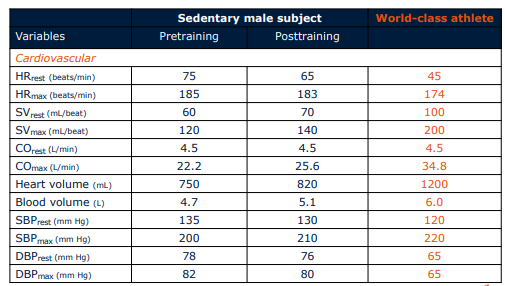
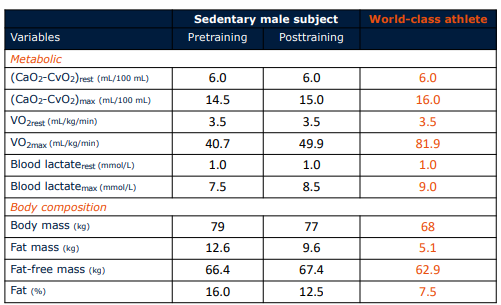
Reference values for pretraining, post-training, athlete