1.8.1 Born-Haber cycles
 Call Kai
 Learn
Learn Practice Test
 Spaced Repetition
 Match
Match Flashcards
 Knowt Play
1/26

There's no tags or description
Looks like no tags are added yet.
Name | Mastery | Learn | Test | Matching | Spaced | Call with Kai |
|---|
No analytics yet
Send a link to your students to track their progress
27 Terms
use of Born-Haber cycles
allow lattice enthalpies to be calculated which cannot be measured directly
we cannot isolate 1 mole of free, oppositely charged gaseous ions
anhydrgrous magnesium chloride can absorb water to form the hydrated salt MgCl2.4H2O
MgCl2 (s) + 4 H2O (l) → MgCl2.4H2O (s)
why can’t the enthalpy change for this reaction cannot be determined directly by calorimetry?
MgCl2 is soluble, not possible to prevent some dissolving
upwards arrow on Born-Haber cycles
endothermic reaction
downwards arrow on Born-Haber cycles
exothermic reaction
enthalpy of lattice dissociation
the enthalpy change when 1 mole of a solid ionic lattice dissociates fully into gaseous ions under standard conditions
endothermic
upwards arrow on Born-Haber cycle
why is the lattice dissociation enthalpy for sodium oxide greater than that for sodium chloride?
oxide ions have a higher negative charge and a smaller size so have a higher charge density
so stronger attraction between oxide ions and sodium ions, so more energy required to overcome force of attraction
enthalpy of lattice formation
the enthalpy change when 1 mole of a solid ionic lattice is formed from its gaseous ions in under standard conditions
exothermic
downwards arrow
standard enthalpy of formation
enthalpy change when 1 mole of a substance is formed from its elements with all substances in their standard states and under standard conditions
usually exothermic
downwards arrow
atomisation enthalpy
the enthalpy required to form 1 mole of gaseous atoms under standard conditions
endothermic
upwards arrow
equation for the reaction that represents the atomisation of
sodium
chlorine
Na (s) → Na (g)
½ Cl2 (g) → Cl (g)
ionisation enthalpy
the enthalpy required to remove 1 mole of electrons from 1 mole of gaseous atoms to form 1 mole of gaseous 1+ ions, under standard conditions
endothermic
upwards arrow
enthalpy of electron affinity
the enthalpy change when 1 mole of electrons is added to 1 mole of gaseous atoms forming 1 mole of gaseous 1- ions, under standard conditions
first electron affinity is exothermic, downwards arrow
second electron affinity is endothermic, upwards arrow
negative ion formed from the first electron affinity repels the electron being added
mean bond enthalpy
the enthalpy required to break 1 mole of a specific covalent bond in a gaseous state under standard conditions
averaged over a range of different compounds containing that bond
enthalpy of hydration
the enthalpy change when 1 mole of gaseous ions is dissolved in water to form 1 mole of aqueous ions under standard conditions
usually exothermic
why is the enthalpy of hydration of calcium ions less exothermic than that of magnesium ions?
Ca2+ ions are bigger and have a lower charge density
weaker electrostatic attraction to δ- O in water molecules
so less energy is released when attractions form
why is the enthalpy of hydration of fluoride ions more negative than that of chloride ions?
F- ions are smaller and have a higher charge density
stronger electrostatic attraction to δ+ H in water molecules
so more energy is released from this force of attraction
enthalpy of solution
the enthalpy change when 1 mole of an ionic solid is dissolved to water to infinite dilution so that the ions no longer interact, under standard conditions
why do data books not contain a value for the enthalpy of solution of sodium oxide?
it reacts with water to form a solution of NaOH
why do experimental values for enthalpy of solution differ from data books values?
heat gain from surroundings / incomplete dissolving
how to measure the enthalpy of solution
use a burette to measure 10-200 cm3 of water into a polystyrene cup
record initial temperature before adding ionic solid
measure the mass of the weighing boat and (powdered) ionic solid
add the solid to the cup
reweigh the weighing boat and subtract to find the exact mass of solid added
do NOT add washings
record temperature after addition at regular intervals for 10 minutes, until a trend is observed
plot temperature against time
extrapolate lines to when the solid was added to
how to measure enthalpy of hydration
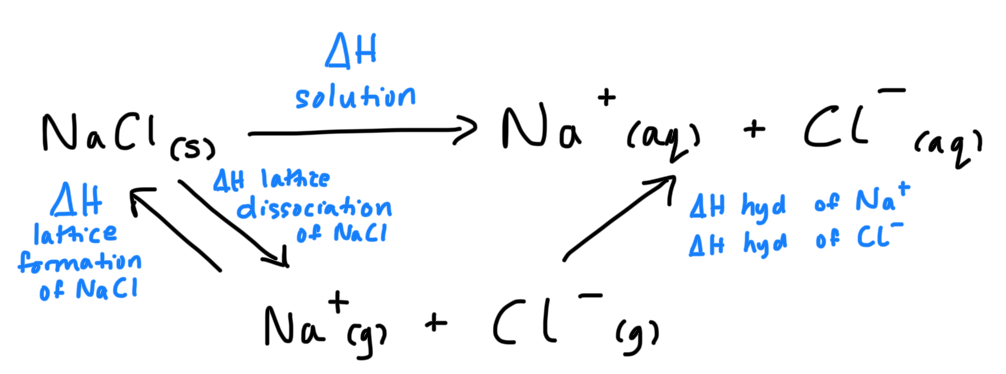
cannot be measured directly as we cannot isolate 1 mole of free, oppositely charged gaseous ions and surround them with water
calculate using enthalpy of solution and lattice enthalpy
link between enthalpy of hydration and enthalpy of solution, example NaCl
perfect ionic model
all ions are perfect spheres and have no covalent character
what is covalent character?
partial sharing of electrons in an ionic bond
due to a cation polarising and distorting the electron cloud of an anion
causes of covalent character in an ionic compound
smaller cation or higher positive charge
so cation has a higher charge density
so cation is more polarising
so polarises and heavily distorts anion electron cloud
_
large anion or higher negative charge
so anion has higher charge density
so anion is less polarisable
so electron cloud easily polarised and distored by cation
how does covalent character affect lattice enthalpies?
increased covalent character =
stronger forces holding the lattice together
experimental lattice enthalpies from Born-Haber cycles will be more exo / more endo (larger in magntitude) than theorectical value calculated using perfect ionic model
the value for enthalpy of lattice formation obtained by experiment is the same as the value obtained by calculation using the perfect ionic model
what does this indicate?
perfectly / purely ionic bonding