truth function logic
 Call Kai
 Learn
Learn Practice Test
 Spaced Repetition
 Match
Match Flashcards
 Knowt Play
1/32

There's no tags or description
Looks like no tags are added yet.
Name | Mastery | Learn | Test | Matching | Spaced | Call with Kai |
|---|
No analytics yet
Send a link to your students to track their progress
33 Terms
what is formal logic
understanding logical structure of sentences
understand valid / entailment / consistency
common form/structure, no ambiguities h
how is TFL a natural language
it has
A vocabulary, i.e. the terms that count as part of the language
A syntax, i.e. rules about how we can combine those terms
A semantics, i.e. an assignment of meaning to those terms
atomic sentences
cant be reduced without losing meaning - identified as A B C D E …
dont have to be simple, just the simplest version of their content
eg A: It is raining outside // C: Jenny is miserable
negation
not
¬A
conjunction
and
A ∧ B
disjunction
or
A ∨ B
conditional
A → B
if A then B
=
B if A
=
A only if B
if A then B
on the condition that A is true, B is true too
‘A if B’
A is true, provided that (on the condition that) B is true
‘A only if B’
A is true only in situations where B is too
same as if A then B
biconditional
A if and only if B
A ↔ B
eg S knows that p IF AND ONLY if S has a justified true belief that p
brackets
‘It’s not the case that Jo and Sam are hungry’ = ¬(J ∧ S)
‘Jo is not hungry, and Sam is hungry’ = -(¬J ∧ S)
you must add brackets whenever you add a connective UNLESS it’s ¬
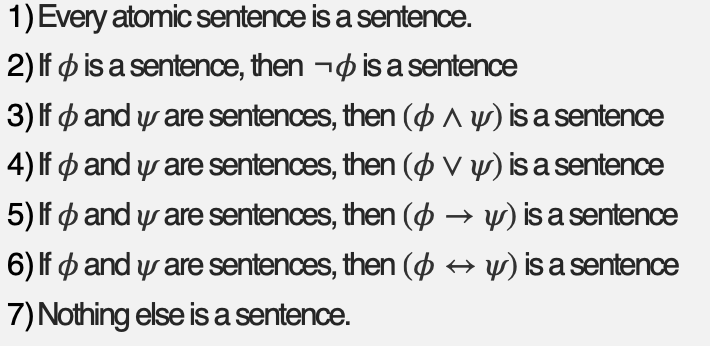
what counts as a sentence
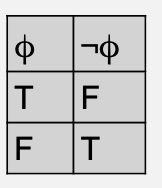
negation truth table
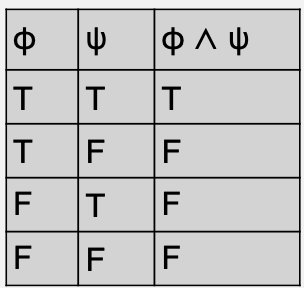
conjunction truth table
disjunction truth table
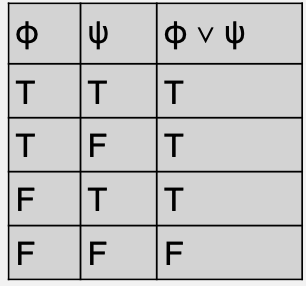
INCLUSIVE disjunction
conditionals truth table
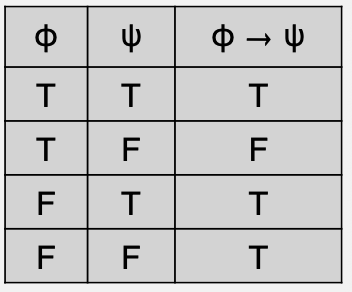
???
biconditionals truth table
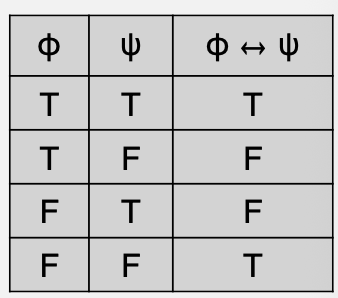
if same truth table = true
if different truth table = false
contingent sentences
a sentence is contingent in TFL iff (if and only if) it is true on at least one truth
table row and false on at least one
all atomic sentences are contingent
tautology
A sentence is a tautology in TFL iff it is T on all truth table rows
eg (P→P), (A∨¬A)
contradiction
A sentence is a contradiction in TFL iff it is T on no truth table rows
(F∧¬F)
Negating a tautology creates a contradiction, and vice versa
following the order
It’s crucial that we apply the rules for connectives in order of
sentence construction
● For instance: (¬A → (A → B))
1. A / B
2. ¬A / (A→B)
3. (¬A → (A → B))
• When constructing our truth table, we apply our rules in this order
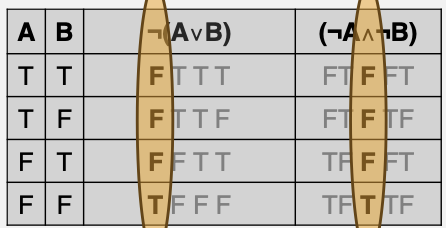
logical equivalence
two sentences are logically equivalent iff there is no
truth table row where one is true and the other is false
● All tautologies are logically equivalent
● All contradictions are logically equivalent
formally valid
An argument is formally valid IFF it is impossible for the premises
to be true and the conclusion false, and this is due to its form
valid-in-TFL
An argument is valid-in-TFL IFF there is no truth table row on which
all premises are true and the conclusion is false
valid argument
‘(A ∨ B), ¬A ∴ B’
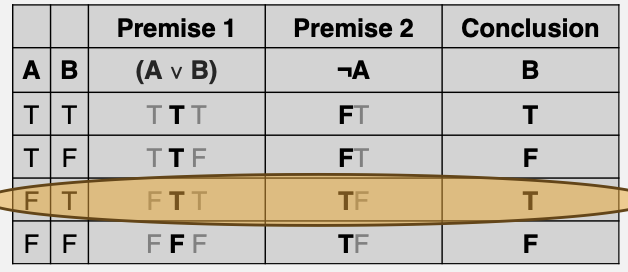
IF All premises are true THEN Conclusion is true
invalid arguments
((𝐴 ∧ 𝐵) ∨ (𝐴 → 𝐵)), ¬𝐴 ∴ ¬𝐵
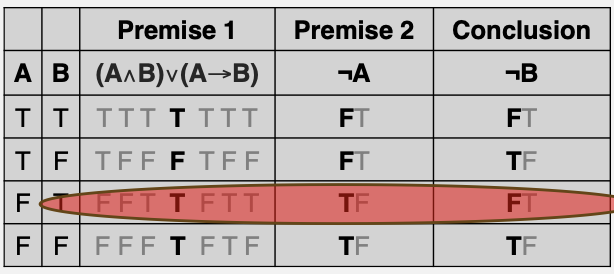
AT LEAST one row on which all premises are true, but the
conclusion is false
edge cases of validity
1. “It’s raining; it’s not raining; therefore I am hungry”
2. “I ate nothing for breakfast; therefore it either is or isn’t Tuesday”
Both are valid. Why?
If it’s impossible for the premises to be true, then it’s
impossible for the premises to be true and the conclusion false
If it’s impossible for the conclusion to be false, then it’s
impossible for the premises to be true and the conclusion false
jointly consistent
{A,B,C…} = sets of sentences
{A,B,C…} is jointly consistent IFF there is some truth-table row on which every member of {A,B,C…} is true
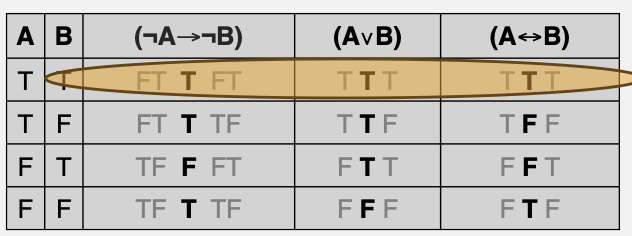
jointly inconsistent
A set of sentences {A,B,C…} is jointly inconsistent IFF there is no
truth-table row on which every member of {A,B,C…} is true
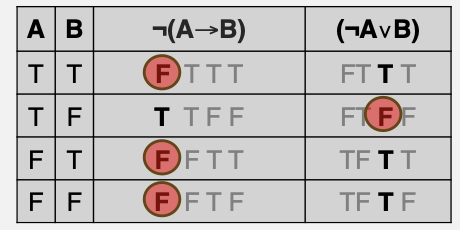
contradiction will be inconsistent with any other sentence
However not all jointly inconsistent sets contain a contradiction:
incomplete truth tables
Sometimes, you don’t need to complete the truth table to get your
answer:
Logical equivalence: as soon as I find a row where the
sentences differ in truth-value, they are not logically
equivalent
Validity: as soon as I find a row where at least one premise is
false, I don’t need to see the rest of the row
Validity: as soon as I find a row where the conclusion is true, I
don’t need to see the rest of the row
Consistency: as soon as I find a row where at least one
member of the set is false, I don’t need to see the rest of the
row
can TFL capture all necessary truths, inconsistencies, and valid arguments
no
weakness of TFL
cant look inside sentences, like FOL can
1. All elephants are mammals;
2. Dumbo is an elephant;
3. Therefore, Dumbo is a mammal
• Since we have no terms we can translate as logical connectives, this becomes:
•
𝐴, 𝐵 ∴ 𝐶
• That’s invalid
• But 1, 2, so 3 is valid!