AP BIO MIDTERM!
 Call Kai
 Learn
Learn Practice Test
 Spaced Repetition
 Match
Match Flashcards
 Knowt Play
1/199

There's no tags or description
Looks like no tags are added yet.
Name | Mastery | Learn | Test | Matching | Spaced | Call with Kai | Chat |
|---|
No analytics yet
Send a link to your students to track their progress
200 Terms
Viruses
Nucleic Acids
DNA or RNA
Protein coat called capsid
Can’t grow
Needs to invade a cell to grow / reproduce
Can’t reproduce on its own
Can’t metabolize
Characteristics of life
Growth
Metabolize
Reproduce
cellular organization
response to stimuli
evolution
Red blood cells
Hold oxygen
Deliver oxygen
Delivers it to organs that need oxygen
No nucleus or organelles
Born with nucleus but as they mature they produce hemoglobin then don’t need the nucleus anymore
Made in the bone marrow
Cup shaped
Concave on both sides
Shape increases surface area
Structure dictates function
Thin membrane that helps oxygen pass through
Antibodies
A protein molecule
Produced and released by plasma
Prokaryotes
Normal typical bacteria
Domain bacteria and archaea
Archaea
Dont really resemble prokaryotes, resemble eukaryotes
Eubacteria, Archaea, eukarya
Eubacteria = prokaryotes
Find archaea in sulfur vents, salty regions, guts of animals
Eukaryotes
Normal bacteria but all of their RNA DNA and chemical reactions are more like their eukaryotes then regular bacteria
Used to have 5 kingdoms (eukaryotic)
Fungus, animal, plant, protists
Domain eukarya
Protists
Fungi
Plants
Endomembrane system
Regulates protein and lysosome traffic and performs metabolic functions
Endoplasmic reticulum
Network of membranes and sacs
Produce proteins
Rough ER
Ribosomes on surface
Made in the nucleolous
Not a fixed organelle
Ribosomes are constantly attaching and breaking off
Package proteins for sections, send transport vehicles to Golgi, make replacement membrane
Smooth ER
No ribosomes on surface
Synthesize lipids, metabolize carbs, detox drugs and poisons, stores Ca
Golgi Apparatus
Synthesis and packaging materials
Small molecules get transported by vesicles
Produces lysosomes
The “post office”
Series of flatted membrane sacs
Materials go to Golgi and fuse to the cis face and go to the trans face
Lysosomes
Intracellular digestions
Recycles cells materials
Programmed cell death
Aptosis
Lysosome membrane breaks and breaks down the cell
Contains hydrolytic enzymes
Phagocytosis
surround and destroy substances
Autophagy
cells ability to break down and repurpose cell parts
Vacuoles
Storage of materials
Food
Water
Minerals
Pigments
Poisons
Membrane bound vesicles
Food vacuoles
Stores food
Contractile vacuole
Controls water balance in unicellular fresh water protists
Central vacuole
Controls water balance in a plant cell
Stores water and ions
Retains water for turgor pressure
Mitochondria
Site of cellular respiration
Double membrane
Outer and inner membrane
Cristae
Folds of inner membrane
Contains enzymes for ATP production
Increased surface area to increased ATP made
Matrix
Fluid filled inner compartment
Chloroplasts
Site of photosynthesis
Double membrane
Thylakoid disk in stacks
Grana
Stroma is the fluid
Contains chlorophylls (pigments) for capturing sunlight energy
Endosymbiotic theory
Mitochondria and chloroplasts share similar origin
Prokaryotic cells engulfed by ancestors of eukaryotic cells
Evidence
Double membrane structure
Have own ribosomes and DNA
Reproduce independently within cell
Cytoskeleton
Network of protein fibers
Support, motility, regulate biochemical activities
Made of three main types of fibers
Microtubules
Hollow tubes
25nm with 15 nm lumen
Microfilaments
Two intertwined strands of actin
7 nm
Intermediate filaments
Fibrous proteins called into cables
8-12 nm
Plant cells
Cell wall
Protect plant, maintain shape
Composed of cellulose
Plasmodemata
Channels between cells to allow passage of molecules from cell to cell
Doesn't have to pass through cell membrane - cell membranes are connected
Extracellular matrix
GLycolipids and glycoproteins
Communication devices for animal cells to recognize each other
Function
Strengthens tissues and transmits external signals to cell
Intercellular junctions
Tight junctions
Two cells are fused to form watertight seal
Skin, gastrointestinal
Desmosomes
“Rivets” that fasten adjacent cells into strong sheets
Gap junctions
Channels through which ions, sugar, small molecules can pass
Surface area to volume
Shapes with a higher ratio are more efficient in exchanging oxygen with the environment
Cubes are efficient
Cell membrane
Plasma membrane is selectively preamble
Allows some substances to cross more easily than other
Fluid mosaic model
Fluid: membrane held together by weak interactions
Mosaic: phospholipids, proteins, carbs
Freeze fracture
Freeze chemically what's being looked at
Used to look at the cell membrane, peeled it apart to see what's on the inside
Phospholipids
Biylaer
Ampipathic
Hydrophilic head, hydrophobic tail
Membrane fluidity
Low temps: phospholipids with unsaturated tails (kinks prevent close packaging)
Cholesterol holds fatty acids together so they cannot change state
Reduces membrane fluidity at moderate temperatures, but at low temperatures hinders solidification
Adaptations
Bacteria in hot springs (unusual lipids)
Prevents them from evaporating
Winter wheats (unsaturated phospholipids)
Prevents from packing
Membrane proteins
Integral proteins
Embedded in membrane
Transmembrane with hydrophilic heads/tails and hydrophobic middles
Peripheral proteins
Extracellular or cytoplasmic sides of membrane
Held in place by cytoskeleton or ECM
Membrane function proteins
Transport
Enzymatic activity
Signal transduction
Cell-cell recognition
Intercellular joining
Attachment to the cytoskeleton and ecm
Carbohydrates (cell function)
Function: cell to cell recognition, developing organisms
Glycolipids, glycoproteins
Blood transfusions are type specific (carbs attached to proteins)
Selective permeability
Small nonpolar molecules cross easily
Hydrocarbons,
Hydrophobic molecules
Co2, O2, N2
Polar uncharged molecules
H2O
Pass in small amounts
Hydrophobic core prevents passage of ions, large polar molecules- movement through embedded channel and transport proteins
Passive transport
No energy required
Diffusion down concentration gradient
High to low concentration
Low entropy (organized, high concentration) to high (disorganized, low concentration)
Smells being highly concentrated at the source and diffusing as it travels farther
Osmosis
Dynamic equilibrium
Moving equilibrium
U-Tube
Hypotonic solution
Cell is hypertonic to environment
Hypertonic solution
Cell is hypotonic to environment
Turgid
Plant cell in a hypotonic environment
Flaccid
equilibrium/normal
Plasmolyzed
Fatal to plants
Almost completely dry
Water potential
Water moves from high φ to low φ
Water potential equation
Φ = φs + φp
φ= Free energy water
Φs = Solute potential = solute concentration
Φp = pressure potential = physical pressure on solution
Turgor pressure
YOU WILL NEVER HAVE PRESSURE POTENTIAL UNLESS IT IS A PLANT CELL IN A HYPOTONIC SOLUTION
Pure water: φp = 0 bars, 0 MPA
Open container: φp = 0 bars, 0 MPA
Solute potential
Φs = -iCRT
I = ionization constant (#particles made in water)
1M Sucrose = 0 particles made, i=1
1M NaCl = 2 particles made, i=2
On test, it will always be 1 as they only use glucose or glucose
C= molar concentration
R= pressure constant (.0831 liter bars/mole-K)
T= temperature in K (273+C)
Addition of solute lowers the solute potential (more negative) and therefore decreases the water potential
Where does water move
Water moves high φ to low φ
Low solute concentration to high solute concentration
(high water φ to low φ)
High pressure to low pressure
Facilitated diffusion
Still moves from high to low concentration
Particles are too large, or polar
Needs help from transport proteins
Help hydrophilic substances cross
Two ways
Provide hydrophilic channel
Loosely bind/carry molecule across
Ex: ions, polar molecules
Aquaporin
Channel protein that allows the passage of H2O
Bulk flow
Glomerular Filtrate
“Cheese cloth”
Nefrons
Blood vessels go in and out
High blood pressure in the nephron
Squeezes stuff through the membrane
Salts get squeezed out in the kidneys
Active transport
Requires ENERGY (ATP)
Proteins transport substances against concentration gradient (low -> high conc.)
Na+ / K+
Pump
Proton Pump
Against the concentration gradient
Pumps, exocytosis, endocytosis
Electrogenic pumps
Generate voltage across membrane
Sodium Potassium Pump
Na+ / K+ Pump
Pump Na+ out and K+ into cell
Nerve transmission
Proton pump
Push protons (H+) across membrane
Mitochondria (ATP production)
Use energy to create a gradient
High concentration on the outside and low on the inside
Cotransport
Membrane protein enables “downhill” diffusion of one solute to drive “uphill” transport of other
Passive transport
Little or no energy
High -> low concentrations
Down the concentration gradient
Diffusion, osmosis, facilitated diffusion
Asmoregulation
Control solute and water balance
Contractile vacuole
Bilge pump
Forces out fresh water as it enters by osmosis
Paramecium caudatum - freshwater protist
Endocytosis
Take in macromolecules and particular matter, form a new vesicles from plasma membrane
Phagocytosis
“Cellular eating” - solids
Endocytosis of larger molecules
Pinocytosis
“Cellular drinking” - fluids
Endocytosis of small solids and liquids
Receptor - Mediated Endocytosis
When the bubble forms due to the signal from a hormone
Ligands bind to specific receptors on the cell surface
Exocytosis
Vesicles fuse with plasma membrane, secrete contents out of cell
Standard Error of the mean (SEM)
If error bars overlap, there is no statistical difference
Behavior
What an animal does and how it does it
Essential for survival and reproduction
Both genetic and environmental factors
Subject to natural selection over time
Proximate Causation
How a behavior occurs or is modified
Ultimate causation
Why a behavior happens in the context of natural selection
Fixed action patterns
Sequence of acts (not learned) that are unchangeable and usually carries to completion
Triggered by sign stimulus
Ensures that activities essential to survival are performed correctly without practice
Kineses
Simple change in activity or turning rate in response to a stimulus
Random motion
Increases the chance that a sow bug will encounter and stay in a moist environment
Taxis
Automatic movement, oriented movement +/ - from stimulus
Certain fish know how to orient themselves in currents to stay in the same spot
Migration
Often innate
Environmental cues signal migration
Animal communications
Pheromones
Chemicals emitted by members of one species that affect other members of the species
Visual signals
Warning flash of white of a mockingbirds wings
Tactile
Male fruit fly taps female fly
Auditory signals
Screech of blue jay or song of warbler
Learned behaviors
Taught or through experience
Habituation
Loss of responsiveness to stimuli that convey little or no information
Imprinting
Learning + innate components
Limited to sensitive in life, generally irreversible
Chicks following their mother
Associative learning
Ability to associate one stimulus with another
Monarch butterflies = foul taste
Classical conditioning
Arbitrary stimulus associated with particular outcome
Pavlovs dogs
Operative conditioning
Trial and error learning
Associate its own behavior with reward or punishment
Foraging behavior
When a reward outweighs a risk
Travelling into other territories for food
Habituation
Loss of responsiveness to stimuli that convey little or no information
Imprinting
Learning + innate components
Limited to sensitive in life, generally irreversible
Chicks following their mother
Associative learning
Ability to associate one stimulus with another
Monarch butterflies = foul taste
Classical conditioning
Arbitrary stimulus associated with particular outcome
Pavlovs dogs
Operative conditioning
Trial and error learning
Associate its own behavior with reward or punishment
Foraging behavior
When a reward outweighs a risk
Travelling into other territories for food
Dominance hierarchies
A higher ranking animal has greater access to resources than a lower ranking animal.
Decided by confrontation during which one animal gives way to another.
Once established, little or no time is wasted in fighting
Altruism
Putting themselves at risk for the benefit of others
Reduce individual fitness but increase fitness of others in population
Inclusive fitness
Total effect of producing own offspring + helping close relatives
Kin Selection
Type of natural selection; altruistic behavior enhances reproductive success of relatives
Hamilton's rule
Population
Group of single individual of a single species living in same general area
Definition of Species
Organisms are considered in the same species if they mate under natural conditions and produce fertile offspring
Determining population size
Count every individual
Random sampling
Mark and recapture
Patterns of dispersal
Clumped - Food, reproduction, dependant, like each other, near required resource
Uniform - territorial, agonistic
Random - no real rhyme or reason as to why they live
Survivorship curves
Represent # individuals alive at each age
Humans - live a long life then die off
Birds - some live and some don’t live long lives
Fish don’t survive very long and don’t live long lives (have tons of offspring cause most don’t survive)
Exponential growth
Population growth in an idealized situation
Called J growth
Shows what population would do in it;s environment
Helps understand species ability and the conditions that may facilitate this growth
Results in J shaped curve
J Growth
Under these conditions th rate of increase is at its maximus, denoted as rmax
Exhibited maximum biotic potential
There are no density dependent limiting factor
A factor that affect the growth of a population the more larger or more dense the population is
Space
Predation
Sickness
Food
Housing
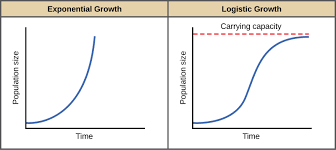
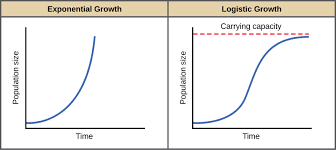
Logistic growth
Environmental resistance
When the environment fights back
S chapped curve
Exponential Growth cannot be sustained for long in any population
More realistic model limits growth by incorporating carrying capacity
The per capita rate of increase declines as carrying capacity is reached
Density dependent factors
Predation
Space
Food
Disease
All of these factors become more severe as population density increases
Intrinsic factors
For some populations, intrinsic (physiological) factors appear to regulate population size
As population density gets larger, lifespan gets shortened and less offspring
as the population density increases hormonal changes depress the immune system increasing the death rate and decreasing the birth rate.
K-Selection
Density dependent selection, selects for life history traits that are sensitive to population density
Organisms that are sensitive to the caring capacity
Long life spans (type I or type II survivorship curve)
Parental care
Large organisms
Multiple reproductive cycles (iteroparity)
Fewer offspring
K strategists because they are sensitive to density dependent factors so they are affected most at k
R-Selection
Density independent selection
Selects for life history traits that maximize reproduction
Many offspring (type III survivorship curve)
Little parental care
Opportunists
Small organisms
One reproductive event (semelparity)
Discrete generations
Generations do not live at the same time (no overlapping generations)
Not affected by density dependant factors because they tend to die before they reach carrying capacity
R strategists because they exhibit max biotic potential
Human population growth
No population can grow indefinitely, humans are no exception
ecologists predicted a global population 7.8-10.8 billion in 2050
Average estimate for carrying capacity for humans is 10-15 billion
Ecological footprint
Summarizes the aggregate land and water area needed to sustain the people of a nation
It is one measure of how close we are to the carrying capacity of Earther(yes!)
Countries vary greatly in footprint size and available ecological capacity
Age structure
The relative number of individuals at each age
Each age group is called a cohort
Quick vs. slow growth
Zero population growth
Birth rate and death rate is nearly the same
Community
Group of populations of different species living close enough to interact
Interspecific interactions
Can be positive, negative, or neutral
Competitions (-/-)
Two or more species compete for a resource that is in short supply
Exploitation (+/-)
One species benefits by feeding upon the other species, which is harmed
Predation, herbivory, parasitism
Interspecific competition
Resources are in short supply
Competitive exclusion principle
Two species cannot coexist in a community of their niches are identical
Niche - the role an organism plays in the environment
Where it lives, where in the food web it is, predator or prey
One would outcompete the other, killing the organism or forcing it to find another niche
Resource partitioning
Differences in niches
Fundamental niche
Potential occupied by the species
Determined by environmental factors
Abiotic
Realized niche
Portion of the fundamental nice the species actually occupies
Controlled by abiotic and biotic factors
Character displacement
Tendency for characteristics to be more divergent in sympatric (same place) populations of two species that in allopatric (different) populations of the same two species
ex bird beaks
Variation of beak size between populations of two species of galapagos finches
Evolved to not compete for the same food
Defensive adaptations
Cryptic coloration
Aposematic or warning coloration
Batesian mimicry
Mullerian mimicry
Herbivory
Cryptic coloration
Camouflaged by coloring
Aposematic or warning coloration
Bright colors of poisonous animals
Dart frog
Batesian mimicry
Harmless species mimic color of harmful species
Larvae imitating a green parrot snake
Mullerian mimicry
2 bad tasting species resemble each other, both are avoided
Bees and yellow jackets
Herbivory (defensive adaptations)
Plants avoid herbivory by chemical toxins, spines, and thorns
Mutualism
+/+
An interspecific interaction that benefits both species
Acacia tree and ants
Commensalism
+/0
Water buffalo and birds
One species benefits and the other is neither harmed nor helped
Clownfish lives in an anemone
Invasive species
Organism that become established outside native range
Go into ecosystem and there's nothing to check them
Characteristics
Tolerates a wide range of conditions
Has a long growing season or short generation time
Has few natural controls, such as predators, disease, or insects
Disperses itself with ease
Produces lots of seeds or eggs
New location has climate and environmental conditions similar to native habitat
Dutch Elm Disease , kudzu, potato blight, spotted lantern flies
Community structure
Species diversity
Species richness (# of different species) + relative abundance of each species
More stable ecosystem
Simspon diversity index
Calculate diversity based on species richness and relative abundance
Highly diverse communities more resistant to invasive species
picture here
High D value (close to 1) = greater biodiversity
Low D value = less biodiversity
Trophic structures
Trophic levels = links in the trophic structure (food webs and food change)
Trophic structure of a community is determined by the feeding relationships between organisms
Transfer of food energy from plants to herbivores to carnivores to decomposers is called the food chain
Length limit of food chain
Inefficiency of energy transfer along chain
Long food chains less stable than short chains
Energetic hypothesis
10% of energy available at 1 level travels to the next level
Suggests that length is limited by inefficient energy transfer
A producer level consisting of 100kg of plant material can support about 10 kg of herbivore biomass (the total mass of all individuals in a population)
Pyramid of biomass
Pyramid of numbers
Pyramid of energy
Food web
Two or more food chains linked together
A given species may weave into the web at more than one trophic level
Dominant species
The most abundant or have the highest biomass
Dominant species exert powerful control over the occurrence and distribution of other species
Sugar maples
Major impact in shading, and soil nutrient availability in eastern North America; this affects the distribution of other plant species
Keystone species
Exert strong control on a community by their ecological roles or niches
They are not necessarily abundant in a community
If they are removed from a community biodiversity significantly drops
Sea otters
Increase sea urchins, destruction of kelp forests
Grizzly bear
Transfer nutrients from sea to land by salmon diet
Prairie dogs
Burrows, soil aeration, trim vegetation
Ecosystem engineers
Foundation species
Cause physical changes in the environment that affect community structure
Beaver dams can transform landscapes on a very large scale
Disturbances influence species diversity
Changes a community by removing organisms or changing resource availability
Ecological succession
Transitions in species composition in a certain area over ecological time
Pioneer organisms
Can live on anything, colonize an area
Primary succession
Plants and animals invade where soil has not yet formed
Colonization of a volcanic island or glacier
Secondary succession
Starts with something
Occurs when existing community is cleared by a disturbance that leaves oil intact
Energy flow in an Ecosystem
Energy cannot be recycled
Must be constantly supplied to an ecosystem (mostly by SUN)