Study for Science Final
 Call Kai
 Learn
Learn Practice Test
 Spaced Repetition
 Match
Match Flashcards
 Knowt Play
1/38

There's no tags or description
Looks like no tags are added yet.
Name | Mastery | Learn | Test | Matching | Spaced | Call with Kai |
|---|
No analytics yet
Send a link to your students to track their progress
39 Terms
Electrons(-)
- Have a negative charge
- Located outside the nucleus of an atom in the electron cloud
- The number of electrons can differ in atoms of the same element; these are ions
Protons(+)
- Have a positive charge
- Determine the identity of the element and the atomic number
- Located inside the nucleus of the atom
Neutrons(n)
- Have no charge are neutral
- Located inside the nucleus of the atom
- The number of neutrons can differ in the - atoms of same element: these are isotopes
Force
Push or pull exerted on an object, measured in newtons (N)
Newton
A unit of measure that equals the force required to accelerate 1 kilogram of mass at 1 meter per second
Net Force
The overall force on an object when all the individual forces acting on it are added together
Balanced Force
When the net force on an object is 0 N(object doesn't move )
Motion
An object's change in position relative to a reference point
Unbalanced Force
When the net force on an object is not 0 N; object moves
Newton first law of motion
An object at rest will remain at rest and an object in motion will stay in motion unless it is acted on by an unbalanced force
newton second law of motion
An object's acceleration depends on its mass and on the net force acting on it (F=ma)
newton third law of motion
If one object exerts a force on another object, then the second object exerts a force of equal strength and opposite direction on the first object
Inertia
The tendency of an object to resist a change in motion
Constant veloctiy
A speed that does not change how fast it is, or the direction that it is in
Accelaration
The rate at which velocity changes over time; an object accelerates if its speed, direction, or both change (a=F/m)
Momentum
The product of an object's mass and velocity
Law of conservation of momentum
The rule that in the absence of outside forces, the total momentum of objects that interact does not change
Buoyant Force
The upward force exerted by a fluid on a submerged object
Independent variable
Can be manipulated; this is the variable the scientist changes
dependent variable
Responding; this is the variable that the scientist measures or observes
constants in expeirmental design
Are known as standardizing variables that need to stay the same for each test in a controlled experiment
experimental control
A control is used to evaluate whether an experiment is working
3 things for a fair expeiremnt
- Precise & Accurate Measurements,
- Repeated Trials
- Detailed Notes
mixture
Is made when two or more substances are combined, but they are not combined chemically
propertires of a mixture
- The components of a mixture can be easily separated
- The components each keep their original properties
- The proportion of the components is variable
homogeneous mixture
All the substances are evenly distributed throughout the mixture
(salt, water, air, blood)
Heterogeneous mixture
The substances are not evenly distributed
(CCCookies, pizza, rocks )
Solution
Is a mixture where one of the substances dissolves in the other
Solute
A substance that dissolves in a liquid; (e.g., salt in water)
Solvent
A substance, usually a liquid that dissolves a solute(solid, liquid,gas ) to form a homogeneous solution
pH scale
Is used to classify substances as acids and bases, 0-14
Acids
Have a pH number that is less than 7
Bases
pH number more than 7
MIX
M: Manipulated
I: Independent
X: X-axis
DRY
D: Dependent
R- Responding
Y: Y-axis
litmus paper thing
Acids taste sour and turn blue litmus red, whereas bases taste bitter, feel soapy, and turn red litmus blue. They neutralize each other to form salt and water.
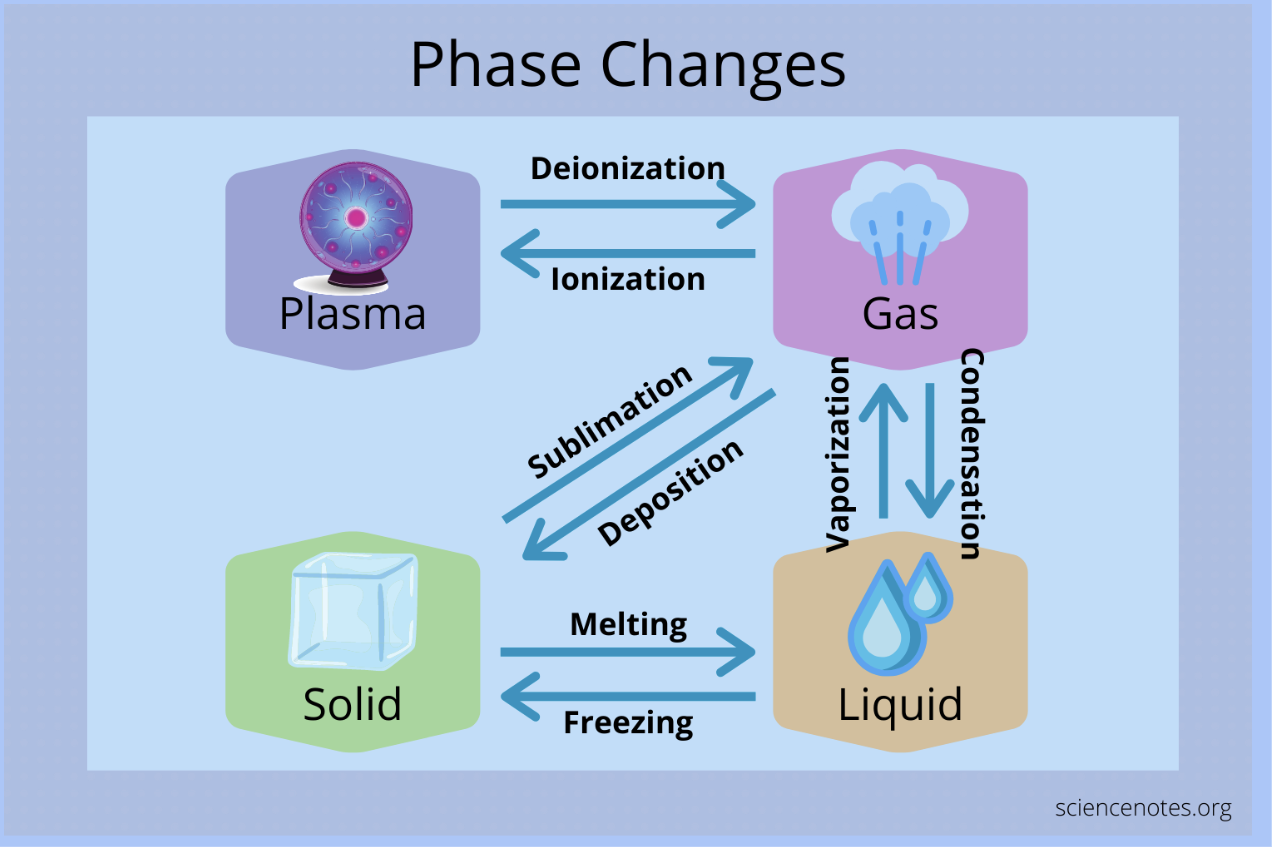
Phase Changes
Period of Periodic table
the 7 horizontal rows
Group of Periodic table
the 18 vertical columns