11.3 Monopoly Demand
 Call Kai
 Learn
Learn Practice Test
 Spaced Repetition
 Match
Match Flashcards
 Knowt Play
1/29

There's no tags or description
Looks like no tags are added yet.
Name | Mastery | Learn | Test | Matching | Spaced | Call with Kai |
|---|
No analytics yet
Send a link to your students to track their progress
30 Terms
What three assumptions define the pure monopoly model?
Barriers (patents, economies of scale, network effects, resource ownership) secure monopoly power.
No government regulation.
The firm is a single‑price monopolist (charge the same price for all units of output).
What is the key difference between a monopolist and a perfectly competitive firm?
The monopolist faces a downward‑sloping demand curve, while the competitive firm faces a perfectly elastic (horizontal) demand curve.
Why is a pure competition’s firm marginal revenue equal to price?
Because it can sell any quantity at the market price; selling more does not require lowering price.
Why is a monopolist’s demand curve the market demand curve?
Because the monopolist is the entire industry, so its demand curve is the market’s demand curve.
The demand curve is downward sloping
Why does a monopolist’s demand curve slope downward?
Because market demand is not perfectly elastic; consumers buy more only at lower prices.
Why must a monopolist lower price to sell more output?
Because it faces a downward‑sloping demand curve.
What is true about monopoly?
MR < Price
Why is marginal revenue < price for a monopolist?
Lowering price to sell one more unit also lowers the price on all previous units, reducing revenue on those units.
What is the marginal revenue of the 4th unit in the example?
You sell 3 units at $142 each, so you make $426
You want to tell a 4th unit but because the demand curve slopes down, you have to lower the price to $132 to convince people to buy more —> now all units sell for $132
New revenue is 4 × 132 = $528
You gained $132 from selling the 4th unit
But you lost $10 on each of the first 3 units
→ 3 × 10 = $30 lost
So the net gain in revenue (MR) is:
$132 – $30 = $102
That $102 is marginal revenue.
And it’s less than the price ($132).
MR = $132 gained − $30 lost on earlier units = $102.
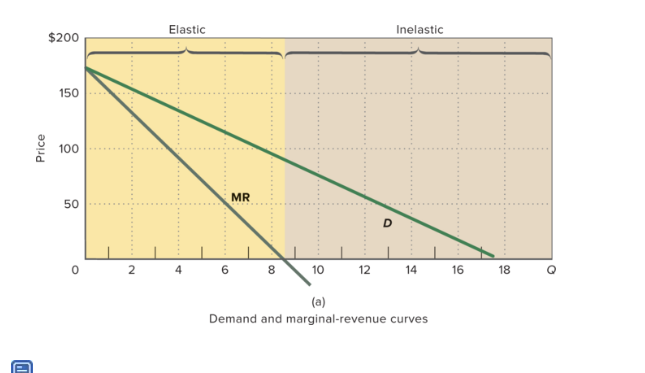
Why is MR below the demand curve for a monopolist?
Because MR accounts for the revenue lost on previous units when price is lowered; price does not.
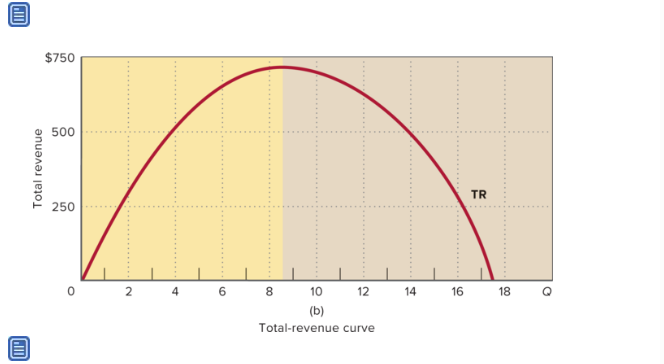
What does declining marginal revenue imply about total revenue?
Total revenue increases at a diminishing rate.
When is marginal revenue positive?
When total revenue is increasing (elastic region of demand).
When is marginal revenue zero?
When total revenue reaches its maximum.
When is marginal revenue negative?
When total revenue is decreasing (inelastic region of demand).
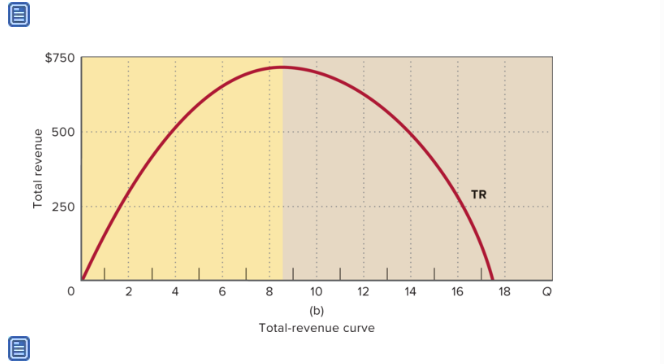
What does the TR curve look like for a monopolist?
TR rises, reaches a peak, then falls — matching MR positive, zero, and negative.
Why is a monopolist a pricemaker?
Because changing output moves the firm along its downward‑sloping demand curve, changing the price it can charge.
How does a monopolist “make the price”?
By choosing output first; the demand curve then determines the price consumers will pay for that quantity.
A monopolist chooses the quantity first, and the demand curve tells them the price.
In the elastic region, what happens when price falls?
Total revenue increases (MR > 0).
In the inelastic region, what happens when price falls?
Total revenue decreases (MR < 0).
Why will a monopolist never operate in the inelastic region of demand?
Because lowering price there reduces total revenue while output increases total cost → profit falls.
Where on the demand curve does a monopolist always operate?
In the elastic region, where MR is positive.
What rule does a monopolist use to choose output?
Produce where MR = MC.
After choosing output using MR = MC, how does the monopolist choose price?
It goes up to the demand curve to find the highest price consumers will pay for that quantity.
Why does monopoly price exceed marginal cost?
Because the monopolist sets output where MR = MC, but price is taken from the demand curve, which lies above MR.
What are the key features of monopoly pricing?
Downward‑sloping demand
MR < Price
MR = MC determines output
Price comes from demand curve
Monopolist operates only in elastic region
Price > MC
Natural monopoly
Long, declining ATC curve
Spread fixed costs over more and more units —> makes sense to have only ONE firm in this business
In the elastic portion of the graph
Marginal revenue is positive so revenue goes up as we lower price
In the inelastic portion of the graph
Marginal revenue is negative, so when you lower the price you get less revenue
Marginal revenue declines because…
Everyone gets charged the same price; prior quantities get the new lower price
When prices goes lower
Total revenue increases where demand is elastic