mind wandering, earworms and hallucination-like experiences
 Call Kai
 Learn
Learn Practice Test
 Spaced Repetition
 Match
Match Flashcards
 Knowt Play
1/39

There's no tags or description
Looks like no tags are added yet.
Name | Mastery | Learn | Test | Matching | Spaced | Call with Kai | Chat |
|---|
No analytics yet
Send a link to your students to track their progress
40 Terms
mind-wandering
Task-irrelevant thought
…what you’re thinking about when you’re meant to be doing something else!
Decoupling of internal thought from perceptual input (Schooler et al., 2011) - disconnect between what's going on in the external world and what’s happening inside your head
challenges when trying to measure mind wandering
Happens randomly, cant tell people to mind wander
Self-report, not often aware of what you're doing
methods of measuring mind-wandering
questionnaires
experience sampling
brain imaging
sustained attention to response task
results from questionnaires
Zedelius, Protzko, Schooler (2017a)
“how much do you mind wander?” = average of 33% of the day
“how much do other people mind wander?” = average of 38% of the day
Mind wandering Questionnaire: Mrazek et al. (2013)
“I mind-wander during lectures or presentations.”
“I find myself listening with one ear, thinking about something else at the same time”
issue of retrospective bias
may not be accurate
experience sampling study
Killingsworth and Gilbert (2010) Experience Sampling Study: 2500 people
Mind wandering occurred during 46.9% of sampling times
42.5% positive, 31% neutral, negative 26.5%
People were less happy when their mind wandered – “a wandering mind is an unhappy one”
Experience sampling - ask people if they're mind wandering at various times
however likely to miss instances
types of mind wandering
positive-constructive daydreaming - vivid imagery, future planning, curiosity eg cats ruling the world
poor attentional control - feeting thoughts, difficulty focusing. eg name of an actor
guilty-dysphoric daydreaming - ruminative thoughts, thoughts of failure, aggresison. eg i really shouldnt have said that thing last week
When are we mind wandering
Tends to occur in low cognitive load situations and practised tasks
Tasks that don't require all of attentional effort, might be bored
Reading: Smallwood et al. (2008) more spontaneous mind wandering impaired reading comprehension, the more that people mind-wandered, the worse the recall for the passage, couldn't work out who did the murder in the book
Lectures: Risko et al. (2012) watched a video recorded lecture either alone (Experiment 1) or in a classroom context (Experiment 2), memory for the lecture material was tested. Mind wandering tends to happen more during video lecture, more that people mind wandered, poorer the memory was for the content
Driving: Galera et al. (2012) 17% of RTAs due to mind wandering, most cases automatic executive control but in some situations it can be a factor in road traffic accidents
what is your mind doing when it's wandering?
Neuroimaging: fMRI experiments look at blood flow around the brain during specific tasks, e.g. event-related fMRI
Pair up a task with where blood goes in the brain
Baseline condition measure the brain at ‘rest’: compared to experimental condition
The resting brain can reveal what the mind is doing when it wanders
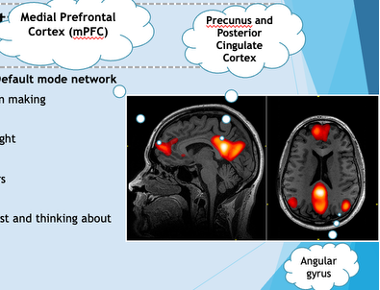
areas involved in the default mode network
Stable and reliable selection of brain areas activated
Medial prefrontal cortex - involved in planning and decision making
Precunus and posterior cingulate cortex - self-referential thought, thinking about themselves, or Thinking about others, Remembering the past and thinking about the future
Angular gyrus - association between memory and attention, involved in sense of decoupling from internal and external, also out of body experience
further types of mind wandering
positive - deliberate mind wandering, enage in when bored etc
poor attentional control - spontaneous mind wandering
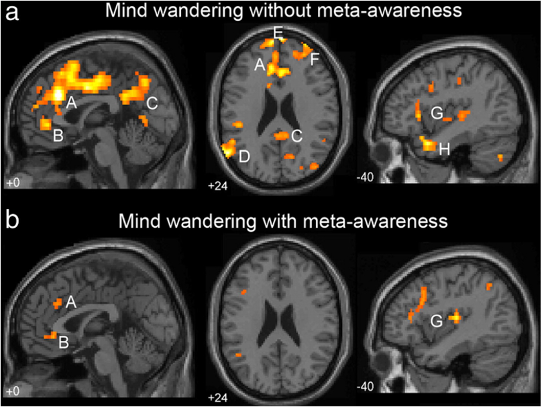
brain activity in deliberate vs spontaneous mind-wandering
Christoff et al. (2007) ESM (experience sampling) during fMRI
Comparison of mind wandering with and without awareness
Mind wandering without awareness : errors on SART, default mode network is much more active (DMN is what the brain does when not engaged in a task etc)
Mind wandering with awareness (aware of your own awareness): not so much default mode network stuff going on. reported during probes. Suggests more in control of your own thinking
can we mind read
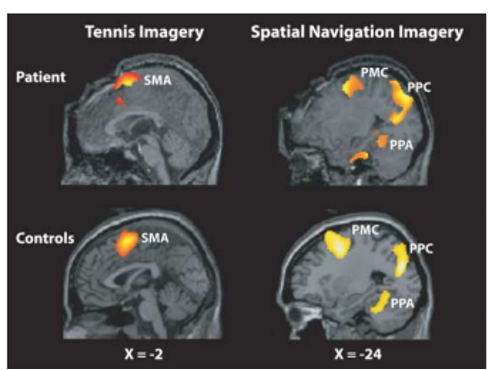
Owen et al. (2006) fMRI with people in Persistent Vegetive states, in deep comas, appear not conscious at all, is there any conscious awareness
Asked participants to either imagine playing tennis (activates a reliable pattern of activation - SMA activates), or imagine walking around house counting windows (reliable activation that is dif to playing tennis) to indicate yes or no
Small percentage were able to do the task and answer questions
Involuntary Music Imagery aka an Earworm
Songs that get stuck in your head, dont know where it comes from
Short clips of a familiar song – usually 15 – 30 sec in length, often they will just repeat, could splice songs together
92% of people experience them at least once a week (Liikannen, 2008)
What do these songs have in common? What triggers the earworm?
Catchy, short choruses that get stuck in your head
Pretty upbeat, not very slow
Quite simple
Where do earworms come from
Williamson et al. (2011) Qualitative analysis of earworm reports from BBC6 music listeners = 1308 reports
Memory triggers, see a word or hear a word which triggers a song
Music exposure
Affective states, eg stress
Low attention spans, doing something which isn't engaging your attention fully
Why do we have earworms
Most research focused on describing the experience - theoretical links lacking
Evolutionary role for earworms, have to get used to hearing patterns and rehearsing patterns
Zeigarnik theory: hearing an incomplete song creates the desire to finish it -> because not completing it, increased prominence in memory (Hyman, 2013) BUT informal theory and later formal testing found little evidence (inconsistent evidence)
Beaman (2018) Earworms are just a form of mind wandering – nothing special!
Killingly et al. (2021) music becomes stuck in phonological loop, which leads to repetition
issues with earworm theories
several unanswered questions about earworms: why music? why are earworms so common? why do we continually rehearse it? (Arthur, 2023)
Who mind wanders
Younger people mind wander more than older people, younger people = frontal lobe still developing, less attentional focus
Individual differences in working memory capacity associated with mind wandering (Mrazek et al, 2012)
Personality: low conscientiousness, high openness to experience linked to mind wandering
Earworms: Musicians or those with high music appreciation (Liikkanen, 2008; Beaman and Williams, 2010)
How do we stop mind wandering
Mediation has been part of eastern and Buddhist practice for thousands of years
“Paying attention in a particular way: on purpose, in the present moment, and non-judgmentally” Kabat-Zinn (1994), p.4)
Improved attention, and perceptual sensitivity (MacLean et al., 2010) when engage in meditation
Mzarek et al. (2012) 8 mins of mindful breathing reduced errors and RT on the SART; Mzarek et al (2013) 2-week programme = improved working memory capacity and reading comprehension scores
How can you stop earworms
Beaman et al. (2015) Chew gum! Engaging subvocal system (involves muscles) interferes with musical imagery, when have an earworm, areas activated are also involved in singing song, links to muscles
Willliamson et al. (2014)
Engage with it: Listen to the song to the end
Distraction: Listen to something else or occupy your mind with another task
Let it be…
Benefits of mind wandering
Mooneyham and Schooler (2013) Costs and benefits of mind wandering: review
Planning: Baird, Smallwood, and Schooler (2011) during low load tasks both self-focus and goal-focused mind wandering tends to be focused on the future, useful for us
Creative problem solving: incubation period - solutions tend to come quicker and more creative if interval involves completing an undemanding task (Baird, et al. 2012) (give creative problem solving task, give them a period of non-focused mind wandering time, give another creative problem solving task)
Do an alternative uses task, if give an unfocused incubation period, then do an alternative usage task, come up with way more
Attentional cycling: cycling through different streams of information, maintaining multiple goals at a time, links to prospective memory. Can keep goals ongoing
Dishabituation: aid to learning - brief moments of disengaging may be beneficial? Refreshes your focus
Relief from boredom: boring jobs…
specific group who mind wander a lot
adhd
Spontaneous mind wandering - poor attentional control
A persistent pattern of inattention and/or hyperactivity-impulsivity that interferes with functioning or development” DSM 5
Three main types
Primarily hyperactivity/impulsivity: around 15% more common for men to have this, means men are more likely to be diagnosed
Primarily Inattentive: around 20 – 30% where see the most difficulties, hard to keep sustained attention. girls tend to have more mind wandering elements
Combination of both: around 50 – 75%, one form is more prevalent, may be elements of both forms within people
types of mind wandering in people with adhd
higher incidence of spontaneous mind wandering compared to deliberate mind wandering and in comparison to control participants (Seli, 2015)
Mind wandering lacks consistency and topic focus (Bozhilova et al., 2018), dotting round all over the place
Issues with metacognition e.g. awareness of spontaneous bouts of mind wandering meta awareness mediates link between mind wandering and negative consequences Franklin et al., 2017). More aware people become of mind wandering can mitigate some of the negative consequences
default mode network and mind wandering
Differences in the deactivation of default mode network between people with ADHD and those without Liddle et al. (2011). Asked children to complete a go, no go task. Either gave people an incentive or no incentive. Also compared children on and off drugs and control (no adhd)
Children with adhd, not on stimulants - default mode network more active
If give them an incentive, activation pattern is much more similar to the control
Default mode network closely related to adhd, flicks on and off, less controlled
Intrusive thoughts (linked to guilty dysphoric)
Not always negative – Maladaptive daydreaming syndrome (Soffer-Dudek & Somer, 2018), people spend so much of their time daydreaming about positive things, takes over lives
Intrusive thoughts are a core characteristic of many clinical conditions
Depression: negative automatic thoughts, about self and situation
Anxiety, OCD, PTSD: excessive rumination/worry, catastrophising
For those with clinical conditions they are considered more distressing, anxiety provoking, and difficult to control (Rachman & de Silva, 1978). Sense of losing control over thinking is distressing to some people
Suggestion that the meaning of and perceived consequences of thoughts are different – higher need to control thoughts (Zedelius, 2020)
OCD and mind wandering
Engage in compulsive behaviours to reduce the stress caused by obsessive thoughts
“Recurrent and persistent thoughts, urges or images that are experienced, at some time during the disturbance, as intrusive, unwanted, and that in most individuals cause marked anxiety or distress.” DSM V
Thought suppression: active attempts to stop negative, intrusive thoughts
white bear supression task
potential rebound effect of thought suppression (Wegner 1994)
Why? Ironic Control theory (Wegner, 1994) Two processes
1) thought stopping and switching to other less distressing thoughts
2) monitoring for potential intrusive thoughts that may need to be diverted, process of monitoring makes the thought more likely to occur
If give people a period when told not to think about something, think about it more
Earworms: more frequent and find them more distressing (Euser et al.,2016)
Hallucinations and mind wandering
Hallucination: in Latin “go astray in thought”
Perception of something as real, in the absence of an external stimulus, e.g. seeing, hearing, smelling or feeling something that isn’t there
Core symptom of different psychiatric and health conditions, e.g. schizophrenia and other psychosis, but also Charles bonnet syndrome (lose sight later in life but think they're seeing)
Later thinking sees hallucination as existing on a continuum within general population
characteristics of clinical hallucinations
Auditory hallucinations most common, followed by visual hallucinations, but can be in any sensory modality
Most auditory hallucinations feature speech, but some are other sounds, e.g. knocking on walls, music
Around 55% of these hallucinations are perceived to be negative, either derogatory, threatening, or sinister. However can be nice and encouraging
Musical hallucinations are common too, but also earworms more common in people with schizophrenia (Mason et al.)
characteristics of non-clinical hallucinations
Around 10% population have non-clinical auditory verbal hallucinations (Maijer et al., 2018)
Hypnogogic hallucinations, sensory deprivation etc. in a dream state, think you're awake but hear something weird, open eyes and properly wake up
More likely to be perceived as pleasant or neutral
Brain scans during hallucinations
McGuire (1993) PET scans - Significantly more blood flow to the Broca’s area (producing speech) during hallucination episodes, compared to when absent.
Shergill (2000) fMRI study – 6 men with schizophrenia who experience hallucinations – activations in areas associated with auditory perception, speech and memory. Pressed button when they thought they heard speaking. There are areas involved that are actually linked to producing sounds/speech
But difficult to assess due to confounding factors, as looking for auditory activation but the fmri scanner is very loud. Also when working with people with schizophrenia, medication may interfere. also co-occurence of symptoms
auditory detection task
Barkus et al. (2007) Auditory signal detection task. play people white noise, say there may be another sound hidden in white noise, can you find it
fMRI experiment: 8 high hallucination prone participants: activation during false positives (hearing heard speech when none present) vs. to correct rejections (correctly saying speech was not present)
Brain activations during false positives:
Right middle temporal gyrus - involved in semantic memory/perceptual processes and language
Bilateral fusiform - involved in multimodal memory processes, combination of different sensations
Putamen - involved in motor skills, learning and motivation
conclusions about hallucinations
both clinical and non-clinical hallucinations are associated with areas linked to inner speech (planning out speech or thinking about speech)
But why is this form of mind wandering perceived as external?
theories of hallucination
Vivid Imagery
Source monitoring/Reality discrimination issues
Vivid imagery
how clearly you can picture or “hear“ something in your mind
Hallucinations as a result of abnormal vivid imagery – easier to confuse for actual perception
Mintz and Alpert (1972) White Christmas Task hear song in white noise: 85% of hallucinating participants had a clear auditory image, vs. 40% of non-hallucinating participants
Bentall and Slade (1985) Auditory signal detection task: hallucination experience not due to unusual vivid imagery, but more due to increased willingness to believe sound present
Source monitoring/reality discrimination
Interpreting internally generated information (e.g. inner speech) as stemming from an external source
Morrison and Haddock (1997) word association task and a delayed source monitoring test – those who experience AV hallucinations more likely to attribute their thoughts as coming from an external source. Word association, then delay period, then asked if they said the word or whether the experimenter did, more likely to say it came from the experimenter
EMG during hallucinations indicates sub-vocalisation (Gould, 1948) micromovements of muscles in jaw
Misidentifying own sub-vocal speech as external (Moseley et al. 2013)
summary
Mind wandering can be more problematic for people with certain clinical condition, if it manifests as intrusive thoughts or hallucinations
The mechanisms underlying these experiences vary in the general population too
Cognitive biases and impaired mechanisms (e.g. default mode network) may contribute to mind wandering becoming problematic