History's Hockey Stick
 Call Kai
 Learn
Learn Practice Test
 Spaced Repetition
 Match
Match Flashcards
 Knowt Play
1/5

Earn XP
Description and Tags
Name | Mastery | Learn | Test | Matching | Spaced | Call with Kai |
|---|
No analytics yet
Send a link to your students to track their progress
6 Terms
What is a Ratio Scale? Why is it utilised for GDP?
-Where the Y Axis will increase at a multiple of either 2x, 3x, 10x etc…
-Using it for GDP allows to compare growth rates - if it is a straight line then it grows at a constant rate
What is the formula for growth rate?
Lol

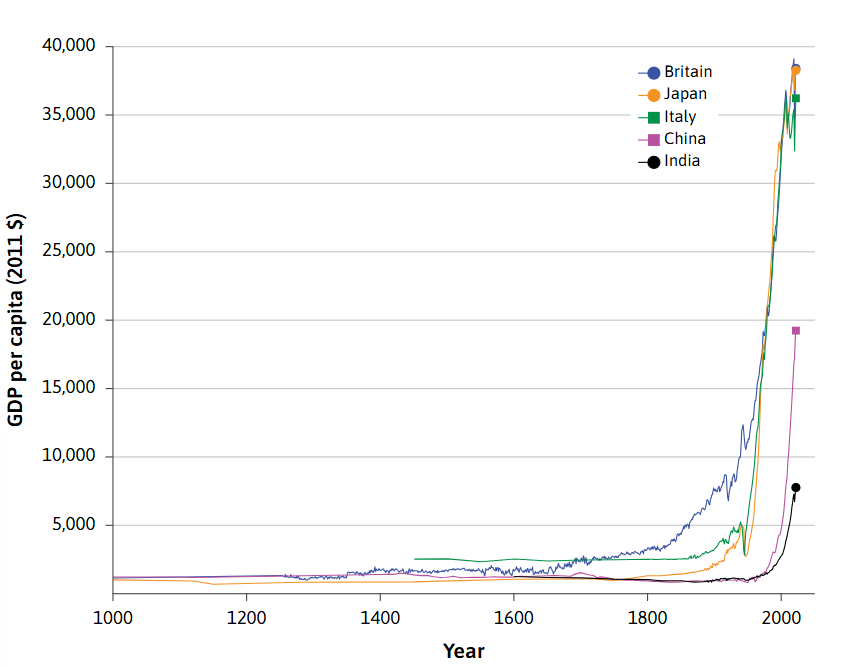
Illustrate what the Hockey Stick Graph looks like, and where the upwards momentum really took off
-For Britain, growth began at around 1650 and exploded around the 1820s
-For Japan, it began around the 1780s and exploded around the 1850s
-For Italy, it began around the 1820s, and exploded soon afterwards
-For China, it began its downward trend at around 1700 and launched upwards only in the 1950s
-For India, the same story as the Chinese, only that its lag behinds.
Why did India and China lag behind?
-India: After 300 years of British Rule came to an end, the deprivation the children in India faced was massive. A child at the end of the British Raj’s lifetime could only expect to live up to 27. 50 years later, it is now at 65
-China: Once richer than Britain before the 1300s, but is now behind in terms of GDP Per Capita PPP Adjusted
What was the main takeaway from the Hockey Stick Graph
-For an extremely long time, living standards didn’t grow in a sustainable way
-When it did occur, it happened at different times in different nations, leading to differences in living standards across the world
Adam Smith - give some key Economic Facts about him
-His ‘An Inquiry into the Nature and Causes of Wealth of Nations’ talked of the coordination amongst all the economic actors may just randomly occur without any person/institution consciously attempting to create/maintain it. Went against the current notion of where rulers imposed order. The Invisible Hand
-This could occur as a result of individuals pursuing their self-interest. This also benefitted social overall - because it is in his own interest to do so
-The Division of Labour / Specialisation, according to Smith, constitutes a significant source of prosperity, due to the huge productive benefits it brought about - the Pin Factory example
-And such productive measures were paired with the construction of canals and foreign trade, as such a huge supply had to find buyers wherever it could.
-However, in ‘The Theory of Moral Sentiments’, he talked about how the Market System can fail, especially when sellers band together to avoid competing. He specially targeted government-protected monopolies like the East India Companies
-He wanted a Government to be involved with the economy in terms of Defence, Infrastructure, Justice and more.